



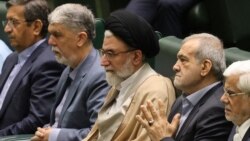
US Counterterrorism Chief Kent Quits Citing Iran Conflict, White House Rejects Claims
Joseph Kent, the head of the United States' National Counterterrorism Center, said he is resigning over the Iran military operation.
Kent said in a letter to President Donald Trump, which he posted on X on March 17, that the United States was deceived into "believing that Iran was an imminent threat" by Israeli officials and "influential members of the American media. He added that while he supported the values and foreign policy Trump talked about during all three of his presidential campaigns, he could not continue given the current situation with Iran.
"I cannot in good conscience support the ongoing war in Iran," said Kent, a combat veteran whose navy cryptologist wife died in Syria in 2019.
Kent added that he hoped Trump would reverse course and "chart a new path for our nation."
White House spokeswoman Karoline Leavitt said in a statement on X that Kent made "many false claims" in his letter, including that Iran posed no imminent threat to the United States.
She also called the assertion that Trump was influenced by others "absurd."
"President Trump has been remarkably consistent and has said for DECADES that Iran can NEVER possess a nuclear weapon," she said.
Kent, who was nominated by Trump and confirmed to the post by the Senate, is the highest ranking official in the administration to have stepped down specifically because of the Iran war.
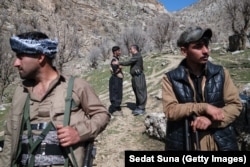
In Photos: Iranian Kurds Watch And Wait As Tehran's Air Strikes Hit Region
After initially voicing support, US President Donald Trump says he doesn't want Iran's Kurds to enter the military operation against Tehran -- at least for now. Still, one group of exiled Kurds is "preparing for war" just in case, according to a photographer who visited one stronghold of Iranian Kurds.
Photojournalist Sedat Suna gained access on March 12 to a mountain base of the Komala -- Reform Faction, an armed political entity of Iranian Kurds based in the northeastern region of Iraq that has recently been targeted by Iranian drone strikes.
To see the full photo story, click here.
Explosions Rock Baghdad As Drone Strikes Target US Embassy
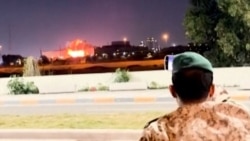
Witnesses recorded explosions in Baghdad on March 17 as drone strikes targeted the US Embassy compound in the heavily fortified Green Zone in Iraq's capital city.
Footage recorded on mobile phones showed smoke and fire as air defenses intercepted several drones.

Iran Security Chief Ali Larijani Killed In Strike, Claims Israel
Israeli Defense Minister Israel Katz has claimed that Iran's security chief, Ali Larijani, was killed in an air strike on Tehran.
There was no evidence presented to back up the claim.
Iran appeared to try and refute the statement, showing what it said it was a handwritten note by Larijani from March 17. A photo of the note was also posted on Larijani's X account.
The news on Larijani came just after the Israeli Defense Forces (IDF) claimed they had killed Gholamreza Soleimani, commander of Iran's paramilitary Basij force, in the same wave of air strikes on Tehran on March 16.
"Yesterday, the IDF targeted & eliminated Gholamreza Soleimani, who operated as commander of the Basij unit for the past 6 years," it said in the claim, made on March 17.
That report has been neither denied nor confirmed by Iranian authorities.
To read the full report, click here.
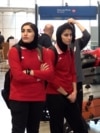
Women's Soccer Team Heads Home To Iran After 5 Members Give Up Asylum Claims In Australia
Seven members of the Iranian women's soccer team sought asylum in Australia after they declined to sing Iran's national anthem ahead of an Asian Cup game, sparking a backlash on Iranian state media. But five of them later withdrew their asylum claims and joined the rest of the team as they traveled through Malaysia en route to Iran. Two remained behind in Australia as rights advocates raised fresh concerns that some team members were returning home under intense government pressure.

UK Maritime Monitor: Tanker Struck By 'Unknown Projectile' Off UAE's Fujairah
United Kingdom Maritime Trade Operations (UKMTO), a shipping security monitoring group, reported that a tanker anchored near the key oil trading hub of Fujairah in the United Arab Emirates had been struck by an "unknown projectile" on March 16, causing minor structural damage with no crew injuries or environmental impact.
Since US and Israeli air strikes against Iran began on February 28, at least 20 maritime incidents involving commercial vessels and offshore infrastructure have been reported in and around the Strait of Hormuz, according to UKMTO.
Tehran has previously signaled that ships transporting oil to the United States, Israel, and their partners could be considered legitimate targets.
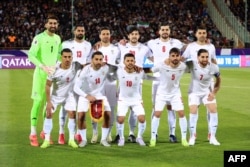
Iran Seeks To Move World Cup Matches From US To Mexico Amid Safety Concerns
Iran's Soccer Federation is "negotiating" with FIFA about relocating its opening World Cup matches from the United States to Mexico, citing safety concerns for its players, federation President Mehdi Taj said.
"When [US President Donald] Trump has explicitly stated that he cannot ensure the security of the Iranian national team, we will certainly not travel to America," said Taj in a post on the Iranian Embassy in Mexico's X account.
"We are negotiating with FIFA to hold Iran's World Cup matches in Mexico," he added.
Earlier, Trump said it would not be appropriate for Iran's national soccer team to participate in the FIFA World Cup 2026, which is set to be co-hosted by the United States this summer.
"The Iran National Soccer Team is welcome to The World Cup, but I really don't believe it is appropriate that they be there, for their own life and safety," Trump wrote on his Truth Social platform on March 12.
We are now closing the live blog for the day. We'll be back tomorrow at 7:30 a.m. Central European time to cover the latest events across the Middle East.
Trump Repeats Call For Naval Help In Hormuz
US President Donald Trump repeated his calls for US allies to send naval forces to help unblock shipping in the Strait of Hormuz and criticized nations that are not doing so.
"Some countries have already started to get there. It takes a little while to travel an ocean, but we have some that are really enthusiastic," he said at a White House event, without naming any specific country. "Some are less than enthusiastic, and I assume some will not do it."
Iran has responded to the US-Israeli air strike campaign by using weapons to threaten shipping in the strait, virtually halting passage out of the Persian Gulf on the route that normally handles about one-fifth of global oil and liquefied natural gas volume. Blockage of the strait has crimped supplies, sending oil process higher and compounding concerns about the war's effects on the global economy and people's pocketbooks.
Trump said he had spoken with French President Emmanuel Macron about forming a coalition to secure the strait, describing Macron’s response as "an eight on a scale of zero to 10" and expressing confidence that France would assist.
He also criticized Britain's reluctance to provide support despite being "our oldest ally." Trump said he was "not happy" with Prime Minister Keir Starmer, who had said he wanted a "viable" option to reopen the strait, but also said he believes the United Kingdom will participate.
Trump Questions Whether Mojtaba Khamenei Is Alive
US President Donald Trump said the United States does not know whether Iran's new supreme leader, Ayatollah Mojtaba Khamenei, is still alive.
"We don't know...if he's dead or not. I will say that nobody has seen him, which is unusual," Trump said during an event at the White House on March 16.

Iranian clerical leaders announced on March 9 that Mojtaba Khamenei, 56, was replacing his father, Ayatollah Ali Khaemenei, who was killed on the first day of US-Israeli air strikes on Iran on February 28.
The younger Khamenei has not appeared in public, and US defense chief Pete Hegseth said last week that he was believed to have been wounded.
"A lot of people are saying that he's badly disfigured. They're saying that he lost his leg...and he's been hurt very badly. Other people are saying he's dead," Trump said.
Trump said Iran had expressed interest in negotiations but suggested the country’s leadership remains disorganized after the US strikes.
"They are a country based on disinformation, and now they're using disinformation plus AI," he said. "We have no idea who we are negotiating with."
"We don't know who their leader is,” Trump said. "We have people wanting to negotiate. We have no idea who they are."