


Save The Children Says War Delaying Deliveries Of Life-Saving Medicines
The Save the Children aid organization said the war in Iran has disrupted transport of crucial medical supplies for more than 400,000 children.
"The conflict in the Middle East and wider region is obstructing key delivery routes for humanitarian supplies, delaying life-saving medical shipments for at least 410,000 children in three countries" and "the global impact will only grow," it said in a statement.
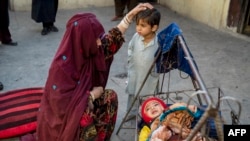
"The escalating conflict is having dire ripple effects on global aid supplies due to disruptions to key air, sea, and land routes, with shipping costs estimated by Save the Children to skyrocket about 10-50 percent to reroute aid in some cases," it added.
Aid deliveries hit by the delays were set for delivery to families in Sudan, Yemen, and Afghanistan, the organization added.
It said that a consignment for Sudan is currently stuck in the United Arab Emirates because the crucial Strait of Hormuz is almost completely blocked to shipping.
A separate shipment destined for Yemen is stuck in Dubai and now will have to be transported by land.
"Lifesaving aid is being delayed around the world, costs are soaring as a result of the fuel price increases at a time when governments are cutting vital foreign aid budgets, and families in some of the world’s most fragile places risk losing the support they depend on," said Willem Zuidema, the organization's global supply chain director.
Message Attributed To Khamenei Says Killing of Senior Officials Will Have 'A Price'

Messages attributed to Mojtaba Khamenei have responded to the recent killings of senior Iranian figures.
RFE/RL's Radio Farda reports that Iranian media have published two written messages they said were from Mojtaba Khamenei, the country’s newly appointed supreme leader, expressing condolences over the deaths of leading officials, including Ali Larijani, secretary of the Supreme National Security Council, and Gholamreza Soleimani, head of the Basij pro-government militia.
One message published on his Telegram account, according to Reuters, warned that Iran was likely to retaliate, saying "every drop of spilled blood comes at a price, and the criminal murderers of these martyrs will soon have to pay it,"
Since being named as the Islamic republic's third supreme leader on March 8, no images or recordings of Khamenei have been released, with only written statements circulated by state media.
US President Donald Trump said this week that it was unclear whether Khamenei was alive, while Defense Secretary Pete Hegseth suggested he may have been “badly disfigured.”
South Pars Strikes May Signal Shift To Energy Targets, Says Analyst
Gregory Brew, a historian of Iranian oil and a senior analyst at Eurasia Group, has been speaking to RFE/RL's Radio Farda about the air strikes on the South Pars field. According to him the development could signal a potential shift in targeting.

“The attack...indicates Israel’s willingness to hit aspects of Iran’s energy infrastructure, and then, of course, Iran’s willingness to retaliate against other energy targets," he said.
It's unclear if "Israel is going to start targeting energy infrastructure more broadly -- this could be a warning shot, a prelude to a more significant campaign," he added.
He noted that it is also uncertain whether Iran’s retaliation against Persian Gulf energy targets would be sufficient to deter further attacks, given that its capabilities have been degraded.
"We will have to wait and see but this does suggest that without de-escalation , likely led by President Trump, this war is going to continue and could very well escalate to a point where energy becomes a more prominent target," he said.
Gulf Energy Infrastructure Hit After South Pars Attack
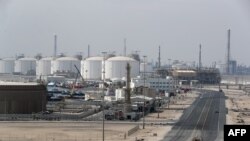
Following an attack on the South Pars gas field on March 18, subsequent incidents have disrupted energy infrastructure across the Middle East.
The strike on South Pars -- which is shared by Iran and Qatar -- caused fires and reduced output at the world’s largest gas reserve, prompting Iran’s Revolutionary Guards Corps to warn Persian Gulf states to evacuate key oil and gas facilities, including Qatar’s main gas hub Ras Laffan.
Qatar later reported a fire at Ras Laffan after an alleged Iranian attack, with emergency crews deployed to contain the blaze.
Meanwhile, Saudi Arabia said it intercepted ballistic missiles targeting Riyadh and destroyed a drone heading toward a gas facility, with no reported casualties.
The fallout has also affected Iraq, where authorities confirmed on March 18 that gas imports from Iran have been completely halted, creating a 3,100-megawatt shortfall in Iraq's electricity grid.
The crisis has been compounded by disruptions to shipping through the Strait of Hormuz, which have hindered regional oil and gas exports.
Iraqi and Kurdistan regional authorities, however, have since partially resumed exports of crude oil from Kirkuk fields in the north of the country via Turkey’s Ceyhan port.
Spanish PM Says Middle East War Won’t Distract From Support For Ukraine
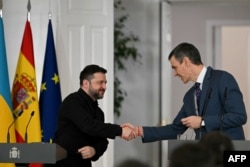
Spanish Prime Minister Pedro Sanchez says that the war in the Middle East would not distract his country from supporting Ukraine in its defense against Russia’s invasion.
"We cannot deny that the crisis in the Middle East is monopolizing conversation and precisely for that reason, I want to say to the government of Ukraine that nothing and no one will make us forget what is happening in Ukraine," Sanchez said at a joint press conference with Ukrainian President Volodymyr Zelenskyy in Madrid on March 18.
“We will keep our support for the Ukrainian people with the same intensity,” he added.
A day earlier, Zelenskyy told the BBC he had a “very bad feeling” about the impact of the Middle East conflict on the war in Ukraine, saying peace negotiations were being “constantly postponed” due to “one reason -- war in Iran.”
In The US War On Iran, Russia Is A Winner (Mostly)
- By Mike Eckel
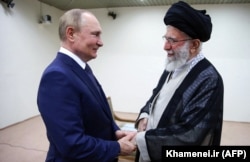
High oil prices? Check. Fewer US weapons for Kyiv? Check. Washington distracted from the ongoing war on Ukraine? Check. Europe nervous about energy costs? Check. Tensions in the West? Check.
Nearly three weeks into the furious campaign of US and Israeli air strikes, the Tehran government -- Russia’s closest partner in the Middle East is being shoved toward collapse, regional politics have been scrambled and Moscow has been left watching, largely helplessly, from the sidelines.
The Kremlin isn’t entirely unhappy, though.
“I do think that it complicates the security and the economic picture for Europe. And it distracts [US President Donald] Trump from Ukraine, and all of that will feel like it gives a lot of extra room to Moscow,” said Sam Greene, a longtime Russia expert and professor of Russian politics at King's College London.
European policymakers “might begin to shift their willingness to support Ukraine and to maintain their stance on Russia,” he told RFE/RL. “It’s that sort of thing that blows wind into [Russian President Vladimir] Putin’s sails.”
Read more here.
Iranian Government Weakened But Still A Threat, Says Gabbard
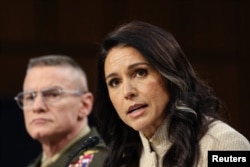
With the US-Israeli conflict with Iran now in its third week, US Director of National Intelligence Tulsi Gabbard said Iran’s government has been weakened but remains functional and capable of attacking US and allied interests.
“The regime in Iran appears to be intact but largely degraded by Operation Epic Fury,” she told a Senate hearing on March 18, warning that “Iran and its proxies remain capable of and continue to attack US and allied interests in the Middle East. If a hostile regime survives, it will seek to begin a years-long effort to rebuild its missiles and UAV (drone) forces.”
Gabbard’s assessment comes amid uncertainty over Iran’s nuclear program.
Her prepared remarks said enrichment capabilities had been destroyed and not rebuilt, while her oral testimony suggested Iran was attempting to recover from damage.
Based on reporting by Reuters
UN Agency Says Status Of New Iran Nuclear Site Unknown
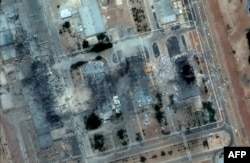
The United nation's nuclear watchdog says it does not know the status of a new Iranian uranium enrichment facility in Isfahan, as inspectors have yet to access the underground site.
Rafael Grossi, the head of the International Atomic Energy Agency (IAEA), said a planned visit was canceled after the complex was struck at the start of the 12-day war with Israel in June, leaving uncertainty over whether the facility is operational or still under construction.
Iran notified the UN agency of the site the same month, but Grossi said key questions remain about whether centrifuges have been installed there.
Separately, Iran told the IAEA that a projectile struck near the Bushehr nuclear power plant on March 17 without causing damage. The agency also confirmed strikes earlier this month on Iran’s Natanz enrichment facility.
Based on reporting by Reuters
Israel Says 3 Planes Severely Damaged At Ben Gurion Airport
Three private planes parked at Ben Gurion Airport near Tel Aviv suffered "severe" damage after they were hit by debris from intercepted Iranian missiles, the Israel Airports Authority (IAA) said on March 18.
Reuters reports that the IAA said the damage had occurred over the past few days, but it not provide details about the aircraft owners.
Since the US-Israeli conflict with Iran began on February 28, flights at Israel’s main airport have been halted, with only repatriation flights operating.
Iranian Emergency Workers Search For Survivors Trapped Under Rubble
- By RFE/RL
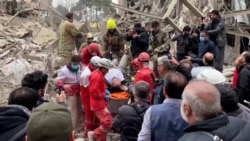
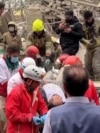
Emergency workers from the Iranian Red Crescent Society search for survivors trapped under the rubble following ongoing US-Israeli air strikes on Iran. Daily attacks on Tehran have left rescue teams scrambling to deal with the deadly aftermath. Iran has responded with attacks across the region, including on civilian areas.