




High oil prices? Check. Fewer US weapons for Kyiv? Check. Washington distracted from the ongoing war on Ukraine? Check. Europe nervous about energy costs? Check. Tensions in the West? Check.
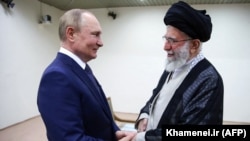
Nearly three weeks into the furious campaign of US and Israeli air strikes, the Tehran government -- Russia's closest partner in the Middle East -- is being shoved toward collapse, regional politics have been scrambled, and Moscow has been left watching, largely helplessly, from the sidelines.
The Kremlin isn't entirely unhappy, though.
"I do think that it complicates the security and the economic picture for Europe. And it distracts [US President Donald] Trump from Ukraine, and all of that will feel like it gives a lot of extra room to Moscow," said Sam Greene, a longtime Russia expert and professor of Russian politics at King's College London.
European policymakers "might begin to shift their willingness to support Ukraine and to maintain their stance on Russia," he told RFE/RL. "It's that sort of thing that blows wind into [Russian President Vladimir] Putin's sails."
In the Kremlin's calculus about the fallout from the war on Iran, oil prices are a key variable.
Exports of oil and gas have fueled, and funded, Russia's all-out war on Ukraine, now in its fifth year. Western sanctions have chipped away at those revenues, in part because of a "price cap" that essentially limits how much money Moscow can garner.
Undermining Unity
But the Iran war has now sent oil prices soaring, which means more money for Moscow and the war on Ukraine. That's a welcome development for Putin, given that the Russian economy is sputtering and may be slipping into recession.
"High energy prices may not just provide a lifeline when Russia's economy was already under increased strain of sanctions and the high costs of the war, it is also starting to undermine the unity of the countries supporting Ukraine," said Katja Bego, a senior research fellow in Chatham House's Europe Program.
"If the energy crisis in the Middle East persists and further deepens, we are likely to see more European leaders start to make such calls, and it will no longer just be countries like Hungary and Slovakia breaking rank," she said.
Additionally, with Americans grumbling about high gasoline prices, the Trump administration issued a sanctions waiver allowing buyers to purchase some Russian oil already in tankers scattered around the world.
"Moscow's ideal scenario for a Middle East war is not a swift victory or a catastrophic escalation, but a conflict of moderate duration and intensity that keeps oil prices high without significantly disrupting the global economy," Aleksandra Prokopenko, a former Russian Central Bank adviser, said in a post to X.
"The beneficiary of this war is Putin, filling up his coffers with oil dollars…and the reduction in support being given to Ukraine," Richard Shirreff, a former British general and ex-NATO deputy commander, told CNN this week. Europe and Canada "must absolutely double down…increasing support for Ukraine."
US Treasury Secretary Scott Bessent defended the decision to grant a waiver for Russian oil, arguing the measure was "narrowly tailored" and would "not provide significant financial benefit to the Russian government."
"The temporary increase in oil prices is a short-term and temporary disruption that will result in a massive benefit to our nation and economy in the long term," Bessent said in the statement posted to X.
The White House declined to comment.
'There's Always A Danger That Eventually You Piss Off Washington'
A major reason why Ukraine has been able to defend itself against a larger Russian military is Western weaponry. Above all, that's Washington, which has supplied, among other things, air-defense systems to help Kyiv down Russian missiles and drones.
Across the Middle East, the United States and Israel -- not to mention US allies like Kuwait, Bahrain, and the United Arab Emirates -- have been trying to keep pace with Iran's retaliation, firing scores of their own anti-missile and anti-drone weapons. Ukrainian President Volodymyr Zelenskyy said Persian Gulf nations had fired more than 800 American-made Patriot missiles in three days alone.
The more US stockpiles are depleted, the fewer weapons there are for Ukraine.
That's bad for Kyiv and good for Moscow, which continues to pummel Ukraine frontline positions, civilian apartment buildings, electricity grid, and power plants, leaving Kyiv struggling to keep up its defenses.
"For Putin, a long war in Iran is a plus," Zelenskyy said in an interview with the BBC. "In addition to energy prices, it means the depletion of US reserves and the depletion of air defense manufacturers. So we [Ukraine] have a depletion of resources."
Ukraine has also struggled to keep US-backed peace negotiations from tilting too far to Russia's advantage. After multiple rounds, the talks have now sputtered to a halt.
Last week, one of the Kremlin's main envoys, Kirill Dmitriev, flew to Florida to meet with the US officials overseeing the Ukraine peace talks: special envoy Steve Witkoff and Trump's son-in-law Jared Kushner. Dmitriev later described the talks as "productive."
Two days later, the US Treasury Department issued its sanctions waiver on Russian oil.
If the Trump administration were distracted by the Iran war, Greene said, that could open a greater role for Europe, which on the whole is seen as more supportive of Ukraine.
"I think that that does make Moscow nervous, but at the same time, [the Russians] have been walking this very fine line of trying to stay engaged with the negotiating process without actually giving anything up," he said. "And there's always a danger that eventually you piss off Washington."
'Influence In Decline'
The biggest negative variable in the Kremlin's Iran war calculus is the loss of clout in the region, experts said. Moscow was already smarting from the December 2024 collapse of Bashar al-Assad's regime in Syria, where Russia invested decades of resources to build up its military presence.
Then this January, US forces swooped into Caracas, and captured Venezuelan leader Nicolas Maduro -- another ally of Moscow.

"This is yet another case of the Kremlin failing to truly support its ally in its hour of need, and [showing] itself largely impotent," Bego said. "It is also yet another regime aligned with the Kremlin finding itself under potentially existential strain."
"Russian influence in [the Middle East] appears to be in a steady, and for the foreseeable future, decline," said Maria Engqvist, director of the Russia and Eurasia studies program at the Swedish Defense Research Agency. "For now, Moscow has very limited possibilities to manage this and can't do much about it."
Russia has not entirely abandoned Tehran; reportedly Moscow is providing intelligence, and possibly sensitive targeting information, which has helped Iran hit things like the CIA station in Riyadh.
"Both cases, Venezuela and Iran, highlight the practical difficulties that the Russian leadership have to implement their own strategic ambitions," Engqvist said. "This is likely to erode the confidence of [Moscow's partners] in Russia as a provider of anything that may be useful to them and their respective relationships."