


Zelenskyy Hails US-Iran Cease-Fire, Says Ukraine Ready To 'Respond In Kind' To Russia
Ukrainian President Volodymyr Zelenskyy welcomed the cease-fire between the United States and Iran, calling it the "right decision to ending the war," adding that Ukraine is "ready to respond in kind if the Russians stop their strikes."
"Ukraine has always called for a ceasefire in the war waged by Russia here in Europe against our state and our people, and we support the ceasefire in the Middle East and the Gulf that paves the way for diplomatic efforts," Zelensky wrote on X on April 8.
He added that "in recent weeks, Ukraine has been helping to protect lives in the Middle East and the Gulf" and announced that "Ukrainian expert military teams will continue to work in the region to help further develop security capabilities."
European Leaders Welcome Cease-Fire Announcement
European leaders have expressed support for the two-week cease-fire announced by Washington and Tehran on April 8, although they emphasized the continuing need for de-escalation and diplomacy.
“Ceasefires are always good news. Especially if they lead to a just and lasting peace,” said Spanish Prime Minister Pedro Sanchez. “But this momentary relief cannot make us forget the chaos, the destruction, and the lives lost. The Government of Spain will not applaud those who set the world on fire just because they show up with a bucket.”
“What’s needed now: diplomacy, international legality, and PEACE,” he added in a post on X.
French President Emmanuel Macron said he welcomed the news of the temporary truce between Washington and Tehran, but added that the situation in Lebanon remains critical and called for Lebanon to be included in the deal. Israel earlier on April 8 released a statement saying that while it supports Trump's decision to stop attacking Iran for two weeks, the cease-fire doesn't include Lebanon.
"Our wish in this context is to be assured that the cease-fire fully includes Lebanon," Macron said.
Macron said about 15 countries were planning to facilitate the resumption of traffic through the Strait of Hormuz, through which a fifth of the world's oil supply usually flows.
"About 15 countries are currently mobilized and are participating in the planning, under France's leadership, to enable the implementation of this strictly defensive mission in coordination with Iran to facilitate the resumption of traffic," Macron said on April 8.
European Council President Antonio Costa said in a statement on X that he urges “all parties to uphold [the cease-fire’s] terms in order to achieve sustainable peace in the region. The EU stands ready to support ongoing efforts and remains in close contact with its partners in the region. I thank Pakistan and all other parties involved in facilitating this agreement.”
"I welcome the two-week ceasefire the US and Iran agreed last night. It brings much needed de-escalation," European Commission President Ursula von der Leyen said on X, adding it was crucial negotiations continue for an enduring solution.
Kaja Kallas, the EU’s foreign policy chief, said that the agreement represents "a step back from the brink after weeks of escalation."
"It creates a much-needed chance to tone down threats, stop missiles, restart shipping, and create space for diplomacy towards a lasting agreement," she added.
With reporting by Reuters
Iran Internet Blackout Hits 40 Days Despite Cease-Fire Announcement
NetBlocks, a web-outage monitor, says Iran's Internet blackout has entered its 40th day amid the announcement of a temporary cease-fire between the United States and Iran.
NetBlocks said in a post on X on April 8 that the "wartime censorship measure" continues in Iran even as Washington and Tehran "each declare victory," "with the Iranian people once again left in the dark."
British PM Starmer Heads To Gulf Region
British Prime Minister Keir Starmer announced that he is traveling to the Gulf region on April 8 to meet with regional leaders following the announcement of a temporary cease-fire between the United States and Iran.
The prime minister's office said the trip is aimed at strengthening diplomatic efforts to preserve the cease-fire and turn it into a lasting agreement. He will reportedly return to the United Kingdom on April 10.
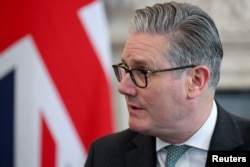
In a statement, Starmer said he welcomed the agreement on a two-week cease-fire, which he described as "a moment of calm" for the region and the wider world, and stressed that Britain, together with its partners, would work to "support and sustain the cease-fire."
The British leader has previously faced criticism from US President Donald Trump for not supporting US and Israeli attacks on Iran. Starmer has also hosted multinational meetings on how allies can respond to disruptions affecting the Strait of Hormuz.
The British government said Starmer will discuss ways to aid the truce during the trip, with the aim of achieving a lasting solution to the conflict and protecting the British and global economies.
This trip was planned before the cease-fire was announced.
Bahrain Reports Iranian Strike Hours After US-Iran Cease-Fire Announced
Bahrain has reported an Iranian strike just hours after Tehran and Washington agreed to a temporary halt in hostilities, which included Iran refraining from attacking countries in the region.
The Interior Ministry of Bahrain issued a warning earlier to citizens ahead of an incoming attack, urging them to "remain calm and head to the nearest safe place." Soon after, it reported on X that the country's "Civil Defense extinguished a fire in the facility as a result of the Iranian aggression."
As a result of the strike, "two citizens sustained minor injuries and a number of houses were damaged in the Sitra area as a result of shrapnel falling from the interception of an Iranian drone," the ministry reported.
Smoke had been seen rising from an area on Sitra Island, which is close to Manama and hosts the country's principal energy facilities.
Ukrainian FM Welcomes US-Iran Cease-Fire, Says 'American Decisiveness' Also Needed Against Moscow
Ukrainian Foreign Minister Andriy Sybiha has welcomed the US-Iran agreement to "unblock" the Strait of Hormuz and achieve a two-week cease-fire, calling it a sign that "American decisiveness works."
Sybiha added that similar decisiveness is now needed "to force Moscow to cease fire and end its war against Ukraine."
Israel Voices Support For US-Iran Cease-Fire But Says Lebanon Not Included
Israel said that it supports Trump's decision to stop attacking Iran for two weeks subject to the immediate reopening of the Strait of Hormuz and the cessation of attacks against the United States, Israel, and other countries in the region.
But the statement, released by the office of Prime Minister Benjamin Netanyahu, said the cease-fire did not include Lebanon, which contradicted an earlier statement from Prime Minister Shehbaz Sharif of Pakistan.
To read the full report, click here.
US Senator Shaheen Welcomes Iran Cease-Fire But Wants 'Real Accounting' Of War
US Democratic Senator Jeanne Shaheen, ranking member of the Senate Foreign Relations Committee, says she welcomes a temporary cease-fire to stop the fighting with Iran, though concerns remain over what the war has achieved, citing a sharp increase in gas prices, the "enormous disruption" to the global economy, and the deaths of 13 US service members.
“Diplomacy is the only way forward. There must now be an intensive diplomatic effort, alongside our allies, to conclude this conflict and ensure Iran does not develop a nuclear weapon,” the senator from New Hampshire said in a statement late on April 7 after the cease-fire deal was announced.
US Senator Lindsey Graham Expects Congress To Review Iran's Proposed 10-Point Plan To End War
Lindsey Graham, the Republican senator for South Carolina and a vocal supporter of military action against Iran during the presidency of Donald Trump, says he expects to review in Congress Iran's proposed 10-point plan to end the war with the United States.
"As to an Iranian ten point proposal to end the war, I look forward to reviewing it at the appropriate time and its submission to Congress for a vote, like we did with the Obama JCPOA," Graham wrote in a social media post on X.
Graham said it is imperative that "every ounce of the approximately 900 lbs. of highly enriched uranium" Iran possesses must be controlled by the United States and removed from Iran "to prevent them in the future from having a dirty bomb or returning to the enrichment business - the Libyan model, for lack of a better phrase."
The JCPOA, or Joint Comprehensive Plan of Action, was a deal signed in 2015 between Iran and the P5+1 (US, UK, France, China, Russia, plus Germany) designed to limit Tehran’s nuclear program in exchange for relief from international sanctions.
Trump pulled the United States out of the deal in 2018 after calling it a "disaster."
Political Analyst Jason Brodsky Says US-Iran Cease-Fire Deal Doesn't Remove Trump's Threat Of Force
WASHINGTON -- As news of the agreement between Iran and the United States for a two-week cease-fire eased fears of a major escalation in the conflict, Jason Brodsky, policy director at United Against Nuclear Iran, characterized the move as "a tactical pause -- a delay" and suggested that the threat of force has not been removed, merely shelved.
"I think President [Donald] Trump retains the option of escalating. The attack plans have been prepared. That credible military threat remains," he told RFE/RL, adding that both nations remain in a position to strike.
"The Iranians have the ability to threaten the Strait of Hormuz. So both can revert to previous postures if this deal fails to hold."
Brodsky also noted Tehran made a significant pivot from its previous rhetoric to make the deal, as it had previously insisted on a permanent end to hostilities rather than a temporary fix.
"If this is fully implemented, Iran's regime backed down amid President Trump's threats," Brodsky observed, noting that Iranian officials like Parliament Speaker Mohammad Baqer Qalibaf, had previously rejected temporary truces.
"After coercive diplomacy, Tehran climbed down from that demand and agreed to a temporary ceasefire."
However, he added that the underlying ideology of the Iranian leadership might make a long-term resolution to the war difficult.
"In the end, as long as the Islamic Republic is the Islamic republic, there are likely no happy endings here. It requires enmity with the US to survive as a system.”