




Trump, Iran Reach Last-Minute Agreement On Two-Week Cease-Fire
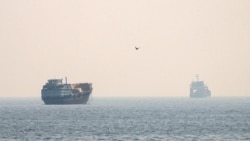
US President Donald Trump and Iran have agreed to a two-week Pakistani-brokered cease-fire, pulling back from the brink to allow the two sides time to negotiate a peace deal.
Trump, who earlier on April 7 wrote that "a whole civilization will die tonight" if Iran fails to reach a deal, said in a social media post that he had received a 10 point proposal from Tehran and he believes "it is a workable basis on which to negotiate."
The Tasnim news agency, which is close to the powerful Islamic Revolutionary Guards Corps (IRGC), confirmed a cease-fire has been "established" between the two sides "with specific conditions."
Trump also gave no details of the Iranian proposal, but added that the agreement hinges on Tehran allowing for the free passage of ships in the Strait of Hormuz, a key oil and gas shipping lane.
"...wherein they requested that I hold off the destructive force being sent tonight to Iran, and subject to the Islamic Republic of Iran agreeing to the COMPLETE, IMMEDIATE, and SAFE OPENING of the Strait of Hormuz, I agree to suspend the bombing and attack of Iran for a period of two weeks," Trump wrote.
To read the full story, click here.
Pakistani PM Sharif Calls For 2-Week Extension Of US Deadline For Iran
Pakistani Prime Minister Shehbaz Sharif has asked US President Donald Trump to extend by two weeks the deadline he has given Iran to reach an agreement with Washington and open the Strait of Hormuz.
Sharif, whose country is leading efforts to mediate between the United States and Iran, also called on all sides in the war to cease fire and for Tehran to open the strait to shipping for the same two-week period.
"Diplomatic efforts for peaceful settlement of the ongoing war in the Middle East are progressing steadily, strongly and powerfully with the potential to lead to substantive results in near future," Sharif said in a post on X less than five hours before the deadline set by Trump was due to expire.
“To allow diplomacy to run its course, I earnestly request President Trump to extend the deadline for two weeks. Pakistan, in all sincerity, requests the Iranian brothers to open Strait of Hormuz for a corresponding period of two weeks as a goodwill gesture. We also urge all warring parties to observe a ceasefire everywhere for two weeks to allow diplomacy to achieve conclusive termination of war," he wrote.
Reuters cited a senior Iranian official it did not name as saying Tehran was positively reviewing the request for a two-week cease-fire.
White House Press Secretary Karoline Leavitt said Trump had been made aware of Pakistan's proposal and that a response would come.
With reporting by Reuters
Pope, Others Decry Threats Against Iranian 'Civilization' And Civilian Infrastructure
Pope Leo XIV suggested that US President Donald Trump's threat to destroy "a whole civilization" was "unacceptable," while other international figures and Western officials warned all sides in the Iran war against attacks on civilian infrastructure.
"Today...there was this threat against all the people of Iran, and this is truly unacceptable," Leo told journalists on April 7, adding: "There are certainly questions of international law, but much more than that, it is a moral question."
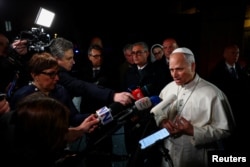
An American who has been critical of the Iran war, Leo urged people in the United States and elsewhere to contact their political leaders or representatives to urge them to work for peace. He did not mention Trump, the United States, or any other country by name.
His remarks came after Trump, reiterating his threat of major US attacks on Iranian power plants and bridges if Tehran doesn't agree to a deal by 8 p.m. EST on April 7, posted on social media: "A whole civilization will die tonight, never to be brought back again. I don't want that to happen, but it probably will."
The UN high commissioner for human rights, Volker Turk, said he deplored "the tirade of incendiary rhetoric being used in the Middle East war" by all parties. Also without mentioning Trump by name, he described threats "to annihilate a whole civilization and to target civilian infrastructure" as "sickening."
"Under international law, deliberately attacking civilians and civilian infrastructure is a war crime," said Turk, who called for urgent steps to deescalate and protect civilians.
UN Secretary-General Antonio Guterres was "deeply troubled" by Trump's statement, UN spokesperson Stephane Dujarric said. "There is no military objective that justifies the wholesale destruction of a society's infrastructure or the deliberate infliction of suffering on civilian populations," Dujarric told a regular briefing.
Canadian Prime Minister Mark Carney also called on the parties in the war to respect international law and warned them against targeting civilians and civilian infrastructure.
"One does not erase a civilization,” French Foreign Minister Jean-Noel Barrot said. He said he hopes Trump "does not go ahead with his threats that would push the region but also the world in a new escalation that would be particularly dangerous."
Several US lawmakers have also criticized Trump's post and warned against targeting civilian infrastructure.
With reporting by Reuters, AFP, and dpa
China, Russia Veto UN Security Council Resolution On Strait Of Hormuz
China and Russia vetoed a resolution on April 7 proposed by Bahrain to the United Nations Security Council that would have encouraged countries to coordinate on protecting commercial shipping in the Strait of Hormuz.
Eleven members of the Security Council voted in favor of the resolution, while veto-wielding permanent members China and Russia voted against it and two countries abstained.
Bahrain, with the support of the United States and other Gulf countries, had spent weeks negotiating a draft resolution that initially would have authorized countries to use "all necessary means" -- a standard UN phrase that can include military force -- to protect shipping in the strait.
However, after opposition from China, Russia, and France, the language was revised. The final version instead called on countries to coordinate defensive efforts and ensure safe passage through the waterway.
The Strait of Hormuz remains a critical global shipping route, and its disruption has raised major economic concerns worldwide.
Earlier, Bahrain’s UN ambassador Jamal Al-Ruwaii warned of the broader impact, saying, "We cannot accept the economic terrorism" and "the entire world is affected by these developments."
Interactive Map: Iran's Power Plants
Iran has 29 power plants with an output of at least 1,000 MW. US President Donald Trump has threatened a major attack against the country's power infrastructure if it does not agree to reopen the Strait of Hormuz.
Tap a power plant on the map to see its name and power output.
EU Groups Looking At Energy-Saving Measures In Response To Iran War Crisis
Key European Union oil and gas groups will hold meetings this week as countries around the bloc scramble to deal with the impact of the US-Israel-led war with Iran on energy prices and supplies.
European Commission spokeswoman Anna-Kaisa Itkonen told a news briefing on April 7 the oil coordination group will meet on April 8, while the gas group will convene the following day.
The EU is facing energy-saving measures such as reduced air travel, highway speed limits, and work-from-home directives as the war has resulted in the blockage of the Strait of Hormuz, the transit corridor for about 20 percent of the world's oil and gas.
To read the full report, click here.

Macron Says French Nationals Held By Iran Released
Prime Minister Emannuel Macron said two French nationals held in Iran for more than three years have been released and are on their way home.
"Cecile Kohler and Jacques Paris are free and on their way back to France after three and a half years of detention in Iran," Macron said in a social media post on X on April 7.
The pair were arrested in Tehran in May 2022 as they were wrapping up a sightseeing holiday in Iran. In October 2025, they were sentenced to lengthy prison terms for allegedly spying for France and Israel.
Families for the two educators have denied the charges.

JD Vance: America Has Tools It Hasn't Yet Used Against Iran
US Vice President JD Vance warned on April 8 that the United States "has tools at our disposal that we have not yet decided to use" against Iran.
"The United States has achieved its military objectives," Vance, who was in Hungary to meet with Prime Minister Viktor Orban, told reporters, adding that the situation now depends on Tehran and that further steps remain under consideration.
"We have tools at our disposal that we have not yet decided to use," he reiterated, emphasizing that the United States retains additional options. He added that the president could choose to act if Iran does not change course.
Vance did not provide further details on what those tools might be.
Trump Issues Dire Warning To A 'Whole Civilization'
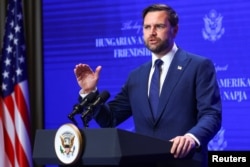
US President Donald Trump has warned that "a whole civilization will die tonight" if Iran fails to reach a deal with the United States before his self-imposed deadline expires amid a ratcheting up of air strikes on Iranian targets and a defiant response from Tehran.
"A whole civilization will die tonight, never to be brought back again," Trump wrote on his Truth Social platform on April 7. "I don’t want that to happen, but it probably will."
Trump's threat follows his warnings that the United States would target Iran's power plants and bridges in remarks described by Iranian officials as threats that amount to "war crimes," though some international legal experts dispute such a claim.
To read the full report, click here.
Chinese Envoy, French Ambassador Meet Ahead Of UN Vote On Hormuz
France's ambassador to China, Bertrand Lortholary, met with Zhai Jun, China's special envoy to the Middle East, on April 7 as the delayed UN security council vote is expected to go ahead on a Bahraini resolution to protect commercial shipping in the Strait of Hormuz.
The Chinese Foreign Ministry released a statement from both sides, with Lortholary stating the five-point peace plan agreed between Pakistan and China last week was "more in line with France's position." The French ambassador also affirmed the country's willingness "to maintain coordination with China to promote the restoration of peace and stability in the region."
The resolution, which was to be voted on late last week, saw resistance from China, France, and Russia and has since been watered down. A previous draft resolution would have authorized "all necessary means" to protect shipping on the strait.
On April 2, China's ambassador to the United Nations, Fu Cong, spoke against authorizing any use of force, saying such a move would be "legitimizing the unlawful and indiscriminate use of force, which would inevitably lead to further escalation of the situation and lead to serious consequences."