





Hours before a US deadline for Iran to reach a deal or face intense attacks on power plants and other infrastructure, Pakistan urged President Donald Trump to give Tehran two more weeks to allow the two sides to reach a peace settlement.
Pakistani Prime Minister Shehbaz Sharif, whose country is leading efforts to mediate between the United States and Iran, also called on all sides in the war to cease fire and for Tehran to open the Strait of Hormuz to shipping for the same two-week period.
The last-ditch request came as global concern over Trump's remark earlier on April 7 that "a whole civilization will die tonight" if Iran fails to reach a deal mounted, with Pope Leo, an American, suggesting it was "truly unacceptable" and others warning against attacks on civilian infrastructure.
"Diplomatic efforts for peaceful settlement of the ongoing war in the Middle East are progressing steadily, strongly and powerfully with the potential to lead to substantive results in near future," Sharif said in a post on X less than five hours before the deadline set by Trump -- 8 p.m. EST on April 7, or 3:30 a.m. on April 8 in Iran-- was due to expire.
“To allow diplomacy to run its course, I earnestly request President Trump to extend the deadline for two weeks," he wrote.
"Pakistan...requests the Iranian brothers to open Strait of Hormuz for a corresponding period of two weeks as a goodwill gesture. We also urge all warring parties to observe a cease-fire everywhere for two weeks to allow diplomacy to achieve conclusive termination of war."
White House Press Secretary Karoline Leavitt told media outlets that Trump had been made aware of Pakistan's proposal and that a response would come.
Reuters cited a senior Iranian official it did not name as saying Tehran was positively reviewing the request for a two-week cease-fire, but also that Iran is ready both for peace and for war.
There have been few signs the sides are ready for compromise in the war, which began with US and Israeli air strikes on Iran on February 28, and little overlap between proposals put forth by Washington and Tehran.
"A whole civilization will die tonight, never to be brought back again," Trump, who has extended the deadline several times since he first issued the ultimatum in March, wrote on his Truth Social platform on April 7. "I don’t want that to happen, but it probably will."
Trump's post followed his warnings that the United States would target Iran's power plants and bridges in remarks described by Iranian officials as threats that amount to "war crimes," though some international legal experts dispute such a claim.
It also came just hours after US and Israeli air strikes hit multiple locations across Iran, including infrastructure and the strategic Kharg Island.
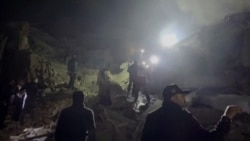

Iranian media reported explosions across Tehran and the sound of air defense fire on April 7, with some accounts describing fighter jets flying at low altitude over the capital.
Strikes were also reported on Kharg Island, where some 90 percent of Iran's oil exports are shipped from, as well as major bridges on the Tabriz-Zanjan highway and another near the holy city of Qom.
Several media outlets including CNN, Reuters, and Fox News quoted US officials confirming the strikes on Kharg Island. The Wall Street Journal said "more than 50 military targets" were hit in the attacks.

Prior to Trump's comments on social media, the Islamic Revolutionary Guards Corps (IRGC) warned in a statement just moments after the strikes were reported that it would target US and allied infrastructure across the region if the United States crossed "red lines."
The IRGC also put American partners in the Persian Gulf and beyond on notice, saying that restraint shown toward neighboring states "out of good neighborliness" was now over and that "all such considerations have been lifted" -- a signal that Gulf Arab states hosting US military assets could become direct targets.
The statement marks a shift in Iran's stated position.
While Tehran has previously struck targets in several regional countries, it had until now maintained that those states themselves were not the intended enemy -- a distinction it appears to be threatening to abandon.

Among the sites hit in downtown Tehran was a historic synagogue, according to Iranian media.
Homayoun Sameyah, the Jewish community's representative in Iran's parliament, told state media that the building was "ancient" and "sacred," and that Torah scrolls remained buried under the rubble.
Trump had earlier warned that the "the entire country" of Iran "could be taken out in one night."
Speaking in Budapest on April 7 after meeting Hungarian Prime Minister Viktor Orban, US Vice President JD Vance said the administration had largely achieved its military goals in the campaign and that he was "confident" Washington will get a response from Tehran before the deadline expires.
Meanwhile, Iran struck Tel Aviv, with Israeli television reporting around 10 impact sites across the city causing damage to buildings and vehicles. No injuries were recorded.
The Israeli military accused Iran of using cluster munitions -- weapons that disperse into smaller submunitions, or bomblets, in midair and are nearly impossible to intercept with conventional air defenses. The southern port city of Eilat was also targeted with cluster munitions, according to media reports.

Iran Rejects Cease-Fire Proposal
Trump’s warning on April 6 centered on Iran's control of the strategically vital Strait of Hormuz, a chokepoint for global oil shipments.
Iran's response fell short of what Washington demanded.
Tehran submitted a 10-point peace proposal through Pakistani mediators, but the plan rejected a temporary cease-fire and instead called for a permanent end to hostilities. It also included conditions unlikely to be acceptable to the United States or Israel.
Iran's defiance was on open display.
Mahdi Mohammadi, a senior adviser to Parliament Speaker Mohammad Baqer Qalibaf, posted on X that Iran had "clearly and openly won the war" and would only accept an outcome that established "a new security order in the region."
He added: "It is Trump who has around 20 hours to surrender to Iran or his allies will be sent back to the Stone Age. We will not back down!"
Following a call by a senior official from Iran's Sports and Youth Ministry for people to form "human chains" around power plants, Iranian media outlets including official news agency IRNA reported that gatherings took place outside plants in several cities, as well as on at least one bridge, and published images of people standing shoulder-to-shoulder holding placards and the national flag. It was unclear how many people participated and whether any had been coerced or given incentives to take part.
The Wall Street Journal, citing unnamed Middle Eastern officials, reported hours before the deadline set by Trump that Iran had cut off direct communications with the United States over his threat to destroy Iran's "whole civilization" but that talks with cease-fire mediators continued.
Asked by a journalist whether he expected Iran to "come to the table," US Secretary of State Marco Rubio said, "Hope we have more news later today on that."
The threat to Iranian infrastructure is drawing warnings from inside the country.
Mahdi Masaeli, secretary of Iran's electricity industry syndicate, said on April 7 that attacks on power plants, transmission lines, or substations could trigger "widespread blackouts."
While Iran's grid -- with a capacity of around 100,000 megawatts against current consumption of less than half that -- has some capacity to reroute power, Masaeli warned that serious damage would be a "turning point" in the conflict.
"The problems would not double," he said. "They would grow exponentially."
Previous strikes have already disrupted key industrial sectors.
Attacks on the Mobarakeh Steel complex have affected steel output, while strikes on the Bandar Emam petrochemical facility have hit production of PVC and cable materials, with black market activity emerging as a result, Masaeli said.

