




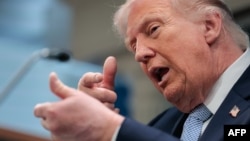
WASHINGTON -- With a US ultimatum set to expire, President Donald Trump has warned Iran that its infrastructure could be struck within hours if it does not comply with his demands, particularly reopening the Strait of Hormuz.
Tehran has rejected short-term cease-fire proposals, demanding a permanent end to hostilities and guarantees against future attacks.
RFE/RL spoke with Nate Swanson, former Iran director at the White House National Security Council who is now at the Atlantic Council, about the escalating crisis and prospects for diplomacy as Trump's deadline of 8 p.m. Eastern Time on April 7 looms.
RFE/RL: The US president has issued a stark ultimatum, warning Iran's infrastructure could face massive strikes within hours if key demands aren't met. How realistic is such a rapid, large-scale disruption of Iran's decentralized systems, and how much of this is strategic signaling rather than operational capability?
Nate Swanson: My assessment is that this is primarily being done for psychological reasons, to extract concessions from Iran and force some form of agreement.
I can't speak definitively on whether the US could hit all those targets in such a short time frame, but Iran's infrastructure is highly decentralized. There are dozens of separate power systems, transportation nodes, and other critical networks. The idea of neutralizing every bridge or key node within a matter of hours seems implausible.
This fits a broader pattern: threatening maximum consequences to generate leverage.
So far, "maximum pressure" has not fundamentally altered Iranian decision-making or forced capitulation. I don't see clear evidence that even this level of escalation would change their calculus, but ultimately that's a decision for Iran's leadership.
RFE/RL: We're also hearing about diplomatic efforts. Pakistan has floated a two-tier framework, the so-called Islamabad Accord, proposing a 45-day cease-fire followed by a comprehensive deal. What are Iran's key red lines, and is there any middle ground?
Swanson: Iran is looking for guarantees that this war won't simply restart in a few months. They want assurance that a cease-fire is permanent, not temporary. That's why they are rejecting short-term language and pushing for fundamentally different terms.
The second component is economic. Iran is seeking to benefit from its control of the Strait of Hormuz. They refer to this as reparations, but in practice it could take a number of forms -- essentially formalizing a mechanism through which they derive ongoing economic concessions tied to the waterway.
What has changed in recent days is that Iran appears increasingly confident, perhaps overly so, about what it can achieve. Their demands have expanded to include broader regional issues such as hostilities in Lebanon, which were not previously central to their position. That raises the bar significantly and makes a near-term deal much less likely.
The US is focused on moving forward quickly, while Iran places significant weight on historical grievances..."Nate Swanson
RFE/RL: There have been leadership changes inside Iran. Is there evidence of a pragmatic faction emerging, or are hard-liners consolidating control?
Swanson: The system is extremely opaque. Even for those who follow Iran closely, it's very difficult to determine who is actually making decisions or how authority is distributed at any given moment.
That said, hard-liners are clearly emboldened.
Certain figures have gained influence in recent developments, and the overall trajectory points toward stronger hard-line participation in decision-making. Whether this amounts to a full consolidation of power is still unclear, it's simply too early to say. These kinds of transitions typically unfold over time.
RFE/RL: Trump suggested Iranians might be willing to endure infrastructure losses in exchange for freedom. Is that your assessment?
Swanson: Iranian society is not monolithic. There are certainly people who want the regime to collapse, and there are others who strongly support it. A significant portion of the population falls somewhere in between and is primarily focused on day-to-day survival.

My expectations for mass mobilization are low. While some segments may support continued pressure, many others simply want the conflict to end. It's very difficult to generalize, and I wouldn't assume a unified response from the population.
Calling for uprisings in the current environment is extremely risky. Protests have been brutally suppressed, and there have been no meaningful defections from the security apparatus. Encouraging people to take to the streets could put lives at risk without producing tangible outcomes.
In the longer term, the focus should be on influencing the decision-making of Iran's leadership. Whoever governs Iran needs to understand that their choices will determine whether the country stabilizes and prospers or remains isolated and in conflict.
RFE/RL: You said earlier that Tehran views the current situation as a continuation of the June 2025 war, while the United States treats it more as a fresh starting point. For Iran, this is essentially a fight for survival. How does this fundamental disconnect in perspective affect the prospects for a diplomatic breakthrough?
Both European and Gulf partners are already reassessing their positions and recalibrating their relationships with both the US and Iran.Nate Swanson
Swanson: It's a major obstacle. The US is focused on moving forward quickly, while Iran places significant weight on historical grievances and past actions.
There's also a deep lack of trust, especially given the US withdrawal from the nuclear deal and subsequent developments. That makes negotiations much more difficult.
Since the June 2025 conflict, Iran's position has hardened considerably. There is far less flexibility, and the leadership appears more focused on preparing for sustained confrontation than on compromise.
RFE/RL: Has control over the strait become the central bargaining chip?
Swanson: Yes. Iran now effectively has a fourth pillar in its security strategy: control of the Strait of Hormuz.
This is extremely significant. It directly affects global commerce and US interests. In some ways, it has become even more consequential than other elements, such as proxy forces, which are increasingly seen as liabilities.
That represents a major shift and gives Iran a new, very powerful source of leverage.

RFE/RL: If the conflict continues for a prolonged period, what would that mean for the unity of countries aligned against Iran? Do you expect US allies to remain aligned, or could they begin pursuing separate arrangements with Tehran?
Swanson: There's a real risk of divergence. Both European and Gulf partners are already reassessing their positions and recalibrating their relationships with both the US and Iran.
In the short term, alignment largely holds. But the longer the conflict continues, the greater the pressure on these countries to pursue their own interests, including the possibility of separate arrangements with Tehran.
We're already seeing subtle shifts -- both in Europe and among Gulf states -- and those differences are likely to become more pronounced over time if the conflict continues.

