



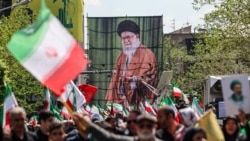
Strikes Hit Tehran As US Deadline To Target Power Plants Nears
US-Israeli strikes continued to hit Iran on April 7 as it faces a looming deadline to reach a deal to end the war and open the Strait of Hormuz. US President Donald Trump has threatened to destroy "every power plant" and bridge in the country if Tehran doesn't reach an agreement by 8 p.m. US Eastern Time. Iran, meanwhile, remained defiant and responded with more retaliatory attacks on Israel. (Video by RFE/RL's Radio Farda and Will Tizard)


Iran Reports Strikes On Its Infrastructure Ahead Of Trump Deadline
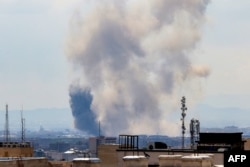
US and Israeli air strikes hit multiple locations across Iran, including infrastructure and the strategic Kharg Island, as an evening deadline from Washington for Tehran to agree to a deal to end the war approached with neither side signaling the intention to back down.
Iranian media reported explosions across Tehran and the sound of air defense fire on April 7, with some accounts describing fighter jets flying at low altitude over the capital.
Strikes were also reported on Iran's Kharg Island, where some 90 percent of Iran’s oil exports are shipped from, as well as major bridges on the Tabriz-Zanjan highway and another near the holy city of Qom.
The reports could not be independently verified.
Read more here
Revolutionary Guards Warn Iran Will Respond Beyond Region If US Crosses 'Red Lines'
In a stark escalation of rhetoric, Iran's Islamic Revolutionary Guards Corps (IRGC) warned in a statement that it would target US and allied infrastructure across the Middle East region if the United States crossed "red lines."
The warning on April 7 came hours before a deadline set by US President Donald Trump, who threatened to wipe out Iran's power plants and bridges if it doesn't reach an agreement to end the war.
The IRGC also put American partners in the Persian Gulf and beyond on notice, saying that restraint shown toward neighboring states "out of good neighborliness" was now over and that "all such considerations have been lifted" -- a signal that Gulf Arab states hosting US military assets could become direct targets.
The statement marks a shift in Iran's stated position: while Tehran has previously struck targets in several regional countries, it had until now maintained that those states themselves were not the intended enemy -- a distinction it appears to be threatening to abandon.
With reporting by Kian Sharifi and AFP
Gunfight Near Israeli Consulate In Istanbul Leaves One Dead, Police Injured

One attacker was killed and two others wounded in a shoot-out with security forces near the Israeli consulate in Istanbul, Governor Davut Gul said on April 7.
Two police officers were slightly injured in what he described as a “provocation.”
Turkish authorities said the consulate has been inactive for two years and that there were no staff on site.
Interior Minister Mustafa Ciftci said the suspects had travelled from the nearby Kocaeli province and their identities were known, with one linked to a group “exploiting religion.”
The motive remains unclear.
With reporting by dpa
Jewish Synagogue In Iran Reportedly Hit In Strike
Amid reports of multiple explosions across Tehran along with air defense fire and low-flying fighter jets, a historic downtown synagogue in the city is among the sites hit and badly damaged, according to Iranian media.
Homayoun Sameyah, the Jewish community's representative in Iran's parliament, told state media that the building was "ancient" and "sacred," and that Torah scrolls remained buried under the rubble.
Strikes Hit Tehran As Trump Deadline Nears
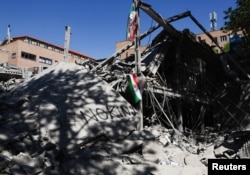
US and Israeli air strikes hit multiple locations in Tehran and Qom early on April 7 as an evening deadline from Washington for Iran to agree to a deal to end the war approached, with both sides signaling no intention of backing down.
Iranian media reported multiple explosions across Tehran and the sound of air defense fire, with some accounts describing fighter jets flying at low altitude over the capital.
Among the sites hit in Tehran was a historic synagogue in downtown Tehran, according to Iranian media.
Homayoun Sameyah, the Jewish community's representative in Iran's parliament, told state media that the building was "ancient" and "sacred," and that Torah scrolls remained buried under the rubble.
Meanwhile, Iran struck Tel Aviv, with Israeli television reporting around 10 impact sites across the city causing damage to buildings and vehicles. No injuries were recorded.
Read more here
Ex-White House Adviser Sees Rising Risks As Trump's Iran Deadline Looms

WASHINGTON -- With a US ultimatum set to expire, President Donald Trump has warned Iran that its infrastructure could be struck within hours if it does not comply with his demands, particularly reopening the Strait of Hormuz.
Tehran has rejected short-term cease-fire proposals, demanding a permanent end to hostilities and guarantees against future attacks.
RFE/RL spoke with Nate Swanson, former Iran director at the White House National Security Council who is now at the Atlantic Council, about the escalating crisis and prospects for diplomacy as Trump's 8 p.m. Eastern Time deadline on April 7 looms.
RFE/RL: The US president has issued a stark ultimatum, warning that Iran’s infrastructure could face massive strikes within hours if key demands are not met. From your experience, how realistic is such a rapid, large-scale disruption of Iran’s decentralized systems -- and how much of this is strategic signaling rather than operational capability?
Nate Swanson: My assessment is that this is primarily being done for psychological reasons -- to extract concessions from Iran and force some form of agreement. I can’t speak definitively on whether the US could hit all those targets in such a short time frame, but Iran’s infrastructure is highly decentralized. There are dozens of separate power systems, transportation nodes, and other critical networks. The idea of neutralizing every bridge or key node within a matter of hours seems implausible.
This fits a broader pattern: threatening maximum consequences to generate leverage.
So far, “maximum pressure” has not fundamentally altered Iranian decision-making or forced capitulation. I don’t see clear evidence that even this level of escalation would change their calculus -- but ultimately, that’s a decision for Iran’s leadership.
Read more here
2 Killed In Iraq As Missile And Drone Strikes Reported Across Gulf Region
A drone strike “coming from Iran” hit a residential home in Iraq’s Kurdistan region, killing two people, local authorities said as missile and drone attacks were reported across the Persian Gulf region.
Saudi Arabia said it intercepted seven ballistic missiles, while the United Arab Emirates also reported incoming attacks while warning sirens were activated in Bahrain.
Kuwait said it detected dozens of missiles and drones within 24 hours, with minor injuries from falling debris.
The strikes comes as the UN Security Council is set to vote on a draft resolution to protect shipping in the Strait of Hormuz, though it has been softened after Chinese objections to authorizing force to keep it open.
Meanwhile, Iran’s UN envoy urged Saudi Arabia and the UAE to respect “good neighborliness” and not allow their territory to be used against Iran.
Adviser To Iran's Parliament Speaker Signals Hard Line On Cease-Fire
A senior adviser to Iran’s parliament speaker, Mohammad Baqer Qalibaf, has signaled Tehran’s hardening stance on ending the war, saying any cease-fire must reshape regional security arrangements.
Writing on X on April 7, Mehdi Mohammadi framed the conflict as already decided in Iran’s favor and set out stark conditions for its conclusion.
“Iran has clearly and openly won the war and will only accept an outcome that consolidates its gains and creates a new security order in the region," he wrote. "The correct framing is this: It is Trump who has around 20 hours to surrender to Iran or his allies will be sent back to the Stone Age. We will not back down!"
Last week, US President Donald Trump threatened to send Iran “back to the stone ages” with sweeping strikes on Iranian infrastructure if Tehran fails to meet a deadline tied to reopening the Strait of Hormuz.
Mahdi's remarks come as Iran has proposed a 10-point plan rejecting a temporary cease-fire, instead seeking a permanent end to hostilities, security guarantees, and sanctions relief.
Israel Warns Iranians To Stay Away From Trains; Mashaad Rail Services Suspended
Israel’s military has warned Iranians to avoid train travel nationwide, signaling possible strikes on the Iran’s rail network.
In a Persian-language message on X on April 7, the Israel Defense Forces told Iranians that staying on trains "endangers your lives," and urged people to "refrain from using trains or travelling by train throughout the country" until 9 p.m. Iran time (5:30 p.m. UTC).
Hours after the Israeli warning, the governor of Mashhad announced that all train services from the city’s railway station have been suspended until further notice.
Hassan Hosseini described the Israeli warning as “unethical” and said the decision had been taken “as a precaution.”