

Several Government Employees Arrested On 'Treason' Charges
State media in Iran reported on April 13 that a number of government employees in Lorestan Province have been arrested on charges of “treason.”
The reports did not specify the number of those detained or their identities, nor did they define the charge of “treason.”
However, the reports said the detainees were employees of various institutions, including Lorestan University, the Medical Sciences University, the Tax Administration, the School Renovation Department, the Engineering Organization, and a number of teachers working in the province’s education sector.
The Tasnim News Agency, which is close to the Islamic Revolutionary Guards Corps, said the charges include “treason and cooperation with hostile networks.”
Over the six weeks since the start of the US-Israel war with Iran and the subsequent cease-fire, Iran’s judiciary has reported daily arrests across the country of individuals described by state media as “traitors” or accused of photographing and filming war-damaged areas.
Some of those detained have been brought before courts, while others have been forced to confess on state television.
In some cases, authorities have cited the charge of “corruption on earth,” which in Iran can carry the death penalty.
Finnish President Says Iran Blockade 'Makes Sense' From Washington's Perspective, Warns Of Risks

WASHINGTON -- Finnish President Alexander Stubb says that a US blockade strategy toward Iran “makes sense” from Washington’s perspective, while warning of significant uncertainties and escalation risks.
Speaking in Washington on April 13, during a visit for meetings and policy events in the US capital, Stubb argued that the consequences of the conflict had proven broader than expected, particularly due to the strategic importance of the Strait of Hormuz.
“The blockade, from an American perspective, I would say, makes sense, if it works out,” he said, adding that it could give the US leverage but also raising concerns about potential tensions with other powers.
Stubb said negotiations between Washington and Tehran were continuing at a lower level, which he described as a positive sign. However, he cautioned that any resolution could take time, noting the years-long process behind the Joint Comprehensive Plan of Action, a landmark 2015 Iran nuclear deal, which has since unraveled after the US withdrew in 2018 and Tehran scaled back on compliance.
Stubb added that “Iran holds a lot of the cards right now.”
The Finnish leader also warned of the risk of broader regional escalation, saying conflicts were increasingly shifting from local to regional in scope. “I am extremely concerned about the escalation,” he said.
On the role of NATO, Stubb emphasized that the alliance remained defensive and was not directly engaged in the crisis, with any support for US actions likely to take place through a “coalition of the willing” rather than NATO structures.
He also said he “fully understand[s] the American perspective” regarding expectations of allied support, including access to bases, though such arrangements are governed by bilateral agreements.
European countries are focusing on de-escalation efforts, including maintaining freedom of navigation in the Strait of Hormuz, he said.
Veterans Of 1980s 'Tanker War' See Parallels In Current Hormuz Crisis
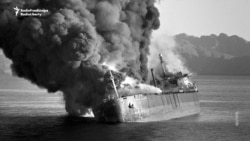
The US military said it would begin a blockade of ships traveling to and from Iranian ports following the failure of US-Iranian peace talks on the weekend. Former sailors who navigated tankers through the Strait of Hormuz during the Iran-Iraq War of the 1980s told RFE/RL that today’s crisis echoes that conflict four decades ago. (Video by RFE/RL, Amos Chapple, Margot Buff, and Will Tizard)

What To Know About The US Naval Blockade Of Iran
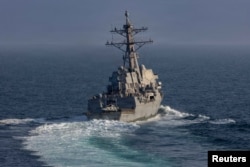
A US naval blockade on ships entering Iranian ports and coastal areas has come into effect, following failed peace talks between US and Iranian negotiators over the weekend.
And it already poses a dilemma: risk attack from Iranian assets near the Strait of Hormuz, or hold back and hope to catch vessels breaking out into the open seas.
The move is the latest attempt by US President Donald Trump to force Iran into making concessions, including a commitment not to seek a nuclear weapon or the means to build one.
It follows more than a month of air strikes and long-standing economic sanctions.
Read more here.
Maritime Restrictions Now In Force At Iranian Ports, Coastline, Says Shipping Monitor
The United Kingdom Maritime Trade Operations (UKMTO), a shipping security monitor, says it has been informed that as of 2pm GMT on April 13 "maritime access restrictions are being enforced, affecting Iranian ports and coastal areas, including locations along the Arabian Gulf, Gulf of Oman, and the Arabian Sea east of the Strait of Hormuz."
The UKMTO said in an advisory that the measures apply “without distinction to vessels of any flag” engaging with Iranian ports and energy infrastructure, covering “the entirety of the Iranian coastline.”
While transit through the Hormuz strait to non-Iranian destinations is not reported to be blocked, vessels may encounter a military presence and inspections.
The UKMTO says neutral ships in Iranian ports have been "granted a limited grace period" to depart, with further details expected in official notices for mariners.
The Air Strikes Have Paused But Iranians Worry About What Comes Next
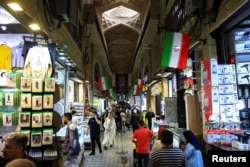
On April 9, a day after a cease-fire was announced between the US, Iran, and Israel, Maryam (not her real name) took her three cats and returned to her apartment after spending nearly six weeks at a friend’s house in a northern neighborhood of Tehran.
She said she couldn’t handle the bombings on her own, and her friend had invited her to stay. Maryam, who is in her late 40s, said she felt relieved when the cease-fire was announced. But she quickly adds that she's still very worried about the future.
“The first thing we say to each other these days is: ‘We survived,’” she said.
“I’m glad the war is over. At the same time, I still feel we are in a state of limbo, and I’m worried that the economic situation will become worse than before,” she added.
Read more here.
Physical Oil In Europe Nears $150 As Hormuz Crisis Sparks Supply Fears
Physical crude oil prices in Europe have surged to record levels as tensions escalate around the crucial Strait of Hormuz waterway.
With the US Navy preparing a blockade aimed at restricting Iranian exports, fears of supply shortages have been rising.
While benchmark Brent crude rose above $100 a barrel, the price of physical oil for immediate delivery climbed to nearly $150 -- a record high, according to Reuters.
Buyers in Europe and Asia are scrambling to secure supplies amid uncertainty.
The physical market is "under a lot of strain" one analyst told Reuters, with real cargo prices far exceeding those seen in financial markets.
Pope Responds To Trump Remarks, Says He Will 'Continue To Speak Out'
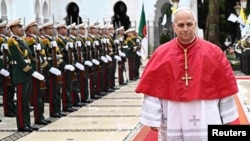
Pope Leo has said that he intends to continue taking a stand against war, following criticism by US President Donald Trump on the leader of the 1.4-billion-member church.
"I will continue to speak out loudly against war, looking to promote peace, promoting dialogue and multilateral relationships among the states to look for just solutions to problems," Leo told Reuters aboard a papal flight to Algiers on April 13, where he is embarking on a 10-day tour of four African countries.
"Too many people are suffering in the world today," he said. "Too many innocent people are being killed. And I think someone has to stand up and say there's a better way."
The pope also told reporters that he had "no fear of the Trump administration, or speaking out loudly."
The US president had criticized the Catholic leader on April 12, saying he was “not a big fan” and accusing the pontiff of "toying with a country that wants a nuclear weapon."
"Pope Leo is WEAK on Crime, and terrible for Foreign Policy." Trump wrote in a post on Truth Social.
With reporting by Reuters
War Critic Spain Reopens Embassy In Tehran
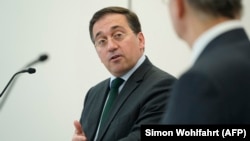
The Spanish Embassy in Tehran, which had been temporarily closed for security reasons following the US and Israeli war with Iran, has reopened.
Iranian news agencies reported that the embassy resumed its work on April 13 to support "mediation" following the two-week cease-fire, which went into force on April 8.
The Spanish ambassador who arrived in Iran a day earlier, said that he would attempt "to support peace efforts from all sides."
Spain has positioned itself as one of the main Western critics of the US and Israel since the war began.
Speaking after Israeli strikes on Lebanon on April 8, Spanish Foreign Minister Jose Manuel Albares said a day later that the strikes violated the cease-fire and international law.
The US, Iran, and Israel had disagreed about whether the cease-fire applied to Lebanon, where Israel has been targeting Iran-backed Hezbollah fighters.
Iranian officials have played up Spain's opposition to the war. There have been reports inside Iran, which can not be verified by RFE/RL, of pro-government forces gathering in the streets in the evening and holding Spanish flags.
Iran Warns No Gulf Ports Will Be Safe If US Begins Blockade
On April 13, the Khatam al-Anbiya headquarters, which is the central operational headquarters of Iran's armed forces, said that if the announced US naval blockade of Iranian ports was implemented, "no port in the Persian Gulf and the Gulf of Oman will be safe."
The military body says that the US "imposition of restrictions" on the movement of ships in international waters was "an illegal act and an example of piracy."
Following the failure of peace talks in Pakistan over the weekend, President Donald Trump has said that the US will start blockading ships from entering or exiting Iranian ports from 10 a.m. Eastern Time (5.30 p.m. in Iran) on April 13.
The spokesman for the Iran's military headquarters added that "the security of ports in the Persian Gulf and the Gulf of Oman is either for everyone or for no one."
"Enemy-affiliated vessels do not and will not have the right to pass through the Strait of Hormuz, and other vessels will continue to be allowed to pass through the strait, subject to the regulations of the Islamic Republic of Iran's armed forces," the spokesman said.
Since the beginning of the conflict, Iran has severely restricted maritime traffic through the Strait of Hormuz, reducing flows to a small fraction of normal levels and driving global energy prices sharply higher. Tehran has also declared it will require vessels seeking to pass through the chokepoint to pay tolls.