




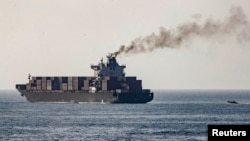
WASHINGTON -- With a cease-fire in the US-Israeli war on Iran due to expire on April 22, US actions at sea are drawing renewed attention to a central issue: how deeply Iran's military establishment is embedded in the country's economy.
The disabling on April 19 of the M/V Touska, a container ship reportedly linked to Iranian trade networks, highlighted the control of the Islamic Revolutionary Guard Corps (IRGC) over key industries, from banking and energy to shipping and telecommunications.
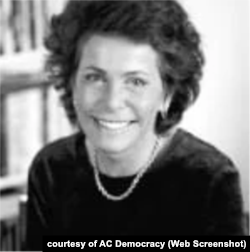
In an interview with RFE/RL, Rachel Ehrenfeld, director of the American Center for Democracy and the Economic Warfare Institute and author of multiple books on terrorism financing, said the IRGC's economic reach is not incidental but rather a crucial foundation of its power.
She argued that targeting infrastructure and commercial activity directly affects the regime's military capabilities.
RFE/RL: You've long argued that the IRGC's dominance over Iran's economy is central to its military power. How significant is the US seizure of the Touska in that context?
Rachel Ehrenfeld: It depends who owns the ship, which foundation. The IRGC has the biggest foundation in Iran. When Ayatollah [Ruhollah] Khomeini started in 1979 with the Islamic Revolution and took over Iran, he thought about how to make sure the economy would flourish and that it would be resilient and protected from outside sanctions, for example.
So what do you do? You create foundations, and different elements in the revolutionary forces of Iran were allocated different portions of the economy. As a charity organization overseeing charities, they named them different names, and the biggest is the IRGC.
He decreed that this would be the system.... [And former Supreme Leader Ayatollah Ali Khamenei] in 2004 issued what was essentially a fatwa or directive through Iranian legislative bodies, and it was actually enshrined in law. This is the structure that allowed the IRGC to develop Iran's shadow economy. It is part of the economy, but it is not accountable. They do not pay taxes. In Iran, everybody has to pay taxes.
This helps them circumvent international sanctions, because you have a charitable organization sending money here or there. They are using all kinds of financial institutions and banking systems all over the world.
Within the big foundation -- they call them "bonyads" in Farsi -- they have subdivisions, and those parts are also involved. So now they control banking, real estate, telecommunications, transportation, mining, energy, defense, chemicals, petrochemicals -- you name it, they have possession of it.

I do not know if this [ship] belongs to the IRGC or not, but since their system is such, everybody should actually know.... To my surprise, the Americans -- the administration -- have really not explained how the economy is working there.
And that is to their detriment; they are getting a lot of criticism because, "Oh, you are going to destroy the infrastructure." Well, they own the infrastructure, most of it. There is private, civil commerce, and some civil economy, but it is not large, and it also can be taken away easily by the regime.
In the last couple of weeks, with the closing of the Internet by the regime, many people who had private businesses -- civil, civic businesses -- were using the Internet to do business. This was closed down. It cost billions. People cannot communicate and cannot do business.
So destroying most of the large infrastructure, including shipping, would be part of the forces -- armed forces, if you want -- even if they are not supposed to be armed merchant ships that are serving the purposes of the Iranian regime for war, not for peace.

RFE/RL: You described the IRGC as operating a "state within a state." Given recent leadership shifts, how much of Iran's economy does the IRGC control today, and is it even possible to separate civilian governance from military power?
Ehrenfeld: Well, sort of. The civilian, whatever civilian there is, is under the thumb of the IRGC. From the last data that I could actually surmise, they control something around two-thirds of the economy.
This goes back to what Khamenei, and before him Khomeini, called a "resistance economy." They wanted to create an economy that is resistant to the enemy.
People should know about it so they will stop criticizing when infrastructure is hit, because these are all serving the IRGC, which is the strongest force in Iran.
RFE/RL: Reports suggest a "military council" has sidelined the Pezeshkian administration. Does this indicate the IRGC has effectively consolidated control over the Iranian state?
Ehrenfeld: It looks like it did, because we heard one day that the straits (Strait of Hormuz) were open, and then immediately afterward, a couple of hours later, no -- they were closed. So this clearly indicates there is some power struggle going on.
But as far as I understand, the IRGC is really the group that is running the regime.
RFE/RL: By using disabling fire against a container ship, is Washington signaling that it now views the IRGC's commercial fleet as a legitimate military target?
Ehrenfeld: Of course it is, because you do not know what they are carrying. What they are carrying can be arms, can be ammunition, can be something that will solve their needs.
Even if it is something like dates from somewhere in the desert, the money from the sales will go to the pockets of the IRGC. Everything that is moving there now is able to move because the IRGC is allowing it or intending it to move.
RFE/RL: The Touska was reportedly carrying dual-use goods. In your research, how commonly does the IRGC conceal military-related materials within civilian shipments?
Ehrenfeld: They are notorious for dual use. And again, even if it was something that they can sell, or something that they can refurbish and use for something else, it is all about the value -- the financial value.
How much does it cost? They sell it, they make money, or it saves them money. So everything that comes and goes is benefiting them.
RFE/RL: You've argued that targeting infrastructure can be more effective than direct military confrontation. Are current US actions an example of that strategy being put into practice?
Ehrenfeld: If the United States -- and hopefully other countries, not only Western countries, but also Iran's neighbors -- implement the blockade properly and stick to the sanctions, Iran's economy will collapse, not before long.
RFE/RL: There are reports of a "selective blockade" near Larak Island. Does the IRGC's deep involvement in the economy shield it from such pressure or make it more vulnerable?
Ehrenfeld: They are also threatening commercial shipping in other places, like near Bab al-Mandab. They are trying really to disrupt international maritime shipping.
They have to be prevented from doing it. This kind of blackmail cannot be allowed.
RFE/RL: As we approach the April 22 cease-fire deadline, how do you assess the regime's economic endgame? Are there signs of strain?
Ehrenfeld: I do not know. The IRGC is running it, and this is a radical, ideological regime. Their goal is to cause as much chaos as possible, to kill as many "infidels" as possible, and to die for their beliefs so that the 12th Imam can come.
When you believe in such an ideology, which most people in the world do not understand, I do not know what will prevail. But the optimal thing that can happen is regime change.
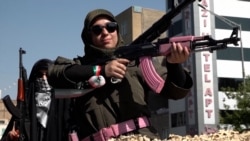

RFE/RL: If the cease-fire lapses without progress, what do you expect next?
Ehrenfeld: I think that military power should bring this regime to its knees -- eliminate as many leaders as possible or force the regime to disappear.
I hope the people of Iran will go out to the streets and force change. There are many people who are dissatisfied. We have seen demonstrations, and we know that the IRGC and Basij have been killing demonstrators.
Many people do not want this. The leadership has been stealing billions, enriching themselves, and sending their families abroad while ordinary people suffer.
RFE/RL: What are the most likely next moves from Washington?
Ehrenfeld: Do you know anyone who knows what President Trump thinks? I have no idea. But I think he will find a way to do what he wants and what he promised.
RFE/RL: If talks fail, should IRGC-controlled infrastructure such as ports be primary targets?
Ehrenfeld: It is difficult to get rid of [the IRGC] because they are divided into cells throughout the country. It is not just about hitting headquarters.
But the infrastructure has to be hit very hard. And there should be a blockade, freezing Iranian money anywhere it can be found -- in foreign banks and financial institutions -- really starving them economically so they will have to change course.
RFE/RL: Finally, does this moment represent a broader shift in how economic warfare is being used against state actors like Iran?
Ehrenfeld: There will be many lessons learned from this war. Economic warfare has many stages and can help a great deal, especially since Iran's economy was already in a bad situation before the war.
If you want to win, you have to use the best strategies: economic and kinetic warfare together. Hopefully not for long, because both hurt innocent people as well.
And that is very unfortunate. But this regime has been in place for decades, and those trying to stop its expansion cannot simply be blamed for taking action now.

