


Trump Says US To 'Guide' Stranded Neutral Ships Out Of Hormuz Starting May 4
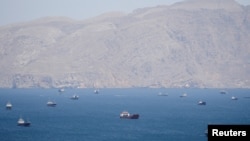
President Donald Trump said US forces will on May 4 begin guiding stranded “neutral” ships out of restricted waters near the Strait of Hormuz, even as he asserted that Washington was having “positive discussions” with Iran about ending war in the Middle East.
Calling the effort a “humanitarian” gesture, Trump on May 3 said the US “for the good of Iran, the Middle East, and the United States,’ has told neutral countries that “we will guide their Ships safely out of these restricted Waterways, so that they can freely and ably get on with their business.”
In the Truth Social posting, he did not immediately describe what assets would be used to conduct the mission or how long it would last. But he did warn that action would be taken should Iran attempt to interfere with the US mission, potentially reigniting hostilities with Tehran that currently are paused through a cease-fire.
"If, in any way, this Humanitarian process is interfered with, that interference will, unfortunately, have to be dealt with forcefully," Trump said.
The US president said the action was being taken at the request of countries whose ships are stuck in the waterway as Iran has prevented most traffic through the strait in retaliation for the US-Israeli air strikes that started on February 28. The US is also conducting a blockade to prevent ships from leaving or entering Iranian ports.
“Countries from all over the World, almost all of which are not involved in the Middle Eastern dispute going on so visibly, and violently, for all to see, have asked the United States if we could help free up their Ships, which are locked up in the Strait of Hormuz,” he said.
Trump added that he has told his representatives to inform the countries "that we will use best efforts to get their ships and crews safely out of the blocked Strait of Hormuz."


"The Ship movement is merely meant to free up people, companies, and Countries that have done absolutely nothing wrong — They are victims of circumstance.”
"Many of these Ships are running low on food, and everything else necessary for largescale crews to stay on board in a healthy and sanitary manner,” Trump added.
Peace talks between the United States and Iran – mediated by Pakistan – have faltered since a first round of discussions in Islamabad on April 11-12.
On May 3, Iranian officials said they were studying Trump’s response to Tehran's latest 14-point peace proposal handed to the US through Pakistan.
Trump on May 2 said he was preparing to review Tehran’s proposal but said he could not imagine it would be acceptable.
Iranian Media: Tehran Received US Response To Latest Peace Proposal
Iran's Foreign Ministry said on May 3 that it had received a response from the United States to its latest peace proposal, which Tehran had earlier handed to Pakistan, a country that has been mediating talks between the two countries.
A day earlier, US President Donald Trump said he would probably reject the Iranian proposal because "they have not paid a big enough price." He also said he viewed the Iranian leadership as divided, making it an obstacle to negotiating an end to the war.
While there was no immediate confirmation from Washington or Islamabad on the US response, Iranian state media quoted Foreign Ministry spokesperson Esmaeil Baghaei as saying there were no talks over Iran's nuclear capabilities at this stage.
The issue has been central in any possible resolution of the conflict, as it remained the main US demand after it began its joint military effort with Israel against Iran. Tehran has refused to agree to give up its nuclear ambitions and has reportedly pushed to leave them outside the current negotiations.
Commercial Ships 'Redirected' By US Forces, As CENTCOM Chief Visits Area Of Operations
Dozens of commercial ships have been "redirected" to comply with the American naval blockade of Iranian ports and vessels, the US military said.
In a May 3 post on X, US Central Command (CENTCOM) said its chief, Admiral Brad Cooper, has visited one of US guided-missile destroyers deployed to the area, as the vessel "patrolled regional waters in support of the US blockade operations against Iran."
"As of today, 49 commercial vessels have been redirected to comply with blockade. US forces remain fully committed to total enforcement," CENTCOM added.
Since the beginning of joint US-Israeli military operations against Iran, more than 50,000 US troops, over 200 fighter aircraft, two aircraft carrier strike groups, and long-range bombers have been involved in the campaign.
Last month, after the two sides agreed to a cease-fire, Washington increased economic pressure on Tehran by imposing a naval blockade, limiting its export capacity.
Iranian Academic Tells Of Waiting In Line To Use Internet
A report by a semi-official Iranian news agency sheds an intriguing light on Internet usage in the country.
On day 65 of a nationwide Internet blackout, Alireza Esthamaty, the dean of the medical faculty at Tehran University, told ISNA news agency that “professors are forced to take turns using the Internet, and wait in line to use the facilities.”
Iran’s current Internet blackout began after US and Israeli air strikes on February 28 and, given Iran's population is over 90 million people, it is arguably the largest government-directed communications outage in recorded history.
Internet-monitoring watchdog NetBlocks described it as "unsurpassed in scale and severity in a connected society." It has severely limited the flow of information to and from Iran.
The Iranian authorities also turned off the Internet as a means of suppressing mass nationwide protests in January. While security forces killed thousands of people, opposition activists were unable to get online and organize.
The authorities now appear to be using the current blackout to create a more pliant web only available to those loyal to the clerical establishment.
Rather than a total blackout, authorities have maintained an elaborate whitelisting system of selectively granting connectivity to favored institutions, companies, and individuals while leaving the rest of the population cut off.
Academics are among those benefitting from the new regime, dubbed Internet Pro. But Esthamaty was quoted as saying that even this is a far from satisfactory service.
“Internet access is available in several places at the university, but outside the university, especially at night when many academic activities and preparation for lectures and classes are taking place, Internet access is disrupted," he said.
In addition to this, Esthamaty said access to laptops was restricted, adding that Internet Pro "does not meet academic needs."
Amnesty International has criticized Iranian authorities for imposing what it calls "digital darkness," describing access to the Internet as "a basic human right and indispensable in times of conflict."
At Least One Killed, Others Reportedly Injured By Israeli Forces In Lebanon
At least one person has been killed by the Israel Defense Forces (IDF) in Lebanon, in the latest armed incident during a shaky cease-fire there between the IDF and Iranian-backed Hezbollah.
The IDF-Hezbollah conflict threatens to disrupt the cease-fire between Washington and Tehran, with Iran repeatedly insisting that it needs to be resolved within negotiations on ending its conflict with the United States.
Hezbollah is both a militant group and political party that controls much of southern Lebanon. It is considered a terrorist organization by the United States, while the European Union has only blacklisted its armed wing.
Lebanon’s state-run National News Agency cited the country’s Health Ministry as saying that "the Israeli enemy's raid on the town of Arab Salim in the Nabatieh district resulted in one martyr and three wounded, including a child.”
An online statement by the IDF said two “armed Hezbollah terrorists” were “eliminated” after “posing an imminent threat.” It added that further “terrorists” were killed in a subsequent strike.
It was not clear if the IDF was referring to the same incident, and there was no immediate independent confirmation about what happened.
Earlier on May 3, the IDF issued a warning to residents of some areas of southern Lebanon to evacuate their homes and move at least a kilometer away due to what it said were ongoing operations against Hezbollah.
The previous day, the Israeli military said it had struck dozens of Hezbollah targets in southern Lebanon.
OPEC+ Announces Increased Oil Output After Price Spike
Seven of the world’s biggest oil producers have announced that they will increase their output “to support oil market stability,” days after a dramatic oil price spike amid market fears that shipping through the Strait of Hormuz will not resume anytime soon.
Saudi Arabia, Russia, Iraq, Kuwait, Kazakhstan, Algeria, and Oman took the decision at a virtual meeting on May 3 to raise output by 188,000 barrels per day in June.
The move came after oil prices reached their highest level since Russia’s full-scale invasion in 2022, reaching $126 per barrel on April 29 following a report in The Wall Street Journal that US President Donald Trump had told aides to prepare for an "extended" blockade of Iranian ports. The price has since slipped back slightly.
“The countries will continue to closely monitor and assess market conditions, and in their continuous efforts to support market stability,” a statement by OPEC+ said. However, while the move may provide some relief, it does not change the underlying causes of the current price levels.
The US blockade is preventing Iran shipping oil to China, adding to price pressures caused by Iran’s blockade that has stopped other Persian Gulf countries sending oil supplies to customers around the world. Washington’s blockade began on April 13, following failed US-Iranian talks in Islamabad.
Tehran launched its blockade after US-Israeli air strikes on Iran started the war on February 28.
Prior to the war, some 20 percent of global oil supplies passed through the Strait of Hormuz.
Separately, Kremlin spokesman Dmitry Peskov said that ongoing Ukrainian attacks on the Russian oil industry was also adding to price pressures.
“If additional volumes of our oil are dropped from the market, prices will rise further from current levels, which are already above $120 a barrel. That would mean that even with lower export volumes, our companies would earn more money, and the state would receive more revenue,” Peskov said.
Ukrainian drone strikes have reached as far as 1,500 kilometers inside Russia in recent days.
“It is important that every strike reduces the capabilities of Russia’s military industry, logistics, and oil exports,” Ukrainian President Volodymyr Zelenskyy wrote on social media on April 29.
Controversial Clip Emerges Of Iranian Women On Beach Without Hijab
After the appearance of a video of young men and women on an Iranian beach, a local prosecutor has said that the video is generated by AI and promised action.
The 15-second video emerged on May 2 and shows men and women, who are not wearing government-mandated hijabs, on a beach in Iran's Kish Island. The Persian Gulf island is known for its duty-free shopping, luxury resorts, and a more relaxed attitude when compared to the Iranian mainland.
On Iranian beaches, women must follow strict modesty rules, typically wearing full-body swimsuits, while men face fewer restrictions and are generally allowed to wear standard swimsuits. Some beaches in Iran are gender segregated.
According to the Jamaran, a news and information website, the Kish prosecutor said that "after technical investigations, it was determined that the published clip is a combination of an original clip and artificial intelligence."

The prosecutor also said that "a case has been opened" and the authorities were trying to identify and take legal action against "those responsible for the production [of the clip]."
How Is The World Coping With The Closure Of The Strait Of Hormuz?
It has been over two months since one of the world’s key oil chokepoints was shut down. And it has meant a seismic global readjustment and a number of creative workarounds. Watch our explainer with Kian Sharifi.
Iran Executes Kurdish Man In Jail Since 2022
Iran’s Mizan news agency, which is close to the country's judiciary, has reported the execution of a man accused of involvement in the killing of a security official during the Women, Life, Freedom protests that swept across the country in 2022.
The reported execution of Mehrab Abdullahzadeh is the latest in a series of judicial killings in Iran in recent weeks and followed reports of two other men being executed the previous day.
In February, the Kurdish Human Rights Network published a message from Abdullahzadeh in which he said he was 25 years old when he was imprisoned following his arrest by the Islamic Revolutionary Guards Corps (IRGC) in Urmia, in Iran’s West Azerbaijan Province.
In his message, from Urmia Central Prison, he said that "from the first day of my arrest, they forced me to confess through torture and threats." He added that his only “crime” was “being Kurdish.”
Kurds make up around 10 percent of Iran's population and primarily live in the country's west along the border with Iraq. Iran has long been accused of suppressing and discriminating against the country's ethnic minorities, including Kurds.
At least one of the men executed on May 2, Nasser Bakrzadeh, was also identified as Kurdish.
The current wave of executions comes amid what rights groups have described as a broader crackdown in Iran, following mass protests in January, which security forces suppressed by killing thousands of people.
This has continued, and even intensified, since US and Israeli air strikes began on February 28. Rights organizations have long accused the Islamic republic of using the death penalty to sow fear in society.
We are now closing the live blog for the day. We'll be back at 7:30 a.m. Central European time to cover the latest events across the Middle East.