


Trump Rejects Iran's Response To Peace Deal As 'Totally Unacceptable'
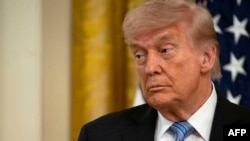
US President Donald Trump wrote on social media on May 10 that Tehran's response to the latest US peace proposal was "totally unacceptable," without saying in the terse statement what the terms were or what his next steps might be.
"I have just read the response from Iran’s so-called “Representatives.” I don’t like it — TOTALLY UNACCEPTABLE!" he wrote on Truth Social.
The posting came shortly after Iran’s semiofficial Tasnim news agency laid out what it said were the terms of Tehran’s response, saying demands include the lifting of long-standing sanctions against Iran, the end of the US naval blockade, and guarantees against further attacks.
Tasnim, which is close to the hard-line Islamic Revolutionary Guards Corps (IRGC), reported that Tehran’s proposal called for an end to fighting on “all fronts,” including Lebanon as well as in Iran.
Following Trump's rejection, Iranian state media reported that the Iranian demands also included the need for the US to pay compensation for war damages and that Tehran's control of the Strait of Hormuz be officially recognized.
State media also said that accepting the US proposal would amount to "surrender" for Iran.
Earlier in the day, Trump had angrily lashed out at his predecessors for their policies toward Iran, saying the Middle East nation for 47 years “has been ‘tapping’ us along, keeping us waiting, killing our people with their roadside bombs, destroying protests, and recently wiping out 42,000 innocent, unarmed protestors, and laughing at our now GREAT AGAIN Country.”
Many reports have suggested the US plan is set out in a one-page memorandum that called for an end to fighting and the unblocking of the Strait of Hormuz but which left other key issues -- including Iran’s right to enrich uranium -- until later.
Imprisoned Iranian Nobel Laureate Narges Mohammadi Transferred To Tehran Hospital
Jailed Iranian Nobel Peace Prize winner Narges Mohammadi has been transferred to a hospital in Tehran, her foundation said on May 10, amid reports that she is "on the brink of death" due to harsh prison conditions.
The foundation said Mohammadi had been granted a temporary suspension of her sentence in exchange for the payment of a substantial bond.
Mohammadi, 54, had been undergoing treatment in a hospital in the northwestern city of Zanjan, where she had been imprisoned.

Her lawyer, Mostafa Nili said she is now being treated at Tehran's Pars Hospital by her own medical team.
Mohammadi’s husband, Taghi Rahmani, who lives in Paris, on May 9 said her condition remained critical and that she had suffered a severe drop in blood pressure and was struggling to speak.
On May 2, her brother Hamidreza Mohammadi told RFE/RL's Radio Farda that she was on the "brink of death."
"She is dying," Hamidreza said. "Because of the harsh conditions of prison and the damage that has been done to her, she is on the brink of death. The responsibility for Narges's life, and the lives of all prisoners, rests directly with [judicial authorities and the security apparatus]."
The rights activist was awarded the 2024 Nobel Peace Prize for her fight for women's rights in Iran.
She has spent much of the last decade behind bars as a result of her work and in, December 2025, was arrested again during a memorial ceremony in the northeastern city of Mashhad.
Following her arrest, she was given a new prison sentence of 7 ½ years, and is being held in Zanjan prison, some 330 kilometers west of the capital, Tehran.
Trump Rejects Iran's Response To Peace Deal As 'Totally Unacceptable'
US President Donald Trump wrote on social media on May 10 that Tehran's response to the latest US peace proposal was "totally unacceptable," without saying in the terse statement what the terms were or what his next steps might be.
"I have just read the response from Iran’s so-called “Representatives.” I don’t like it — TOTALLY UNACCEPTABLE!" he wrote on Truth Social.
The posting came shortly after Iran’s semiofficial Tasnim news agency laid out what it said were the terms of Tehran’s response, saying demands include the lifting of long-standing sanctions against Iran, the end of the US naval blockade, and guarantees against further attacks.
Tasnim, which is close to the hard-line Islamic Revolutionary Guards Corps (IRGC), reported that Tehran’s proposal called for an end to fighting on “all fronts,” including Lebanon as well as in Iran.
Following Trump's rejection, Iranian state media reported that the Iranian demands also included the need for the US to pay compensation for war damages and that Tehran's control of the Strait of Hormuz be officially recognized.
State media also said that accepting the US proposal would amount to "surrender" for Iran.
Earlier in the day, Trump had angrily lashed out at his predecessors for their policies toward Iran, saying the Middle East nation for 47 years “has been ‘tapping’ us along, keeping us waiting, killing our people with their roadside bombs, destroying protests, and recently wiping out 42,000 innocent, unarmed protestors, and laughing at our now GREAT AGAIN Country.”
Many reports have suggested the US plan is set out in a one-page memorandum that called for an end to fighting and the unblocking of the Strait of Hormuz but which left other key issues -- including Iran’s right to enrich uranium -- until later.
Netanyahu Says Iran's Enriched Uranium Must Be 'Taken Out'
Israeli Prime Minister Benjamin Netanyahu said on May 10 that Iran's enriched uranium must be "taken out" before any peace agreement with Tehran.
"It's not over, because there's still nuclear material -- enriched uranium -- that has to be taken out of Iran. There's still enrichment sites that have to be dismantled," Netanyahu said to CBS.
"You go in and you take it out," he added, saying US President Donald Trump had a similar position. "I'm not going to talk about military means, but the president, what President Trump has said to me -- 'I want to go in there.'"
While the statement was in contrast to Trump's public position, in which he has been vocal about his willingness to negotiate a peaceful resolution to the conflict, the US president issued a threatening statement on his social media platform later on the same day.
"Iranians have been 'tapping' us along, keeping us waiting, killing our people with their roadside bombs, destroying protests, and recently wiping out 42,000 innocent, unarmed protestors, and laughing at our now GREAT AGAIN Country," Trump said in his Truth Social post.
"They will be laughing no longer!" he added.
The issue of Iran's nuclear ambitions has long been central to the resolution of the conflict between Iran and the United States.
However, in its latest peace proposal sent to Tehran earlier in the week, Washington has reportedly excluded the issue, postponing negotiations over it to after peace takes effect.
US Central Command: Over 20 Warships Enforcing Blockade Against Iran
Trump Says US Still Has Potential Targets In Iran
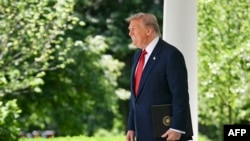
US President Donald Trump said that American military operations against Iran may not be over, suggesting the United States could still target additional sites if necessary.
In an interview with journalist Sharyl Attkisson broadcast on May 10, Trump was asked whether combat operations involving Iran had concluded.
"No, I didn't say that," Trump said. "I said they were defeated, but that doesn't mean they're done. We could go in for another two weeks and hit every single target."
Trump added that US and Israeli strikes had already hit "probably 70 percent" of the intended targets.
"We have other targets that we could conceivably hit," he said. "But even if we don't, it will take years for them to rebuild."
The remarks come amid ongoing diplomatic efforts to end the war between Tehran and Washington.
Trump also addressed Iran's enriched uranium stockpiles, saying the United States was monitoring the sites closely.
"We have it under surveillance," he said, adding that US space-based monitoring capabilities were tracking activity around the facilities.
Iran has repeatedly rejected proposals that would require it to transfer its stockpile of enriched uranium to the United States.
On May 10, Iranian state media said that Tehran had submitted a response to the latest US proposal to end the war, but details were not announced.
Iranian Media: Tehran Has 'Responded' To US Peace Proposal
Iran's response to the latest US proposal to reach an agreement to end the war has been sent to Pakistan as a mediator in the negotiations, the country's official news agency, IRNA, reported on May 10.
"According to the proposed plan, at this stage the negotiations will focus on ending the war in the region," IRNA wrote.
Iran's state media later said that Tehran's proposal focuses on ending all fronts of the war, especially Lebanon.
This comes while US President Donald Trump reiterated on May 6 that the United States plans to take control of Iran's enriched uranium.
Axios and Reuters reported on the same day that Washington and Tehran were close to a "one-page memorandum of understanding" to end the war.
Reuters reported that the memorandum did not even mention the suspension of Iran's nuclear activities or the reopening of the Strait of Hormuz, which has been effectively closed by Iran's Islamic Revolutionary Guards Corps since the first US-Israeli strikes on Iran began on February 28.
The Wall Street Journal reported that in the US proposal, however, Tehran must prove it is not seeking nuclear weapons and must dismantle the Fordow, Natanz, and Isfahan facilities, halt underground nuclear activity, and agree to halt enrichment for 20 years.
Iranian Official Advises US To 'Surrender And Make Concessions'
A top Iranian official called on the United States to "surrender and make concessions," repeating past threats that Tehran has made over the course of the nearly 3-month-old war.
The comments by lawmaker Ebrahim Rezaei, who is spokesman for the National Security Commission of the Iranian Parliament, came on May 10, when Iran is reportedly set to respond to a US peace proposal.
"As of today, our restraint is over," he wrote on X. "The best way is to surrender and make concessions. You must get used to the new regional order."
"Any attack on our vessels will be met with a heavy and decisive response from Iran to American vessels and bases," he wrote.
It wasn't immediately clear if Rezaei's threats reflected official policy for the regime.
News reports have said Tehran was likely to respond to the new US proposal on May 10.
Qatar Confirms Report Of Drone Attack On Cargo Vessel
Qatar said a drone hit a cargo vessel off its coast sparking a fire early on May 10.
The UK Maritime Trade Operations Center, a nautical watchdog, said earlier that a bulk carrier had reported being struck by an "unknown projectile" while sailing 23 nautical miles northeast of Doha, .
Qatari officials said no injuries were reported in the incident, which sparked a fire. The ship from Abu Dhabi.
The origin of the drone was not immediately clear; in recent weeks, Iranian-launched drones have hit ships and land targets throughout the Gulf region.
Meanwhile, United Arab Emirates military officials reported two incoming drones that it said originated from Iran.
It's the fourth such drone attack on the UAE -- a key US ally in the Gulf-- in under a week.
Kuwaiti Military Reports Drones In Country's Airspace
Kuwait announced that its military had detected several drones that entered the country's airspace early on May 10, marking the first such incident since the cease-fire in the Iran war came into effect on April 13.
Earlier this week, the United Arab Emirates said its air defenses had engaged two Iranian ballistic missiles and three drones, leaving three people injured.
Kuwait had previously reported incidents of Iranian missiles and drones in its airspace during the war, including a wave of Iranian drones on April 8 that targeted vital infrastructure.
Angry Words, But No Response Yet From Iran On US Peace Proposal
The war in Iran and the wider Middle East appeared to be in a holding pattern as Washington awaited Iran's response to its latest peace proposal, while Tehran, which has not yet offered a formal reply, maintained its belligerent stance toward the United States.
Iran's hard-line Islamic Revolutionary Guards Corps (IRGC) angrily responded to the continuation of the US naval blockade of Iranian ports, threatening that "any attack on Iranian tankers and commercial vessels will result in a heavy attack on one of the American centers in the region and enemy ships."
To read the full report, click here.