




Pentagon Disputes Report Saying Hormuz Mine Clearance Could Take Six Months
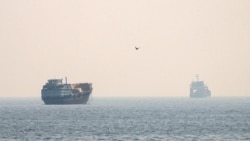
The Pentagon has disputed an article by The Washington Post which said that clearing Iranian mines from the Strait of Hormuz could take six months.
Citing unnamed officials, the newspaper reported on April 22 that US lawmakers were told Iran may have laid 20 or more advanced mines, some remotely floated using GPS technology to make detection harder.
Pentagon spokesman Sean Parnell rejected the report, saying that the media had been "cherry picking leaked information, much of which is false."
He added that a prolonged closure of the strait was "an impossibility and completely unacceptable" to US Defense Secretary Pete Hegseth.
The ongoing disruption of the crucial waterway, which usually accounts for one-fifth of global oil trade, has raised energy prices and hurt shipping confidence.
Britain and France are leading talks with more than 30 countries on a defensive coalition to reopen the strait and conduct mine-clearing operations.
With reporting by AFP
Germany Urges Tehran To 'Seize' Opportunity Of Cease-Fire To Hold Talks With US
The German government has urged Iran to "seize the opportunity" of the current cease-fire with the United States to continue diplomatic negotiations in Islamabad to prevent renewed fighting in their war.
In an April 23 statement, the government also called on Tehran to halt its military nuclear program, cease threatening Israel and other neighboring states, and ensure the Strait of Hormuz is opened "permanently, reliably, and without restrictions or fees."
"If a comprehensive agreement is reached, the German government is prepared to gradually ease existing restrictive measures with its partners," it said. "If, on the other hand, Iran continues to block the Strait of Hormuz, the German government is prepared to discuss additional sanctions."
The statement also said that once a "lasting" peace has been achieved, Germany and its allies are ready "to contribute to freedom of navigation in the Strait of Hormuz in accordance with international law and national procedures."
Oil Prices Rise 4 Percent Amid Uncertainty Over US-Iran Cease-Fire
Oil prices rose about 4 percent on April 23 as uncertainty over the fate of the cease-fire between Iran and the United States continued.
According to market data, the US West Texas Intermediate crude oil contract rose 4.06 percent to $96.73 per barrel shortly after midnight.
Brent North Sea crude, the global oil price index, also rose 3.62 percent to $105.63 per barrel.
However, prices retreated slightly minutes later.
These fluctuations come as Iran has announced it will not open the Strait of Hormuz as long as the US naval blockade of its ports continues.
Iran Says It Has Executed Man For Ties To Banned Opposition Group
Iran's judiciary announced on April 23 that it had executed a man after he was convicted of being a member of the People's Mojahedin Organization (MEK), a banned opposition group, and allegedly collaborating with Israeli security forces.
"Soltanali Shirzadi Fakhr was hanged early this morning for membership in the terrorist group" of the MEK and "collaboration with the Israeli regime's spy service," reported Mizan Online, the official website of the Iranian judiciary.

Mizan wrote that Fakhr was a "longtime member" of the MEK and had "extensive cooperation in various fields" with the group for years. It also claimed Fakhr had confessed to taking part in two official MEK operations against the Islamic republic.
The details of his arrest were not clear.
Following the violent crackdown on nationwide mass protests in January, Iran has ramped up executions, and it recent week has hanged several political prisoners accused of having ties to the MEK, including Mohammad Taghavi Sangdehi, Akbar Daneshvarkar, Babak Alipour, and Pouya Ghobadi.
Iran has also intensified executions in recent weeks for charges of participating in the mass protests, as well as "collaboration with Israel."
Iran has one of the highest execution rates in the world, and human rights groups say the Islamic republic uses the death penalty to instill fear in society.
On April 22, US President Donald Trump said Iran had halted alleged plans to execute eight women arrested over pre-war anti-government protests after he urged Tehran to release them.
Iran's judiciary dismissed the claim as "false news" and said the women were never at risk of execution.
Panama Calls Seizure Of Ship In Strait Of Hormuz 'Illegal'


Panama condemned the seizure of a ship flying its flag as it passed through the Strait of Hormuz, calling it an "illegal detention."
According to media reports, Panama's Foreign Ministry has announced that the ship, the MSC-Francesca, was "forcibly" transferred to Iranian waters.
Panama also accused Iran of violating international law, saying the move was a "serious attack on maritime security" and an "unnecessary escalation" of tensions.
Montenegro's maritime affairs minister confirmed the seizure of the MSC-Francesca, saying four Montenegrin sailors were on board and that the crew was safe.
The Islamic Revolutionary Guard Corps (IRGC) Navy announced on April 22 that it had seized "two offending ships" that it claimed were attempting to "secretly exit" the Strait of Hormuz.
According to the IRGC announcement, the Israeli-owned MSC-Francesca and the Greek-owned Epaminondas were stopped on charges that they intended to "secretly" exit the Strait of Hormuz "without authorization" and "by committing repeated violations and tampering with navigational aid systems and endangering maritime security."
The IRGC Navy said these vessels have been transferred to Iranian territorial waters to examine the cargo and documents.
The announcement came on a day when, according to maritime sources, three container ships were targeted by gunfire.
End Of Iran Sanctions Waiver Sharpens Focus On Financial Pressure
WASHINGTON -- The expiration of a US sanctions waiver on Iranian oil last weekend has brought renewed attention to Washington's economic strategy, as policymakers seek to limit Tehran's access to revenue while navigating global energy market pressures.
The measure, known as General License U, lapsed on April 19, ending a short-lived window that allowed a significant volume of Iranian crude -- estimated at up to 170 million barrels -- to circulate more freely on international markets.
The decision coincides with a broader push by the US Treasury to intensify pressure on networks linked to Iran's military procurement, including a new round of sanctions announced on April 21 targeting entities involved in weapons development.
For some analysts, the timing reflects a deliberate effort to align economic tools with a wider strategic posture.
To read the full analysis, click here.
US Senate Rejects New Attempt To Limit Trump’s Military Authority Against Iran
The US Senate on April 22 voted 51-46 to reject a Democratic-led effort to limit President Donald Trump’s authority to use military force against Iran.
It was the fifth such attempt since the start of the eight-week conflict. The proposal, led by Senator Tammy Baldwin of Wisconsin, would have required the withdrawal of US armed forces from hostilities within or against Iran unless explicitly authorized by Congress.
Democrat John Fetterman voted with most Republicans against the measure, while Republican Rand Paul joined Democrats in supporting it.
Democrats said they would continue pressing for further war powers votes.
CENTCOM Says 31 Vessels Turned Around In US Blockade
US Central Command (CENTCOM) said in a post on X on April 23 that American forces had ordered 31 vessels to turn around or return to port as part of the US blockade on Iran.
CENTCOM wrote that "the majority have complied with US directions" and that "most have been oil tankers."
The United States began its naval blockade of Iranian ports on April 13 in response to Iran's effective closure of the crucial Strait of Hormuz, a sticking point in attempts to end the US-Israeli war with Iran that started on February 28.
We are now closing the live blog for the day. We'll be back at 7:30 a.m. Central European time to cover the latest events across the Middle East.
US Wants 'Unified' Iranian Proposal For Ending War, No Firm Deadline For Now
WASHINGTON -- US President Donald Trump wants to see a “unified” response from Tehran to US proposals for ending the US-Israeli war with Iran and has not set a “firm deadline” at this point, the White House said a day after he unilaterally extended a cease-fire that had been due to expire on April 22.
Trump is “offering a bit of flexibility” to the Iranian regime, White House Press Secretary Karoline Leavitt told reporters. She asserted there is “a lot of internal division” in Tehran.
“This is a battle between the pragmatists and the hard-liners in Iran right now, and the president wants a unified response, and so as we await that response, there's a cease-fire with the military and kinetic strikes” while economic pressure and a US naval blockade remain in place, Leavitt said.
Trump has made a “very strong proposal” for ending the war and “has not set a firm deadline to receive an Iranian proposal” in response, she said, without going into detail. Earlier on April 22, Leavitt told Fox News that Iran must agree to turn its enriched uranium over to the United States as part of negotiations to end the war.
The war began with US and Israeli air strikes on Ian on February 28. After face-to-face talks in Islamabad on April 11-12 ended without an agreement, a new round was expected this week but has not materialized, with Iran never confirming it would take part and US negotiators holding off so far on traveling to Pakistan.
Leavitt’s comments came after Iranian parliament speaker Mohammad Baqer Qalibaf repeated Tehran’s accusations that the US naval blockade on Iran, which Trump imposed on April 13 and has said will stay in place until there’s a deal, was a violation of the cease-fire.
In a post on X, Qalibaf said that “reopening the Strait of Hormuz is impossible with such a flagrant breach of the cease-fire."
Iran has effectively shut the narrow strait, normally the conduit for about one-fifth of global oil and liquefied natural gas supplies, since shortly after the war began.