




South Korea Weighs Role In US Hormuz Mission After Ship Blast
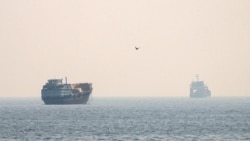
South Korea has said it would “review its position” on joining US-led operations in the Strait of Hormuz after Donald Trump blamed Iran for an apparent attack on a South Korean-operated vessel.
An explosion and fire struck the Panama-flagged cargo ship HMM Namu on May 4 while it was anchored in the vital waterway, which has been largely blocked since the outbreak of the conflict in the Middle East in late February.
South Korea’s Foreign Ministry said on May 5 that all 24 crew members on the Namu were safe and that the fire had been extinguished, adding that “the exact cause of the accident would be figured out after the vessel is towed and its damage is assessed.”
Trump said Iran had fired on the ship and urged Seoul to join US efforts to escort stranded vessels, suggesting it was time for allies to contribute to securing the strait.
Seoul’s Defense Ministry said it would “carefully review our position,” citing international law, maritime safety, and alliance considerations. It also said that it had been "actively participating in international discussions on cooperation to ensure safe passage" through the strait.
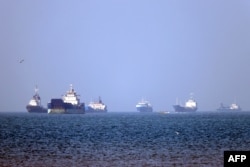
Vanguard, a British maritime risk management company that monitors shipping threats, said authorities were investigating whether the blast was caused by an attack, a drifting mine or another external factor, as dozens of South Korean-linked vessels remain stranded in the crucial shipping lane.
With reporting by AFP and Reuters
Trump Warns Iran Will Be 'Blown Off Face Of The Earth' If US Vessels Targeted In Hormuz
US President Donald Trump has threatened that Iran would be “blown off the face of the earth” if it targets US vessels seeking to reopen the Strait of Hormuz, as tensions strain a fragile cease-fire between the two sides.
The warning comes as Washington pushes ahead with a naval operation to escort commercial traffic through the Persian Gulf, where more than 800 ships and around 20,000 crew remain stranded along the strait, which is critical for global oil flows.
Speaking to Fox News on May 4, Trump praised the effort as “one of the greatest military maneuvers ever done” and said Iranian officials had been “far more malleable” in recent talks.
Iran, however, has warned it will strike US vessels approaching the strait and has disputed US claims that it had destroyed six Iranian small boats and intercepted Iranian missiles and drones.
Washington says it has already redirected dozens of commercial ships amid the ongoing standoff.
With reporting by AFP and The Guardian
We are now closing the live blog for the day. We'll be back at 7:30 a.m. Central European time to cover the latest events across the Middle East.
'Forced Confessions': Iranian Prisoners Speak Amid Wave Of Executions
Iran announced the hanging of three more men on May 4 as a wave of executions continued amid the backdrop of Tehran's war with the United States and Israel.
Before being hanged on the weekend, another two members of Iran's Kurdish minority issued audio statements from prison. One human rights activist told RFE/RL's Radio Farda that there are concerns the rate of executions will increase as Iranian authorities attempt to instill fear in the population.



Rubio Heads To Rome, Vatican As Iran War Strains US Ties With Europe
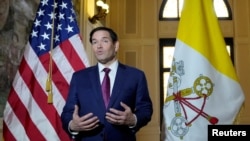
WASHINGTON -- US Secretary of State Marco Rubio is set to visit Rome and the Vatican on May 6-8 in what officials describe as an effort to shore up strained ties with key European partners as the war in Iran deepens divisions across the Atlantic.
According to a State Department announcement, the trip will serve to “advance bilateral relations.”
Rubio is set to meet with Holy See leadership to discuss the situation in the Middle East and mutual interests in the Western Hemisphere.
“Meetings with Italian counterparts will focus on shared security interests and strategic alignment,” spokesperson Tommy Pigott said on May 4.
A former senior State Department official who spoke to RFE/RL on condition of anonymity said the timing of the trip signals its importance.
“Secretary Rubio’s trip is an important step in diplomacy,” the ex-official said, adding that the face he is taking the trip at this time is an indication of how much the administration of US President Donald Trump "values the relationship with Italy and the Holy See."
The visit comes against a backdrop of increasing tensions between Washington and its European allies over both the Iran conflict and broader policy disagreements, including trade and military commitments.
Analysts say the trip is as much about damage control as diplomacy.
“The Iran war is putting extreme strain on President Trump’s relations with European allies,” Charles Kupchan, a senior fellow at the Council on Foreign Relations, told RFE/RL. “Rubio is dispatching the fire trucks to try to put out the conflagration and limit the damage.”
Read more here
CENTCOM Head Says Iran Launched 'Cruise Missiles, Drones, And Small Boats' At US Navy
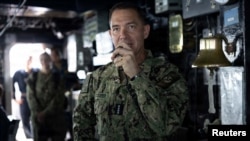
US forces intercepted cruise missiles and drones fired by Tehran on May 4, a US admiral said, as Washington launched an operation to guide stranded "neutral" ships out of restricted waters near the Strait of Hormuz.
As the operation announced by US President Donald Trump a day earlier took effect, Admiral Brad Cooper, the head of US Central Command (CENTCOM) which oversees American forces in the region, said "multiple cruise missiles, drones, and small boats" were launched at US Navy ships and commercial ships "protected" by the United States.
He added that the US military "blew up" six small Iranian boats in the crucial waterway with Apache and SH-60 Seahawk helicopters and urged Iranian forces to stay away from US military while the operation was underway.
He also said that US ships were not "just escorting" the commercial ships out of the strait but employing a "much broader defensive package."
"We have multiple layers that include ships, helicopters, aircraft, airborne early warning, electronic warfare,” Cooper said.
With reporting by CNN
War Pushes Iran's Economy Even Further Toward The Brink
- By Kian Sharifi

For years, Iran's economy has struggled as international sanctions and administrative mismanagement took their toll. Since US and Israeli air strikes hit the country on February 28, the situation has grown markedly worse.
Already decrepit infrastructure has been targeted in the strikes, knocking out factories, steel mills, bridges, and ports. Even worse, oil and gas facilities have been struck, while a US blockade on all traffic calling at Iranian ports still functioning has all but cut off Tehran's main lifeline: oil money.
With the currency at historic lows against the dollar and an Internet shutdown crippling businesses, analysts say Iran's economy is now in uncharted territory.
"So, unless the regime seeks concessions from the US to lift the blockade, the economy will have to remain extremely depressed," said Jason Tuvey, deputy chief Emerging Markets economist at the London-based Capital Economics.
Read more here
UAE Slams 'Unacceptable' Drone And Missile Attacks
The United Arab Emirates said that it had come under Iranian missile and drone attack, strongly condemning the strikes as a “dangerous escalation” and holding Tehran fully responsible for their consequences.
Authorities in the United Arab Emirates' major port city of Fujairah reported a drone strike that targeted an energy installation and caused a fire.
"Fujairah Civil Defense teams immediately responded to the incident and are continuing their efforts to control it," the Fujairah media office said in a statement on May 4, following multiple air alerts.
The UAE’s Foreign Ministry said the "unacceptable" attacks, which injured three people, constituted a direct threat to the country’s security and violated international law, warning it “will not hesitate to protect its security and sovereignty” and reserves the right to respond.
Fujairah, on the shore of the Arabian Sea, has been a key exporting hub of the UAE.
The port facility there has become even more crucial after the effective closure of the Strait of Hormuz, as it has allowed the UAE to access global shipping without using the waterway.
The UAE's Defense Ministry said Iran had also targeted the country with four cruise missiles on May 4.
"Three were successfully engaged over the country's territorial waters, while one fell in the sea," it said.
With reporting by Reuters
Bessent Urges China To Persuade Iran To Open Strait Of Hormuz
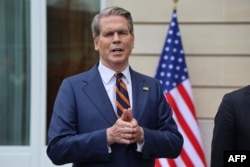
US Treasury Secretary Scott Bessent has urged China to contribute to diplomatic efforts to convince Iran to open the Strait of Hormuz, as President Donald Trump and his Chinese counterpart, Xi Jinping, are scheduled to meet next week.
"China, let's see them step up with some diplomacy and get the Iranians to open the strait," Bessent said in an interview with Fox News on May 4, adding that Beijing was purchasing as much as 90 percent of Tehran's energy resources. "They are funding the largest state sponsor of terrorism."
A day earlier, Trump announced that US forces will begin guiding stranded "neutral" ships out of restricted waters near the Strait of Hormuz. Iran reacted, warning that maritime activity in the waterway must comply with Tehran's naval protocols or face enforcement action.
In the interview, Bessent said that Trump and Xi have been discussing the situation in Iran and plan to talk about it in person at their upcoming summit in Beijing on May 14–15.
CENTCOM Says 2 US-Flagged Vessels Transited The Hormuz Strait
US Central Command, which oversees American forces in the Middle East, says two US-flagged vessels have "successfully transited through the Strait of Hormuz and are safely headed on their journey."