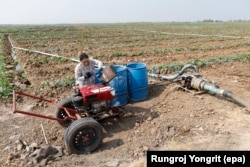

12 Nobel Laureates Call For Immediate Release Of Narges Mohammadi

Following the transfer of Nobel Peace Prize winner and Iranian political prisoner Narges Mohammadi to a hospital, a group of 112 Nobel laureates from various fields issued a joint statement calling for her immediate and unconditional release and the dropping of all charges against the human rights activist.
The statement was released on May 12 in coordination with the Nobel Women's Initiative and the Narges Foundation. The signatories include Nobel laureates in chemistry, economics, literature, medicine, peace, and physics.
The statement said that reports published by the Narges Foundation and other credible sources indicate that Mohammadi's physical condition has become "critical" and that she is experiencing severe weight loss, unstable blood pressure, and serious heart symptoms.
Nobel laureates have warned that Mohammadi's life may be at "immediate risk" and have emphasized that she has been denied access to specialized medical services for months.
Mohammadi was transferred to Tehranpars Hospital by ambulance on May 10 and is currently being treated by a specialized medical team. However, the signatories of the statement emphasized that her hospitalization does not eliminate "the injustice of her imprisonment."
Jody Williams, winner of the 1997 Nobel Peace Prize, said in the statement: "No one should be imprisoned for peacefully protesting or defending human rights."
Tawakol Kerman, another Nobel Peace Prize laureate, has also described Mohammadi as "a fearless voice of women who stand up against oppression" and has called for continued global support for Iranian women.
The signatories also called on the authorities of the Islamic republic and the international community to take immediate action to release Mohammadi and ensure her access to appropriate medical services.
Kuwait Announces Arrest Of 4 Individuals 'Affiliated With IRGC'
Kuwait's Interior Ministry announced that it had arrested "four infiltrators" affiliated with Iran's Islamic Revolutionary Guards Corps (IRGC) after they attempted to enter the Persian Gulf country by sea.
The official Kuwaiti government news agency, KUNA, reported the news.
The ministry added that during the clash with these individuals, one Kuwaiti armed force member was injured and "two infiltrators" managed to escape.
KUNA also quoted the Kuwaiti Interior Ministry as saying that the detainees "confessed" during interrogation that they were affiliated with the IRGC.
The ministry's claims could not be independently verified.
According to the report, they "admitted that they were on a mission to infiltrate Bubiyan Island in a fishing boat that had been specifically chartered to carry out hostile acts against Kuwait."
Previously, the Kuwaiti Defense Ministry had released initial news of the four people's attempt to enter the country by sea.
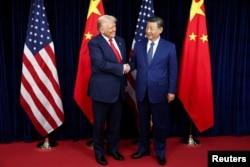
Iran, Taiwan, And Trade Tensions: What To Expect At The Trump-Xi Summit
US President Donald Trump and Chinese leader Xi Jinping are set to open a closely watched summit in Beijing as Washington and Beijing seek a fragile economic truce while maneuvering over Iran, Taiwan, and control of critical supply chains.
Trump, who last visited China in 2017, will arrive on the evening of May 13 and engage in two days of talks and public appearances with Xi on May 14-15. The trip marks the two leaders' first face-to-face talks in more than six months as they try to stabilize ties strained by tariffs, mineral export controls, and other areas of disagreement.
While the highly anticipated meeting will cover a range of economic and geopolitical issues -- from US soybean exports to China's relationship with Russia -- the Iran war is also expected to feature on the summit's agenda, senior US officials told reporters during a May 10 briefing.
To read the full report, click here.
Lawmaker Warns Iran Could Enrich Uranium To Weapons Grade If Attacked
An Iranian lawmaker says that Tehran could enrich uranium to 90 percent purity -- a level associated with nuclear weapons capability -- if the country comes under attack again.
Ebrahim Rezaei, a hard-liner who represents parliament's national security and foreign policy commission and is known for making extreme proclamations that do not necessarily reflect policy, said in a post on X on May 12 that Iran might consider responding to a future strike by pursuing enrichment.
Rezaei said lawmakers would examine the option.
His remarks came after US President Donald Trump said on May 11 that the current cease-fire between the United States and Iran was "on life support" following his rejection of an Iranian proposal, highlighting the fragility of ongoing diplomatic efforts.
Trump previously stated that US and Israeli attacks during the 12-day conflict in June 2025 had “obliterated” Iran’s nuclear facilities, significantly reducing the country’s enrichment capabilities.
However, uncertainty remains over the whereabouts of roughly 400 kilograms of uranium enriched to a purity of 60 percent -- material considered only a short technical step away from weapons-grade levels near 90 percent.
According to US intelligence assessments, Iran’s nuclear program is unlikely to face a major setback unless that stockpile of highly enriched uranium is either seized or destroyed.
US, UK, Australia Tighten Sanctions On Iran Over Oil Trade, Security Threats
The US Treasury Department has sanctioned 12 individuals and entities accused of helping the Islamic Revolutionary Guards Corps (IRGC) facilitate the sale and shipment of Iranian oil to China, as Washington intensifies its "maximum pressure" campaign against Tehran.
In a statement released on May 11, the Treasury said the measures are aimed at disrupting Iran's ability to generate, move, and repatriate funds used to support its weapons programs, terrorist proxies, and nuclear ambitions.
"As Iran's military desperately tries to regroup, Economic Fury will continue to deprive the regime of funding for its weapons programs, terrorist proxies, and nuclear ambitions," Treasury Secretary Scott Bessent said.
Bessent added that the Treasury "will continue to cut the Iranian regime off from the financial networks it uses to carry out terrorist acts and to destabilize the global economy."
Meanwhile, Australia announced on May 12 new targeted financial sanctions and travel bans against Iranian individuals and entities over what it described as the regime's ongoing brutal oppression of its people and destabilizing regional activities.
"In January, the Iranian regime massacred thousands of its own citizens and carried out mass arrests of peaceful protesters, torturing detainees, subjecting them to forced confessions and preventing them from communicating with loved ones," the Australian government said in a statement released on May 12.
"The seven individuals and four entities sanctioned today include senior officials and entities involved in these horrific acts, including violence against women and children," it added.
The move came alongside fresh sanctions imposed by the United Kingdom targeting organizations and individuals accused of enabling hostile Iranian activities and overseas criminal operations.
The UK Foreign Office said the measures respond to Iran's action against "global security and its use of criminal gangs to carry out threats overseas."
"Criminal proxies backed by parts of the Iranian regime who threaten security in the UK and Europe will not be tolerated, nor will illicit finance networks," British Foreign Secretary Yvette Cooper said.
The United Kingdom already has imposed more than 550 sanctions on Iranian individuals and organizations, including the entirety of the IRGC and over 90 sanctions in response to human rights violations.
Iran Executes Another Prisoner, Says Judiciary
Iran's judiciary announced the execution of another prisoner, Abdul Jalil Shahbakhsh, on the morning of May 12.
Mizan, official news outlet for the judiciary, identified Shahbakhsh as a "trained terrorist" from the Ansar al-Furqan group.
The report states that following his arrest during "counterterrorism operations" in the east of the country, a case was filed against Shahbakhsh and he was brought "to the Revolutionary Court on charges of rebellion through armed attacks on law enforcement headquarters and membership in the Ansar al-Furqan rebel group."
Mizan wrote that the death sentence was issued to him due to "the existence of solid evidence and documentation extracted from the defendant's communication devices and audio files, as well as his explicit confessions during various stages of interrogation and interrogation."
Since the US-Israeli war with Iran began on February 28, the Islamic republic has increased the number of executions, executing several people on some days.
Human rights group have said that Iran has one of the highest execution rates in the world, second only to China.

Qalibaf Says US 'Has No Alternative' But To Accept Iran's Terms
Iran's top negotiator, Mohammad Baqer Qalibaf, says the United States "has no alternative" but to accept Tehran's latest counterproposal to end the war.
"There is no alternative but to accept the rights of the Iranian people as laid out in the 14-point proposal," Baqer, who is also speaker for the Iranian parliament, wrote on X on May 12. "Any other approach will be completely inconclusive; nothing but one failure after another."
Iranian Foreign Ministry spokesman Esmail Baqaei said in his weekly press conference on May 11 that Tehran's response --issued via mediator Pakistan on May 10 -- included stopping the war, lifting the US blockade on the Strait of Hormuz, freeing Iran's assets, and "establishing security in the region and Lebanon."
US President Donald Trump called Tehran's counterproposal "totally unacceptable."
"The longer they drag their feet, the more American taxpayers will pay for it," added Baqer.
We are now closing the live blog for the day. We'll be back at 7:30 a.m. Central European time to cover the latest events across the Middle East.
As Iran Talks Stall, Markets Bet on Diplomacy, Experts Say
WASHINGTON -- The latest exchange between Washington and Tehran over a proposed path toward de-escalation has raised new questions about what comes next in the growing crisis around the Strait of Hormuz.
President Donald Trump described Iran’s latest response to a US-backed proposal as “totally unacceptable,” even as both sides continue to signal interest in negotiations over sanctions relief, nuclear restrictions, and the future of shipping through the strategic waterway.
Analysts in Washington say the standoff is increasingly testing assumptions that diplomacy can move quickly enough to prevent wider economic fallout from the conflict.
So far, financial markets have remained relatively calm despite some choppy moments.
But experts say the relative market stability reflects expectations that negotiations will eventually produce some form of agreement.
“There’s pressure on both sides to make some sort of deal,” Mark Cancian said during a discussion hosted by the Center for Strategic and International Studies (CSIS) on May 11.
To read the full story, click here.
UN Official Warns Hormuz Disruption Could Deepen Global Hunger Crisis
A senior United Nations official has warned that disruptions to fertilizer shipments through the Strait of Hormuz could trigger a major humanitarian crisis and worsen global hunger.
Jorge Moreira da Silva, head of the UN Office for Project Services and leader of a special UN task force on fertilizer transport, said the world has only "a few weeks" to prevent what could become "a massive humanitarian crisis."
He warned that continued disruption in the Strait of Hormuz could push "45 million more people into hunger and starvation."
The UN task force was established to help maintain shipments of fertilizers and related materials -- including ammonia, sulphur and urea -- through the strategic waterway amid regional tensions.