




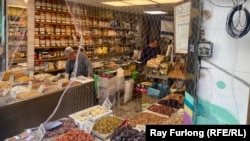
TEL AVIV -- Bijan Bahordari has two flags in the window of his fast-food restaurant: the blue-and-white Israeli Star of David and that of pre-revolutionary Iran, the green-white-red tricolor with a golden lion and sun in the center.
After ladling stuffed peppers, rice, and a rich red sauce into a takeaway container for a customer, he stopped to talk about what it's like to witness his adopted homeland at war with the land of his birth.
"I wish and I hope that they finish the regime now. And I am waiting to go back there. Seventeen years, I lived there. And I remember everything," he told RFE/RL. "In the morning, I check my phone, the radio, the TV -- it doesn't matter what."
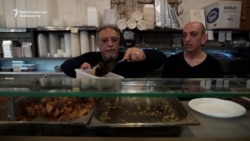

Bahordari left Iran as a teenager to go traveling in 1978. While he was away, the Shah of Iran was toppled and the Islamic republic was established. Bahordari has never returned.
He's now married in Israel, has children, and for 10 years has been running the New Food Of Life cafe at Levinsky Market, an area dotted with Persian businesses.
There are an estimated 250,000 Iranian Jews in Israel, defined as Jews born in Iran plus second and third generations. Bahordari is slightly unusual, since he moved here before the Islamic Revolution. Most others came afterward.
One such Iranian is the owner of a shop selling nuts and dried fruit a few steps from Bahordari's business. Identifying himself simply as Meir, he said he had come to Israel in 1979. The current war, he said, left him with mixed feelings -- but also hope.
"It's very strange. Everything is strange. We attack each other. But it is for a good cause. The Iranian people are suffering. Their government is evil, very bad for all the world -- not just for Iran," he said, switching from English to Hebrew to make his point clearly.

But while he is hopeful about the future, he also acknowledged the dangers of the current situation -- not only that there are civilian casualties in Iran, but also that regime change could have unpredictable and potentially violent consequences of its own.
"I would be very disappointed and sad if it turns out like that. Not just me, a lot of people all over the world. We are strongly connected via social networks. We're all praying. We all applaud," he said.
Listing a roll-call of countries where the Iranian diaspora is scattered, he said that earlier "they were afraid to speak out. But now, they feel confident. We are expecting the regime to fall."
Iran still has a Jewish population. Estimates of its size vary from a few thousand people to somewhere in the 10,000 to 20,000 range. This population was much higher prior to 1979.
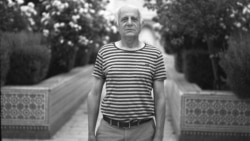
Many Jews fled in the aftermath of the revolution as the new authorities adopted a sharp anti-Israel stance, including not recognizing Israel's right to exist. The 1979 execution of Habib Elghanian, a prominent figure in the Tehran Jewish community, helped further prompt an exodus to Israel and other countries, particularly the United States.
Part of that exodus was Nicola, who was 9 years old when her family left Iran in 1979. Now a holistic therapist in Jerusalem, she recalled being told at 10 o'clock one night that she would be leaving the next morning. She said she was allowed to take three items.
Nicola chose not to give her surname because of concerns for the safety of her mother, now aged 77, who chose to stay in Iran and is still there now.
"One eye is crying and the other eye is happy," she said, about the current situation.
"I'm praying that after 47 years the regime will fall…. I'm crying because I know the price that people in Iran are paying," she added.
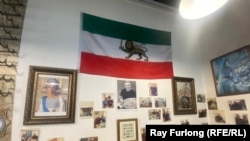
Back at Bahordari's Tel Aviv cafe, he pointed to a wall of photos showing famous guests including Israeli actors and singers. The wall also features portraits of the late shah and his wife.
With tears welling in his eyes, Bahordari revealed his dream.
"I will make another restaurant -- very big -- in Iran. And I'll put the flags of Israel, the United States, and Iran, and [a picture of] the shah, together. It's going to be very, very special," he said.

