



Accessibility links

Breaking News

Islamic State Seizes Syria's Ancient Town Of Palmyra

A year ago, all was quiet at Palmyra. This picture, from March 14, 2014, shows locals with bicycles at the ancient oasis city.
1/9 A year ago, all was quiet at Palmyra. This picture, from March 14, 2014, shows locals with bicycles at the ancient oasis city.
Syrian authorities say Islamic State militants have advanced to within 2 kilometers of Palmyra, an ancient city with outstanding architectural heritage dating from the first century. The militants have caused significant damage to similar sites they have overrun in Iraq, posting videos of themselves destroying antiquities. UNESCO includes Palmyra on its list of World Heritage sites, describing it as one of the most important cultural centers of the ancient world -- a crossroads for local, Persian, Greek and Roman influences.
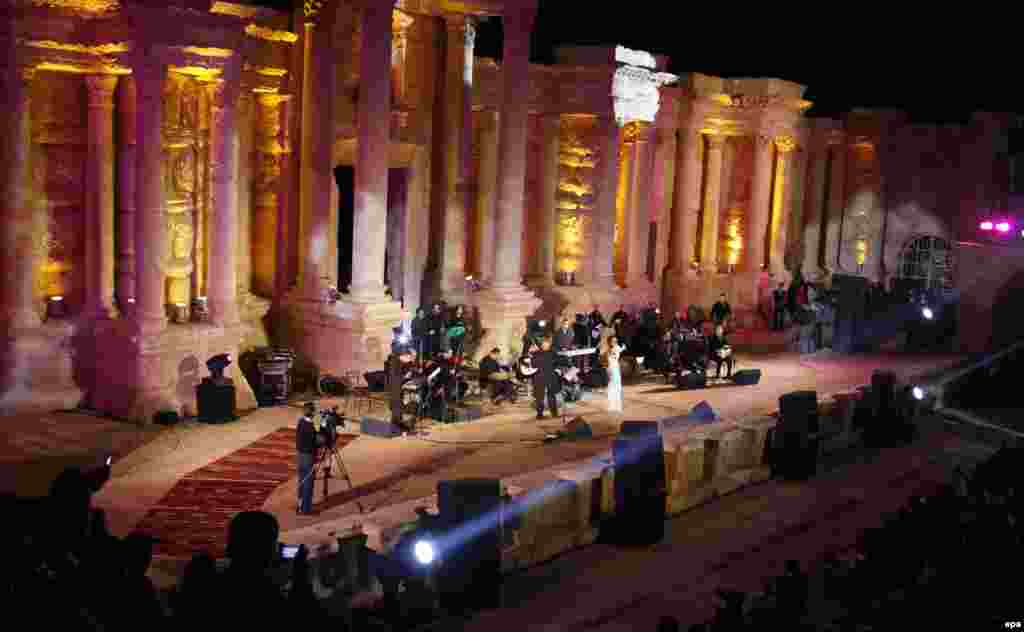
The remains of the Roman theatre date back to the 2nd century. Until recently, it was host to the annual Palmyra Festival.
2/9 The remains of the Roman theatre date back to the 2nd century. Until recently, it was host to the annual Palmyra Festival.
Syrian authorities say Islamic State militants have advanced to within 2 kilometers of Palmyra, an ancient city with outstanding architectural heritage dating from the first century. The militants have caused significant damage to similar sites they have overrun in Iraq, posting videos of themselves destroying antiquities. UNESCO includes Palmyra on its list of World Heritage sites, describing it as one of the most important cultural centers of the ancient world -- a crossroads for local, Persian, Greek and Roman influences.
Lebanese singer Najwa Karam performs at the opening ceremony of the Palmyra Festival in 2010.
3/9 Lebanese singer Najwa Karam performs at the opening ceremony of the Palmyra Festival in 2010.
Syrian authorities say Islamic State militants have advanced to within 2 kilometers of Palmyra, an ancient city with outstanding architectural heritage dating from the first century. The militants have caused significant damage to similar sites they have overrun in Iraq, posting videos of themselves destroying antiquities. UNESCO includes Palmyra on its list of World Heritage sites, describing it as one of the most important cultural centers of the ancient world -- a crossroads for local, Persian, Greek and Roman influences.
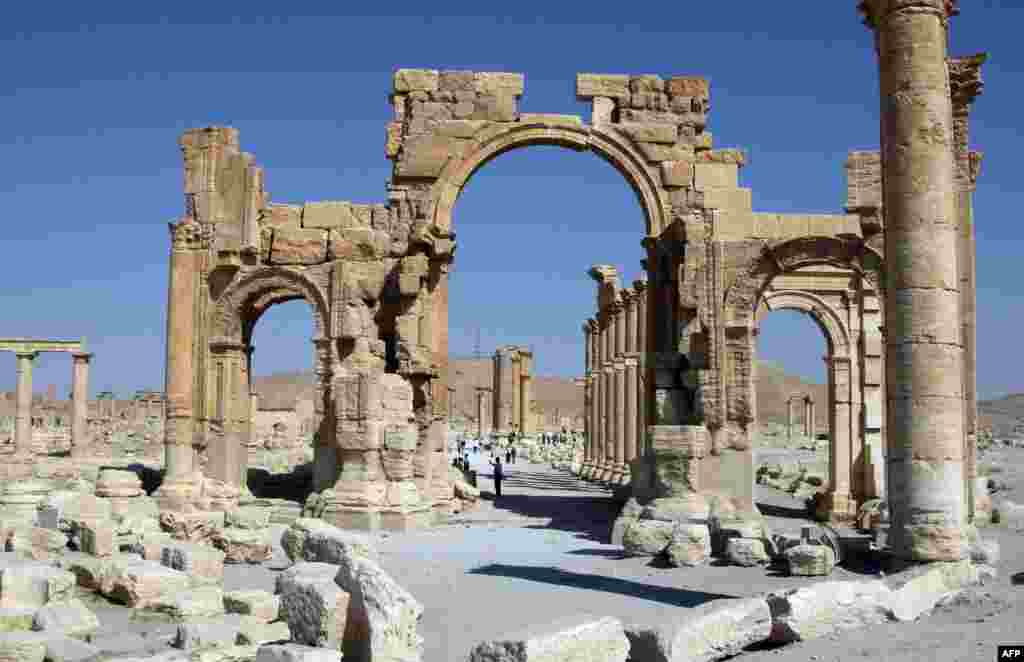
More Roman ruins. Palmyra became increasingly prosperous after the Romans took control at the beginning of the 1st century.
4/9 More Roman ruins. Palmyra became increasingly prosperous after the Romans took control at the beginning of the 1st century.
Syrian authorities say Islamic State militants have advanced to within 2 kilometers of Palmyra, an ancient city with outstanding architectural heritage dating from the first century. The militants have caused significant damage to similar sites they have overrun in Iraq, posting videos of themselves destroying antiquities. UNESCO includes Palmyra on its list of World Heritage sites, describing it as one of the most important cultural centers of the ancient world -- a crossroads for local, Persian, Greek and Roman influences.
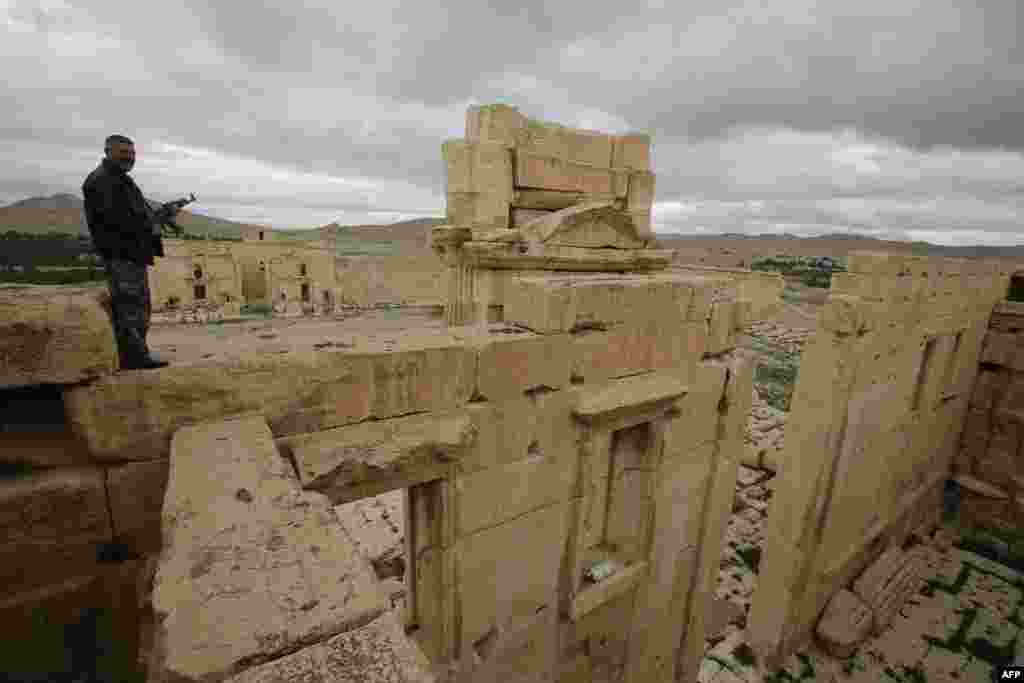
March 2014 - A Syrian policeman stands on the sanctury of Baal, one of three pagan gods worshipped in Palmyra in the 1st century.
5/9 March 2014 - A Syrian policeman stands on the sanctury of Baal, one of three pagan gods worshipped in Palmyra in the 1st century.
Syrian authorities say Islamic State militants have advanced to within 2 kilometers of Palmyra, an ancient city with outstanding architectural heritage dating from the first century. The militants have caused significant damage to similar sites they have overrun in Iraq, posting videos of themselves destroying antiquities. UNESCO includes Palmyra on its list of World Heritage sites, describing it as one of the most important cultural centers of the ancient world -- a crossroads for local, Persian, Greek and Roman influences.
Palmyra is believed to have been founded by King Solomon.
6/9 Palmyra is believed to have been founded by King Solomon.
Syrian authorities say Islamic State militants have advanced to within 2 kilometers of Palmyra, an ancient city with outstanding architectural heritage dating from the first century. The militants have caused significant damage to similar sites they have overrun in Iraq, posting videos of themselves destroying antiquities. UNESCO includes Palmyra on its list of World Heritage sites, describing it as one of the most important cultural centers of the ancient world -- a crossroads for local, Persian, Greek and Roman influences.
A 2nd century limestone relief excavated in 2008 from a cemetery in Palmyra. Shapes of 13 men and women, all from the same family, are engraved on it.
7/9 A 2nd century limestone relief excavated in 2008 from a cemetery in Palmyra. Shapes of 13 men and women, all from the same family, are engraved on it.
Syrian authorities say Islamic State militants have advanced to within 2 kilometers of Palmyra, an ancient city with outstanding architectural heritage dating from the first century. The militants have caused significant damage to similar sites they have overrun in Iraq, posting videos of themselves destroying antiquities. UNESCO includes Palmyra on its list of World Heritage sites, describing it as one of the most important cultural centers of the ancient world -- a crossroads for local, Persian, Greek and Roman influences.
From the same dig - the scene depicts two Palmyrian merchants and a child standing next to a camel.
8/9 From the same dig - the scene depicts two Palmyrian merchants and a child standing next to a camel.
Syrian authorities say Islamic State militants have advanced to within 2 kilometers of Palmyra, an ancient city with outstanding architectural heritage dating from the first century. The militants have caused significant damage to similar sites they have overrun in Iraq, posting videos of themselves destroying antiquities. UNESCO includes Palmyra on its list of World Heritage sites, describing it as one of the most important cultural centers of the ancient world -- a crossroads for local, Persian, Greek and Roman influences.
The sun sets behind ruined columns at Palmyra, November 2010.
9/9 The sun sets behind ruined columns at Palmyra, November 2010.
Syrian authorities say Islamic State militants have advanced to within 2 kilometers of Palmyra, an ancient city with outstanding architectural heritage dating from the first century. The militants have caused significant damage to similar sites they have overrun in Iraq, posting videos of themselves destroying antiquities. UNESCO includes Palmyra on its list of World Heritage sites, describing it as one of the most important cultural centers of the ancient world -- a crossroads for local, Persian, Greek and Roman influences.
Previous slide
Next slide

Islamic State (IS) fighters have taken full control of the ancient city of Palmyra and have entered the UNESCO World Heritage site containing prized ruins.

The British-based Syrian Observatory for Human Rights said on May 21 that the extremist group now controlled about half of Syria's territory.

It said regime troops pulled back from positions in and around Palmyra, including from an intelligence outpost, a military air base, and a prison following clashes that have killed at least 100 pro-government fighters.

The ruins at Palmyra are one of the world's most renowned historic sites and there were fears the extremists would destroy them as they did major archaeological sites in Iraq.

The city is famous for its 2,000-year-old towering Roman-era colonnades and other ruins and priceless artifacts. Before the war, thousands of tourists a year visited the remote desert outpost.

The fall of the town to the Islamic State group after a week of fighting was an enormous loss to the government, not only because of its cultural significance, but because it opens the way for the extremists to advance to key government-held areas, including Damascus and the Syrian coast to the south.

Next to it are also important gas and oil fields in the country's central region.

With the fall of Palmyra, IS now controls about 40 percent of Syria and almost all of the country's oil fields, which are a major source of revenue for the militant group.

There are fears the IS militants would destroy the ruins as they did major archaeological sites on Iraqi territory.

"I am terrified," said Maamoun Abdulkarim, Syria's director-general of antiquities and museums. "This is a PR battle for Daesh, and they will insist on scoring victory against civilization by destroying" the ancient ruins, he said, using the Arabic acronym for the group.

The fall of Palmyra just days after Islamic State fighters seized the strategic Iraqi city of Ramadi showed the extremists' ability to advance on multiple fronts at opposite ends of a sprawling battlefield that spans the two countries. It also erased any sense that recent IS losses in Tikrit and elsewhere had dealt a major blow to the militants.

The Syrian Observatory for human rights reported that government forces collapsed in the face of IS attacks and withdrew from the town late May 20. Beibares Tellawi, an activist in Homs province, confirmed IS was in control of the town.

He said the militants had reached the notorious Tadmur prison, where thousands of Syrian dissidents have been imprisoned and tortured over the years. The government evacuated what it considered its most important prisoners days ago, but the fate of the rest of the 1,000 or so prisoners was not immediately known.

Syrian state TV acknowledged that pro-government forces had withdrawn from Palmyra, and the IS-affiliated Aaamaq News Agency reported the town was "under the complete control of the Islamic State fighters."

IS fighters had also seized control of the Jazl oil field in the Homs countryside, the Aaamaq report said.

Homs governor Talal Barazzi earlier reported that at least 19 people had died in fighting before the miltants assumed control of the city, including seven civilians and 12 pro-government militiament known as National Defense Forces.

Abdulkarim said workers were able to save hundreds of statues and masterpieces from Palmyra that were transported to safe houses in Damascus.

"But how do you save colonnades that weigh a ton? How do you save temples and cemeteries and, and, and. . .?" he asked.

He appealed to the international community to declare "a red line" around Palmyra and called on the U.S.-led coalition to "at least prevent IS convoys from reaching it."

With reporting by Reuters and dpa
  • 16x9 Image

    RFE/RL

    RFE/RL journalists report the news in 24 languages in 18 countries where a free press is banned by the government or not fully established. We provide what many people cannot get locally: uncensored news, responsible discussion, and open debate.

This item is part of
XS
SM
MD
LG