


Following weeks of digital darkness due to an Internet blackout by authorities trying to quell antiestablishment unrest -- in which thousands are thought to have been killed in a brutal crackdown by security forces -- Iranians are slowly managing to get online using anti-filtering tools.
The monitoring group NetBlocks said on January 28 that most regular Internet users still face heavy filtering and only intermittent service under a whitelist system despite a significant increase in internationally visible networks and datacenters.

Golnaz Esfandiari from RFE/RL's Radio Farda spoke about the Internet shutdown in Iran, as well as whether Iranian officials should be allowed on Western social media platforms, with Mahsa Alimardani, associate director for the Technology Threats and Opportunities program at WITNESS.
Alimardani has been following the Internet situation in Iran for many years and recently spoke at a side event to the World Economic Forum in Davos, Switzerland, about the Internet restrictions in Iran.
Radio Farda: Is there any precedent for a country depriving its citizens, 90 million people, from access to the Internet for nearly three weeks?
Mahsa Alimardani: Unfortunately, there is precedent globally for longer Internet shutdowns. We've seen them happen in places like Kashmir by the Indian government. However, the precedent that they have set is in terms of breaking their own record for the longest Internet shutdown. So they broke their own record.
Radio Farda: Yes. And as you noted, this is not the first time that Iran has imposed an Internet shutdown and disrupted the free flow of information during a crackdown, a bloody crackdown on protests. What can be done to help Iranians access the Internet and prevent another shutdown in the future?

Alimardani: To be honest, as someone who has been studying information controls and access to the Internet for well over a decade now, this has been a really big question in terms of [how] accessing traditional Internet has always been governed by this notion of digital sovereignty.... Whether it be in an authoritarian country like Iran or in a democratic country, it's usually through some sort of national infrastructure and there are concepts of digital sovereignty and how this infrastructure is maintained within these sovereign borders. And, of course, we know in contexts such as Iran, in contexts where authoritarian regimes enact Internet shutdowns or weaponize access to the Internet to commit crimes or to create these sorts of crises, this traditional means of looking at the Internet is very harmful and really needs to be revolutionized and rethought.
Many internet researchers -- I mean, I can reference one academic who is a professor in Europe, Azadeh Akbari. She wrote a really great article about how we need to really break this notion of digital sovereignty with this really atrocious example of what a government has done under a blanket, like an unprecedented scale of massacres using the blanket of the shutdowns as one of the tools to enable this. And, I mean, I think what has happened in Iran is this is a really horrific event that will change Iranians and the course of Iran forever.



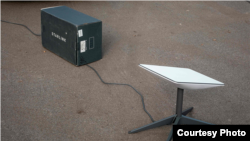
I can't obviously talk about what the future will hold for Iran in the coming weeks, months or years. But what I can say is that this event has really changed things and there should be a fundamental shift in how people are thinking about these things. And so one of the things that has become very apparent is the potential for satellite Internet to really help reorient and reimagine what a regime like the Islamic republic can do. And so we've seen this small window during the shutdowns. The small window that had allowed for the little information and documentation to come out during the shutdown has been through the Starlink satellite terminals that have been smuggled into Iran, a great risk to everyone involved in the smuggling process, sold at great prices. The market value right now seems to be $2,000 for a Starlink terminal, which, of course, is not a very realistic price point for a country going through so much poverty and an economic crisis.

So it's this very privileged and inaccessible type of Internet. And it's something that I've been thinking about, and I've been trying to work on with different advocates and policymakers, which is to create a means of scaling this satellite Internet, which is a really new technology. And being able to scale it beyond the limited window that the Starlink terminals have right now, but scale it for potentially a population of 90 million people and to subvert these traditional means of accessing the Internet.
Radio Farda: And do you see this happening in the near future, something like that on such a large scale?
Alimardani: It's a very ambitious ask and it's a campaign and a coalition that we have started with with my own organization, WITNESS, another human rights organization, Access Now, that does a lot of work on Internet shutdowns. Another Iranian human rights organization, For Human Rights, CHRI, and the strategic litigation project as well as Article 19 [are also involved.] So this is the starting coalition. We're trying to expand and involve and have more stakeholders. It is very ambitious, but I think what we need when we are facing such a scale of atrocities, we need to have ambitious projects to really reimagine and not only reimagine these frameworks for Iran, but anywhere else where connectivity becomes a means to disrupt access to humanitarian needs or to allow for human rights abuses to occur.
Radio Farda: Do you think countries have been forceful enough in condemning Iran's Internet shutdown, which, as you noted, make it difficult to obtain reliable information about the extent of the brutal crackdown on the protests? And, as you know, it has also worsened the economic situation of scores of Iranians who were already struggling to make ends meet.
Alimardani: Yes. To be honest, it's often quite difficult to get the right support. I think there's been some development aid. Of course, before this moment, we have seen a lot of the human rights sector be decimated through cuts to development agencies and different sectors, which is not easy. But of course, there should be a movement to get funding and support for these efforts for connectivity, as well as different projects aimed at documentation and truth and veracity because these things work hand in hand -- the connectivity and the ability to document and document the authentic Iranian voices and document authentic evidence that can be used to hold this regime accountable.
So definitely more needs to be done in terms of the investment and resources and support countries are putting in, more than just kind of symbolic statements and condemnations, but real investment needs to be done. I mean, one of the concrete asks that I've been working on is our direct-to-sell coalition and campaign, direct2sell.org. There's obviously many other efforts. In recent days, you might have heard that there's been an increase in connectivity over the Iranian network, unstable, not consistent connectivity, but being enabled through various...tools.
Radio Farda: We've noticed that more and more people are getting online using proxy servers.
Alimardani: Exactly, yes. And the data shows it's still not the same as obviously before. And overall, you can accurately say that in large parts, the shutdown continues, but there is a bigger kind of window we're seeing across the network. And, of course, from what I've been experiencing and talking to is it's not consistent. It comes and goes. But yes, the connectivity has definitely been there.
Radio Farda: You've been following the Internet situation in Iran for years. Where do you think Iran is heading in terms of the Internet? Could the communication blackout become permanent?
Alimardani: It's really hard to say, just because the different officials tied to this regime put out different statements that often even sometimes contradict each other. So, in the thick of the blackout and the midst of the massacres, they were putting out statements that it could be one or two years before things ever go back to normal. And then there was another statement that it would be in no rush. So it's really unclear what's happening.
But one thing for sure is that the means of maintaining the shutdown has become much more sophisticated than it has in previous years. The ways that they've been able to maintain their own kind of connectivity, many people have seen probably regime officials online on social media. And so they have been able to maintain their own networks. Again, the national information network and getting the domestic Internet up and running has been glitchy and imperfect, but they've been working on getting that availability and there's different theories of why this -- these pockets of connectivity are available. There's no official statement or position why. There's theories that they're playing around with the network, trying to fine-tune what they're doing or they actually do want to create these openings.

Radio Farda: You mentioned Iranian officials using social media. Should they be allowed on Western social media platforms when they're preventing their own citizens from accessing the Internet. Should [Supreme Leader Ali] Khamenei be allowed to post on X?
Alimardani: This is a really good question. And I've studied a lot of the discourse and things he's put on his social media and by all accounts and means, he has broken all the terms and services of most of these social media platforms and his accounts should be removed. I believe they've been removed on Meta platforms and for legitimate reasons. He incites hatred toward marginalized groups. He has broken the rules and regulations that a lot of these platforms have on promoting terrorist organizations.
So by all systematic rules and regulations that need to be consistently upheld, his account and many of the other officials, if not all of them are breaking those rules and should be removed. And there's a really horrific situation happening, which is that a lot of regime propaganda accounts are now putting forth a lot of horrific footage of forced confessions across social media platforms. And there's a lot of different campaigns to undermine the situation. In 2022, when I worked at Article 19, we worked to block some of these campaigns. So when executions of protesters started in early 2023, the regime was pushing a hashtag, do execute them, [saying falsely] that the protesters were terrorists. And so back then, we did successfully actually work with Twitter and Meta to block these hashtags and to remove as much of that content as possible, which was inciting hatred and inciting a movement to support the murder of innocent protesters.
And right now, this is another problem. Meta is quite strict with removing this kind of content. And, of course, these are crimes that should be archived and documented, and there's many different projects that are doing this...but it should not be allowed to proliferate on the platforms because they essentially use this as a form of their own propaganda, as a way to instill fear. And it has been a bit of a struggle to talk to platforms like X, which have much more libertarian attitudes towards content moderation, especially under its current governance model. So it's really important to stop authorities from using these Western platforms for these horrific campaigns, which have the killing and murder of protesters as their end goal.