




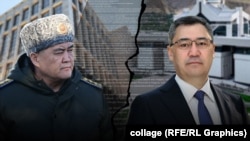
The sudden dismissal of Kamchybek Tashiev as head of Kyrgyzstan’s State Committee for National Security (SCNS) marks a major shift in the country’s political balance.
A central ally of President Sadyr Japarov since the 2020 uprising that brought them to power, Tashiev was removed on February 10 while undergoing medical treatment in Germany.
Appointed in October 2020, Tashiev became one of Kyrgyzstan’s most powerful officials. He took a hard line in border talks with Tajikistan and Uzbekistan and led sweeping domestic crackdowns. In 2023, security forces killed prominent crime boss Kamchy Kolbaev in an operation Tashiev oversaw, part of broader anti-crime and anti-corruption campaigns that recovered billions of soms for the state.
While supporters said his methods were necessary to preserve order, critics accused him of pressuring political opponents and squeezing independent media and civil society.
In a farewell message shared by his allies, Tashiev defended his record: “I served our state, the people, and the president honestly and I am proud of this. The only thing I regret is that I was not given the opportunity to say goodbye to the personnel.... Law is the foundation of order. Peace, stability, and statehood of Kyrgyzstan should stand above any emotions and political speculation.”
Power Consolidation In Bishkek
Allies of Japarov described the move as institutional rebalancing, with Deputy Cabinet Chairman Edil Baysalov acknowledging tensions within the system: “We must honestly recognize that in recent years there was some imbalance in the public administration system.... Power must be clear, constitutionally defined, and focused in one center of responsibility.”
Many analysts see the dismissal as a calculated effort by Japarov to remove a potential rival. Daniil Kislov, editor of Fergana.Media, said Tashiev had evolved into “an alternative center of power,” adding that the president "decided to remove a potential rival before he gained too much weight."

Kislov also warned that the reshuffle could trigger broader changes in the security services, including the departure or replacement of officials loyal to Tashiev.
Within hours of Tashiev’s dismissal, President Japarov removed his three deputies at the SCNS and several other officials considered close to him. The agency was quickly restructured: the State Border Service and the State Guard Department were separated from the security system.
The political reverberations quickly spread beyond the security services. Parliament speaker Nurlan Turgunbek-uulu resigned from his post, saying the decision was made “to maintain political stability.” A close ally of Tashiev, he told lawmakers, “Nobody pressured me. It is my own decision for the political stability of the country.” The legislative body accepted his resignation and proposed parliament deputy Marlen Mamataliev as the new speaker.
At the same time, security authorities detained another five former officials for signing a letter urging an early presidential election. Among them were former Deputy Interior Minister General Kursan Asanov and former parliamentary deputy Aaly Karashev. Three other signatories had been detained earlier.
Border Negotiations
Tashiev played a central role in often tense border negotiations with Tajikistan and Uzbekistan, making him a key figure in one of the region’s most sensitive issues.
Uzbek political analyst Kamoliddin Rabbimov described him as “a much more aggressive, nationalist, and hard-line politician,” contrasting him with Japarov, whom he called “a calm and reasonable person.”
And perhaps as a sign of the regional importance of dismissing Tashiev, Uzbek President Shavkat Mirziyoyev reportedly phoned Japarov after the reshuffle.
Rabbimov warned, however, that political fragmentation could grow following the move: “The disgruntled Tashiev might try to destabilize the situation.... But Japarov is an experienced politician. He will try to carry his mission through to the end.”
Moscow, despite close ties with Bishkek, has not publicly commented. Russian media had previously described Tashiev as “the main Russophobe in Kyrgyzstan.”
A Fragile Moment
Kyrgyzstan has experienced revolutions in 2005, 2010, and 2020. Tashiev himself helped lead the last uprising and could now, some analysts warn, reemerge as an opposition figure, particularly in the southern regions of Osh and Jalal-Abad where he retains influence.
These areas sit in the Ferghana Valley, a complex triangle where the borders of Kyrgyzstan, Uzbekistan, and Tajikistan meet -- a region with a history of tension and violence, most notably the ethnic clashes in 2010, which left hundreds dead and thousands wounded.
His dismissal consolidates Japarov’s authority but also ends a powerful political tandem that has shaped the Kyrgyz political landscape for five years. The outcome of this reshuffle -- whether it fosters greater political calm or triggers fresh instability -- could have repercussions not only for Kyrgyzstan but for the entire Central Asian region.

