



Accessibility links

Breaking News

News

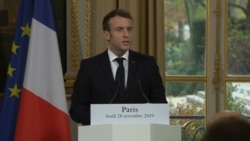
Macron Says Russia, China Not NATO Allies' Common Enemies -- Terrorism Is

Macron: NATO's Enemy Is Terrorism, Not Russia Or China
please wait

No media source currently available

0:00 0:00:33 0:00

French President Emmanuel Macron has said that he stands by comments he made three weeks ago when he described NATO as "brain-dead," and he defended his push for dialogue with Russia.

In a November 7 interview with the Economist magazine, Macron deplored a lack of strategic cooperation among NATO members, and pointed to what he saw as a waning commitment to the Western military alliance by the United States.

The assessment drew sharp criticism from allies, with NATO Secretary-General Jens Stoltenberg warning against undermining the transatlantic alliance.

"I totally stand by raising these ambiguities because I believe it was irresponsible of us to keep talking about financial and technical matters given the stakes we currently face," Macron said after talks with Stoltenberg in Paris on November 28.

The meeting took place before NATO leaders meet outside London next week for its 70th anniversary, amid persistent tensions between Russia and the West over issues including the Ukrainian and Syrian conflicts and Moscow's meddling into other countries' elections.

NATO has also raised concerns regarding the implications of China's increased presence and activity in the North Atlantic area.

"A wake-up call was necessary. I'm glad it was delivered, and I'm glad everyone now thinks we should rather think about our strategic goals," Macron told a joint news conference with Stoltenberg.

"Is our enemy today Russia, as I sometimes hear? Is it China? Is it the goal of NATO to designate them as enemies? I don't believe so. Our common enemy today is terrorism, which has hit each of our countries," he added.

Stoltenberg said that "in uncertain times, we need strong multilateral institutions like NATO."

He also praised France's role in fighting Islamist terrorism in the Sahel region, which saw the death of 13 French soldiers in Mali this week.

Macron also took aim at NATO-member Turkey, saying its military offensive against Kurdish militia fighters in northern Syria "endangers the actions" of the coalition against the Islamic State extremist group -- a coalition "of which NATO is a member."

Turkish Foreign Minister Mevlut Cavusoglu dismissed the French leader's criticism and accused him of being a "sponsor of terrorism."

Macron angered Ankara last month by hosting an official from the Kurdish-led Syrian Democratic Forces (SDF).

On Russia, Macron also said that Paris had "absolutely not accepted" a proposal from Moscow to impose a moratorium on missile deployments in Europe, as suggested in leaks in the German press earlier this week.

"We considered that, as a basis for discussion, we shouldn't just brush it off," he said, adding that "this is the security of Europe we're talking about."

Russia has called on the United States and other countries to declare a moratorium on the deployment of short- and intermediate-range nuclear missiles on the continent -- a proposal described as not "credible" by NATO.

The move followed the demise of the Cold War-era Intermediate-Range Nuclear Forces (INF) Treaty earlier this year that banned Russia and the United States from deploying land-based, short- and intermediate-range nuclear weapons.

Acknowledging concerns among NATO allies about his overtures to Moscow, Macron said that "the absence of dialogue with Russia" hadn't made Europe "any safer."

With reporting by AFP and Reuters

All Of The Latest News

Biden Says Putin Didn't Expect 'Cohesion' Among Western Allies

U.S. President Joe Biden (left) prepares to sit as he speaks with NATO Secretary-General Jens Stoltenberg at the alliance's headquarters in Brussels on March 24.

U.S. President Joe Biden says President Vladimir Putin miscalculated Western resolve before launching Russia’s unprovoked invasion of Ukraine and didn't think Western countries would remain unified in their use of sanctions and support for arming Ukrainian forces.

Biden told reporters at a news conference in Brussels that Russia's invasion of Ukraine had built greater unity within NATO, the European Union, and the Group of Seven economies.

"NATO has never, never been more united than it is today. Putin is getting exactly the opposite of what he intended to have as a consequence of going into Ukraine," Biden said after a meeting with NATO leaders.

Putin "didn't think we could sustain this cohesion," Biden said.

NATO countries and other allies have imposed harsh sanctions against Russia, crippling the ruble and the Russian economy. So far, however, the European Union has not gone as far as the United States and banned oil and natural gas from Russia.

Biden also said NATO would respond if Russia used chemical weapons in Ukraine and that he thought Russia should be removed from the Group of 20 major economies.

Biden said the nature of NATO's response to any use of chemical weapons "would depend on the nature of the use."

Biden said the topic of Russia's membership in the G20 was raised during his meetings with world leaders in Brussels.

"My answer is yes, depends on the G20," Biden said, when asked if Russia should be removed from the group.

Biden also said that if countries such as Indonesia and others do not agree with removing Russia from the G20, then in his view, Ukraine should be allowed to attend the meetings.

With reporting by Reuters, AP, and AFP

Kazakh Activist Sentenced For Supporting Banned Opposition Groups

Murat Sapiev

ORAL, Kazakhstan -- A court in Kazakhstan has sentenced an activist to three years of restricted freedom for openly supporting the banned Democratic Choice of Kazakhstan (DVK) movement and its associate, the unregistered Koshe (Street) party, amid an ongoing crackdown on supporters of the two opposition groups.

A court in the northwestern city of Oral handed the parole-like sentence to Murat Sapiev on March 24 after finding him guilty of organizing and taking part in unsanctioned rallies for the DVK and Koshe party in 2020-21.

The court also banned Sapiev from involvement in public and political activities for five years.

Sapiev rejected the charges, saying he used his right to express his thoughts and opinions. His lawyer said no decision had been made on an appeal.

Many activists across the Central Asian country have been handed lengthy prison terms or restricted-freedom sentences in recent years for their involvement in the activities of DVK and Koshe and for taking part in rallies organized by the two groups.

The DVK is led by Mukhtar Ablyazov, the fugitive former head of Kazakhstan's BTA Bank and an outspoken critic of the government. Kazakh authorities labeled DVK extremist and banned the group in March 2018.

Human rights groups have said Kazakhstan's law on public gatherings contradicts international standards, as it requires preliminary permission from authorities to hold rallies and envisions prosecution for organizing and participating in unsanctioned rallies even though the constitution guarantees its citizens the right of free assembly.

The Kazakh authorities have insisted there are no political prisoners in the country.

UN General Assembly Overwhelmingly Approves Resolution Demanding Protection Of Civilians In Ukraine

The resolution was approved by 140 countries in the 193-member assembly. Four countries -- Syria, Belarus, North Korea, and Eritrea -- joined Russia in voting against, while 38 abstained.

The UN General Assembly has adopted a nonbinding resolution demanding the protection of civilians and civilian infrastructure in Ukraine and an immediate halt to the war.

The resolution, approved on March 24 at UN headquarters in New York, was favored by 140 countries in the 193-member assembly. Four countries -- Syria, Belarus, North Korea, and Eritrea -- joined Russia in voting against, while 38 countries abstained.

The resolution "demands an immediate cessation of the hostilities by the Russian Federation against Ukraine, in particular of any attacks against civilians and civilian objects."

It also demands the protection of civilians, medical personnel, aid workers, and journalists.

A similar nonbinding resolution on March 2 demanded Russia immediately cease its use of force. That resolution was backed by 141 countries.

U.S. Ambassador to the UN Linda Thomas-Greenfield described the vote on March 24 as an "astounding success," telling reporters, "There's really no difference between 141 and 140."

She said the latest resolution built on the March 2 vote and appealed to "the one person with the ability to stop the violence. And that's Vladimir Putin."

The resolution criticizes Russia for creating a "dire" humanitarian situation after Moscow invaded its neighbor one month ago in what it calls a "special military operation" to destroy Ukraine's military infrastructure.

Ukraine and Western allies have accused Moscow of attacking civilians indiscriminately and targeting facilities such as hospitals and buildings used as shelters. Moscow denies attacking civilians.

Ukraine put forward the new resolution on March 23. The text was originally prepared by France and Mexico at an emergency session of the General Assembly.

A competing text by South Africa, which did not mention Russia by name, received only 50 votes and was therefore not adopted. Russia had appealed for countries to support that text, arguing that the resolution drafted by Ukraine and allies had been "politicized."

With reporting by AFP and Reuters

EU Leaders Call Putin's Rubles-For-Gas Plan Breach Of Contract

Russian gas accounts for around 40 percent of Europe's total consumption.

Several leaders from European Union members have scoffed at Russia's demand that some "unfriendly" countries will be forced to pay for its natural gas and oil in rubles, saying the move is a breach of contract.

In a move seen aimed at bolstering Russia's beleaguered currency in the face of crippling economic and financial penalties over its invasion of Ukraine, President Vladimir Putin has said Moscow will no longer accept payments in dollars or euros, what he called "compromised currencies" from countries that have imposed the sanctions.

While Putin did not name any countries, it is understood the policy would target Britain, Canada, Japan, Switzerland, Ukraine, the United States, and members of the European Union.

Live Briefing: Russia Invades Ukraine

RFE/RL's Live Briefing gives you all of the major developments on Russia's invasion, how Kyiv is fighting back, the plight of civilians, and Western reaction. For all of RFE/RL's coverage of the war, click here.

"This would be a unilateral decision and a clear breach of contract, and it would be an attempt to circumvent the sanctions," European Commission President Ursula von der Leyen said at the start of an EU summit in Brussels on March 24.

"We will not allow our sanctions to be circumvented...the time when energy could be used to blackmail us is over," she added.

Russia invaded Ukraine on February 24, prompting the sanctions and global condemnation.

The sanctions have sent the Russian currency into freefall, while cutting Russia out of international money transfers and freezing its foreign currency abroad.

Putin gave the government and central bank one week to figure out the details on moving operations into the ruble, with energy giant Gazprom charged with making the corresponding changes to contracts.

Russian gas accounts for around 40 percent of Europe's total consumption. Daily EU gas imports from Russia this year have varied between 200 million euros to 800 million euros.

"This is basically a breach of contract, this is important to understand," Italian Prime Minister Mario Draghi said of Putin's move.

Added Slovenian Prime Minister Janesz Jansa, "I don't think anybody in Europe knows what rubles look like, nobody will pay in rubles."

Ukrainian Foreign Minister Dmytro Kuleba called Moscow's demands "humiliating" and warned countries potentially affected by the move not to give in.

"If any EU country bows to Putin's humiliating demands to pay for oil and gas in rubles, it will be like helping Ukraine with one hand and helping Russians kill Ukrainians with the other. I urge relevant countries to make a wise and responsible choice," he said on Twitter.

Russia Expels Montenegrin Diplomat In Tit-For-Tat Move

Demonstrators in Podgorica express their support for Ukraine after the Russian invasion on February 24.

Russia's Foreign Ministry says it has officially informed Montenegro that it is expelling one of the country's diplomats in Moscow.

"This measure is a response to the decision of the Montenegrin side, adopted on March 4, this year, to declare a diplomat of the Russian Embassy in Podgorica persona non grata," the Foreign Ministry said in a statement on March 24.

Earlier this month, the Montenegrin Foreign Ministry declared a Russian diplomat persona non grata, noting that the decision had been made at the behest of the national security agency.

That announcement came after media reports in Montenegro alleged that two members of the Russia Foreign Intelligence Service had met in February with a senior official from the ruling pro-Serbian Democratic Front in the city of Danilovgrad.

Relations between Russia and Montenegro have been complicated for years.

In 2014 Montenegro imposed sanctions against Russia, joining European Union members, after Moscow illegally annexed Ukraine's Crimea region.

In 2016, Montenegro accused Russia of sponsoring a failed coup attempt, allegedly designed to stop Montenegro from joining NATO.

Based on Reporting by TASS, Interfax, and Balkan Insight

Kyrgyz Activist Fined For Protesting Against Russia's Invasion Of Ukraine

Aziza Abdirasulova

BISHKEK -- Noted Kyrgyz human rights activist Aziza Abdirasulova has been fined for publicly protesting against Moscow's unprovoked invasion of Ukraine.

The Birinchi Mai district court in Bishkek on March 24 ordered Abdirasulova to pay a 3,000-som ($30) fine after finding her guilty of disobeying police orders as she protested in front of the Russian Embassy in Bishkek.

Abdirasulova pleaded not guilty.

Earlier the same day, the court sentenced lawyer Nurbek Toktakunov to five days in jail for contempt of court.

Toktakunov defended Abdirasulova and two other activists, Dinara Oshurakhunova and Ondurush Toktonasyrov, who were fined two days before for refusing to follow police instructions.

The three activists were detained on March 17 in front of the Russian Embassy in Bishkek, where they were protesting the war in Ukraine.

They were charged with minor hooliganism and disobedience to police and released from custody hours later.

Kyrgyz TV Director Detained Over Ukraine Report Denied Release

Taalai Duishembiev

BISHKEK -- A court in Kyrgyzstan has rejected an appeal filed by the director of Next TV to end his pretrial detention over a news report about Russia's invasion of Ukraine.

The Bishkek City Court ruled on March 24 that a lower court's decision to hold Taalai Duishembiev in pretrial detention until at least May 3 cannot be changed.

Duishembiev was detained on March 3 over the airing of a controversial report in which an interviewee alleged the existence of an agreement between Bishkek and Moscow to send Kyrgyz troops to Ukraine to assist the Russian armed forces in their invasion.

The State Committee for National Security has said it launched the probe against the TV channel for inciting interethnic hatred.

The report in question quoted the exiled former chief of the Committee for National Security (KNB) of neighboring Kazakhstan, Alnur Musaev, as saying that Kyrgyzstan and Tajikistan had agreed to support Moscow's unprovoked invasion of Ukraine by sending troops to help Russia.

There has been no evidence of Tajik or Kyrgyz troops fighting in Ukraine since the unprovoked invasion was launched by Moscow.

However, some reports have said there were ethnic Tajik and Kyrgyz who hold Russian citizenship among the Russian troops fighting in Ukraine.

Next TV's owner, Ravshan Jeenbekov, has rejected the charge, insisting that the report quoted Musaev directly while balancing his statements with other people's views on the issue as well.

The Kyrgyz Foreign Ministry has rejected the report and has called on local media outlets to base their reporting on the ongoing war in Ukraine solely on official government statements.

Kyiv Woman Wants Godmother In Moscow 'To See' Her Damaged Home

Kyiv Woman Wants Godmother In Moscow 'To See' Her Damaged Home
please wait

No media source currently available

0:00 0:02:22 0:00

Former Leader Of Belarusian Opposition Group Detained For 2020 Election Protests

Zmitser Dashkevich (file photo)

MINSK -- The former leader of the Belarusian opposition movement Malady Front (Youth Front) has been detained for taking part in the 2020 protests against the official results of a presidential election that handed a sixth presidential term to authoritarian ruler Alyaksandr Lukashenka.

The Main Directorate for the Fight Against Organized Crime and Corruption (GUBOPiK) said on March 24 that Zmitser Dashkevich was detained the day before and charged with the "organization and preparation of activities that violate social order, or the participation in such activities."

Dashkevich's wife, Nastassya, told RFE/RL that her husband was taken away by police after a search of their home on March 23.

The 40-year-old Dashkevich is one of the most well-known critics of Lukashenka and his regime.

The father of three, whose wife is expecting a fourth, has already spent several years in prison on convictions in two criminal cases that rights organizations and opposition groups have called politically motivated.

The protests were met with the sometimes-violent detention of tens of thousands of people. Much of the opposition leadership has been jailed or forced into exile.

Several protesters have been killed and there have also been credible reports of torture during the widening security crackdown.

The opposition says the election was rigged. Several western countries, including the United States, have since imposed economic and financial sanctions on Lukashenka and members of his regime over the violent repression of dissent in the country.

NATO Warns Of Possible Russian Pretext For Using Chemical Weapons

NATO Secretary-General Jens Stoltenberg (left) walks with U.S. President Joe Biden at an extraordinary summit at NATO headquarters in Brussels on March 24.

NATO Secretary-General Jens Stoltenberg has warned that Moscow may be seeking to create a false flag by accusing the United States of preparing a chemical-weapons attack on Russia that it could then use to justify its own use of such weapons.

Stoltenberg said on March 24 that in response, the alliance had activated its chemical and nuclear "defense elements" to protect member states against any possible contamination fallout if Russia uses chemical weapons in Ukraine.

It is also going to send detection equipment and protection to Ukraine to help it deal with any such attacks.

"We are concerned partly because we see the rhetoric and we see that Russia is trying to create some kind of pretext accusing Ukraine, the United States, and NATO allies of preparing to use chemical and biological weapons," Stoltenberg told reporters, adding that any use of chemical weapons would have widespread consequences.

"There is also a risk that it [a chemical-weapons attack] will have a direct effect on people living in NATO countries because we can see contamination, we can see the spread of chemical agents or biological weapons into our countries," Stoltenberg added.

Slovenian Prime Minister Janez Jansa warned that while the Russian military might not use chemical weapons, an air strike or shelling of a chemical plant could be just as dangerous, triggering "a disaster of large scale."

Earlier in the day, Ukrainian President Volodymyr Zelenskiy accused Russia of deploying phosphorus weapons in his country, though he did not present any evidence to back up his claim.

U.S. Broadens Russian Sanctions List

Russian President Vladimir Putin (left) speaks with Sberbank CEO German Gref during a meeting in Moscow in September 2019.

The United States has slapped sanctions on more than 400 Russian politicians, oligarchs, and companies over Moscow's unprovoked invasion of Ukraine.

The U.S. Treasury said in a statement on March 24 that the expanded list of those sanctioned over the war includes dozens of Russian defense companies, 328 members of the Russian State Duma, and the head of Russia's largest financial institution, Sberbank.

"Today, in its latest action to impose severe costs on the Russian Federation for its illegal, unwarranted, and baseless war against Ukraine, the U.S. Department of the Treasury's Office of Foreign Assets Control (OFAC) is designating key enablers of the invasion," the statement said.

"This action aligns with similar actions taken by the European Union, the United Kingdom, and Canada, and reflects continued unity to hold [Russian President Vladimir] Putin accountable for his war of choice," it added.

The list includes Sberbank CEO German Gref, who has also been a close confidante of Putin since the 1990s.

The statement said that inclusion on the list freezes "all property and interests in property" in the United States "or in the possession or control of U.S. persons."

Sofia Recalls Ambassador To Russia For Consultations

Ambassador to Bulgaria Eleonora Mitrofanova (file photo)

SOFIA -- NATO and EU member Bulgaria says it is recalling its ambassador to Russia for consultations in response to "undiplomatic, sharp, and rude" comments from the Russian ambassador to Sofia.

"We will call back our ambassador from Russia for consultations back to Bulgaria.... Usually when one country calls back its ambassador for consultations, the other should follow and do the same," Prime Minister Kiril Petkov said on March 24.

In an interview with Russian TV earlier this week, Russian Ambassador Eleonora Mitrofanova said that the Bulgarian people did not back their government's position toward Russia's invasion of Ukraine.

Mitrofanova told Russia-24 TV that "the people of Bulgaria still do not support the rhetoric and actions of their government regarding the special operation in Ukraine."

Bulgaria last week expelled 10 Russian diplomats, saying they were carrying out activities deemed incompatible with their diplomatic status, a move followed up quickly by the Baltic states of Estonia, Latvia, and Lithuania.

With reporting by Reuters

Latvia Blacklists 25 Russian Celebrities Over Supporting War In Ukraine

People watch a broadcast of Russian President Vladimir Putin's speech during a concert marking the eighth anniversary of Russia's annexation of Crimea outside Luzhniki Stadium in Moscow on March 18.

Latvia has added 25 Russian celebrities to its list barring entry to the former Soviet republic over their support of Russia's invasion of Ukraine.

The Foreign Ministry said on March 24 that those blacklisted will not be allowed to enter the NATO and EU member for an "indefinite period of time."

Many of the 25 Russians included on the list took part in a public event held at Moscow's Luzhniki sports stadium last week to support President Vladimir Putin and back Russia's aggression against Ukraine, which began one month ago.

The list includes popular actor Vladimir Mashkov, internationally known for his work in the 2001 film Behind Enemy Lines and the 2011 blockbuster Mission Impossible -- Ghost Protocol, and Oscar-nominated filmmaker Nikita Mikhalkov.

Actress Masha Mashkova, Mashkov's daughter, who lives in the United States, told CNN on March 22 that her father lived "in a different reality."

"It's just unthinkable and surreal. And the fact that so many Russian people, including my dad, believe that this violence is somehow justified, it breaks my heart," she said.

Other Russian celebrities blacklisted by Latvia include conductor and opera company director Valery Gergiyev, dancer Sergei Polunin, singers Polina Gagarina, Nikolai Rastorguyev, and Stas Mikhailov, and piano player Denis Matsuyev.

With reporting by CNN and LSM

NATO Leaders Agree To Extend Stoltenberg's Term By One Year

NATO Secretary-General Jens Stoltenberg speaks during a news conference on the eve of a NATO summit, amid Russia's invasion of Ukraine, in Brussels, Belgium March 23

NATO has agreed to extend Secretary-General Jens Stoltenberg's term by one year to oversee the security alliance's response to Russia's unprovoked invasion of Ukraine.

"Allies thanked the secretary-general for his leadership and dedication, particularly at this critical moment for international security," NATO said in announcing the extension on March 24.

Stoltenberg, a trained economist who was also once Norway's prime minister, was chosen to head the Norwegian central bank in February. He had agreed to serve out his term in Brussels, which ends on September 30, before taking up his new post around December 1.

NATO said Stoltenberg's term will now end on September 30, 2023.

"As we face the biggest security crisis in a generation, we stand united to keep our alliance strong and our people safe," Stoltenberg said at an extraordinary meeting of the security alliance over Russia's war against Ukraine.

Russia's invasion of Ukraine one month ago has triggered Europe's largest military conflict since World War II, leading the alliance to to fundamentally rethink its defense policies.

Ukraine Claims Attack Destroyed Russian Naval Ship In Berdyansk Harbor

Ukraine Claims Attack Destroyed Russian Naval Ship In Berdyansk Harbor
please wait

No media source currently available

0:00 0:00:54 0:00

U.K. Broadens Russian Sanctions List To Include More Oligarchs, Gazprombank, Sberbank Chief

Oleg Tinkov

The United Kingdom has added several high-profile Russian individuals and companies to its sanctions list as Prime Minister Boris Johnson vowed to tighten the "economic vice" around President Vladimir Putin over Moscow's unprovoked invasion of Ukraine.

The British government said on March 24 that 59 individuals and entities had been added to the sanctions list, effectively freezing their assets and restricting the people on the list from coming to the country.

The expanded list includes Russian oligarchs Evgeny Shvidler, financier Oleg Tinkov, and German Gref, the head of Russia's largest bank, Sberbank. Companies now on the list include Gazprombank, Alfa Bank, and the state-run shipping firm Sovcomflot.

"The harder our sanctions, the tougher our economic vice around the Putin regime, the more we can and do to help the Ukrainians [and] I think the faster that this thing could be over," Johnson said at an extraordinary NATO summit in Brussels after the updated list was announced.

The United States and its allies have imposed several series of crippling economic and financial sector sanctions against Russia since it launched a war against Ukraine on February 24.

U.S. President Joe Biden is expected to announce more penalties against Moscow on March 24.

His national-security adviser, Jake Sullivan, told reporters on March 22 the actions "will focus not just on adding new sanctions but on ensuring that there is joint effort to crack down on evasion on sanctions."

Gazprombank is one of the main channels for payments for Russian oil and gas. Alfa-Bank is one of Russia's top private lenders.

Borrell Accuses Moscow Of Stalling On Talks With Ukraine

Josep Borrell: "Right now, Russia doesn't want to sit and negotiate anything." (file photo)

Josep Borrell, the European Union's top diplomat, says Russia is stalling in talks on a cease-fire in Ukraine and won't take the discussions seriously until it has reached its goals with its unprovoked invasion.

In an interview with Spain's TVE broadcast on March 24, Borrell said Russian President Vladimir Putin has his eyes on surrounding the Black Sea coast to the border with Moldova in order to isolate Ukraine from the water.

"Right now, Russia doesn't want to sit and negotiate anything. What it wants is to occupy the ground," Borrell said. "It wants to negotiate in earnest only when it has secured a position of strength."

Russia launched its invasion of Ukraine on February 24. While it has moved on fronts mainly in the north and east, the fiercest battles so far have been over the port city of Mariupol, with Ukrainian forces putting up stiff resistance.

Taking control of the city of some 400,000 would give Russia a land link between Crimea -- which Moscow seized in 2014 – and territory controlled by Kremlin-backed separatists in eastern Ukraine.

Residents of Mariupol, tens of thousands of whom have yet to escape the besieged city, have been trapped for weeks with dwindling basic supplies, such as water, food, and fuel. At least 2,300 people have died, some buried in mass graves, authorities have said.

Zelenskiy Asks NATO For More Support As Western Leaders Hold Summits On Ukraine War

U.S. President Joe Biden (left) talks with French President Emmanuel Macron (center) and Britain's Prime Minister Boris Johnson ahead of an extraordinary NATO summit in Brussels on March 24.

President Volodymyr Zelenskiy has urged NATO to provide Ukraine with unrestricted military aid as Western leaders, including U.S. President Joe Biden, kicked off a series of extraordinary summits in Brussels to map out the next steps in efforts to stop Russia's unprovoked invasion of Ukraine.

Live Briefing: Russia Invades Ukraine

RFE/RL's Live Briefing gives you all of the major developments on Russia's invasion, how Kyiv is fighting back, the plight of civilians, and Western reaction. For all of RFE/RL's coverage of the war, click here.

"To save people and our cities, Ukraine needs military assistance without restrictions. In the same way that Russia is using its full arsenal without restrictions against us," Zelenskiy told NATO leaders via video link as fierce fighting continues in the besieged city of Mariupol and other flash points across the country.

"The alliance can still prevent the deaths of Ukrainians from Russian strikes, from Russian occupation, by giving us all the weapons we need," Zelenskiy added in the video address.

While Zelenskiy suggested the alliance could supply Ukraine with equipment such as anti-missile weapons, tanks, and even jets, his speech was possibly more noteworthy for what he didn't ask for: the enforcement of a no-fly zone to negate Russia's air superiority and membership in NATO.

Previously, the Ukrainian leader had made several impassioned pleas for NATO to create and enforce a no-fly zone over the country, a request that has been roundly rejected because the United States and other allies say it will escalate the conflict by bringing NATO forces in direct engagement with Russia's military.

Instead, Zelenskiy said his request for weapons and other military equipment from NATO members would give Ukraine "just like you, 100 percent security."

"I am sure you already understand that Russia does not intend to stop in Ukraine. Does not think and will not. She wants to go further, against the eastern members of NATO. The Baltic states, Poland -- that's for sure," he said.

Zelenskiy added that NATO had yet to show what it can do to save people, "to show that this is indeed the most powerful defense alliance in the world."

Biden, who is taking part in a European Union summit as well as a gathering of the Group of Seven industrialized states, used the occasion to slap sanctions on more than 400 Russian politicians, oligarchs, and companies over Moscow's unprovoked invasion of Ukraine.

The U.S. Treasury said in a statement that the expanded list of those sanctioned includes dozens of Russian defense companies, 328 members of the Russian State Duma, and the head of Russia's largest financial institution, Sberbank.

Sberbank CEO German Gref has been a close confidante of Russian President Vladimir Putin since the 1990s.

Britain also announced that it was adding 59 Russian individuals and entities to its sanctions list, effectively freezing their assets and restricting the people on the list from coming to the country. Companies now on the list include Gazprombank, Alfa Bank, and the state-run shipping firm Sovcomflot.

Lithuanian President Gitanas Nauseda said EU countries need to strengthen their sanctions against Russia and prepare themselves to end their reliance on Russian fossil fuels.

"This is the best time to start to reduce the reliance on energy resources from Russia. This is the best day to punish this country for this terrible military aggression," Nauseda said after arriving for the EU summit.

In a separate video message late on March 23, Zelenskiy called on the world's democracies to unite in the face of Russia's "crude and cruel" force, accusing the invaders of atrocities against civilians and warning the West that freedom must take precedence over economic interests.

"At these three summits, we will see who is a friend, who is a partner, and who betrayed us for money. Life can be defended only when united," he said.

Russian ground forces slowed or stopped in their tracks by Western-armed Ukrainian troops are resorting to indiscriminately shelling military and civilian targets alike from a distance.

Zelenskiy told the G7 summit that the threat of full-scale use by Russia of chemical weapons in Ukraine is "real," and accused Russia of having already used phosphorus bombs against civilians.

Speaking ahead of the alliance summit, NATO Secretary-General Jens Stoltenberg said Russian President Vladimir Putin made a "big mistake" with his unprovoked invasion of Ukraine.

Stoltenberg also said any use of chemical weapons would "fundamentally change" the nature of the conflict between Russia and Ukraine, as it would be a "blatant" violation of international law that will have "widespread and severe consequences."

He said leaders at the meeting will discuss "the need for a reset of our deterrence and defense in the longer term."

WATCH: Drone video has revealed widespread devastation in the besieged Ukrainian port city of Mariupol. The footage posted to social media on March 22 showed the smoldering ruins of damaged residential buildings that have been hit by Russian shelling.

Drone Footage Shows Widespread Devastation In Mariupol
please wait

No media source currently available

0:00 0:00:32 0:00

NATO has already said it will double the number of deployments it has in Europe by adding four more. The new installments will be located in Romania, Hungary, Slovakia, and Bulgaria.

Josep Borrell, the European Union's top diplomat, said on March 24 that Russia was stalling in talks on a cease-fire in Ukraine and won't take the discussions seriously until it has reached its goals.

A senior U.S. defense official said on March 23 that Moscow's ground forces appeared to be setting up defensive positions 15 to 20 kilometers outside Kyiv as they had made little to no progress toward the city center.

The official, who spoke on condition of anonymity, said in some areas east of Kyiv, Ukrainian troops appear to have pushed the Russians farther away.

The official added that there is activity from Russian ships in the Sea of Azov, where the besieged strategic port of Mariupol is located.

The Ukrainian Navy said on March 24 that it had struck a Russian naval transport vessel docked in the Sea of Azov near Mariupol.

"The Orsk large landing ship of the Black Sea Fleet of the occupiers has been destroyed in the port of Berdyansk captured by Russia," the Ukrainian Navy wrote on social media.

Plumes of black smoke could be seen coming out of a large gray vessel docked next to big cranes in amateur footage of what the Ukrainian Navy said was the strike on the ship.

Ukraine Claims Attack Destroyed Russian Naval Ship In Berdyansk Harbor
please wait

No media source currently available

0:00 0:00:54 0:00

There was no immediate response to the claim from the Russian Defense Ministry and the strikes could not be independently confirmed.

In an interview with Spain's TVE broadcast on March 24, Borrell said Putin has his eyes on surrounding the Black Sea coast to the border with Moldova in order to isolate Ukraine from the water.

"Right now, Russia doesn't want to sit and negotiate anything. What it wants is to occupy the ground," Borrell said. "It wants to negotiate in earnest only when it has secured a position of strength."

Biden is scheduled to give a news conference after the March 24 meetings, then head to Poland for talks with leaders in that country, which has taken on the bulk of Ukrainian refugees fleeing the fighting.

The month of pitched battles across Ukraine have pushed almost 4 million civilians out of the country and left tens of thousands stranded in cities without utilities and dwindling foods supplies, creating what the Red Cross has called "apocalyptic" conditions.

The UN General Assembly on March 24 overwhelmingly demanded aid access and civilian protection in Ukraine and criticized Russia for creating a "dire" humanitarian situation.

The resolution, drafted by Ukraine and allies, received 140 votes in favor and five against -- from Russia, Syria, North Korea, Eritrea, and Belarus -- and 38 abstentions.

Despite the sanctions and diplomatic pressure being exerted on Moscow, the Red Cross said the situation was becoming dire in some parts of Ukraine.

Mariupol, which had a population of 400,000 before the war, has been reduced to rubble, with thousands of civilians dead and many more seeking a route out of the city to safety.

International Committee of the Red Cross President Peter Maurer was in Moscow on March 24. Maurer said he and Russian Foreign Minister Sergei Lavrov had discussed the need to protect civilians during Moscow's operations in Ukraine.

"We certainly also discussed the international humanitarian law and provisions of the Geneva Convention in regard to conduct of hostilities...that civilians must be protected," Maurer said at a joint press conference with Lavrov.

Moscow has not provided an update to casualty figures since early in the invasion, when it said on March 2 that 498 soldiers had been killed. However, a NATO official told AP that the Russian death toll was likely to be between 7,000 to 14,000, although numbers on both sides are impossible to independently confirm.

Ukraine's General Staff of the armed forces said in a tweet on March 23 that more than 15,000 Russian soldiers had died in the fighting.

With reporting by AP, AFP, and Reuters

Britain To Send 6,000 Missiles To Aid Ukrainian Military

British Prime Minister Boris Johnson (file photo)

British Prime Minister Boris Johnson said late on March 23 that his country would send 6,000 more missiles and about $33 million in financial aid to Ukraine’s military, which is battling against a brutal invasion by Russian forces.

The missiles will consist of anti-tank and high-explosive weapons, Johnson said on the eve of a NATO and G7 summit in Brussels.

"The United Kingdom will work with our allies to step up military and economic support to Ukraine, strengthening their defenses as they turn the tide in this fight," he said in a statement.

"We cannot and will not stand by while Russia grinds Ukraine's towns and cities into dust," Johnson said.

According to his office, Johnson will press Western allies at the Brussels summits to "step up a gear" in their responses to Moscow's actions.

He will urge the delivery of "enhanced defensive support to Ukraine and doubling down on economic sanctions,” according to his office.

The announcement comes as Ukrainian President Volodymyr Zelenskiy urged citizens around the world to take to the streets to protest Russia's invasion of his country.

"Come with Ukrainian symbols to support Ukraine, to support freedom, to support life," Zelensky said in a video address in English. "Come to your squares, to your streets, make yourselves visible and heard."

Based on reporting by AFP and AP

Russia To Expel U.S. Diplomats In Tit-For-Tat Retaliation For Earlier Move By Washington

The Russian Foreign Ministry said it had summoned a senior U.S. diplomat and handed them a list of American diplomatic staff who had been declared personae non gratae.

The Kremlin says it is expelling a number of U.S. diplomats in reaction to Washington's move earlier this month to expel 12 Russian representatives to the United Nations based in the United States.

"On March 23, a note with the list of the American diplomats declared 'persona non grata' was handed to [a senior diplomat] who was summoned to the Ministry of Foreign Affairs," the ministry said in a statement, without disclosing the number of people hit by the order.

On February 28, Washington ordered 12 members of Russia's diplomatic mission to the UN to leave the United States, accusing them of being “intelligence operatives” engaged in espionage.

A spokeswoman for the U.S. mission to the UN said the diplomats ordered to leave had "abused their privileges of residency in the United States by engaging in espionage activities that are adverse to our national security."

The mission said the expulsions had been “in development for several months” and were in accordance with the United States’ agreement with the United Nations as host of the UN.

The diplomatic moves come as tensions are high and the United States and its allies consider additional sanctions against Russia over its invasion of Ukraine.

Based on reporting by Reuters, AP, and AFP

Swimming Panel Investigates Rylov For Alleged Attendance At Moscow War Rally

Yevgeny Rylov won the gold medal in the men's 100-meter and 200-meter backstroke events at the Tokyo Olympics.

The international swimming governing body says it has started an investigation of Olympic champion Yevgeny Rylov for his alleged appearance at a pro-war rally in Moscow last week.

Switzerland-based FINA said on March 23 that its disciplinary panel was investigating Rylov "for a potential violation of the FINA rules following his alleged participation in a pro-war rally at the Luzhniki Stadium in Moscow" on March 18.

It said the FINA board had asked the panel to expedite the proceedings involving Rylov.

FINA made the remarks as part of an announcement confirming that athletes from Russia and close ally Belarus would not take part in its World Aquatics Championships in Budapest, which are starting on June 18.

Russian cultural and sports groups and individuals have been barred from many international competitions following Moscow’s unprovoked invasion of Ukraine. Belarus has also been hit after Russia used its territory to move troops into Ukraine.

“FINA maintains its strongest condemnation of the Russian invasion of Ukraine. FINA also wishes to reiterate its commitment to supporting the Ukraine Swimming, Diving and Artistic Swimming Federation as they prepare for upcoming competitions,” FINA said in its statement.

The March 18 Moscow sports rally featured Russian President Vladimir Putin speaking before a large crowd, many of whom were holding Russian national flags and patriotic posters to mark the eighth anniversary of the 2014 annexation of Ukraine's Crimea.

Putin used the occasion to justify Moscow's invasion of Ukraine.

Based on reporting by AP and RFE/RL's Russian Service

UN General Assembly Vote On Ukraine Now Likely On March 24

General Assembly resolutions are nonbinding and are mainly symbolic. (file photo)

The UN General Assembly will not likely vote on a resolution on the humanitarian situation in Ukraine until March 24, delaying the expected vote by one day.

The delay was caused by the large number of speakers seeking to address the matter, diplomats said.

Live Briefing: Russia Invades Ukraine

RFE/RL's Live Briefing gives you all of the major developments on Russia's invasion, how Kyiv is fighting back, the plight of civilians, and Western reaction. For all of RFE/RL's coverage of the war, click here.

The text of the resolution, introduced by Ukraine, is clearly directed against Russia.

The General Assembly previously voted on Moscow’s actions, but Ukraine and its Western allies are seeking to get more than the 141 “yes” votes cast on March 2 to adopt a resolution that called out Russia's "aggression against Ukraine."

Russia, Belarus, Eritrea, North Korea, and Syria voted “no,” while 35 states, including China, abstained.

General Assembly resolutions are nonbinding and are mainly symbolic.

There is also a much more neutral text proposal from South Africa that does not mention Moscow as an aggressor despite its unprovoked invasion of Ukraine.

Meanwhile, Russia failed on March 23 in its attempt to get its own humanitarian resolution on the Ukraine conflict passed in the UN Security Council.

Only China joined Russia to vote in favor of the text in the 15-member Security Council. The remaining 13 countries abstained.

Western countries have described the country's introduction of a humanitarian resolution as "cynical" and an "insult."

Based on reporting by dpa and AP

First Female U.S. Secretary Of State Madeleine Albright Dies At Age 84

Former U.S. Secretary of State Madeleine Albright in 2019.

Madeleine Albright, a native of Czechoslovakia who fled Nazi and communist persecution in Europe to become the first female U.S. secretary of state, has died at age 84.

Her family said on March 23 that she died of cancer, surrounded by family and friends.

Albright served as the U.S. ambassador to the United Nations from 1993 to 1997 before being named as secretary of state by Democratic President Bill Clinton. She served in the State Department post for the four years of Clinton’s second term.

When she became secretary of state, Albright was the highest-ranking woman ever in the U.S. government, although she was not in the line of succession to the presidency because she was foreign-born.

Clinton said in a Twitter statement that Albright was "one of the finest Secretaries of State, an outstanding UN Ambassador, a brilliant professor, and an extraordinary human being."

Republican former President George W. Bush, who was often criticized by Albright, wrote on Twitter: “[Wife] Laura and I are heartbroken by the news of Madeleine Albright’s death. She lived out the American dream and helped others realize it.”

“She served with distinction as a foreign-born foreign minister who understood firsthand the importance of free societies for peace in our world. I respect her love of country and public service, and Laura and I are grateful to have called Madeline Albright our friend.”

Albright was awarded the Medal of Freedom, the nation’s highest civilian honor, by President Barack Obama in 2012.

As ambassador to the UN, Albright pressed for a tougher stance against ethnic Serbs in Bosnia-Herzegovina after Bosnian Serb military forces laid siege to the capital, Sarajevo, killing at least 10,000 soldiers and civilians.

As secretary of state, she played a key role in persuading Clinton to intervene militarily against Yugoslav and Serbian leader Slobodan Milosevic over his treatment of Kosovo's ethnic-Albanian population in 1999.

Kosovar leaders praised Albright's contributions to the small Balkan country's independence.

President Vjosa Osmani described her as "a great friend of Kosovo."

"She gave us hope, when we didn't have it," Osmani said in a Facebook post, adding that the "people of Kosovo will remember her forever."

"She became our voice and our arm when we had neither a voice nor an arm. She recognized the pain of our people because she had experienced persecution herself since childhood," she said.

She was born near Prague in 1937 as Marie Jana Korbelova. Her family fled Czechoslovakia in 1939 as the Nazis took over the country, and spent the war years in London.

After the war, as communists took over much of Eastern Europe, her Czech diplomat father took the family to the United States.

With reporting by AP, AFP, and Reuters

RFE/RL Freelance Correspondent Polina Efimova Detained In Russia

According to colleagues, police detained Polina Efimova while she was interviewing Ukrainian refugees in the Russian city of Taganrog. (file photo)

RFE/RL freelance correspondent Polina Efimova has been detained in the Russian city of Taganrog as she was talking to refugees from the Ukrainian city of Mariupol, which is under siege by Russian armed forces.

Efimova’s colleagues told the Novaya gazeta newspaper that she was detained when interviewing refugees from Mariupol in a bus near the Sports Palace in Taganrog on March 23.

According to her colleagues, police detained Efimova after she said that she did not have documents with her to prove that she was a journalist.

Mariupol, which had a population of 400,000 before the war, has been reduced to rubble, with thousands of civilians dead and many more seeking a route out of the city to safety amid constant bombardment by Russian forces.

For the past two weeks, Russia has attempted to encircle Mariupol, an important port on the Sea of Azov and the most contentious battleground in the war so far.

With reporting by Novaya gazeta and OVD-Info

U.S. Government Declares That Members Of Russian Forces Have Committed 'War Crimes' In Ukraine

U.S. Secretary of State Antony Blinken (file photo)

WASHINGTON -- The U.S. government has determined that members of Russia's forces have committed war crimes during the country’s invasion of Ukraine, Secretary of State Antony Blinken said on March 23.

“Today, I can announce that, based on information currently available, the U.S. government assesses that members of Russia’s forces have committed war crimes in Ukraine,” Blinken said in a statement.

"Our assessment is based on a careful review of available information from public and intelligence sources," Blinken said.

Live Briefing: Russia Invades Ukraine

RFE/RL's Live Briefing gives you all of the major developments on Russia's invasion, how Kyiv is fighting back, the plight of civilians, and Western reaction. For all of RFE/RL's coverage of the war, click here.

"As with any alleged crime, a court of law with jurisdiction over the crime is ultimately responsible for determining criminal guilt in specific cases," he added.

The International Criminal Court in The Hague generally prosecutes alleged war crimes.

U.S. President Joe Biden had called Russian President Vladimir Putin a "war criminal" when talking to journalists on March 16, sparking an angry reaction from Moscow.

The U.S. military accused Russian forces on March 21 of committing war crimes in their bloody invasion, while European and Ukrainian officials have also used the term in describing Russia’s actions.

In addition, Blinken himself had previously called Russia’s attacks on Ukraine “war crimes,” but this is the first official statement by the U.S. government declaring the assessment, headlined: “War Crimes by Russia’s Forces in Ukraine,” the statement said.

“Since launching his unprovoked and unjust war of choice, Russian President Vladimir Putin has unleashed unrelenting violence that has caused death and destruction across Ukraine,” the statement added.

“We’ve seen numerous credible reports of indiscriminate attacks and attacks deliberately targeting civilians, as well as other atrocities. Russia’s forces have destroyed apartment buildings, schools, hospitals, critical infrastructure, civilian vehicles, shopping centers, and ambulances, leaving thousands of innocent civilians killed or wounded.”

Based on reporting by AP, AFP, Reuters

Load more

XS
SM
MD
LG