


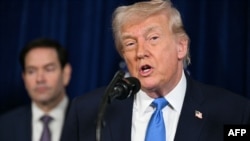
President Donald Trump said the United States has captured and holds Venezuela's Nicolas Maduro after carrying out a large-scale strike that has been sharply condemned by Iran, Russia, and other allies of the South American country.
In a news conference on January 3, Trump and other US officials gave some details of the operation to take Maduro into custody, adding the United States will "run" Venezuela “until such time as we can do a safe, proper, and judicious transition.”
"This extremely successful operation should serve warning to anyone who would threaten American sovereignty or endanger American lives," Trump, who posted a picture on social media showing Maduro standing bound in a tracksuit with blindfolded eyes and headphones on, said.
What happens next in Venezuela is far from clear, but the US strikes and the capture of Maduro have already been strongly condemned by some of Caracas's strongest partners, as well as United Nations Secretary-General Antonio Guterres, who said the US military action sets a "dangerous precedent."
Maduro -- who was indicted by the United States in 2020 -- and his wife are currently on board the US warship USS Iwo Jima and are heading to New York, Trump said, where they will face charges alleging "drug trafficking and narco-terrorism conspiracies."
Moscow, which maintains close ties with Venezuela, said it was extremely concerned by reports that Maduro and his wife had been forcibly removed from the country and urged Washington to release them.
"In light of confirmed reports that Venezuelan President Nicolas Maduro and his wife are in the United States, we strongly urge the American leadership to reconsider its position and release the legally elected president of a sovereign country and his wife," the Russian Foreign Ministry said in the statement.
Iran, Russia Denounce US Attack On Venezuela
The US military action on the Venezuelan capital of Caracas comes after months of rising economic and military pressure from Washington on the South American country, including intercepting Venezuelan oil tankers and killing dozens in strikes on boats near its waters that allegedly were carrying drugs.
Washington has also contested Maduro's legitimacy as president since he was the hand-picked successor to Hugo Chavez in 2013, pointing to successive elections that the opposition and others said were rigged in his favor.
Venezuela is Moscow's most important partner in Latin America and has provided diplomatic backing and military support for Maduro's regime over the years as he has faced international and domestic pressure over contested elections and an ongoing economic crisis.
The Russian Foreign Ministry called the strikes an "act of armed aggression against Venezuela" by the United States, saying any "excuses" given to justify such actions were "untenable."
The ministry added that Latin America must "remain a zone of peace."
Russian Foreign Minister Sergei Lavrov said he had spoken to Venezuelan Vice President Delcy Rodriguez by telephone and that he "expressed firm solidarity with the people of Venezuela in the face of armed aggression" and said Moscow would "continue to support" the government, according to a Russian summary of the conversation.
Iran, another key ally of Venezuela, condemned the US military attack, according to Iranian state outlet Press TV.
The Iranian Foreign Ministry said the attack violates Venezuela's sovereignty and territorial integrity as well as the UN charter.
"The US military aggression against an independent state that is a member of the United Nations is a gross violation of regional and international peace and security, the consequences of which will affect the entire international system," the ministry said.
More International Reactions To US Strikes
Cuba, one of Maduro's staunchest allies, denounced what it described as a "criminal" US attack on Venezuela and is urgently calling for a reaction from the international community.
Brazilian President President Luiz Inacio Lula da Silva said Washington had crossed an "unacceptable line" with the attack, and Mexico's Foreign Ministry also condemned the strikes, saying the move "seriously jeopardizes regional stability."
Many governments across Europe, including those in Poland, Britain, Belgium, and Italy, said they are closely following the situation and working to ensure the safety of their citizens in the region.
Others, such as Ukraine and Kosovo, have said following the strikes that they stand firmly with Washington and its most direct intervention in Latin America since the 1989 invasion of Panama.
"If this could be done to dictators, the United States would know what to do next," Ukrainian President Volodymyr Zelenskyy said in his comments to the press in Kyiv.
In a statement, European Union foreign policy chief Kaja Kallas said Maduro "lacks legitimacy" and called for "restraint" and a "peaceful transition" following his capture.
"Under all circumstances, the principles of international law and the UN Charter must be respected. We call for restraint," Kallas said.
China, which maintains strong economic and strategic ties with Venezuela, was slow to issue a statement on the strikes.
But a Chinese Foreign Ministry spokesperson said in a statement that Beijing "is deeply shocked by and strongly condemns the US’s blatant use of force against a sovereign state and action against its president."
Beijing, along with Moscow, expressed support for Venezuela this month as it confronted a US blockade on sanctioned oil tankers. China remains a top buyer for the majority of the oil shipped out of the South American country.
The day before the strikes, Maduro welcomed Qiu Xiaoqi, China's special representative on Latin American affairs, for a visit to Caracas, where they discussed China-Venezuela ties and Chinese investment projects in the country.
What Happens Next?
It's unclear where exactly the fast-moving situation in Venezuela is heading.
While Maduro has been captured, his government is still in power. Venezuelan Defense Minister Vladimir Padrino has vowed to resist US interference and a state of emergency has been declared in the country.
According to the country's constitution, Vice President Rodriguez is now in charge, although the US and Venezuela's opposition regard the 2024 vote that elected her and Maduro as fraudulent.
"We don’t want to be involved with having someone else get in, and we have the same situation that we had for the last long period of years. So we are going to run the country,” Trump said.
Shortly after Trump's news conference, Rodriguez said that Maduro is Venezuela's only president, calling for "calm and unity" to defend the country, which she added will "never be the colony of any nation."
Opposition leader Maria Corina Machado has positioned herself as a possible replacement who would be backed by the West, but large swaths of Maduro's political opponents are not supportive of US intervention.
In a statement released on X, Machado said Maduro will face “international justice for the atrocious crimes committed against Venezuelans” and called for opposition ally Edmundo Gonzalez Urrutia to immediately be recognized as the country's transitionary leader.
He also said the United States will be "very strongly involved" in Venezuela's oil industry and accused Venezuela of "stealing" from US oil companies.
"We're going to have our very large United States oil companies, the biggest anywhere in the world, go in, spend billions of dollars, fix the badly broken infrastructure, the oil infrastructure, and start making money for the country," Trump said.
Venezuela, which has been under US oil sanctions since 2019, produces about a million barrels of crude per day, most of which is sold on the black market at steep discounts.
Trump has claimed that the country has been using oil money to finance "drug terrorism, human trafficking, murder and kidnapping."
The strikes ordered by the Trump administration have also been criticized by some members of US Congress, where the issue of military action against Venezuela has been a hotly debated issue in recent months.
Shortly after the strikes were launched, Democratic Senator Ruben Gallego of Arizona wrote on X: "This war is illegal."
While many Republican lawmakers have praised the Trump administration's actions in Venezuela, other Democratic lawmakers echoed criticism, pointing out that the administration failed to notify Congress ahead of time under the War Powers Act.
That US law is designed to limit the president's ability to commit troops to a conflict without Congressional approval.
The Trump administration has argued in the past that Article II of the US Constitution, which states the president is the commander-in-chief of the US military, grants the president the ability to defend the country against those who pose an imminent threat to American lives.
Speaking at the same news conference as Trump, Secretary of State Marco Rubio said members of Congress were notified about the military operation in Venezuela immediately afterwards.
"This is not the kind of mission that you can do congressional notification on," Rubio said.
"It was a trigger-based mission in which conditions had to be met night after night."

