


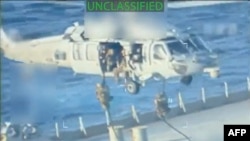
An oil tanker seized by US forces in the Caribbean has been under US Treasury sanctions since 2022 for allegedly being part of a global fleet of vessels engaged in illegally smuggling Iranian oil.
A Treasury statement from the time said the network was led by Viktor Artemov, a Ukrainian citizen with links to Hezbollah and Iran's Islamic Revolutionary Guards Corps-Quds Force (IRGC-QF), according to his US sanctions list entry.
US President Donald Trump announced the seizure of the tanker while speaking to reporters at the White House on December 10. Video released by US Attorney General Pam Bondi showed helicopters descending on the vessel and special forces taking control of it.
"For multiple years, the oil tanker has been sanctioned by the United States due to its involvement in an illicit oil shipping network supporting foreign terrorist organizations," she wrote on social media. "Our investigation alongside the Department of Homeland Security to prevent the transport of sanctioned oil continues."
Transporting Venezuelan Oil
Bondi said the ship was also used to transport sanctioned Venezuelan oil. The seizure comes amid a major US naval build up in the region and a controversial campaign of deadly attacks on alleged Venezuelan drug smuggling ships.
Venezuela condemned the seizure as an "act of piracy" and a "grave international crime."
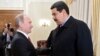
Later on December 11, the Kremlin issued a statement saying Russian President Vladimir Putin had spoken to his Venezuelan counterpart, Nicolas Maduro.
"Putin expressed solidarity with the Venezuelan people and reaffirmed his support for the Nicolas Maduro government's policies aimed at protecting national interests and sovereignty in the face of growing external pressure," it said.
The vessel, The Skipper, was named The Adisa when it was sanctioned. The 2022 Treasury statement listed it alongside eight other vessels it said were part of "a vast, complex, and interwoven global network of front companies that are used to facilitate oil shipments" for a smuggling network.
The operation involved "blending oil to conceal the Iranian origins of the shipments and exporting it around the world in support of Hezbollah and the IRGC-QF," through a network of shell companies in the Marshall Islands, Mauritius, and Singapore, it added.
This is a typical modus operandi for a shadow fleet, used to evade sanctions by nations such as Russia, Iran, and Venezuela.
Sailing Under Different Flags
In a recent interview, Benjamin Hilgenstock, a senior economist at the Kyiv-based KSE institute, told RFE/RL "when a ship becomes a shadow tanker, that's the time when you’ll get these weird special-purpose vehicles on the Marshall Islands involved as owners or when you get these constantly changing UAE-based ship managers."
The Skipper, launched in 2005, appears to be currently owned by a Nigeria-based company called Thomarose Global Ventures, according to publicly available data.
Another typical tactic for shadow fleet vessels is frequent changes of the flag under which the ship is registered. The Skipper was sailing under a Guyanan flag at the moment of its capture by US forces. But Guyana says it was not actually registered to the country.
"There have been cases where crews got arrested when the ship didn't have a proper flag," Hilgenstock said.
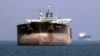
Iran's economy is heavily reliant on oil revenues, and it has used its shadow fleet of tankers to evade sanctions.
Dalga Khatinoglu, an Iran energy expert based in Azerbaijan, told RFE/RL's Radio Farda on December 11 that shadow tankers linked to the IRGC's oil-export operations are taking significant risks.
He suggested that seizing these vessels is especially damaging to the IRGC's finances, as the guards are responsible for exporting roughly one-third of Iran's oil to fund their own budget.
As part of its "maximum pressure" policy against Iran, Trump's administration has made it a priority to drive down Tehran's oil exports.
In November, it sanctioned six more vessels, with Treasury Secretary Scott Bessent stating the move continued efforts to "cut off funding for the Iranian regime's development of nuclear weapons and support of terrorist proxies."
The US Energy Information Administration (EIA) estimated Iran's crude oil and condensate export revenues at about $43 billion for 2024, up $1 billion from the previous year.
There is little publicly available information about Artemov. His US sanctions listing says he was born in Donetsk in 1975 and gives an address for him in Cologny, an elegant town on Lake Geneva in Switzerland where Russian oligarchs have reportedly purchased residences.

