




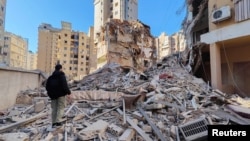
With the US-Israeli military campaign against Iran now into its sixth day, both sides continue to launch attacks amid fears the war could spill over into a broader regional conflict.
Michael Knights, head of research at Horizon Engage, a New York–based strategic advisory firm and an adjunct fellow at The Washington Institute, spoke with RFE/RL's Vazha Taberidze about the likely objectives in the conflict for both sides and what may happen if those aren't achieved.
RFE/RL: What's at stake in this confrontation? What are the strategic objectives of each side?
Michael Knights: The minimal US-Israeli objectives are that Iran's offensive military capability to affect environments outside of Iran has to be reduced to an absolutely maximal extent.
That means that the missile program is crippled for the long term. There's no aircraft available, as few helicopters as possible, no navy, no major long-range rocket systems, [and] ground force capabilities are greatly degraded. That's the minimum.

The bonus would be if the regime begins to crumble and there is ideally an inside-out change of government, meaning a change of government starting in Tehran, not a change of government starting in the provinces. This is why the president of the United States has been essentially begging Iranians to take over institutions and rise up within the cities.
But what we're starting to see is the other alternative happening, which is the crumbling of the regime from the outside, from Iranian Kurdistan, from the edges. That's not as attractive an outcome for anybody because it can start to break the country up and result in significant civil war-type conditions.
I don't think the Trump administration is going to back off without achieving its minimum objectives, which is an unprecedented destruction of the Iranian regime's military war machine and repressive institutions.
RFE/RL: Does the United States have a Plan B if the chosen strategy to achieve those objectives doesn't yield the desired results?
Knights: I think Plan B is to do the destruction and then to stop the operation and to leave the Israelis to continually go back and mow the grass as if Iran is a new Lebanon.
If you look at the Israelis after they defeated Hezbollah, they go back whenever they want and they prevent reconstitution. At this point, that would be a feasible option for the Israelis.
So one end point here is that the US only achieves its minimum objectives of taking down Iranian military capabilities. And from that point onward the Israelis just conduct an endless campaign between the wars over Iran, entering whenever they want, destroying any target that they detect. They do a sort of death of a thousand cuts against the regime over a longer period of time, and they foment uprisings at the edges of the Iranian state.
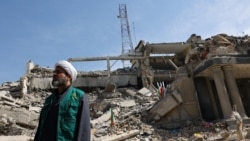

That objective doesn't sound so attractive to the US and to the Gulf states. So they're wondering: Is it just worth carrying on right now and pushing all the way through to the end and seeing if we can get a change of government right now? And it's done and dusted within weeks instead of months or years.
In Venezuela, it was very rapid. We had the Delcy government stepping up after Maduro stepped down, and they demonstrated subservience to the US. The US is recognizing that this option doesn't seem to be available in Iran. And as a result, if you can't overthrow this government, you are stuck with this situation for the long term.
RFE/RL: How big are the advantages that the US and Israel possess?
Knights: In conventional military terms, Iran is a house with no roof right now. The Israelis and the US will have full freedom of movement for the foreseeable future, maybe forever at this point.
Once it's at this point, the Israelis will never stop going back on a monthly basis until that regime is gone. It is bigger than Lebanon, but it's also very important to the Israelis. And they now have the capability to keep intervening for the foreseeable future.
What's at stake here is really the whole future of the region. We're at a dividing line right now where the post-1979 experience of the region can be fundamentally changed. And President Trump, you can tell he's obsessed with the idea that Iran can become a friend. I think the Trump people see Iran as a tragic waste of an amazing market and an amazing potential partner. So they want it over because they think that there's a lot to do there potentially.
RFE/RL: If Iran, maybe at a modest rate, is still able to continue firing, and if it adds even more drones to the mix, it could turn into a longer-term regional war. What would be the implications of that?
Knights: It's a scenario, for sure. At this point, what seems to be happening to try and head off that scenario is two things: The Gulf states themselves, instead of being noncombatants, which is what they're aiming to be, are coming to combatant status, and they themselves are now starting to police further out the counter-drone line.
What they're also likely to do is bring US manned aircraft forward from Jordan. That will provide a much thicker defense screen, particularly against drones over the Gulf itself. So there are things we haven't done yet which can still be used.
At the moment the Gulf states are using their most expensive assets to shoot down Iranian missiles. But there are a lot cheaper assets we haven't utilized yet because the Gulf states chose to tell us: No, go base over Jordan and Israel and Cyprus. Don't be in the Gulf littoral itself. Please don't bring your combat aircraft forward. So we might all see a change in that regard.

But let's just assume the worst-case scenario and that doesn't happen. The Iranians have deeper magazines than us. They manage to keep shooting, which is quite possible. The Houthis certainly did.
A couple of things then. One is that it's going to get very expensive to use Hormuz. It already is. The US is going to have to commit to something like the reflagging system from the Iran-Iraq War era and ensuring individual cargoes. So it's going to get expensive. Trump is not going to like that.
And the Gulf states are not going to like ongoing strikes that last for weeks instead of days. So it's fair to say that we're in a race right now.
RFE/RL: Finally, what's at stake for Russia and China?
Knights: Easy: same as with Venezuela. The problem with Russia and China's great power competition is they don't have power-projection capabilities. As a result, when something is happening far away, like Venezuela, or even as far away as Iran, they simply have no hard-power capability to affect the result. There's still a US hard power advantage at a continental range that the Russians and the Chinese don't have. Their soft power is extraordinary. But in this case it doesn't help a partner.
And everyone can see that Assad in Syria went down despite Russian support. Iran went down despite Russian and Chinese support. Venezuela, Maduro went down, as well. That's the reality.