Maia Sandu won 57 percent of the vote in Moldova's presidential runoff on November 15.
CHISINAU -- The winner of Moldova's presidential election has vowed to balanced ties with the West and Russia, while tackling corruption and drawing investment to one of Europe's poorest countries.
Maia Sandu, a former World Bank economist, decisively defeated pro-Russian incumbent Igor Dodon in a November 15 runoff vote, preliminary results showed.
The vote was viewed as a referendum on whether the former Soviet republic sandwiched between Ukraine and Romania should move closer to the EU or be drawn more tightly into Moscow's orbit.
Speaking to reporters on November 16, Sandu said she would ensure a "real balance" in foreign policy between the West and Russia.
"We will establish a pragmatic dialogue with all countries, including Ukraine, Romania, European nations, Russia, and the United States," she said.
Sandu said her administration would focus on fighting endemic corruption and attracting investment to boost the economy.
"Everyone should see an improvement. That includes people who voted for my opponent. I am telling you: you have not lost, there are no winners or losers here. I will win your confidence with concrete actions," she said.
Although there had been concerns about postelection instability, Dodon quickly conceded defeat.
"I call for calm and peace, absolutely no disturbances or protests. We must not allow any destabilization of the country," he said.
Russian President Vladimir Putin, who openly backed Dodon, quickly congratulated Sandu on her election victory.
"I expect that your work as head of state will facilitate the constructive development of relations between our countries," Putin said, according to a statement on the Kremlin website.
European Commission President Ursula von der Leyen also congratulated Sandu on her victory and pledged greater cooperation.
"Your victory is a clear call to tackle corruption and restore respect for the rule of law -- the path to a prosperous future. The EU is ready to support Moldova," von der Leyen said on Twitter.
During separate telephone calls with Romanian President Klaus Iohannis and Ukrainian President Volodymyr Zelenskiy, Sandu pledged to make efforts to strengthen relations with Moldova's two neighbors, the press office of her Party of Action and Solidarity said.
Sandu captured 57.75 percent of the vote in the presidential runoff, leaving Dodon behind by more than 15 percentage points at 42.25 percent, the Central Election Commission said after 100 percent of the votes had been counted.
Turnout was more than 52 percent -- nearly 10 percentage points higher than the final turnout recorded during the first round.
Observers from the Organization for Security and Cooperation in Europe (OSCE) said the vote was generally well-managed and competitive under challenging circumstances caused by the COVID-19 pandemic. However, observers said negative and divisive rhetoric marred the campaign and issues remain over campaign financing rules.
The vote was the latest rematch between Dodon and Sandu, who won a surprise victory in the first round of the election on November 1 but failed to cross the 50 percent threshold to avoid a runoff.
In 2016, Dodon defeated Sandu by less than 5 percentage points in an election that was marred by allegations of fraud.
Sandu, a former prime minister, campaigned against corruption and called for closer ties with the EU.
Dodon ran on a platform calling for "stability" and promoted his record of securing loans and other economic favors from Moscow.
He has been criticized for his handling of the coronavirus pandemic, during which more than 89,000 Moldovans have been infected and more than 2,000 have died.
Moldova, with a population of about 3.5 million, is one of Europe's poorest countries, hampered by a creaky economy and rampant corruption.
The country is also hobbled by the unresolved status of Transdniester, a breakaway region that has been de facto independent since a separatist war in the 1990s.
Transdniester is backed economically and politically by Moscow, which wants to keep Moldova in its sphere of influence, especially with the ongoing wave of political unrest sweeping across other former Soviet republics.
Will They Stay Or Will They Go? Russian Peacekeepers In The Post-Soviet Space
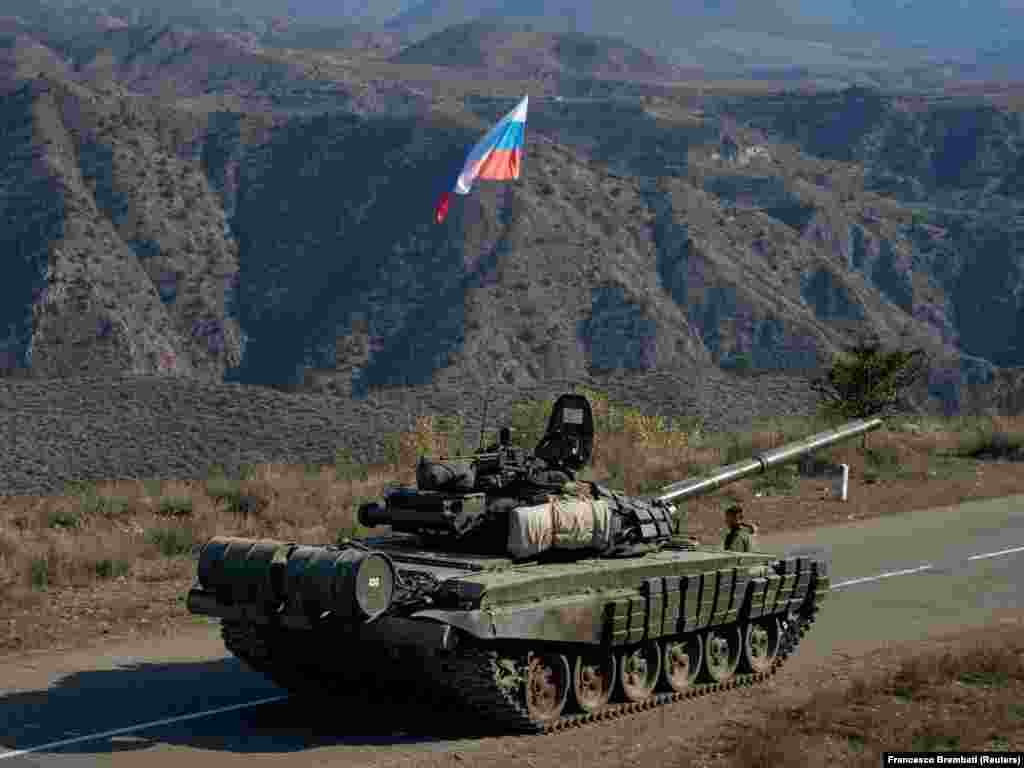
1/10A member of the Russian peacekeeping troops stands next to a tank near the border with Armenia following the signing of a deal to end the military conflict between Azerbaijan and ethnic Armenian forces in Nagorno-Karabakh.
More than 400 Russian troops of a planned 2,000 were already being put in place on November 11 as part of a renewable five-year peacekeeping mission.
Following the Russian-brokered truce signed between Armenia and Azerbaijan late on November 9, Moscow is sending troops to monitor the peace. This is not the first time Russian peacekeepers have been deployed to the former Soviet space, with often very different outcomes.
Show moreShow less
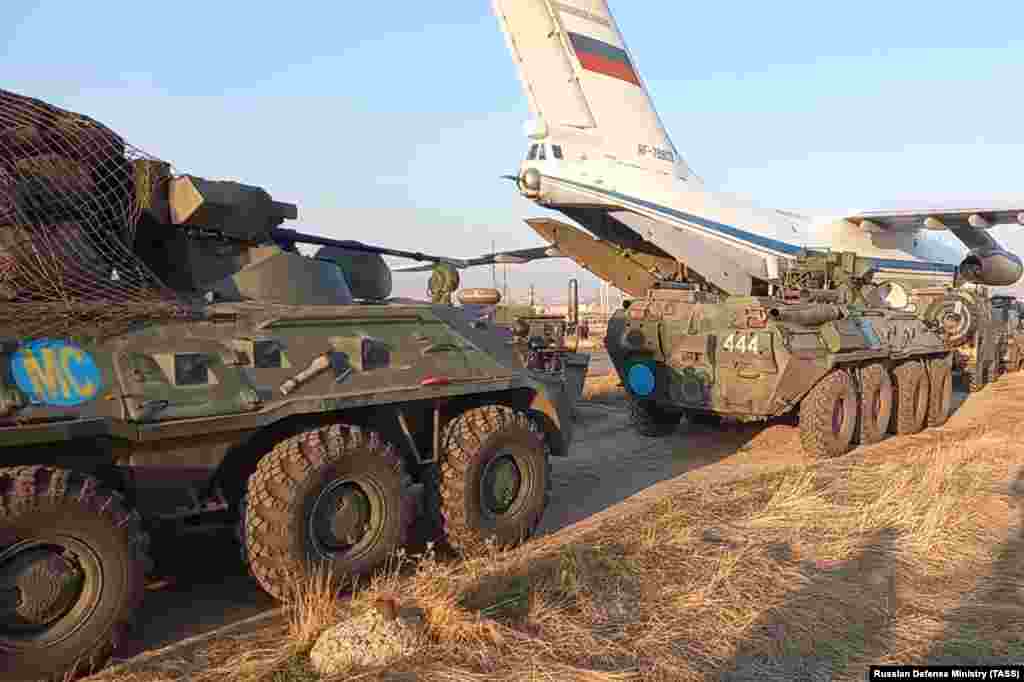
2/10Military vehicles stand next to a plane as Russian peacekeepers arrive at an airport outside Yerevan on November 11.
While the announcement of the cease-fire deal triggered celebrations in Azerbaijan, it sparked angry protests in Armenia, with demonstrators storming government buildings and parliament.
Following the Russian-brokered truce signed between Armenia and Azerbaijan late on November 9, Moscow is sending troops to monitor the peace. This is not the first time Russian peacekeepers have been deployed to the former Soviet space, with often very different outcomes.
Show moreShow less
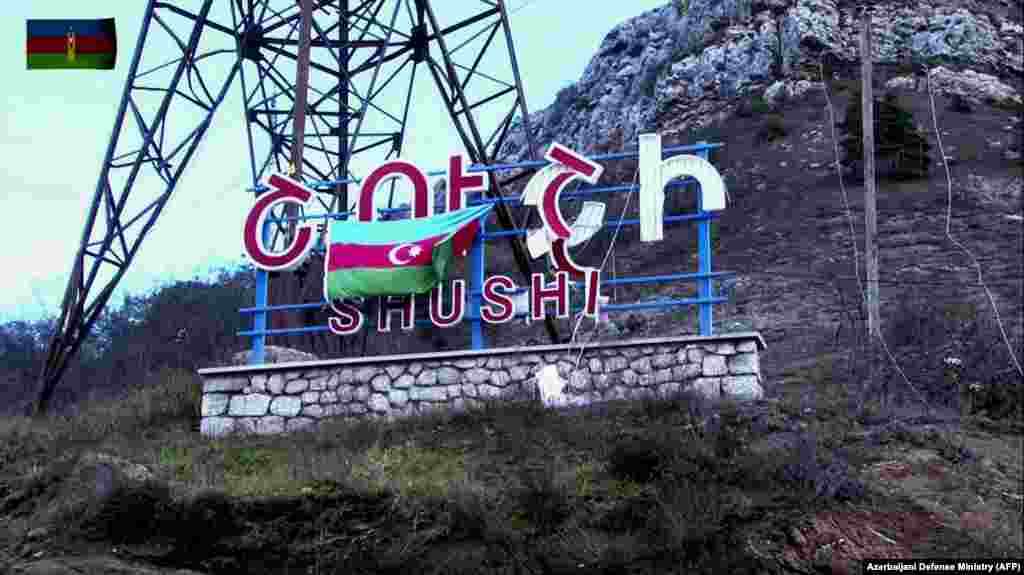
3/10The truce came after Azerbaijani forces made major battlefield gains, including reports they were approaching Nagorno-Karabakh's main city of Stepanakert after taking the nearby strategic town of Shushi, known as Susa in Azeri.
Following the Russian-brokered truce signed between Armenia and Azerbaijan late on November 9, Moscow is sending troops to monitor the peace. This is not the first time Russian peacekeepers have been deployed to the former Soviet space, with often very different outcomes.
Show moreShow less
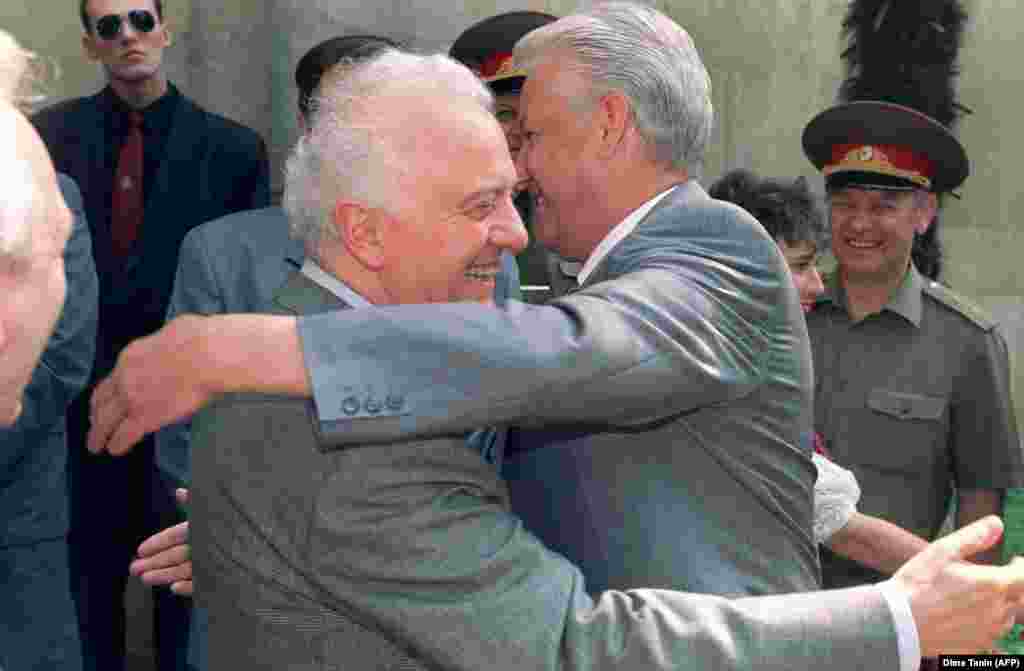
4/10In June 1992, Russia's Boris Yeltsin (right) and Georgia's Eduard Shevardnadze met in Sochi, and signed an agreement that ended sporadic low-level fighting in South Ossetia, in which up to 1,000 people had died over the previous few years. It created a trilateral Joint Peacekeeping Force comprising 500 peacekeepers each from Russia, Georgia, and North Ossetia (co-ethnics of the population in South Ossetia across the border in Russia), as well as a commission overseeing them.
Following the Russian-brokered truce signed between Armenia and Azerbaijan late on November 9, Moscow is sending troops to monitor the peace. This is not the first time Russian peacekeepers have been deployed to the former Soviet space, with often very different outcomes.
Show moreShow less
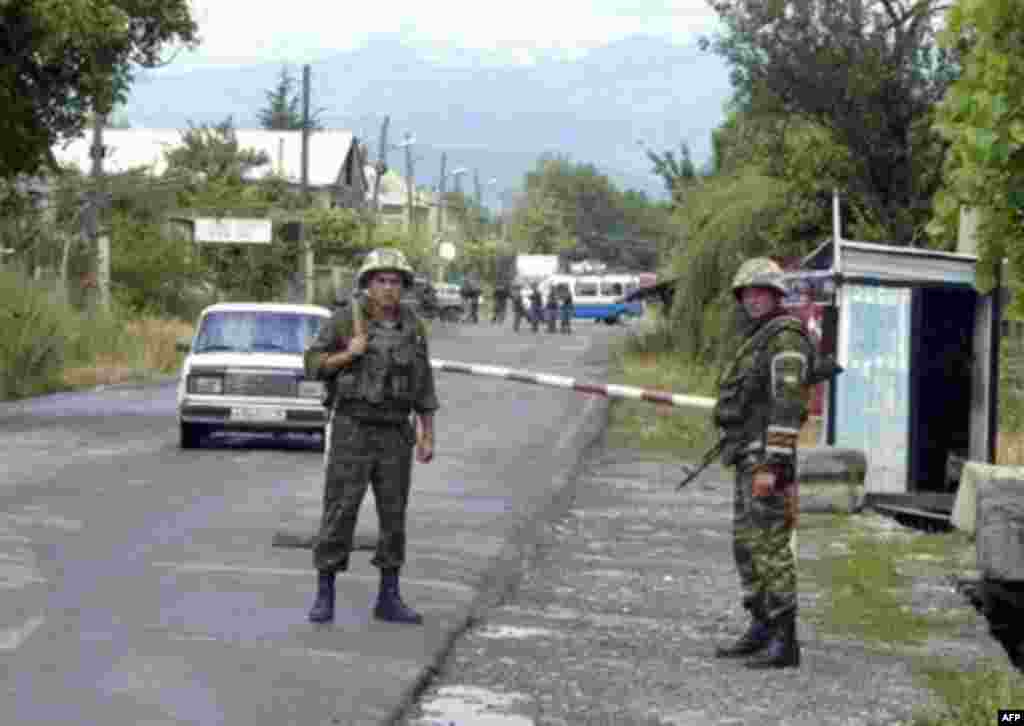
5/10Russian peacekeepers guard a checkpoint in South Ossetia.
The peace held until 2004, when Mikheil Saakashvili came to power in Georgia. Between cracking down on cross-border smuggling and a failed clandestine attempt to retake the region by force, tensions grew and the peacekeeping commission failed to meet at all as each party raised objections.
Following the Russian-brokered truce signed between Armenia and Azerbaijan late on November 9, Moscow is sending troops to monitor the peace. This is not the first time Russian peacekeepers have been deployed to the former Soviet space, with often very different outcomes.
Show moreShow less
6/10Russian tanks move through Tskhinvali in August 2008.
In early August 2008, South Ossetian forces began shelling Georgian villages and Georgian forces retaliated. Each side accused the other of initiating the violence. On August 7, Georgia moved in troops and attempted to regain control of South Ossetia. Moscow responded quickly with a large force of tanks and troops, driving Georgian troops back and occupying a number of towns before a cease-fire on August 12.
Following the Russian-brokered truce signed between Armenia and Azerbaijan late on November 9, Moscow is sending troops to monitor the peace. This is not the first time Russian peacekeepers have been deployed to the former Soviet space, with often very different outcomes.
Show moreShow less
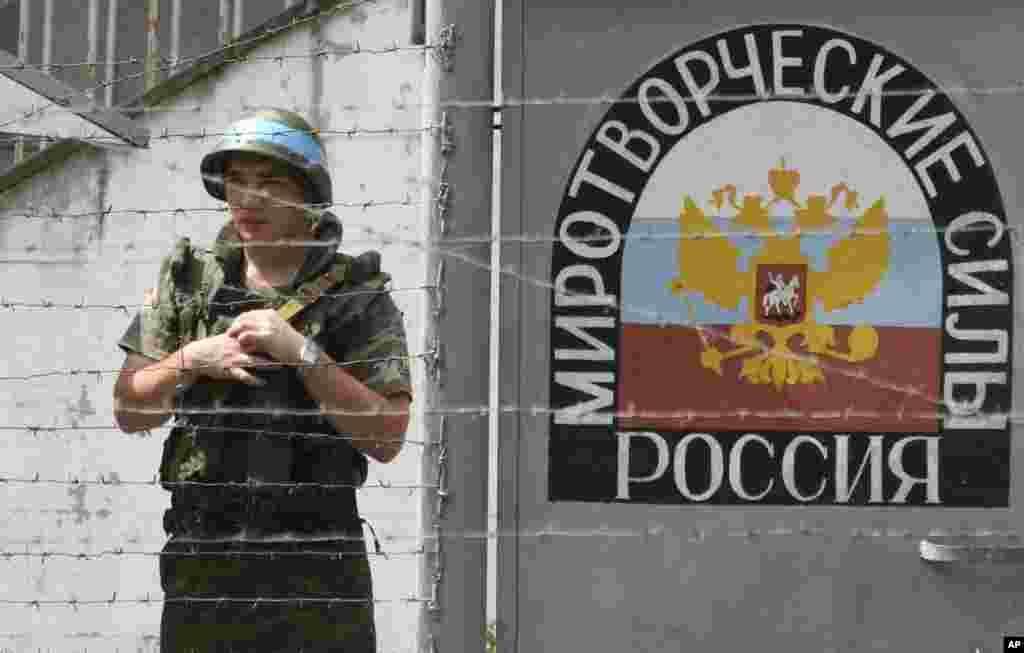
7/10A Russian peacekeeper guards a checkpoint at the Inguri River in Abkhazia on August 14, 2008.
In Georgia's other breakaway region of Abkhazia, Russian peacekeepers had been stationed since 1994 to stop military clashes and ethnic cleansing that began in 1992, along with unarmed UN observers. This force fought sporadically with local Georgian militants as well as militants from the neighboring North Caucasus. As fighting broke out in South Ossetia in August 2008, Russian and Abkhaz forces attacked Georgian troops in the Kodori Gorge and then moved into Georgia.
Following the Russian-brokered truce signed between Armenia and Azerbaijan late on November 9, Moscow is sending troops to monitor the peace. This is not the first time Russian peacekeepers have been deployed to the former Soviet space, with often very different outcomes.
Show moreShow less
8/10Russian President Dmitry Medvedev (center) shakes hands with the leaders of South Ossetia and Abkhazia, Eduard Kokoity (right) and Sergei Bagapsh, in Moscow in September 2008.
On August 26, 2008, Russia recognized the two regions as independent states. Russia has maintained troops in both regions, which have been recognized as independent by only a handful of other countries, including Syria in 2018.
Following the Russian-brokered truce signed between Armenia and Azerbaijan late on November 9, Moscow is sending troops to monitor the peace. This is not the first time Russian peacekeepers have been deployed to the former Soviet space, with often very different outcomes.
Show moreShow less
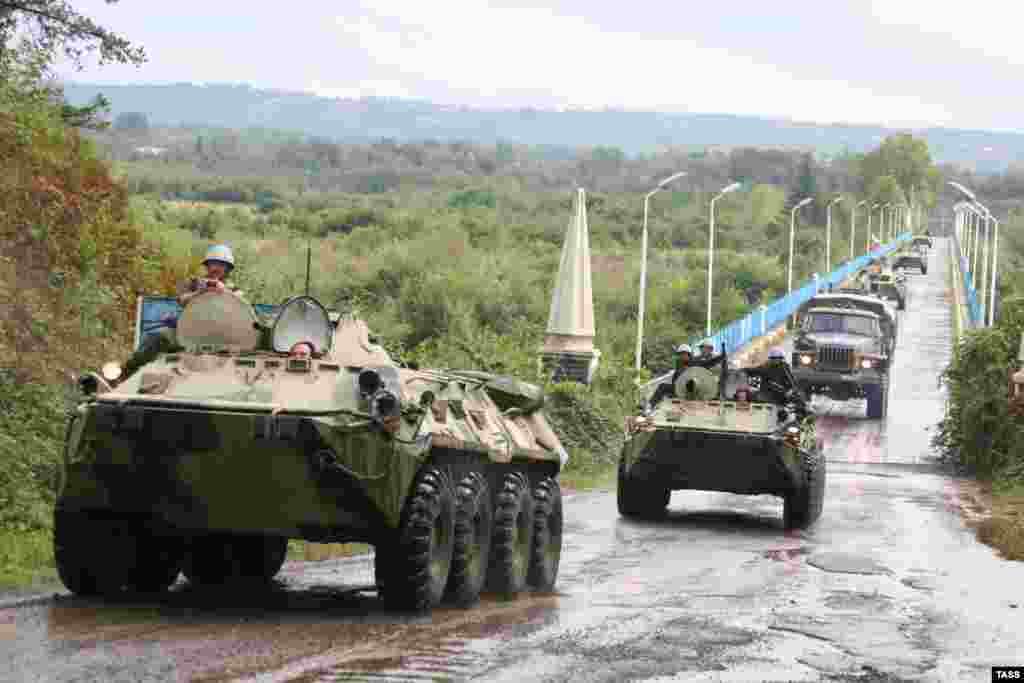
9/10A column of Russian armored vehicles withdraws through Rukhi, Georgia, on its way to Abkhazia in October 2008.
After recognizing Abkhaziaand Soth Ossetia, Russia built a number of military bases in the two regions, and also protects their borders and supports both regions financially. Abkhazia and South Ossetia have been effectively turned into Russian dependencies.
Following the Russian-brokered truce signed between Armenia and Azerbaijan late on November 9, Moscow is sending troops to monitor the peace. This is not the first time Russian peacekeepers have been deployed to the former Soviet space, with often very different outcomes.
Show moreShow less
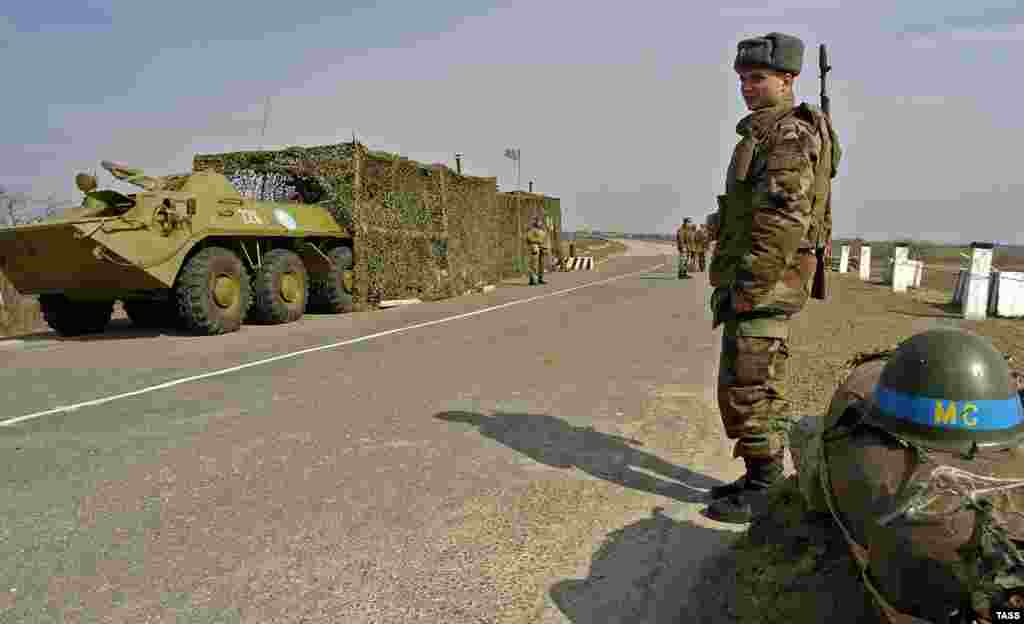
10/10Russian peacekeepers guard a checkpoint in Moldova's breakaway Transdniester region in January 2012.
A force comprising troops from Moldova, Russia, and the breakaway region of Transdniester was set up following a truce in 1992 to stop fighting between Moldovan forces and Transdniestrian forces backed by Cossacks and Russian troops stationed in the enclave. The peace has held since then, but Transdniester's independence is not recognized by any country. Russia has refused repeated demands by the Moldovan government to facilitate the replacement of Russian troops with internationally recognized peacekeepersand maintains strong influence in Moldova as a whole.
Following the Russian-brokered truce signed between Armenia and Azerbaijan late on November 9, Moscow is sending troops to monitor the peace. This is not the first time Russian peacekeepers have been deployed to the former Soviet space, with often very different outcomes.
RFE/RL’s Moldova Service reaches 30 percent of the population in Moldova each week, increasing listeners’ understanding of local, regional, and global events.