



Accessibility links

Breaking News

News

At Least 32 Killed In Heavy Fighting In Nagorno-Karabakh

Fighting Reported In Nagorno-Karabakh
please wait

No media source currently available

0:00 0:00:59 0:00

WATCH: Fighting broke out early on April 2 in the disputed region of Nagorno-Karabakh inside Azerbaijan. Video shot in the Azerbaijani town of Terter, near the line of control, shows shots being fired before dawn, damage from bullets or shrapnel, and people fleeing along the road, apparently in search of safety. (Video provided to RFE/RL's Azerbaijani Service)

Intense fighting has been reported in the disputed region of Nagorno-Karabakh inside Azerbaijan, with heavy casualties reported on both sides and the OSCE expressing its "grave concern" at developments.

The Armenian military accused Azerbaijani forces of launching a major offensive, involving tanks, heavy artillery, and helicopter gunships.

The Azerbaijani military said its frontline forces had first come under "intensive fire" from mortars, grenade launchers, and artillery and that the Azerbaijani Army had to take "urgent measures" to respond.

The Azerbaijani Defense Ministry said that 12 soldiers had died in the fighting. It said one Mi-24 helicopter was shot down and that one tank had been destroyed in a mine explosion.

The ministry claimed the army had "liberated strategic heights and settlements" in the region.

"Six Armenian tanks were destroyed [and] more than 100 Armenian servicemen were killed and injured," it said in a statement.

President Serzh Sarkisian said Azerbaijani troops had killed 18 ethnic Armenian soldiers.

"From our side, 18 soldiers were killed and some 35 others wounded," Sarkisian said at a meeting of the National Security Council in Yerevan, according to his press office.

He did not specify if the soldiers belonged to Yerevan-backed separatist forces in Nagorno-Karabakh or Armenia's armed forces.

Reports from the region said two civilians had also been killed, including a 12-year-old boy.

WATCH: Several soldiers wounded in fresh fighting in the disputed region of Nagorno-Karabakh inside Azerbaijan were transported to a military hospital in the Armenian capital, Yerevan, on April 2. (RFE/RL's Armenian Service)
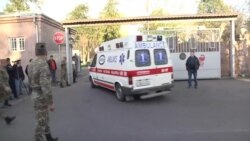
Troops Wounded In Nagorno-Karabakh Clashes Arrive At Yerevan Hospital
please wait

No media source currently available

0:00 0:00:31 0:00

Nagorno-Karabakh lies inside Azerbaijan but is controlled by ethnic Armenians.

The Armenian Defense Ministry called it the most serious escalation of fighting in the conflict since a 1994 truce and called on the United States, Russia, and France -- who lead international efforts to mediate the conflict -- to urgently intervene.

Armenian Prime Minister Ovik Abrahamian convened an urgent meeting over the "unprecedented large-scale hostilities from the enemy," the Armenian government said.

"Armenia is ready to take the necessary steps to stabilize the situation," Abrahamian said.

Armenian President Serzh Sarkisian is expected to convene a Security Council meeting on the situation later on April 2.

WATCH: Sarkisian Calls For Military Cooperation With Nagorno-Karabakh

Sarkisian Calls For Military Cooperation With Nagorno-Karabakh
please wait

No media source currently available

0:00 0:00:57 0:00

In a statement, the co-chairs of the OSCE Minsk Group, which has been mediating the conflict, expressed "grave concern over the reported large-scale cease-fire violations that are taking place along the Line of Contact in the Nagorno-Karabakh conflict zone. We strongly condemn the use of force and regret the senseless loss of life, including civilians.

The statement -- by ambassadors Igor Popov of Russia, James Warlick of the United States, and Pierre Andrieu of France -- called upon the sides to stop shooting and take all necessary measures to stabilize the situation on the ground.

Warlick said on Twitter that the OSCE Minsk Group co-chairs will meet in Vienna on April 4 and convene the Minsk Group on April 5 to address the violence.

Russia's President Vladimir Putin's press secretary, Dmitry Peskov, said Putin is "deeply concerned about the reports on resumed military actions along the line of engagement in Nagorno-Karabakh." He said Putin called on the parties to the conflict to implement an immediate cease-fire and to exercise restraint.

The wreckage of what Karabakh Armenian forces described as an Azerbaijani military helicopter shot down on April 2.

Russian Foreign Minister Sergei Lavrov later spoke separately by phone with the foreign ministers of Azerbaijan and Armenia to urge calm, the Russian Foreign Ministry said. Russia has sold arms to both sides in the conflict.

U.S. Secretary of State John Kerry condemned “in the strongest terms” the cease-fire violations while extending Washington’s condolences to all affected families.

“We urge the sides to show restraint, avoid further escalation, and strictly adhere to the cease-fire,” Kerry said in an April 2 statement.

He added that “the unstable situation on the ground demonstrates why the sides must enter into an immediate negotiation under the auspices of the OSCE Minsk Group co-chairs on a comprehensive settlement of the conflict.”

The U.S. top diplomat reiterated that there is no military solution to the conflict.

EU foreign policy chief Federica Mogherini called on the parties to stop the fighting immediately and observe the cease-fire.

“The sides must show restraint and avoid any further actions or statements that could result in escalation,” Mogherini said in a statement.

She said both sides should refrain from the use of force and resume efforts towards a peaceful resolution of the conflict.

Hikmat Hajiyev, a spokesman for Azerbaijan's Foreign Ministry, called on the international community to condemn Armenia's actions.
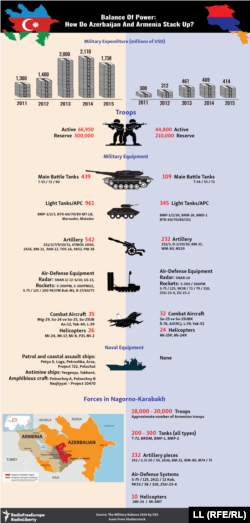
BALANCE OF POWER: How Do Azerbaijan & Armenia Stack Up? (CLICK TO ENLARGE)

The conflict over Nagorno-Karabakh broke out in the dying years of the Soviet Union and killed about 30,000 people.

Years of diplomatic efforts, led by the OSCE, have been largely unsuccessful at resolving the simmering crisis between the two heavily armed neighbors.

The fresh outbreak of violence came as the presidents of both Azerbaijan and Armenia, Ilham Aliyev and Sarkisian, were winding up visits to the United States.

Just hours before the fighting broke out, Aliyev and Sarkisian met jointly with U.S. Vice President Joe Biden, who called on the South Caucasus leaders to peacefully settle the protracted dispute.

On March 30, U.S. Secretary of State John Kerry called for an "ultimate resolution" to the conflict during talks in Washington with Aliyev.

At his meeting with Kerry, Aliyev thanked the United States for trying to end the conflict but said it could only be resolved through a United Nations Security Council resolution calling for the "immediate and unconditional withdrawal of Armenian troops" from Azerbaijan.

Nagorno-Karabakh, populated mainly by ethnic Armenians, declared independence from Azerbaijan. A 1988-94 war claimed an estimated 30,000 lives and displaced hundreds of thousands of people.

Internationally mediated negotiations with the involvement of the OSCE's Minsk Group have failed to result in a resolution. The Minsk Group is co-chaired by France, Russia, and the United States.

WATCH: At least two children were hospitalized in Stepanakert, the main city of Nagorno-Karabakh, after clashes erupted on April 2.
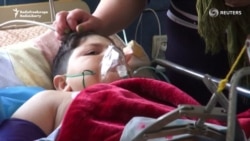

Wounded Children Hospitalized After Nagorno-Karabakh Clashes
please wait

No media source currently available

0:00 0:00:27 0:00

More News

Fugitive Bulgarian Businessman Returns, Immediately Detained By Sofia Authorities

Vasil Bozhkov (center) at Sofia's airport on August 25.

Gaming czar Vassil Bozhkov, 67, was detained upon his return to Bulgaria from self-imposed exile, the Sofia prosecutor’s office said on August 25. Bozhkov left for Dubai three years ago after 18 charges were filed against him, including extortion and attempted bribery. Bozhkov’s lawyer confirmed his client had been detained but declined to say whether the wealthy businessman had made a deal with authorities, saying only that he wanted to clear his name. Bozhkov earlier said he was ready to return to Bulgaria as a “protected witness” to testify against former Prime Minister Boyko Borisov, whom he accused of blackmailing him for several years. Britain and the United States have sanctioned Bozhkov on corruption allegations. To read the original story by RFE/RL’s Bulgarian Service, click here.

U.S. Official Urges North Macedonia To Press Forward On Reforms

Gabriel Escobar (center), deputy U.S. assistant secretary for Balkan policy, in Skopje on August 25

A top U.S. diplomat urged North Macedonia’s government and opposition to move forward on constitutional changes that would help the small Western Balkan nation its effort to join the European Union. During a visit to Skopje, Gabriel Escobar, deputy assistant secretary for Balkan policy, told Prime Minister Dimitar Kovachevsk, opposition leader Hristijan Mickosk, and others that “the European Union and the United States need you -- you are a strategic partner and close friend,” and called on them to make the “difficult decisions that will make a brighter future.” To read the original story by RFE/RL’s Balkan Service, click here.

Iranian Bar Associations Protest Government Moves They Say Will Erode Their Power

Lawyers gather to protest the parliamentary resolution.

Lawyers in several Iranian provinces have staged demonstrations against recent decisions made by the Islamic Consultative Assembly that they say go against the country's judicial foundation.

At a gathering outside their respective bar association buildings on August 24, the lawyers said a parliamentary resolution obliging them to adhere to the directives of the Economic Ministry's Regulatory Board without being able to challenge the changes via the Administrative Justice Court is "inconsistent with the nation's fundamental rights and an infringement on the Bar Association's autonomy."

The resolution "breaches the principle of separation of powers and is at odds with the overarching judicial policies of the nation," the bar associations said, adding an appeal has been launched with the Guardians Council to overturn the decision.

According to official statements from the Iranian Bar Association, the lawyers also have urged senior figures from the three branches of government and the Supreme Supervisory Board of the Expediency Discernment Council to address the "unconstitutional and unlawful elements of the resolution."

A petition supporting the bar associations has gathered more than 19,000 signatures in under 48 hours.

Ali Pezeshki, the Zanjan Bar Association's leader, pointed out that the parliamentary assembly's reconciliation commission has shifted the power to issue, renew, and revoke advocacy licenses from the associations to the Economic Ministry.

The Bar Association, Iran's oldest legal body, has faced persistent pressure from both governmental agencies and the judiciary over the past four decades. Its autonomy and powers have been steadily eroded by a series of legislative measures.

Since the unrest following Mahsa Amini’s death last September, at least 129 lawyers have faced "judicial encounters," according to the group Human Rights Activists in Iran (HRA). This includes both arrests and summonses for a variety of reasons, ranging from practicing their profession to expressing views on social media.

The HRA said that 55 lawyers have been arrested, 70 have been summoned, and numerous others have faced judicial and security confrontations since the protests began. However, the recent wave of summoning lawyers to sign a "commitment" and express regret for the protests suggests an escalation in the crackdown on the legal profession.

The Islamic republic's judiciary has been restricting access to protester cases, often only accepting representation from lawyers approved by the head of the judiciary. However, independent lawyers have sometimes managed to overturn heavy sentences, such as the death penalty, during the appeal stage.

Written by Ardeshir Tayebi based on an original story in Persian by RFE/RL's Radio Farda
Updated

Turkish Foreign Minister Says 'No Alternative' To Ukraine-Russia Grain Deal During Kyiv Visit

Ukrainian Prime Minister Denys Shmyhal (right) with Turkish Foreign Minister Hakan Fidan in Kyiv on August 25.

KYIV -- Turkish Foreign Minister Hakan Fidan said during a visit to Kyiv that there is “no alternative” to the original Ukraine-Russia grain deal that was brokered by his country and the United Nations but which collapsed after Moscow pulled out of the agreement last month.

“We know alternative routes are being sought [for grain shipments], but we see no alternative to the original initiative because they carry risks," Fidan told reporters on August 25 after meeting with President Volodymyr Zelenskiy and Prime Minister Denys Shmyhal in the Ukrainian capital.

"Revitalizing this initiative is a priority for Turkey," Fidan added.

The comments follow remarks by some Western allies suggesting the possibility of establishing alternative ways of ensuring the export of Ukrainian grain, including the “possibilities of railway transportation and the capacities of the ports of individual NATO member states."

The deal initially allowed Ukraine to ship grain through blockaded ports on the Black Sea. However, Russia withdrew from the agreement last month and began attacking Ukrainian port and grain facilities.

Many world leaders expressed concerns that interruption of the grain deal would raise prices and cause further food insecurity, especially in poorer nations, including some in Africa and others such as Haiti.

U.S. Secretary of State Antony Blinken on August 3 took aim at Russia in a speech to the UN Security Council, accusing Moscow of "blackmail" over its withdrawal from the Black Sea Grain Initiative.

Shmyhal earlier said he and Fidan had discussed the crucial grain deal, along with overall trade and economic issues between the two nations, during the Kyiv talks.

Shmyhal wrote on Telegram that the two sides also discussed plans for future restoration of Ukrainian infrastructure after the ongoing Russian invasion is over, as well as "other joint projects."

"We are looking forward to a brisk finalization of all the procedures regarding the acquisition of the [previously agreed] free-trade agreement. We discussed in detail the issue of global food security. In that regard, we have a fruitful dialogue with Turkey, and we count on further cooperation," Shmyhal wrote.

Ukraine and Turkey agreed to the free-trade deal when Turkish President Recep Tayyip Erdogan visited Kyiv in early February 2022, three weeks before Russia launched its full-scale aggression against Ukraine.

Shmyhal also expressed thanks to Ankara for its support of Zelenskiy's efforts to end Russia's unprovoked war while reasserting Kyiv’s position that Ukrainian-Russian peace talks are only possible after the full withdrawal of Russian troops from Ukrainian territory.

Ankara has attempted to maintain relations with both Kyiv and Moscow following Russia's invasion, both on political and economic issues.

Fidan reiterated Ankara's support for Ukraine's independence and territorial integrity and stressed the importance of the resumption of Ukrainian grain exports and the restoration of Ukraine's infrastructure.

Zelenskiy expressed gratitude to Turkey for its role last month in returning to Ukraine five commanders of the Azov Battalion taken prisoner by Russia during the brutal struggle for the city of Mariupol early in the war that culminated with a long, bloody holdout at the Azovstal steel plant.

The commanders had been handed over to Turkey by Russia, and their released angered the Kremlin, which said the return violated an agreement “on the exchange of prisoners.”

Kyiv and Moscow had previously agreed that the five commanders, who were taken prisoner when Russia captured the port city of Mariupol, would remain in Turkey until the end of the war.

Putin Will Not Travel To India For G20 Summit Next Month

Russia's President Vladimir Putin shakes hands with India's Prime Minister Narendra Modi in New Delhi in December 2021.

Russian President Vladimir Putin won’t travel to India for the G20 summit on September 9-10, Kremlin spokesman Dmitry Peskov said on August 25. Peskov said Putin is concentrating on the “special military operation” -- what the Kremlin calls its invasion of Ukraine. Putin has an outstanding arrest warrant issued in his name by the UN's International Criminal Court (ICC), although India, like the United States, China, and Russia, is not a signatory nation. Putin also didn't travel to Indonesia for the G20 summit last year in the face of boycott threats by several countries if he did attend amid Russia's ongoing invasion of Ukraine. To read the original story by RFE/RL’s Ukrainian Service, click here.

Estonia PM Under Pressure To Quit Over Husband's Russia Ties

Estonia's Prime Minister Kaja Kallas

Estonian Prime Minister Kaja Kallas on August 25 faced pressure to resign amid reports that her husband has part ownership in a company that has kept operations in Russia since Moscow invaded Ukraine. Two major Estonian newspapers called on her to resign and two opinion polls found a majority of respondents thought she should step down. Kallas has said she doesn’t believe her husband's companies have done anything wrong, while her husband said he was selling his stake in the company in question. Kallas has regularly urged European businesses to cut ties with Moscow. To read the original story by Reuters, click here.

Lukashenka Says 'Core' Of Wagner Fighters Will Remain In Belarus

"Wagner lived. Wagner is living. And Wagner will live in Belarus. The core remains here," Lukashenka said. (file photo)

Belarus's authoritarian leader Alyaksandr Lukashenka said the “core” of the Wagner mercenary group -- about 10,000 fighters -- will remain in his country in his first comments since the presumed death of the organization’s leader, Yevgeny Prigozhin, in a suspicious plane crash in Russia. "Wagner lived. Wagner is living. And Wagner will live in Belarus. The core remains here," he said in comments reported by the Belarusian state news agency BelTA on August 25. "As long as we need this unit, they will live and work with us." Following Prigozhin’s short-lived mutiny in late June against the Russian military, Lukashenka helped broker a deal that supposedly guaranteed the Russian mercenary leader’s safety and allowed his fighters to relocate to Belarus. To read the original story by RFE/RL’s Belarus Service,click here.

EU Parliament Member Urges Kyrgyz Compliance With Sanctions Against Russia

Kyrgyz President Sadyr Japarov (left) met David McAllister in Bishkek on August 24.

The European Parliament's Foreign Committee chair David McAllister has urged Kyrgyzstan to ensure compliance with international sanctions against Russia amid growing concerns countries in Central Asia are being used to bypass the measures.

"International sanctions are aimed not at Kyrgyzstan but at aggressor countries such as Russia and Belarus. We understand Kyrgyzstan's situation and its involvement in organizations like the Eurasian Economic Community (EAEU) and the Collective Security Treaty Organization (CSTO)," McAllister said during a visit to Bishkek on August 24, where he met with President Sadyr Japarov.

"However, we condemn any country's efforts to evade these sanctions, including the illicit export and import of goods on the sanctions list," he added.

The European Union (EU) has expressed concerns about the increasing demand for EU products from Russia's neighboring countries, including Armenia, Kazakhstan, and Kyrgyzstan, as well as other nations maintaining trade relationships with Moscow, such as the United Arab Emirates, Turkey, and China.

In response to Russia's actions in initiating the war in Ukraine, the European Union, the United States, and several other countries have imposed sanctions against Russia for its full-scale invasion of Ukraine.

Signs the sanctions were being circumventedprompted the United States in July to introduce further sanctions that target 18 individuals and over 120 entities located in both Russia and Kyrgyzstan. These sanctions were designed to hinder Moscow's access to products and technology supporting Russia’s full-scale invasion in Ukraine.

Among the entities were several based in Kyrgyzstan that the U.S. Treasury Department identified as intermediaries facilitating the provision of foreign-made electronics and technologies to Russia. These recent sanctions add to the broader international measures imposed on Russia.

Uzbek President Appoints His Daughter To Position In His Office

Saida Mirziyoeva

Uzbekistan's President Shavkat Mirziyoev appointed his 38-year-old daughter, Saida Mirziyoeva, as an assistant to the president, on August 25, the official Telegram channel of the Uzbek president said. The practice of appointing relatives to influential state positions is common in authoritarian Central Asian nations. In Turkmenistan, President Serdar Berdymukhammedov succeeded his father, Gurbanguly Berdymukhammedov. In Tajikistan, Emomali Rahmon's eldest son, Rustam Emomali, holds key positions, including chairman of the parliament's upper chamber and mayor of Dushanbe. To read the original story by RFE/RL’s Uzbek Service, click here.

Putin Signs Decree Obliging Paramilitary Fighters To Swear Oath To Russian Flag

Russia's President Vladimir Putin (left) and Defense Minister Sergei Shoigu (file photo)

Two days after the presumed death of Wagner mercenary group leader Yevgeny Prigozhin, Russian President Vladimir Putin has signed a decree obliging paramilitary troops to swear an oath to Russia's national flag. The decree applies to all members of volunteer formations -- a term used by officials to describe mercenary groups, as they are officially outlawed in the country. The decree comes two months after Prigozhin-led Wagner troops held a short-lived mutiny against the country's top military officials in what was the biggest threat to Putin’s almost 24 years in power.

Russian Pensioner Arrested For Carrying A Blue And Yellow Bouquet

Russian authorities have cracked down on people wearing symbols honoring Ukraine. (illustrative photo)

Moscow police arrested a pensioner with a yellow-and-blue flower bouquet on August 24, saying he violated an order on holding rallies, Telegram channel Ostorojno Moskva (Caution Moscow) said. The 64-year-old pensioner, identified as Alexander M., was fined 30,000 rubles ($317) after showing up at Ukrainian monument dressed in a blue sweatshirt and yellow trousers -- Ukraine's national colors -- while carrying the bouquet. Since the Kremlin launched its full-scale invasion of Ukraine, Russian authorities have cracked down on people wearing symbols honoring Ukraine. To read the original story by RFE/RL’s Russian Service. click here.

Russian Ultra-Nationalist Detained In Finland On Ukraine's Request

A Finnish police vehicle on patrol in Helsinki (file photo)

Finnish media reports on August 25 said police have detained Yan Petrovsky, a Russian ultra-nationalist and former commander of the Rusich saboteur group that fights alongside of Russia's armed forces against Ukraine. According to the reports, Petrovsky is wanted in Ukraine on suspicion of committing war crimes in the eastern regions of Luhansk and Donetsk in 2014-2015. The Russian Embassy in Helsinki said it had been informed about "detention of a Russian national at Kyiv's request." The United States and the European Union sanctioned Rusich and its commanders for taking part in Russia's invasion of Ukraine. To read the original story by RFE/RL's Russian Service, click here.

Four Latvians Detained For Allegedly Spying For Russia

Latvia's State Security Service (VDD) said on August 25 that it had detained four Latvian nationals on suspicion of spying for Russia's Federal Security Service. Three were sent to pretrial detention, while the fourth was ordered not to leave the country and to report to investigators if he decides to change permanent address. According to the VDD, the men are suspected of "carrying out activities aimed against freedom of actions, immunity, economic, social, and physical safety of other individuals." The detentions came after investigators searched 14 sites and confiscated an unspecified number of documents and information. To read the original story by RFE/RL's Russian Service, click here.

Tsikhanouskaya Says Independence Of Belarus 'Under Greatest Threat'

Svyatlana Tsikhanouskaya said that 32 years ago "the dream of many generations" of Belarusians came true as Belarusian independence arrived thanks to "the heroism of past generations."

Exiled Belarusian opposition leader Svyatlana Tsikhanouskaya, marking the 32nd anniversary of Belarus's adoption of a document issued by the Supreme Soviet of Belarus to assert its independence from the Soviet Union, said her country’s independence has come under its "greatest threat" ever because of the rule of authoritarian leader Alyaksandr Lukashenka.

In a video statement posted on YouTube on August 25, Tsikhanouskaya said that 32 years ago "the dream of many generations" of Belarusians came true as Belarusian independence arrived thanks to "the heroism of past generations."

That has all changed, she added, with moves Lukashenka has taken to align the country closely with neighboring Russia, including allowing the Kremlin to stage military operations from Belarusian territory since the start of its full-scale invasion of Ukraine in February 2022.

"Today, our country again finds itself at a crossroads: to become a part of 'the Russian world' and be absorbed within an empire or to escape its clutches and become a wealthy and free European nation. Today we again have to stand for our independence, because its is under its greatest threat ever in modern history," she said.

"There are Russian soldiers on our territory now, their military bases as well. There are mercenaries, criminals who are destroying Ukrainian cities and killing civilians. [Russia's] nuclear weapons are here, turning Belarus into a target on military maps," Tsikhanouskaya said.

Lukashenka has ruled Belarus with an iron fist since taking power in 1994.

He claimed to have won a sixth term in office in an election in August 2020, which the opposition and many Western government say was rigged.

Since then, he has cracked down hard on dissent and civil society, jailing hundreds and forcing most of the country's opposition figures, including Tsikhanouskaya, to flee in fear of their safety and freedom.

The Declaration of State Sovereignty of the Belarusian Soviet Socialist Republic was issued by the Supreme Soviet of Belarus to assert its independence from the Soviet Union. First approved on July 27, 1990, the declaration initiated the process of Belarus' eventual independence on August 25, 1991. Less than four months later, the Soviet Union was officially dissolved.

Six Crimean Tatars Detained By De Facto Authorities In Russian-Annexed Crimea

Russian-imposed police in Ukraine's Moscow-annexed Crimea on August 24 detained six Crimean Tatars on charges of organizing a terrorist group and participating in its activities. Three of the charged, Ruslan Asanov, Remzi Nemetulayev, and Ametkhan Umerov were sent by a de facto court in Simferopol on August 25 to pretrial detention for at least two months. The three men pleaded not guilty. The other three, Seydamet Mustafayev, Abdulmedzhit Seytumerov, and Eldar Yakubov, are awaiting a court decision on their restrictions. Since illegally annexing Crimea in 2014, Russia has imposed pressure on Crimean Tatars, many of whom openly protested the annexation. To read the original story by RFE/RL's Crimea.Realities, click here.

NGOs Launch Petition Against Internet Blockage, Slowdowns By Kazakh Officials

A group of nongovernmental organizations have urged Kazakh authorities to cancel legislation that allows the government to block or slow access to the Internet. Nongovernmental organizations, including MediaNet International Journalism Center, Legal Media Center, Civil Expertise, Erkindik Kanaty, Eurasian Digital Foundation, Digital Paradigm, and Internet Freedom Kazakhstan initiated a petition for the move, expressing concern that an Internet shutdown during a January crackdown last year highlights their concerns over the state's ability to deprive the public of access to information. In 2021, Freedom House designated Kazakhstan as a "non-free Internet" nation. To read the original story by RFE/RL’s Kazakh Service click here.

Head Of Ukraine's Emergency Service Dismissed, Says Interior Minister Klymenko

he building of the Cabinet of Ministers of Ukraine

Serhiy Kruk, the head of Ukraine's State Emergency Service, has been dismissed, Interior Minister Ihor Klymenko announced on August 25 on Telegram, without giving a reason for the move. Klymenko said Kruk's deputy, Volodymyr Demchuk, would serve as acting head. The move appears to be connected to a helicopter crash in January that killed Interior Minister Denys Monastyrskiy, his deputy Yevhen Yenin, and state secretary Yuriy Lubkovich, plus 11 other people, including a child. Kruk and three other officials from the Emergency Service were accused of negligence and violating flight safety rules in approving the flight in bad weather conditions. To read the original story by RFE/RL's Ukrainian Service, click here.

Former Founding Chairman Of Belarusian Culture Society In Siberia Detained In Belarus

Aleh Rudakou, once a well-known public figure among Belarusian diaspora, moved from Siberia to his native village in Belarus in 2013 after leading the Belarusian Culture society in Irkutsk for 17 years. 

Belarusian authorities in the northeastern district of Polatsk have detained Aleh Rudakou, the former founding chairman of the Belarusian Culture Society in the Russian region of Irkutsk. The Minsk-based Vyasna human right center said on August 24 that Rudakou's wife, Volha, was also detained. The reason for the detention remains unknown. Rudakou, once a well-known public figure among Belarusian diaspora, moved from Siberia to his native village in Belarus in 2013 after leading the Belarusian Culture society in Irkutsk for 17 years. To read the original story by Current Time, click here.

Belarusian Political Prisoner Viktoria Haurylina Goes On Trial Amid Crackdown

The Homel regional court started the trial on August 25.

Another political prisoner in Belarus, Viktoria Haurylina, has gone on trial amid a part of a wide-ranging crackdown on dissent. The Homel regional court started the trial on August 25. Haurylina was arrested in late January and charged with financing an extremist group and the illegal access and distribution of private information. It is not clear what the charges stem from. The trial is being held behind closed doors. Belarus has seen a wave of arrests for those critical of the country's authoritarian ruler Alyaksandr Lukashenka since he was declared the winner of a disputed 2020 presidential election. To read the original story by RFE/RL's Belarus Service, click here.

Updated

Kremlin Claims It Wasn't Involved In Plane Crash Believed To Have Killed Wagner Boss

A makeshift memorial set up following the presumed death of Yevgeny Prigozhin, in Moscow on August 25.

The Kremlin has denied any involvement in the plane crash near Moscow that is believed to have killed Yevgeny Prigozhin, the head of the Wagner mercenary group that ran afoul of President Vladimir Putin by launching a short-lived mutiny against Russia's top army brass over how the war against Ukraine was being conducted.

Kremlin spokesman Dmitri Peskov told a news conference on August 25 that tests to identify the 10 victims and an investigation were still being carried out into the crash, a day after Putin broke his silence on the August 23 accident, referring to Prigozhin in the past tense while sending his condolences to the families of those who perished.

Russia’s Investigative Committee on August 25 said the plane's flight recorder and all 10 bodies had been recovered, with DNA testing now under way.

Prigozhin's name was on the plane's manifest but it has not yet been officially confirmed that he was on the plane, which mysteriously crashed north of Moscow.

Britain's Defense Ministry said on August 25 that while there is not yet "definitive proof" that Prigozhin was onboard and he is known to exercise "exceptional" security measures, "it is highly likely that he is indeed dead."

Putin called Prigozhin "a talented man," who made "serious mistakes," though he didn't elaborate on the miscues made by the man who just two months earlier led a short-lived mutiny against the Russian military and presented the most serious challenge to the Russian leader in his more than two decades in power.

Prigozhin, for years a close ally of Putin, was not arrested or detained at the time of the mutiny, but the president denounced the insurrection as a “stab in the back” and vowed to punish all "traitors" involved.

"There is now a great deal of speculation surrounding this plane crash and the tragic deaths of the plane's passengers, including Yevgeny Prigozhin. Of course, in the West, all this speculation is presented from a well-known angle," Peskov said.

"All of this is an absolute lie, and here, when covering this issue, it is necessary to base yourself on facts. There are not many facts yet. They need to be established in the course of investigative actions," he said.

Yevgeny Prigozhin: From 'Putin's Chef' To Malcontent Mercenary
please wait

No media source currently available

0:00 0:05:34 0:00

Wagner commander and co-founder Dmitry Utkin was also listed among the seven passengers on the Wagner jet, Russia's aviation authority said, quoting the airline. Two pilots and a flight attendant also were onboard the plane, the aviation authority said, adding an investigation into the incident has been launched.

While there has been no official confirmation from the Kremlin or the Defense Ministry that Prigozhin and Utkin died, a Telegram channel linked to Wagner has pronounced him dead.

The channel, Grey Zone, declared Prigozhin a hero and a patriot who it said had died at the hands of unidentified people it called "traitors to Russia."

Grey Zone also reported that another private jet owned by Prigozhin landed safely in the Moscow region. The information could not be independently verified immediately.

However, Reuters on August 25 quoted the CEO of the aircraft operator of that plane as saying it does not have any connection to the mercenary group.

"Neither the plane itself nor its passengers are related to Wagner and never have been," Jetica's CEO Sergey Trifonov told Reuters.

The ownership of the second plane could not immediately be independently verified.

The deaths of Prigozhin and Utkin, if proven true, would be a severe blow to the Wagner group, which was key in Russia's battle to take the Ukrainian city of Bakhmut earlier this year.

Wagner soldiers have also been deployed to Syria, where Russia supports President Bashar Assad’s government in a civil war and in Libya, where they fought alongside forces of commander Khalifa Hifter. The group has also operated in the Central African Republic and Mali.

"The demise of Prigozhin would almost certainly have a deeply destabilizing effect on the Wagner Group," the British Defense Ministry said.

"His personal attributes of hyper-activity, exceptional audacity, a drive for results and extreme brutality permeated Wagner and are unlikely to be matched by any successor.... Wagner's leadership vacuum would be compounded by the reports that founder and field commander Dimitry Utkin and logistics chief Valery Chekalov also died."

The Wagner chief's whereabouts have been largely a mystery since the mutiny. He appeared in his first video since the mutiny earlier this week. In footage possibly shot in Africa and published on August 21 on Telegram channels affiliated with the Wagner group, Prigozhin is seen standing in a desert area in camouflage and with a rifle in his hands.

Earlier he was believed to be moving between Russia and Belarus, where Wagner troops have been setting up camps to train Belarusian armed forces as part of a deal negotiated that helped end the mutiny.

The Wagner insurrection came on the heels of months of intense public infighting with Russia’s military leadership over the war strategy in Ukraine and ammunition supplies.

Uzbekistan's Supreme Court Exonerates 240 Members Of Basmachi Movement

The Basmachi movement, which fiercely fought against Russian and Soviet forces throughout Central Asia, was eradicated by the Soviets by the late 1920s.

Uzbekistan's Supreme Court has exonerated 240 people convicted in the 1920-1930s by the Soviet regime for taking part in the Basmachi (Raiders) movement, which fiercely fought against Russian and Soviet forces. The Supreme Court announced on August 24 its decision to exonerate the men, many of whom were sentenced to death and others who were incarcerated for many years. The Basmachi movement that started during World War I in Central Asia was eradicated by the Soviets by the late 1920s. However, clashes between Soviet armed forces and remaining Basmachi rebels along the border with Afghanistan continued until the early 1930s. To read the original story by RFE/RL's Uzbek Service, click here.

Heineken Exits Russia With One-Euro Sale Of Operations

Cans of Heineken beer are displayed at a shop in Moscow.

Dutch brewer Heineken said on August 25 it had completed its exit from Russia by selling its operations there to Russia's Arnest Group for a symbolic one euro. The world's second largest brewer said the deal had received all the required approvals and was likely to leave it with exceptional losses of 300 million euros ($324.8 million). Heineken announced its intention to exit Russia in March 2022, after Russia's invasion of Ukraine, acknowledging that the process had taken longer than expected. Many multinational companies flocked to leave Russia after the West imposed unprecedented sanctions on Moscow, but the Kremlin has retaliated by seizing some assets. To read the original story by Reuters, click here.

Updated

Russia Reinforcing Troops Ahead Of Renewed Offensive In 'Tense' East, Ukrainian General Says

The father of Ihor Voyevodin cries as he holds a photo of his son, who was killed in a battle with Russian troops, during a farewell ceremony at the University in Kyiv on August 25.

KYIV -- Russian forces are regrouping and sending in reinforcements in preparation of resuming their offensive in the east of Ukraine, General Oleksandr Syrskiy, commander of Ukraine's ground forces, said on August 25.

Live Briefing: Russia's Invasion Of Ukraine

RFE/RL's Live Briefing gives you all of the latest developments on Russia's full-scale invasion, Kyiv's counteroffensive, Western military aid, global reaction, and the plight of civilians. For all of RFE/RL's coverage of the war in Ukraine, click here.

"After a month of fierce fighting and significant losses in the Kupyansk and Lyman directions, the enemy is regrouping its forces and capabilities, while transferring newly formed brigades and divisions from the territory of the Russian Federation," Syrskiy wrote on Telegram.

Even while conducting its preparations, Russian troops “continue to exert a powerful fire influence from artillery and mortars” and are “actively using aviation” in their attacks, Syrskiy said, adding that Ukrainian forces are “taking all measures to strengthen our defense in threatened areas and move forward where possible.”

“The operational situation in the eastern direction remains tense,” he added.

Syrskiy’s comments come after Russia said it had thwarted a massive wave of drone attacks on occupied Crimea and a missile strike on Kaluga as Ukraine's military reported deadly air and drone strikes on its regions.

Russia's Defense Ministry said on August 25 in a statement that its air defenses neutralized a total of 73 drones over the past 24 hours, 42 of them over Crimea.

"Seventy-three Ukrainian unmanned aerial vehicles have been either shot down or jammed by electronic means over the past day," the ministry said.

The Moscow-appointed head of Sevastopol region in Crimea, Mikhail Razvozhayev, said several drones had been destroyed over the sea off Crimea's Cape Khersones.

The Russian ministry also said a Ukrainian missile was downed in Kaluga, a region just southwest of Moscow, while Russian Telegram channels reported blasts in the sky above the Kaluga, Tula, and Moscow regions, likely caused by antiaircraft fire.

Telegram channel Baza reported that the missile was shot down near the Shaikovka military airfield in Kaluga region, some 300 kilometers southwest of Moscow.

Two major Moscow airports, Vnukovo and Domodedovo, temporarily ceased operations, Russian TASS news agency reported.

There we no immediate reports of casualties or damages.

Moscow and its surrounding have been targeted frequently by drone attacks in recent weeks.

Meanwhile, the General Staff of the Ukrainian military reported Russian air and missile attacks on Ukraine overnight, adding that there were casualties among civilians.

"During the past 24 hours, the enemy launched seven missile and 47 air strikes...on the positions of our troops and on populated areas," the military said in its daily report, adding, "Unfortunately, there are dead and wounded among the civilian population."

The military did not provide further details about the targets of the Russian strikes or the victims, saying that incoming information is "currently being clarified."

Ukraine's air defense separately reported that it had shot down four Russian cruise missiles above the Odesa region that had been launched from the Sea of Azov.

On the battlefields in eastern Ukraine, heavy fighting continued amid a seesaw of offensive and defensive actions by both sides.

Ukrainian forces are conducting offensive operations in the direction of the strategic southern city of Melitopol and in the area of Bakhmut in Donetsk, the General Staff said on August 25.

'It's Scary': Residents Of Shelled Kharkiv Buildings Sleep In Tents To Stay Safe
please wait

No media source currently available

0:00 0:02:34 0:00

In the Kupyansk sector of the eastern Kharkiv region and in Avdiyivka in Donetsk, Kyiv's troops have been repelling successive Russian attempts to break the front line and advance to the west.

At least one civilian was wounded on August 25 in the Russian shelling of the village of Podoli in Kharkiv, Ukrainian authorities said.

The General Staff said its troops achieved some successes over the past 24 hours on the Orichiv-Tokmak axis toward Melitopol -- the same sector where it had liberated the village of Robotyne earlier in the week.

Around Bakhmut, the scene of some of the longest and fiercest battles this year, Ukrainian forces are on the offensive south of the city, it said.

Deputy Defense Minister Hanna Malyar said late on August 24 that the situation along the whole eastern front is "tense and very dynamic."

The claims could not immediately be verified.

Finland on August 25 announced the 18th package of military aid for Ukraine worth 94 million euros ($102 million), bringing the total Finnish aid for Kyiv to about 1.3 billion euros ($1.41 billion).

"The support of Finland and our allies to Ukraine remains unwavering," the Finnish government said in a statement.

"The core issue in terms of the future security order in Europe and in Finland is to be able to curb Russia's aggression against Ukraine," the statement quoted Finnish Defense Minister Antti Hakkanen as saying.

Meanwhile, President Volodymyr Zelenskiy in his nightly video address on August 25 urged the country’s allies to speed up delivery of promised F-16 fighter jets to Kyiv’s forces.

"Our goal is to get closer to the time when F-16s will help us keep Russian terrorists away. As fast as possible," he said.

Reports out of the Netherlands, Denmark, and Norway indicate that those NATO nations will be sending an undisclosed number of F-16 jets to Ukraine, although the date of arrival remains uncertain.

On August 24, the United States said it would begin training Ukrainian pilots on F-16 warplanes in October, joining a Western coalition that is helping to prepare Kyiv’s fliers on the sophisticated combat aircraft to join the fight against the Russian invasion.

With reporting by Reuters, dpa, and AP

U.S. Plans To Train Ukrainian Pilots On F-16s In Arizona Starting In October

Ukrainian President Volodymyr Zelenskiy and Danish Prime Minister Mette Frederiksen sit in a F-16 fighter jet at Skrydstrup Airbase in Vojens, Denmark, on August 20.

The United States said it will begin training Ukrainian pilots on F-16 warplanes in October, joining a Western coalition that is helping to prepare Kyiv’s fliers on the sophisticated combat aircraft to join the fight against the Russian invasion.

Pentagon spokesman Brigadier General Pat Ryder on August 24 said the program would begin in the state of Arizona following completion of English-language training sessions for Ukrainian pilots.

"These pilots will be conducting English-language training at Lackland Air Force Base in San Antonio, Texas, in September prior to attending F-16 flying training in Arizona," Ryder said without specifying the number of pilots.

Training of Ukrainian pilots to fly the F-16s is also expected to be conducted by an 11-nation coalition in Denmark and Romania in coming weeks. Greece also said it will provide training for Ukrainian pilots.

Denmark reportedly has already started training eight Ukrainian pilots on the F-16s at a Danish military base in Skrydstrup, along with maintenance and servicing personnel.

The U.S. announcement comes after reports out of the Netherlands, Denmark, and Norway that those NATO nations would be sending an undisclosed number of F-16 jets to Ukraine.

Ukrainian President Volodymyr Zelenskiy on August 20 announced that Denmark had approved sending 19 of the advanced warplanes to Ukraine and that the Netherlands had agreed to send 42 F-16s -- although Dutch Prime Minister Mark Rutte said that while his country has 42 of the planes available, it has yet to decide whether all of them will be donated.

On August 24, Norwegian broadcaster TV2, citing unnamed sources, said Oslo had decided to send an undisclosed number of F-16 jets to Ukraine.

Ukraine has repeatedly requested F-16 fighters from its Western partners, and Denmark and the Netherlands were the first to answer the call. Kyiv has said it needs the planes to bolster its dwindling fleet of Soviet-era jets as it carries on with a counteroffensive in the face of a significant Russian advantage over the skies of Ukraine.

Denmark has suggested its F-16s could be delivered by the end of the year after four to six months of training.

The United States has authorized Denmark and the Netherlands to deliver the American-made F-16s to Ukraine.

On August 21, Danish Defense Minister Jakob Ellemann-Jensen told the Ritzau news agency that Kyiv may only use the Danish and Dutch F-16s within Ukrainian territory.

Russia on August 21 condemned the decisions by Denmark and the Netherlands to provide the warcraft.

"The fact that Denmark has now decided to donate 19 F-16 aircraft to Ukraine leads to an escalation of the conflict," Russian Ambassador to Denmark Vladimir Barbin said in a statement cited by the Ritzau news agency on August 21.

With reporting by Current Time, RFE/RL’s Russian Service, and Reuters

U.S. Imposes Sanctions Over Forced Deportation, Transfer Of Ukraine Children

Ukraine's government estimates that Russian authorities have deported and/or forcibly displaced over 19,500 children from their homes since Russia's 2022 invasion of Ukraine.

The U.S. State Department on August 24 imposed sanctions on 13 people and entities it said are reportedly connected to the forced deportation and transfer of Ukraine's children. The United States is also taking steps to impose visa restrictions on three Russia-installed purported authorities over their involvement in human rights abuses of Ukrainian minors. Ukraine's government estimates that Russian authorities have deported and/or forcibly displaced over 19,500 children from their homes since Russia's 2022 invasion of Ukraine. Among those hit with sanctions was Artek, which the State Department said is a Russian government-owned "summer camp" located in Russian-occupied Crimea. To read the original story by Reuters, click here.

Load more

XS
SM
MD
LG