Accessibility links

Breaking News

Scores Of Detentions Reported In Yerevan As Protesters Aim To Oust Armenian Prime Minister

Updated
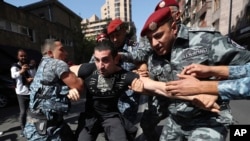
Police officers detain a demonstrator during a protest against Prime Minister Nikol Pashinyan in Yerevan on September 22.

YEREVAN -- Dozens of people have been detained as anti-government protests continued in the Armenian capital on September 22.

Armenian police said after noon local time that 84 people had been detained and charged with disobeying police orders. Armenian opposition groups later claimed some 350 supporters had been detained.

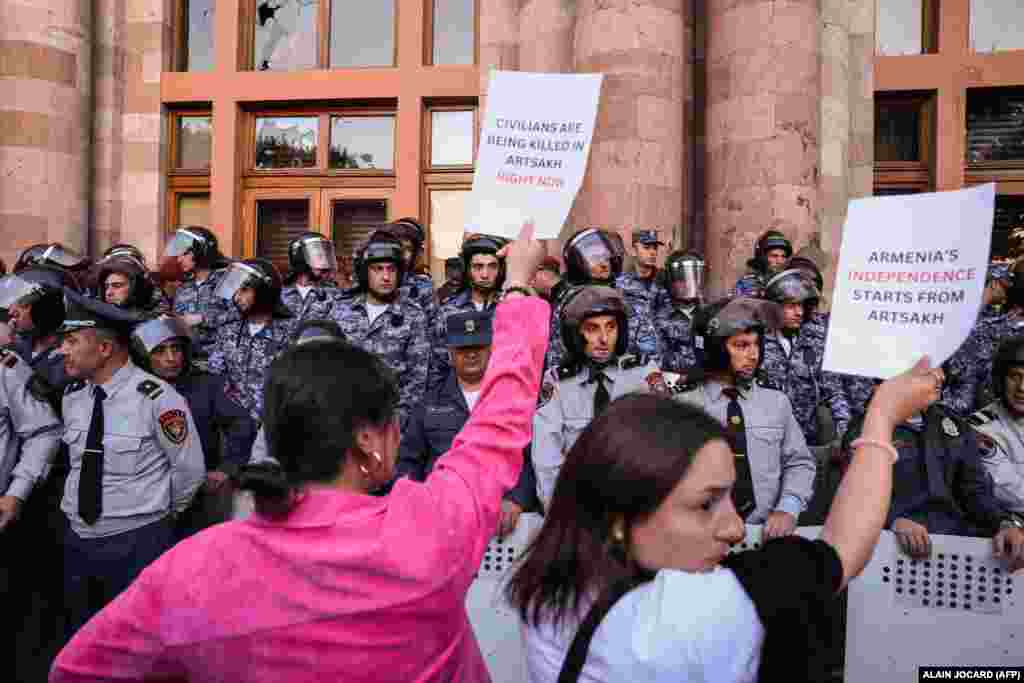
The developments came after opposition leaders called for street blockades and other protest actions to be held on September 22 in an effort to force Prime Minister Nikol Pashinian from power.

Protesters have vowed to continue their action until Pashinian is removed and have said they plan to disrupt a meeting of his cabinet expected later in the day.

Police, who have used stun grenades during clashes with demonstrators since protests began in Yerevan on September 20, had warned that they would implement "special measures" if the clashes continued.

Police reportedly detained one of the protest organizers, Andranik Tevanian, during the demonstrations on September 22. The former parliamentarian was released after being questioned by the Investigative Committee.

Tevanian said during demonstrations on September 21 that "with disciplined and united efforts" Pashinian's ouster as prime minister "will happen in a very short time, even within days."
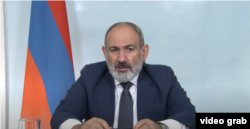
Embattled Armenian Prime Minister Nikol Pashinian

A son of Armenia's former President Robert Kocharian, Levon Kocharian, was among the detained protesters. His lawyer said law enforcement officers "severely beat" his client during his apprehension.

Pashinian has come under criticism for the government's response to Azerbaijan's lightning offensive earlier this week against Nagorno-Karabakh, an Azerbaijani territory that has a large ethnic Armenian population.
Azerbaijan has claimed that the offensive, which it describes as an "anti-terrorist operation," has brought the breakaway region back under its control.

Pashinian told his government on September 22 that Yerevan would accept an influx of ethnic Armenians if they chose to leave Nagorno-Karabakh, but that such a massive resettlement would only occur if it became impossible for them to remain there.

Demonstrators have decried what they call inadequate government support for the ethnic Armenians in Nagorno-Karabakh, while opposition leaders have announced plans to initiate impeachment proceedings against Pashinian.

As anti-government demonstrators blocked roads and assembled in Yerevan's central Republic Square on the morning of September 22, Pashinian expressed hope that ethnic Armenians living in Nagorno-Karabakh can remain there.

WATCH: Thousands of ethnic Armenians gathered at Nagorno-Karabakh's only airport where Russian peacekeepers are based. They were seeking protection and possible transit to Armenia following two days of fighting.

Ethnic Armenians Converge On Airport As 'Reintegration' Talks Held In Nagorno-Karabakh
please wait

No media source currently available

0:00 0:02:51 0:00

Azerbaijan, meanwhile, has reportedly indicated it envisages an amnesty for Armenian fighters in Nagorno-Karabakh who give up their arms amid a tentative cease-fire that stopped the fighting, which broke out when Azerbaijani forces launched a 24-hour military offensive on September 19-20.

"Even with regard to former militaries and combatants, if they can be classified in such a way, and even for them we are envisaging an amnesty or alluding to an amnesty as well," Hikmet Hajiyev, a foreign policy adviser to Azerbaijani President Ilham Aliyev president, told Reuters.

Hajiyev also said that ethnic Armenians in Nagorno-Karabakh have asked for humanitarian aid, which he said would begin to arrive on September 22. Media reports said at least four trucks with aid were seen headed toward Nagorno-Karabakh along the Agdam corridor that runs through Azerbaijan.

Hajiyev said that Baku seeks the peaceful reintegration of Karabakh Armenians.

The ethnic Armenian leadership of Nagorno-Karabakh said on September 22 that an agreement had also been reached for humanitarian aid to be trucked in from Armenia. The leadership said, however, that there had been no deal on security guarantees sought by Karabakh Armenians in exchange for giving up their weapons, or regarding a possible amnesty proposed by Baku.

On September 21, representatives of Azerbaijan and the ethnic Armenian leadership of the breakaway region failed to reach a breakthrough during closely watched "reintegration" talks in the western Azerbaijani city of Yevlax.

The two sides exchanged accusations and denials over reports of gunfire and apparent cease-fire violations in Nagorno-Karabakh's de facto capital, Stepanakert, but more meetings are expected.

Separatist leaders in Nagorno-Karabakh said in a statement following the meeting that they were ready to continue talks with Azerbaijani authorities.

"The parties especially stressed the need to discuss all existing issues in a peaceful environment, noting the readiness to continue meetings," the statement said.

Pashinian said on September 22 that the situation remains tense in Nagorno-Karabakh, internationally recognized as part of Azerbaijan but which has enjoyed de facto independence since breaking away in a war in the 1990s.

Concerns Grow For Humanitarian Situation Of Nagorno-Karabakh Evacuees
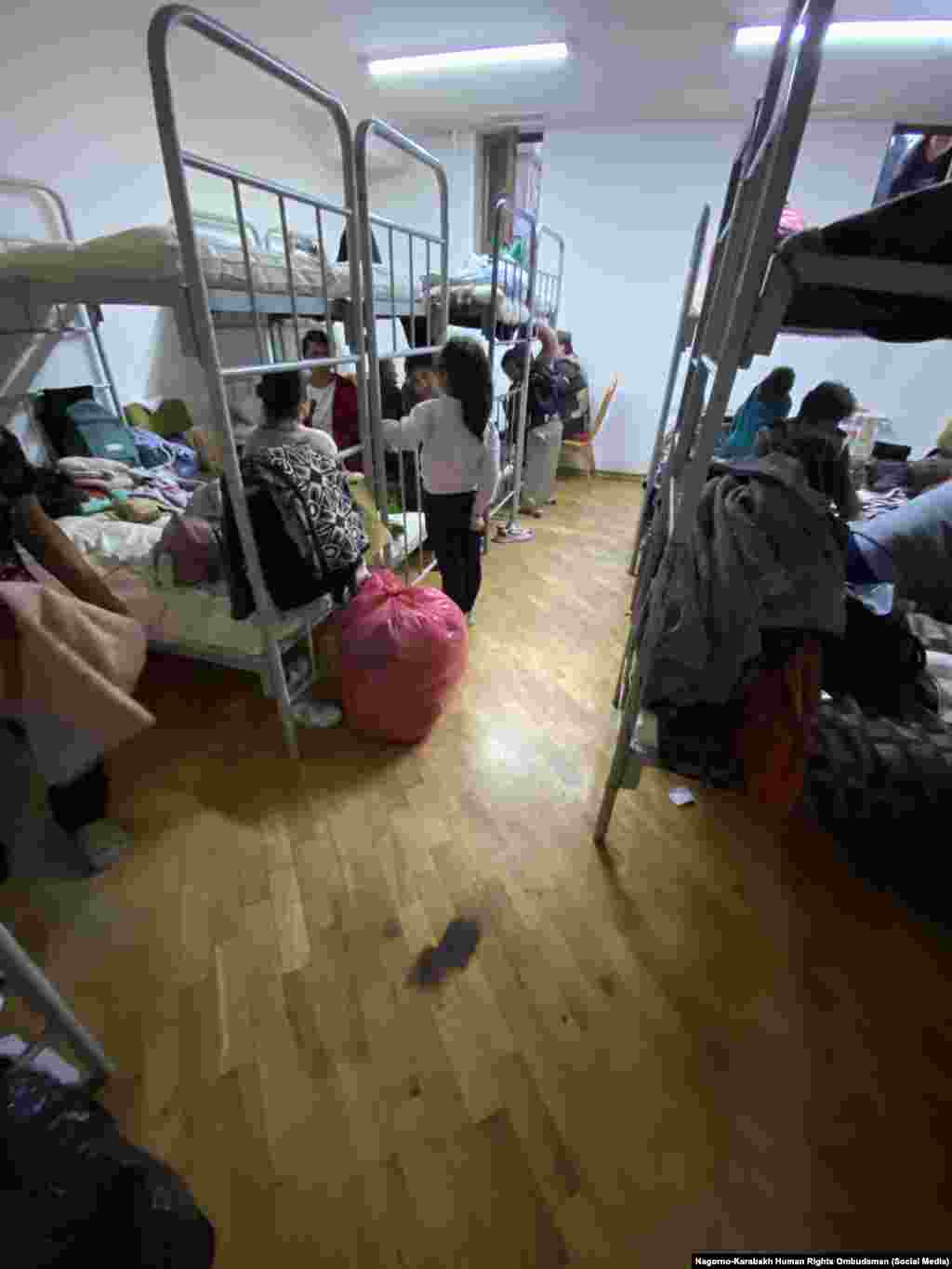
A social media photo dated September 21 from the <strong><a href="https://twitter.com/ArtsakhOmbuds" target="_self">Nagorno-Karabakh human rights ombudsman</a></strong>&nbsp;reportedly shows Armenian evacuees living in challenging conditions.<br />
<br />
&quot;More than 10,000 evacuated people are currently staying in basements without proper food, water, electricity, and all other basic conditions of living. Azerbaijan is committing a genocide in Artsakh (Nagorno-Karabakh)&nbsp;in real time with the tacit consent of the international community,&quot; the ombudsman wrote on X, formerly known as Twitter.
1/10 A social media photo dated September 21 from the Nagorno-Karabakh human rights ombudsman reportedly shows Armenian evacuees living in challenging conditions.

"More than 10,000 evacuated people are currently staying in basements without proper food, water, electricity, and all other basic conditions of living. Azerbaijan is committing a genocide in Artsakh (Nagorno-Karabakh) in real time with the tacit consent of the international community," the ombudsman wrote on X, formerly known as Twitter.
Following a lightning military offensive by Azerbaijani forces in the disputed territory of Nagorno-Karabakh, an estimated 10,000 evacuees are seeking shelter without basic living conditions in basements, while others have massed at an airport in hopes of fleeing to Armenia.
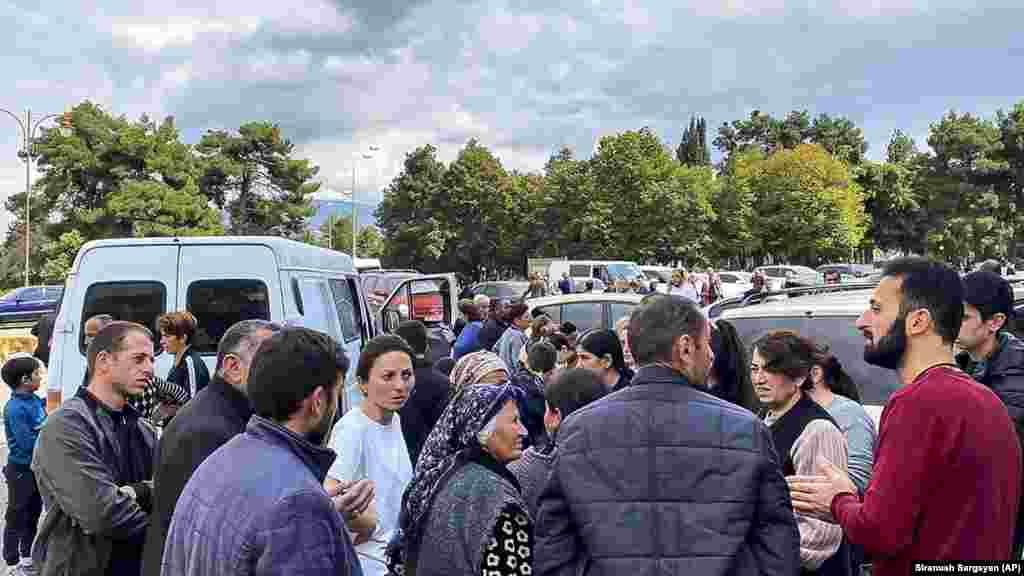
Another social media picture is believed to show displaced Armenians waiting to leave on September 21 near the airport in Nagorno-Karabakh&#39;s de facto capital, Stepanakert.<br />
&nbsp;
<div>
<div>Ombudsman Gegham Stepanian said on <strong><a href="https://twitter.com/Gegham_Artsakh" target="_self">social media</a></strong> that the streets of Stepanakert were &quot;filled with displaced people [who are] hungry and scared.&quot;</div>
</div>
&nbsp;<br />
&nbsp;
2/10 Another social media picture is believed to show displaced Armenians waiting to leave on September 21 near the airport in Nagorno-Karabakh's de facto capital, Stepanakert.
 
Ombudsman Gegham Stepanian said on social media that the streets of Stepanakert were "filled with displaced people [who are] hungry and scared."
 
 
Following a lightning military offensive by Azerbaijani forces in the disputed territory of Nagorno-Karabakh, an estimated 10,000 evacuees are seeking shelter without basic living conditions in basements, while others have massed at an airport in hopes of fleeing to Armenia.
A local government worker (right) tries to calm residents after shooting was heard in Stepanakert.
3/10 A local government worker (right) tries to calm residents after shooting was heard in Stepanakert.
Following a lightning military offensive by Azerbaijani forces in the disputed territory of Nagorno-Karabakh, an estimated 10,000 evacuees are seeking shelter without basic living conditions in basements, while others have massed at an airport in hopes of fleeing to Armenia.
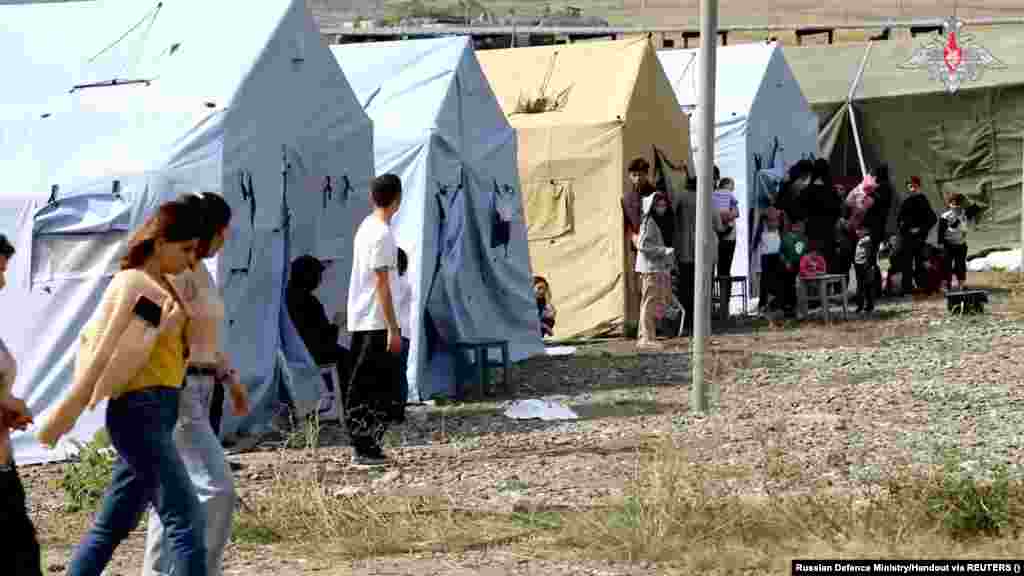
An image released by the Russian Defense Ministry on September 21 reportedly shows civilians evacuated by Russian peacekeepers at an undisclosed location.<br />
<br />
Azerbaijan halted its military action in the breakaway region of Nagorno-Karabakh on September 20 after its swift battlefield success forced Armenian separatists to <strong><a href="https://www.reuters.com/world/asia-pacific/armenians-nagorno-karabakh-agree-disarm-2023-09-20/">agree to a cease-fire</a></strong> that would see the area fully return to Baku&#39;s control.
4/10 An image released by the Russian Defense Ministry on September 21 reportedly shows civilians evacuated by Russian peacekeepers at an undisclosed location.

Azerbaijan halted its military action in the breakaway region of Nagorno-Karabakh on September 20 after its swift battlefield success forced Armenian separatists to agree to a cease-fire that would see the area fully return to Baku's control.
Following a lightning military offensive by Azerbaijani forces in the disputed territory of Nagorno-Karabakh, an estimated 10,000 evacuees are seeking shelter without basic living conditions in basements, while others have massed at an airport in hopes of fleeing to Armenia.
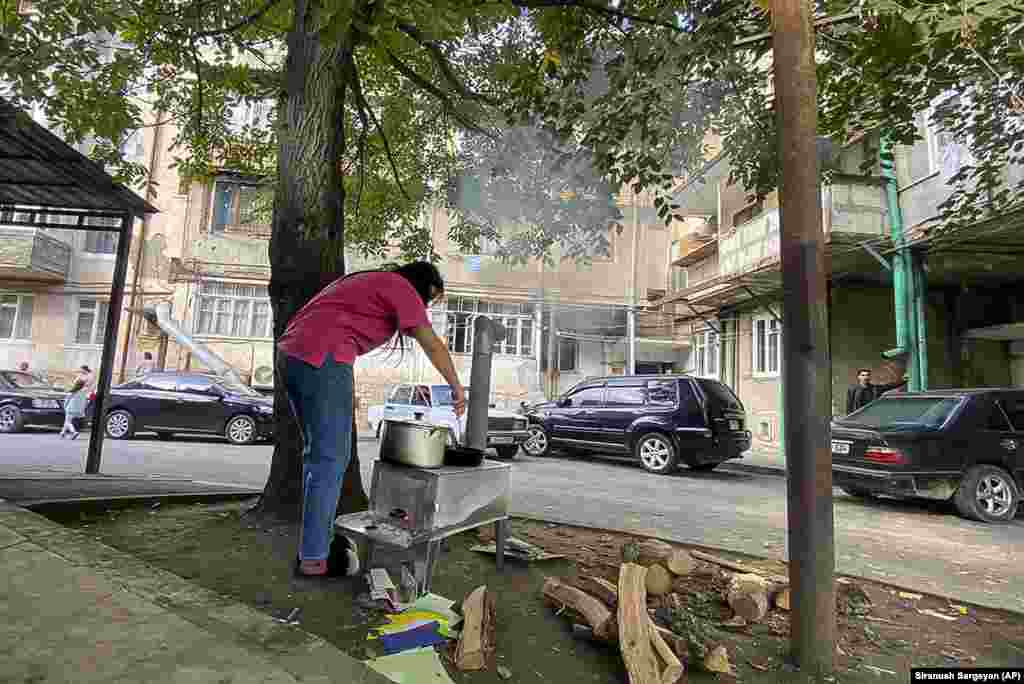
A woman cooks on a makeshift outdoor stove near a street in Stepanakert.<br />
<br />
Stepanian has said that at least 200 people were killed and about twice as many wounded during the latest fighting, including children.
5/10 A woman cooks on a makeshift outdoor stove near a street in Stepanakert.

Stepanian has said that at least 200 people were killed and about twice as many wounded during the latest fighting, including children.
Following a lightning military offensive by Azerbaijani forces in the disputed territory of Nagorno-Karabakh, an estimated 10,000 evacuees are seeking shelter without basic living conditions in basements, while others have massed at an airport in hopes of fleeing to Armenia.
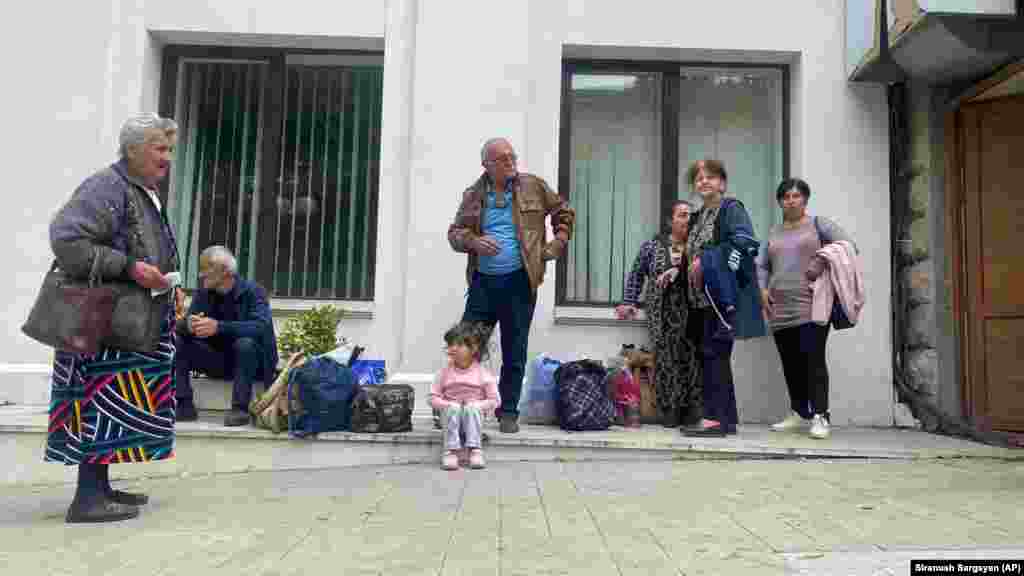
Local residents gather near a local government building after reports of shootings in Stepanakert.<br />
<br />
Separatists running the self-styled Republic of Artsakh -- as Nagorno-Karabakh is known by Armenians -- said they had been forced to agree to Azerbaijan&#39;s terms -- relayed by Russian peacekeepers -- after Baku&#39;s army broke through their lines and seized strategic locations.<br />
<br />
Azerbaijan had said it could no longer tolerate a situation it regarded as a threat to its security and territorial sovereignty.
6/10 Local residents gather near a local government building after reports of shootings in Stepanakert.

Separatists running the self-styled Republic of Artsakh -- as Nagorno-Karabakh is known by Armenians -- said they had been forced to agree to Azerbaijan's terms -- relayed by Russian peacekeepers -- after Baku's army broke through their lines and seized strategic locations.

Azerbaijan had said it could no longer tolerate a situation it regarded as a threat to its security and territorial sovereignty.
Following a lightning military offensive by Azerbaijani forces in the disputed territory of Nagorno-Karabakh, an estimated 10,000 evacuees are seeking shelter without basic living conditions in basements, while others have massed at an airport in hopes of fleeing to Armenia.
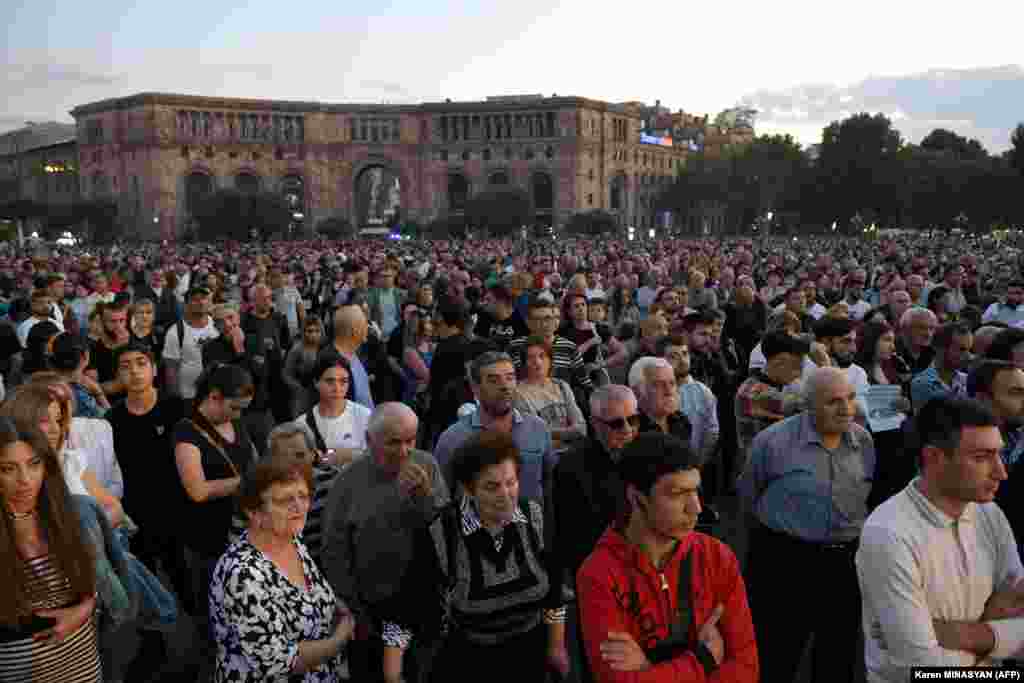
Armenian demonstrators hold placards demanding the resignation of Armenian Prime Minister Nikol Pashinian in Yerevan on September 21.<br />
<br />
Nagorno-Karabakh is internationally recognized as part of Azerbaijan and is currently populated by around 120,000 ethnic Armenians. It broke from Baku&#39;s hold in a war as the Soviet Union collapsed. It survived for decades with direct support from Armenia thanks to control of a land link known as the Lachin Corridor.
7/10 Armenian demonstrators hold placards demanding the resignation of Armenian Prime Minister Nikol Pashinian in Yerevan on September 21.

Nagorno-Karabakh is internationally recognized as part of Azerbaijan and is currently populated by around 120,000 ethnic Armenians. It broke from Baku's hold in a war as the Soviet Union collapsed. It survived for decades with direct support from Armenia thanks to control of a land link known as the Lachin Corridor.
Following a lightning military offensive by Azerbaijani forces in the disputed territory of Nagorno-Karabakh, an estimated 10,000 evacuees are seeking shelter without basic living conditions in basements, while others have massed at an airport in hopes of fleeing to Armenia.
Demonstrators continued to block the streets in Yerevan on September 22, demanding Pashinian&#39;s ouster over the surrender of Nagorno-Karabakh. More than 80 people were detained.<br />
<br />
Armenia has accused Azerbaijan of blocking the Lachin Corridor, the sole road linking Armenia to Nagorno-Karabakh, since December 2022. Azerbaijan had insisted that aid trucks should go through Azerbaijani territory to ensure no contraband was being shipped.
8/10 Demonstrators continued to block the streets in Yerevan on September 22, demanding Pashinian's ouster over the surrender of Nagorno-Karabakh. More than 80 people were detained.

Armenia has accused Azerbaijan of blocking the Lachin Corridor, the sole road linking Armenia to Nagorno-Karabakh, since December 2022. Azerbaijan had insisted that aid trucks should go through Azerbaijani territory to ensure no contraband was being shipped.
Following a lightning military offensive by Azerbaijani forces in the disputed territory of Nagorno-Karabakh, an estimated 10,000 evacuees are seeking shelter without basic living conditions in basements, while others have massed at an airport in hopes of fleeing to Armenia.
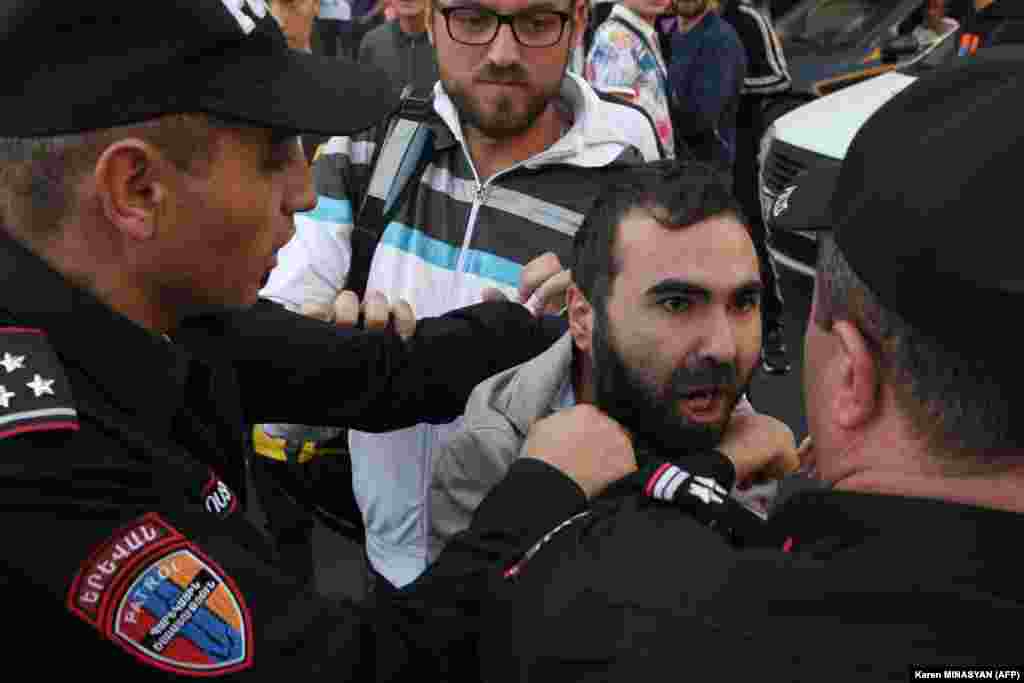
A protester clashes with Armenian police officers in Yerevan on September 21.<br />
<br />
A second war in 2020 saw Azerbaijan reconquer territory in and around the mountainous region and Armenia lose control of the corridor, leaving the road policed by Russian peacekeepers until it was blocked last December.
9/10 A protester clashes with Armenian police officers in Yerevan on September 21.

A second war in 2020 saw Azerbaijan reconquer territory in and around the mountainous region and Armenia lose control of the corridor, leaving the road policed by Russian peacekeepers until it was blocked last December.
Following a lightning military offensive by Azerbaijani forces in the disputed territory of Nagorno-Karabakh, an estimated 10,000 evacuees are seeking shelter without basic living conditions in basements, while others have massed at an airport in hopes of fleeing to Armenia.
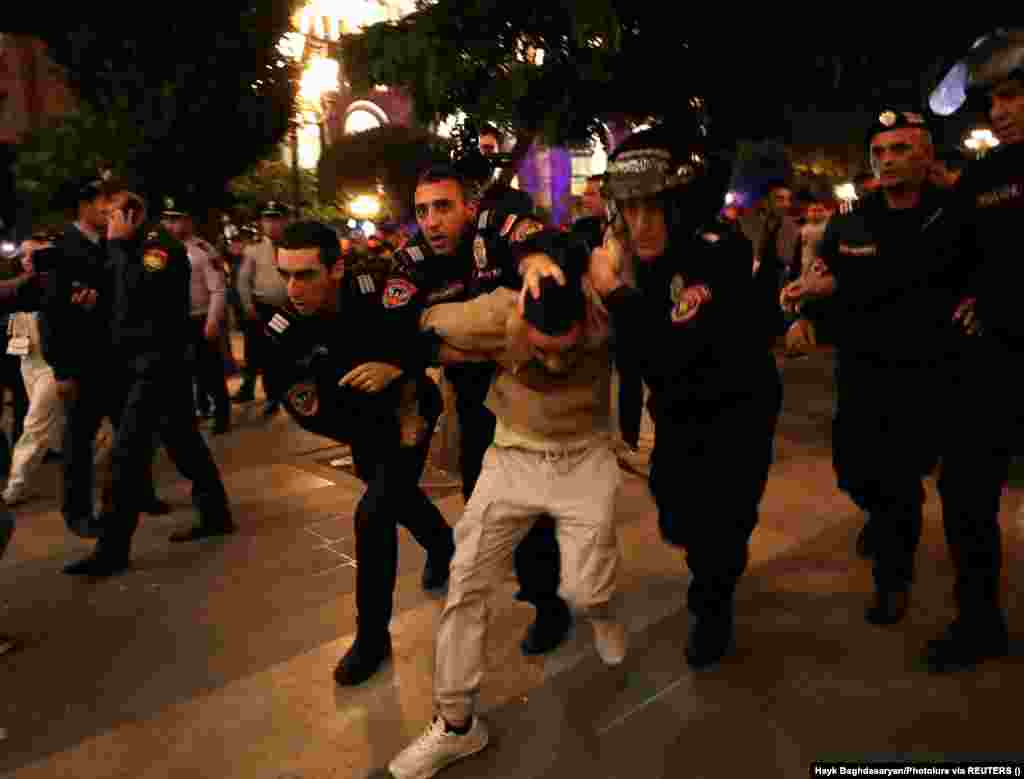
Law enforcement officers detain a protester near a government building in Yerevan on September 21.<br />
<br />
Baku says it has plans to reintegrate Nagorno-Karabakh and its ethnic Armenian population back into Azerbaijan. But the Azerbaijani authorities aren&#39;t saying what the plan is, and the details remain far from clear. The first session of &quot;reintegration&quot; talks ended on September 21 without any sign of a breakthrough.
10/10 Law enforcement officers detain a protester near a government building in Yerevan on September 21.

Baku says it has plans to reintegrate Nagorno-Karabakh and its ethnic Armenian population back into Azerbaijan. But the Azerbaijani authorities aren't saying what the plan is, and the details remain far from clear. The first session of "reintegration" talks ended on September 21 without any sign of a breakthrough.
Following a lightning military offensive by Azerbaijani forces in the disputed territory of Nagorno-Karabakh, an estimated 10,000 evacuees are seeking shelter without basic living conditions in basements, while others have massed at an airport in hopes of fleeing to Armenia.
Previous slide
Next slide

During a short but bloody war in 2020, Azerbaijan recaptured much of the territory as well as seven surrounding districts that had been controlled since the 1990s by ethnic Armenians with Yerevan's support.

Some 120,000 ethnic Armenians live in Nagorno-Karabakh, and Pashinian on September 22 expressed optimism that they can get a real opportunity to return to their homes. At the same time, Pashinian noted a dire humanitarian crisis continues in Nagorno-Karabakh.

In a nationwide address on September 21, Aliyev declared victory in the offensive launched by his forces on September 19 after Baku accused "Armenian sabotage groups" for two separate deadly explosions in areas of Nagorno-Karabakh that are under the control of Russian peacekeepers.

The same day, UN Security Council members including the United States, Turkey, Russia and France called for peace, while Armenian and Azerbaijani officials traded barbs.

Armenian Foreign Minister Ararat Mirzoian, who called for the emergency meeting, accused Baku of an “unprovoked and well-planned military attack” and said Azerbaijan was likely to use force against civilians in Nagorno-Karabakh again unless prevented by global powers.

Azerbaijani Foreign Minister Jeyhun Bayramov countered by accusing Yerevan of spreading misinformation, insisting that Baku had carried out an anti-terrorism operation against Armenian forces.

The offensive was halted on September 20 after Karabakh's ethnic Armenian leadership accepted a cease-fire proposal by the Russian peacekeeping mission, although sporadic fighting has been reported.

Nagorno-Karabakh human rights ombudsman Gegham Stepanian has said that at least 200 people, including 10 civilians, were killed and more than 400 others were wounded in the fighting.

RFE/RL could not independently confirm the casualty figures.

Azerbaijan's Prosecutor-General's Office on September 21 said six Russian peacekeepers had been killed during Baku's military offensive, five "by mistake" by Azerbaijani forces and one by Karabakh Armenian fighters.

With reporting by Reuters and TASS
  • 16x9 Image

    RFE/RL's Armenian Service

    RFE/RL’s Armenian Service, operating out of a bureau in Yerevan, is a leading source of trusted reporting and technical innovation, reaching outsized audiences when developments demand authoritative, up-to-the-minute news most.

  • 16x9 Image

    RFE/RL's Azerbaijani Service

    Despite near-total government control over the media, RFE/RL's Azerbaijani Service has built a high-impact social-media presence in Azerbaijan and a reputation as a leading source of independent news.

This item is part of
XS
SM
MD
LG