


WASHINGTON -- As tensions rise in the Strait of Hormuz and Washington pushes allies to step up, the debate is no longer only about whether NATO has the capabilities to contribute -- but whether the alliance can manage another major security test without deepening transatlantic friction.
At the center of that debate is a mechanism that has so far remained largely absent from the conversation -- Article 4, NATO’s consultation clause, which allows allies to formally convene when one member believes its security, territorial integrity, or political independence is under threat.
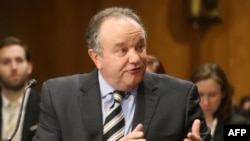
For retired four-star General Philip Breedlove, former NATO Supreme Allied Commander Europe (SACEUR), the missing consultations are part of the problem.
In an interview with RFE/RL on May 5, he said what some portray as a defining “Iran test” for NATO is also an opportunity to reset how the alliance handles crises that fall outside its traditional theater but still carry direct strategic consequences.
RFE/RL: Are we looking at a defining “Iran test” for NATO or a moment that could expose its limits? Given Washington’s expectations and allied divisions, what can NATO realistically do, and where are its constraints?
Phillip Breedlove: As you know, we never did an Article 4 with NATO over this action. My advice to everyone is to step back from all of the pressure tactics and the harsh language, and let's sit down and look at this as an opportunity. What can we do together? What pieces can NATO bring to the puzzle, and if necessary, even call for an Article 4 consultation, so that NATO sees that it's engaged in the ways that we're supposed to engage when we deal with NATO.
Once we sit down, I believe that we can find a lot of places that NATO can, could, and I hope should become a part of the operation. But the key is to stop the harsh approach, stop all of the rhetoric in the newspapers, begin to have real consultations at a cooperation level, and try to find opportunities, and look at this as a positive opportunity for our future together.
RFE/RL: We’re hearing from different officials and experts -- from both sides of the aisle -- who are questioning whether NATO is structured to handle this kind of asymmetric gray-zone crisis when it comes to the Strait of Hormuz. Or was it built for a different era.
We are not united in our effort. And that is going to be a problem in the long run.”
Breedlove: Well, NATO was built to defend against our enemy. We still have the same enemy. That enemy is Russia. We finally have all of our documents and paperwork acknowledging that Russia is the enemy. Russia has started a theater-level war of aggression in Europe as they have attacked Ukraine, and the war now -- lots of people make a mistake when they talk about it -- they say the war is four to five years long. This war is 12 years long. It started in 2014 and it hasn't let up since.
And so NATO was built to defend Europe and NATO allies against our common enemy, which is Mr. Vladimir Putin's Russia. So yes, we were built in a certain way, but I would offer to you that there are lots of capabilities, including mine-sweeping capabilities and others that are in NATO that would be a very excellent addition to the effort that is going on in the Gulf now. And once again, if we back up, lower the rhetoric, and begin to cooperate and look at opportunities together, I think we can get there.
RFE/RL: Take us to your years as SACEUR -- if you were in that seat right now, what would NATO's involvement look like when it comes to Iran?
Breedlove: Well, NATO's involvement would look like exactly what the NAC [the North Atlantic Council, the alliance's top decision-making body] decided it would look like.
You know, the way that the SACEUR works is the SACEUR develops options and presents them to the NAC, which is the real deciding authority in NATO. That's where all the authority and the power is.
Then the SACEUR would take options to the North Atlantic Council, and the NAC would decide. This is the way that NATO basically works. And the SACEUR would offer to the NAC a range of options, and he or she would recommend what their recommendation would be, and then the NAC would deliberate and decide.
And if the NAC did not decide as a whole to support the operation, there might be a “coalition of the willing” that would go and participate with the operation under a NATO flag. So again, this is about doing the proper coordination and level of coordination, looking at opportunities and moving forward together, rather than bickering at each other in the newspapers.
RFE/RL: In practical terms, what can European militaries actually contribute in today’s environment? And on the naval side specifically, do European navies bring critical mine-countermeasure assets that the US currently lacks in this theater?
Breedlove: Well, I'm not sure that the US truly “lacks.” We're not using most of our force there. More force could be brought to bear. But I think what the United States is asking is that other people in the world who benefit or don't benefit based on oil flow would come alongside the United States and help in this process.
And yes, there are several NATO navies with extremely capable maritime assets with very sophisticated antimissile capabilities. And as I said, we have two standing naval mine-countermeasures groups that are always at the ready.
So there are assets in NATO that, if NATO was properly engaged and we could come to agreement, we have a great opportunity for NATO being a part of this effort.
This is way bigger than NATO, way, way bigger than NATO. China is looking at this, and probably is more happy than they've ever been. They see the West divided."
RFE/RL: If tensions continue to escalate, how important is European support for sustaining US operations in the strait? Given that US Secretary of State Marco Rubio is heading to Rome to discuss this with allies, and that there is room -- as you noted earlier -- for negotiation, what role do you see Europe playing in the next phase of this crisis?
Breedlove: Personally, this is my opinion. I believe it's incredibly important. [Russian President Vladimir] Putin and [Chinese President] Xi Jinping have given support to Iran. And Iran, I think, feels in a good position because right now they're really only looking at Israel and the United States in this operation. And as long as Iran, Mr. Xi, and Mr. Putin can maneuver to keep Western allies out of the operation, then the entire burden falls, again, on Israel and the United States.
That will be a tougher road for the United States to take, but I believe that the United States is committed to do what it has to do, with or without allies -- it would just be better for Mr. Xi, Mr. Putin, and religious leaders in Iran to look and see that the United States was joined by other members of the Western world who are interested in this, and that would include even people like South Korea, Japan, Australia, New Zealand, and others. It would be good for these three nations -- Russia, China, and Iran -- to look and see that the Western nations are aligned in an effort to do this.
RFE/RL: If reports are accurate that Vladimir Putin is actively supporting Iran -- including alleged intelligence sharing -- does that not, in itself, warrant a unified NATO response? And how damaging is it to alliance cohesion when adversaries appear increasingly coordinated, while allies remain divided over whether and how to engage?
Breedlove: Well, I said something years ago that people didn't like, but it caught everybody's attention. And that is, you know, if your enemy is fighting you and you are competing or organizing or thinking about him, he's winning.
The bottom line is we have an enemy -- in this case, Iran -- supported by two powers who don't wish well for the United States or the West in general. And so they are united in their effort, and we are not united in our effort. And that is going to be a problem in the long run.
RFE/RL: Some allies have argued from the outset that this is not their war. But given what you’ve described -- Russia’s support for Iran, and Iran’s parallel support for Russia in Ukraine -- doesn’t this effectively broaden the conflict into a wider security challenge for the alliance as a whole?
Breedlove: Well, when I was SACEUR, what I learned was that I can't dictate individual policies to sovereign nations. The sovereign nations are going to have to make their decisions about whether they support or not.
And I think that many of them, if they do the math, so to speak, they will understand what this means to them: yes, they didn't start this war, but now we have a war, and it's beginning to seriously affect the energy opportunities for other nations in the West and some of our allies in the Far East.

And so one would hope that as these sovereign nations deliberate on whether they should become involved or not, they will see the value of not allowing Mr. Xi, Mr. Putin, and the regime in Iran to drive energy cost and energy policy over time.
RFE/RL: What off-ramps exist right now that could de-escalate internal tensions without signaling weakness for NATO?
Breedlove: They [NATO allies] either have to decide to be involved or have some coalition of the willing or individual states become involved, or they don't. So they're on an off-ramp right now. They're not engaged.
RFE/RL: When it comes to the Strait of Hormuz, President Donald Trump has repeatedly said that the US does not depend on the strait the same way Europeans do, and that Europeans benefiting from it should step in. Without the US, can they do it alone?
Breedlove: I think it would be very hard for NATO to do this without the United States. We have an alliance. Why don't we take the opportunity to work in a correct fashion as allies together and work this out? That's, I think, the ramp we want to take.

RFE/RL: Bottom line, General -- does NATO risk appearing divided at a moment when its adversaries, including Russia, China, and Iran, appear increasingly coordinated? And ultimately, does this crisis strengthen alliance unity or risk accelerating transatlantic drift?
Breedlove: This is way bigger than NATO, way, way bigger than NATO. China is looking at this, and probably is more happy than they've ever been. They see the West divided. Mr. Putin, his entire time as leader of Russia, has tried to separate the United States from NATO. He has to be overjoyed at what he sees. We are giving Mr. Putin the biggest gift he's ever had as a leader, and we've got to figure out how to fix that.
The enemies of the West do not need to see the West fighting amongst themselves, and the leaders of the West, I think, if they truly recognize the signal that they're sending Mr. Xi and Mr. Putin by our division, I think they would stop and rethink where we are, and I believe that's important.
That's why I said: we have an opportunity now to put this back together, get it in the right context, and then cooperate our way out of this problem.

