




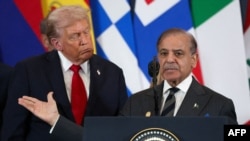
Pakistan has offered to host talks aimed at bringing the Iran conflict to an end, highlighting the country's strengthened ties in both the Middle East and with Washington.
Pakistani Prime Minister Shehbaz Sharif said in a social media post on March 24 that his country "stands ready and honored to be the host to facilitate meaningful and conclusive talks for a comprehensive settlement of the ongoing conflict.”
Pakistan has been one of several countries -- along with Turkey and Egypt -- reportedly playing a role as an intermediary in trying to end fighting that started with US and Israeli air strikes on Iran on February 28.
Some media outlets have reported Islamabad as a possible location for talks between Tehran and Washington -- perhaps as early as this week.

It’s not clear when or if these will go ahead, but as a neighbor of Iran that gets much of its oil from the Persian Gulf, Pakistan has been acutely affected by the conflict and has a strong interest in seeing it end.
“Pakistan has stepped up its efforts to mediate a cease-fire,” a senior military source in the country told RFE/RL’s Radio Mashaal. “The efforts are joined by Turkey and Egypt. Pakistan has a stake for multiple reasons.”
Trump’s ‘Favorite Field Marshall’
A key player in this has been Asim Munir, the head of Pakistan’s army, which traditionally pulls the levers of power behind the scenes while political leaders talk to the TV cameras.
Trump has described Munir as “my favorite field marshal,” and the White House told RFE/RL that the two men discussed the war and US-Iran talks in a call on March 23.
"Pakistan belongs certainly to the winners of Trump II foreign policy. Asim Munir has had at least two meetings with President Trump last year," Christian Wagner, a senior fellow at the German Institute for International and Security Affairs (SWP), told RFE/RL.
"It was quite unexpected that Pakistan suddenly got this high recognition in US foreign policy under the second Trump administration. And the personal relationship between Trump and General Munir has certainly contributed to this," he added.
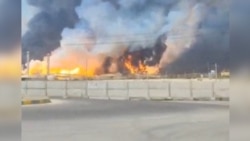

While Trump and Munir were on the phone, Sharif was dialing up Iranian President Masud Pezeshkian.
“We discussed the grave situation in the Gulf region and agreed on the urgent need for de-escalation, dialogue, and diplomacy,” he tweeted afterwards.
Pakistan’s Pain
Several days earlier, Sharif had made a televised address to the nation laying out emergency measures to deal with the fallout from the Iran war. Half of all employees at both state and private institutions would now work from home, while many offices would move to 4-day weeks to conserve energy, he said on March 9.
This was followed by further measures, such as additional taxes on gasoline, to discourage automobile use or fuel hoarding. Transport service providers told RFE/RL’s Radio Mashaal that they could no longer afford to operate.
The grave situation is caused by Pakistan’s reliance on the Persian Gulf for oil supplies. More than 85 percent of Pakistan’s oil comes by ship from Saudi Arabia and the United Arab Emirates, but Iran has turned off the tap by closing the route through the Strait of Hormuz. Pakistan is also heavily reliant on Qatar for Liquefied Natural Gas (LNG). Pakistan’s economic hub, the port of Karachi, has gone quiet.
These economic pressures are one reason for Pakistan’s interest in mediating a diplomatic solution to the Iran war. But there are many others.
In the early days of the war, angry crowds of Shi’a Muslims torched the US consulate in Karachi following the killing of Iran’s supreme leader, Ayatollah Ali Khamenei. It was a dramatic moment that highlighted how Pakistan’s domestic security concerns can be impacted by the war.

Pakistan is mostly Sunni Muslim, but a sizeable minority of its population is Shi’ite, which is the majority denomination in Iran and the affiliation of its clerical establishment.
Islamabad also faces an insurgency in Balochistan and armed conflict with Taliban-ruled Afghanistan. Last year, it also fought a four-day war with India.
“Pakistan, given its location, is acutely vulnerable to conflict spillover effects. And with hot borders with both India and Afghanistan, it can’t afford to get dragged into a conflict on what is typically its most peaceful border,” Michael Kugelman, senior fellow at the Atlantic Council, told RFE/RL.
“In that sense, Pakistan has a sky-high incentive to help move the needle forward however possible to de-escalate the conflict,” he added.
The senior source in the Pakistani army agreed.
“Any unrest or continued conflict in Iran directly impacts Pakistan in terms of a potential refugee influx, sectarian tensions in Pakistan, and emboldening of the secessionist elements in Pakistan’s Balochistan and Iran’s Siestan-Balochistan regions,” he said.
The Saudi Connection
The high-ranking officer also pointed to another factor: Pakistan’s defense agreement with Saudi Arabia, signed in September last year.
A report at the time by the Saudi Press Agency said: “The agreement states that any aggression against either country shall be considered an aggression against both,” but the text of the pact was not made public.
Iran has launched a series of attacks on targets in Saudi Arabia, prompting Saudi Foreign Minister Prince Faisal bin Farhan to hint at military retaliation. This has led to fevered speculation that Islamabad would be obliged to step in on Riyadh’s side.
“Any active involvement of Saudi Arabia in the conflict will present Pakistan with a dilemma of honoring the agreement at the cost of active hostility toward Iran and its domestic consequences,” the military official said.


