




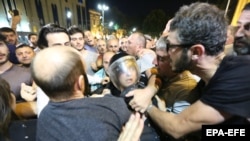
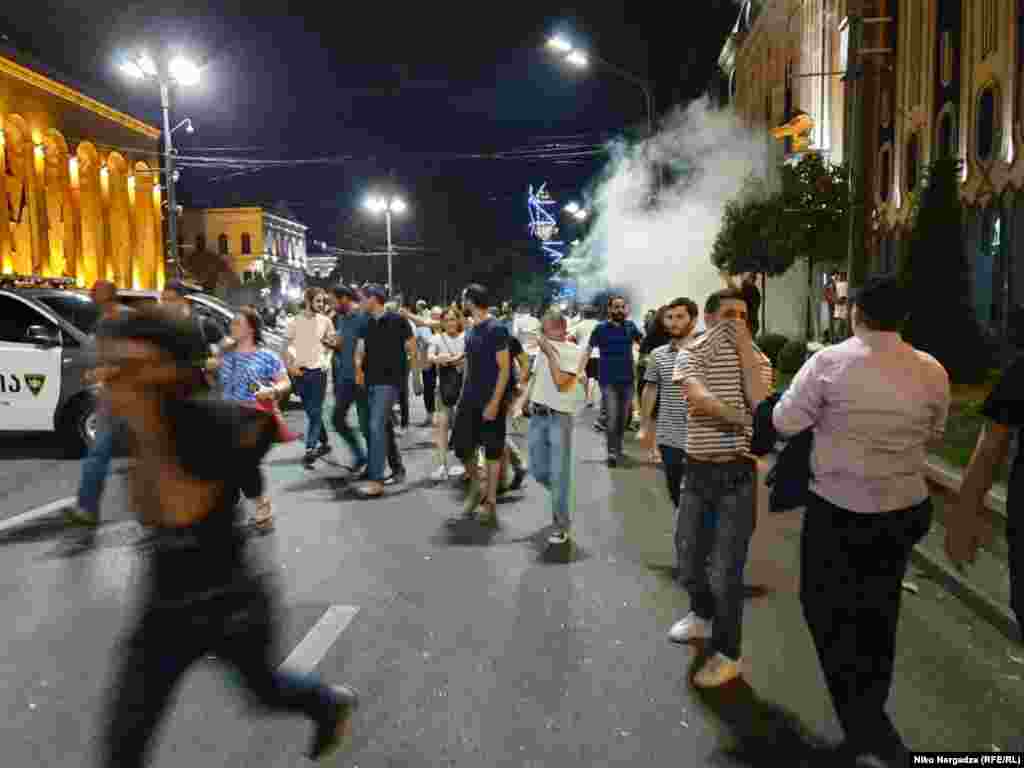
Events took a violent turn overnight when protesters gathered in front of parliament in downtown Tbilisi on June 20 to express outrage after an interparliamentary grouping on Orthodoxy allowed a Russian lawmaker to occupy the speaker's seat earlier in the day.
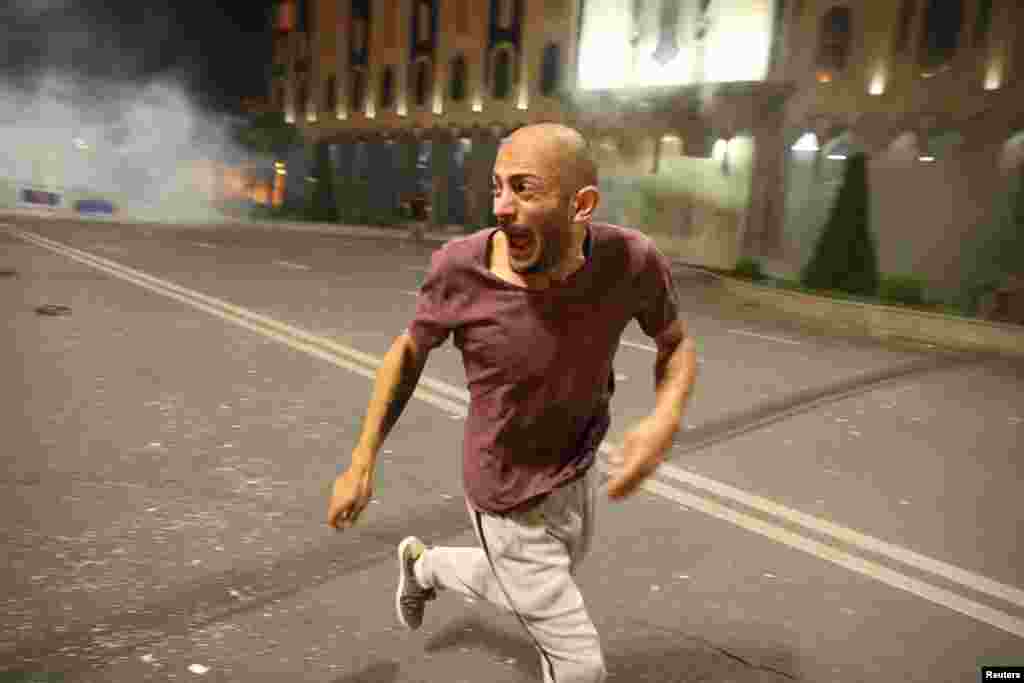
When some of those outside tried to storm the legislative building, police responded with tear gas, rubber bullets, and water cannons in clashes that left hundreds injured, including dozens of police. Tensions remained high as protesters and police braced for more demonstrations.
RFE/RL's Andy Heil asked Thomas de Waal, a senior fellow at Carnegie Europe specializing in Eastern Europe and the Caucasus, to help unpack the sources of Georgia's trouble (hint: it's a "grudge match") and Tbilisi's bedeviled relations with Russia (despite popular attitudes).
RFE/RL: On its surface, the anger and violence in Georgia seemed to erupt out of nowhere, but were there identifiable political, economic, or societal trends in Georgia that created the conditions for this unrest?
Thomas De Waal: Well, I think there are two separate reasons for the crisis last night. One is the ongoing, unresolved dispute between Georgia and Russia over Abkhazia and South Ossetia, which goes back almost 30 years but particularly goes back to 2008 when diplomatic relations were broken off in the August war over South Ossetia. So that's a kind of continuing, unresolved problem, which means that any behavior which is perceived in Georgia as being sympathetic to the Russian state will receive quite a negative reaction, as happened with the visit of this Russian parliamentarian, [Russian State Duma Deputy Sergei] Gavrilov.
Added to that you have domestic unhappiness with the Georgian Dream government; a feeling that it's out of touch with society, that it's unaccountable, that it's quite arrogant. And so there was also a perception that the Georgian Dream had invited this Russian parliamentarian without any consultation and this was yet more proof that the government is out of step with society.
You have an opposition which is still associated with former President [Mikheil] Saakashvili, which is very keen to play up both of those issues, is keen to play the Russia card and accuse Georgian Dream of being soft on Russia, and it's also keen to portray the government as out of step with society.
So the radicals in the opposition used the opportunity last night to call for the resignation of the government, and some of the radicals tried to storm parliament. And this is when you had this heavy-handed response by the police -- this violent response using tear gas, using rubber bullets in which many people got injured.
So, in a sense, this was an accident waiting to happen, given the kind of political reality of Georgia at the moment.

RFE/RL: You mentioned Saakashvili and some of the people close to him in the opposition. President [Salome] Zurabishvili mentioned a "fifth column" at work stoking the unrest. Is that presumably who she is speaking about?
De Waal: She definitely, by "fifth column," means Saakashvili and his United National Movement (ENM) party, and also Rustavi-2, the television station. There's a lot of bad blood between these two [sides] and Zurabishvili is particularly aggressive in her rhetoric against Saakashvili and the opposition. Even though, in many issues they actually agree, this is a clash of personalities; it's a grudge match. This is also a feature of Georgian life over the last 10 years, this deep polarization between two groups who just can't reconcile.
RFE/RL: You said "radicals" turned up last night in front of parliament. Do you [blame these latest events on] a radical element, rather than broader public disenchantment with parliament or the government?
De Waal: I think it's both. I think there's a broader disenchantment with the government, which I think manifests itself mostly in peaceful protests. But I think some of the people in the crowd last night [on June 20-21] were trying to enter the parliament building and therefore were radicals -- they were trying to use this difficult and unpopular incident [of Gavrilov in the parliament] as an excuse to try and execute regime change in Georgia. Which is not to say that the government didn't make a big mistake, but it's to say that some people in the opposition were trying to use this crisis for their own ends.
RFE/RL: Among the protesters last night there were quite a few anti-Putin messages, anti-Russia messages. More than a decade after that Russia-Georgia conflict in 2008, has Moscow in your view tried to exert significant influence in Tbilisi, and are Georgians therefore right to be concerned about what Moscow is up to and what people within their leadership might be abetting or allowing?
De Waal: I think we have to differentiate between the Russian state, which is still very unpopular within Georgia, for good reason, given that there are thousands of Russian troops in Abkhazia and South Ossetia, and given the continuing aggressive behavior by the Russian military. We have to differentiate between the Russian state, on the one hand, and the Russian public, on the other, where we've seen opinion polls suggest that popular attitudes to the other people is generally very good.
Violent Clashes In Tbilisi Over Russian Lawmaker In Parliament
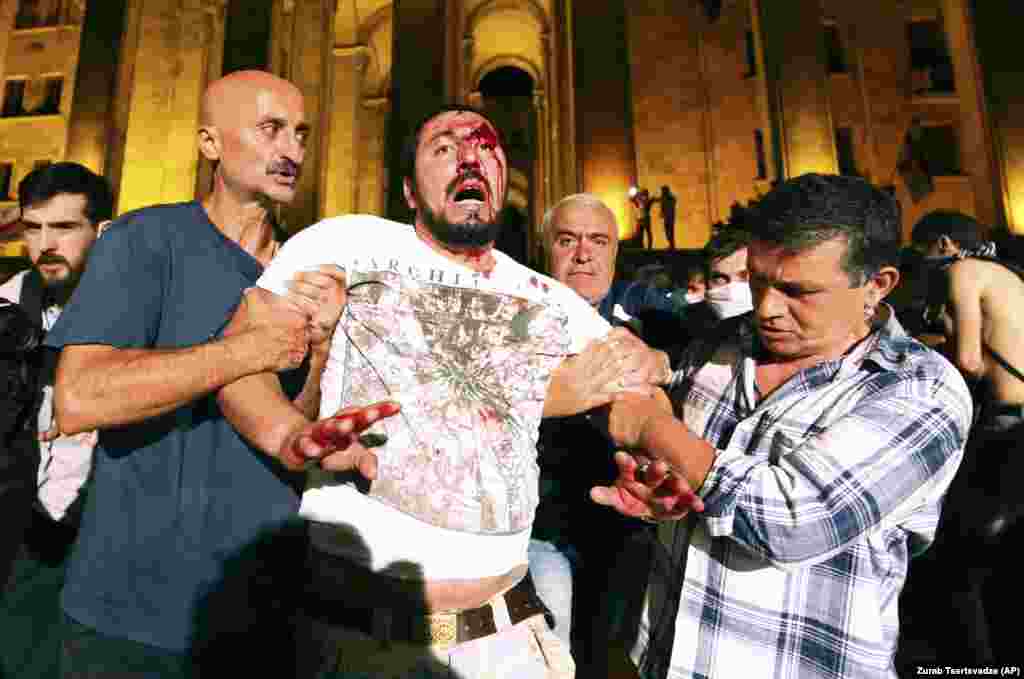


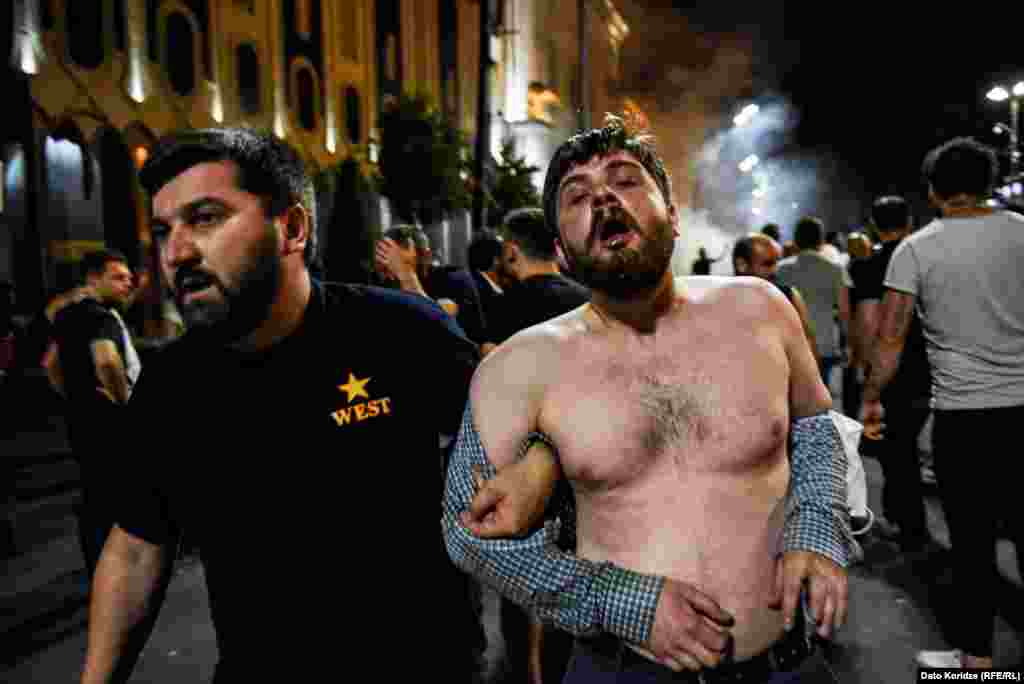
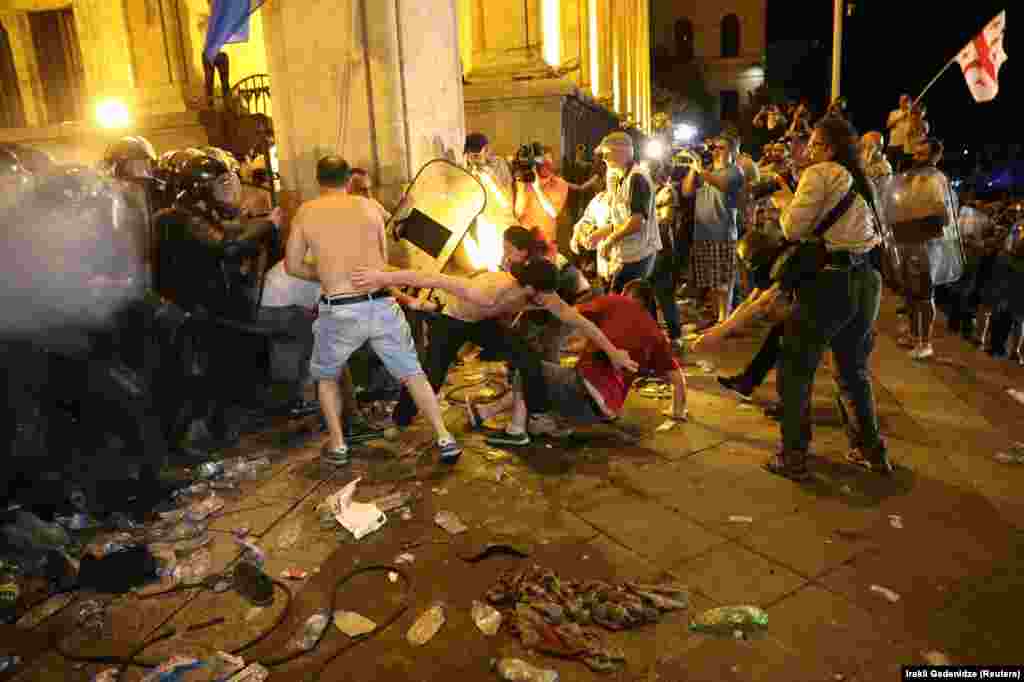


![A protester pushes into police lines. In a <a href="https://www.facebook.com/SaakashviliMikheil/posts/2551757474854618?__xts__[0]=68.ARArXSaitVPE-p6SIXA88JiA79EfwM0RfAGRo7-IY1BdVvsyqXsqk4-n_aCSzjsSXTMMp_4Uv9Hy_nEeoPB1DqY3pEb9B0XjupxR2CsGFYADnpha5bAvK6aAkIeOJyiZ0PGnSOt4DqQW6RWTmuzJIdMptDkRy5RP5YpaOfZCahT3wyR-8B3EERylkioYnSSGIagD84tK_OQXMKgip2htVcp271Tg7gm6vxHE7XXPcaYmXoS0qf0aEQNaDrnwUMKvnilY0bg44Zn5HhnR_jMDMNi8cRQiQ1kD2icwS6r50DxDeMEp6b50VeuNsQT6a5HTLmLe6Sda8ZZBkVgyP7rogACGWN9XtJEtVkYo9g&__tn__=-R" target="_blank">video </a>shared by former Georgian President Mikheil Saakashvili, a protester appears to be hit by a projectile as he remonstrates with police lines in front of the parliament. ](https://gdb.rferl.org/7f5a7597-b721-418f-b1b3-af69d70e3b05_w1024_q10_s.jpg)

![An overturned car as day breaks in Tbilisi on June 21. Opposition politician Grigol Vashadze vowed <span>“We will meet again on Rustaveli Avenue at 19:00 [on June 21]. </span><span>We will need to agree on an action plan with people."</span>](https://gdb.rferl.org/a5dac0fd-be7f-4e35-b3ca-4b35bab426fe_w1024_q10_s.jpg)
You have about a million people, Russian tourists, coming to Georgia last year and not encountering any problems. You see increased trade. So I think the slogans that we saw in the center of Tbilisi last night were anti-Putin slogans but they weren't anti-Russian slogans and I think that's an important difference.
RFE/RL: There were comments very recently where Michael Carpenter, a former U.S. defense official, warned of an "open-door [Georgian] policy" with regard to Russia...
De Waal: I know Mike Carpenter, but I think that was a very ill-judged comment. I think the idea that because some Russians may be coming to Georgia with less [than] good motives that you should therefore shut down this massive stream of people-to-people relations and the tourism and the revenue for Georgia seems to me incredibly misjudged. I mean, that way any countries that have poor relations in the world -- whether they be U.S. and Cuba or U.S. and China -- should stop their citizens from visiting each other. That seems to me a very shortsighted policy.
I think it's been a very good factor in Georgian-Russian relations -- these people-to-people contacts -- and I think it's kind of strengthened the moderates, these people who want to improve the relationship rather than those who want to make it worse. So I certainly don't agree with that point of view.
RFE/RL: Do you see an early resolution to what's going on?
De Waal: Well, you've seen the resignation of the speaker [of parliament, Irakli Kobakhidze on June 21], which will satisfy some of the more moderate oppositionists. But obviously there's still a large segment of people who want to get Georgian Dream out at any cost. But I don't think this is going to be "life threatening" for Georgian Dream, this crisis. I think they have some long-term problems but maybe not so many short-term problems.