




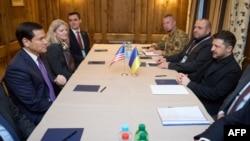
MUNICH -- On his second day at the Munich Security Conference, US Secretary of State Marco Rubio set out to calm nerves and sharpen focus: Ukraine and security, he signaled, very much remain the center of gravity of Washington’s transatlantic policy.
Although his morning address avoided direct mention of Ukraine, the omission proved fleeting. As soon as the floor opened for questions, the war -- and America’s role in brokering its conclusion -- moved to the forefront.

That focus sharpened further in an interview with Bloomberg TV immediately after his address, where Rubio offered his clearest assessment yet of how the grinding conflict may reach its end.
He stated he does not expect the war to conclude in what many would consider a “traditional loss” for either side, arguing that Russia is unlikely to achieve its original, sweeping objectives.
Instead, he suggested, Moscow’s ambitions have narrowed to consolidating the roughly 20 percent of the Donetsk region that it does not yet control -- a goal he acknowledged would require "hard" concessions from Kyiv, both tactically and politically.
Finding a formula acceptable to Ukraine and tolerable to Russia, he said, remains the primary challenge. “It may not work out,” Rubio cautioned, though he maintained that the United States would continue pressing for a deal.
He pointed to intermittent signs of progress in recent weeks and noted that US negotiators Steve Witkoff and Jared Kushner would resume talks in the coming days.
A Marathon Of Alliances
From that point, the day unfolded as a sustained exercise in high-stakes diplomacy.
Rubio first convened with his G7 counterparts, including Ukraine’s foreign minister. The discussion ranged widely -- from conflicts destabilizing Africa and the Middle East to mounting security pressures in the Indo-Pacific and the Western Hemisphere.
Yet Ukraine remained the unavoidable undercurrent. Rubio “reiterated the US commitment to promoting stability in Venezuela and negotiating an end to the Russia-Ukraine war,” State Department spokesman Tommy Pigott said, as ministers pledged tighter G7 coordination against a spectrum of global threats.
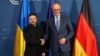
On the conference sidelines, Rubio met Ukrainian President Volodymyr Zelenskyy for roughly 40 minutes. In a statement posted to Telegram, Zelenskyy said he briefed Rubio on “the situation on the front line, ongoing Russian attacks, and the consequences of the attacks on the energy system.”
The two also examined the diplomatic track in detail, including next week’s trilateral talks in Geneva.
“It’s important that the planned negotiations in Geneva be productive, and I thank the United States for its constructive approach,” Zelenskyy said.
The consultations extended beyond the secretary. Zelenskyy also spoke with Trump envoys Witkoff and Kushner ahead of the next round of talks, discussing developments since their previous meetings in Abu Dhabi. Some elements, he noted cautiously, could not yet be made public.
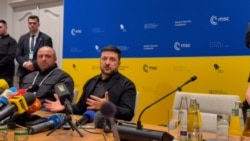
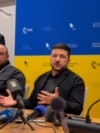

He also briefed them on his conversation with Rubio and expressed appreciation for continued American support. Both sides left Munich projecting a sense of momentum.
But the diplomacy unfolding behind closed doors was only one facet of the story. The conference stage also served as a venue for a broader argument about the future of the Western alliance -- and America’s place within it.
A 'Free World' Speech And Signals Of Continuity
Earlier in the day, Rubio had framed the stakes in strategic terms, describing the “free world” as durable and capable of renewal rather than decline. Veteran US diplomat Daniel Fried, who played a key role in designing American policy in Europe after the fall of the Soviet Union, characterized the address as constructive.
“This was a positive ‘free world’ speech, extolling the virtues of a united West and calling for reform, not destruction, of its key institutions like NATO,” Fried told RFE/RL on February 14, describing it as “a recognizable variant of America’s grand strategy since Pearl Harbor.”
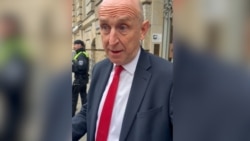
Fried observed that Rubio could have more directly identified adversaries such as Russia and China and devoted more explicit attention to Moscow’s war against Ukraine. Still, he argued, the overall message signaled a steadier course. After a period marked by sharp rhetoric and uncertainty, the tone in Munich was notably more reassuring.
That sense of bipartisan continuity surfaced again later at Ukraine House in Munich during a reception hosted by the Atlantic Council. The Senate NATO Observer Group co-chairs, Democrat Jeanne Shaheen of New Hampshire and Republican Thom Tillis of North Carolina, emphasized that support for NATO remains robust in Washington.
Shaheen argued that the alliance endures because it serves core American interests. Tillis put it more bluntly: “Our fortunes are intrinsically linked, and they will be forever.”

For Alex Wong, a former US principal deputy national-security adviser during the Trump administration, Munich itself carried symbolic weight. The very gathering, he said, reflected the enduring significance of the transatlantic alliance -- proof that the “free world” remains more than a slogan and continues to command political will on both sides of the Atlantic.
Rubio is headed to Slovakia and Hungary on February 15 -- countries geographically adjacent to the war but politically more ambivalent about confronting Moscow.
For Western officials watching closely, that itinerary is also part of the broader strategy: Shore up the alliance’s eastern flank, stabilize the political center, and keep Ukraine at the heart of the transatlantic agenda -- whether named explicitly or not.

