WATCH: Russian performance artist Pyotr Pavlensky walked free after more than six months in detention with a warning that political repression in his country was increasing every day. (RFE/RL's Russian Service)
Russian performance artist Pyotr Pavlensky has been set free after more than six months in detention over his protest actions, but emerged from a Moscow courtroom warning that political repression remains the basis of the Russian government's power.
The Meshchansky district court ordered Pavlensky to pay a fine of almost $8,000 for torching an outer door of the Federal Security Service's (FSB) headquarters in November, but he was spared a jail sentence in a rare show of leniency by the authorities.
Pavlensky refused to testify at his trial, speaking only to journalists and supporters.
"I thank you all," he said on his way out of court. "Thank you to everyone who was not afraid. Your support was very important."
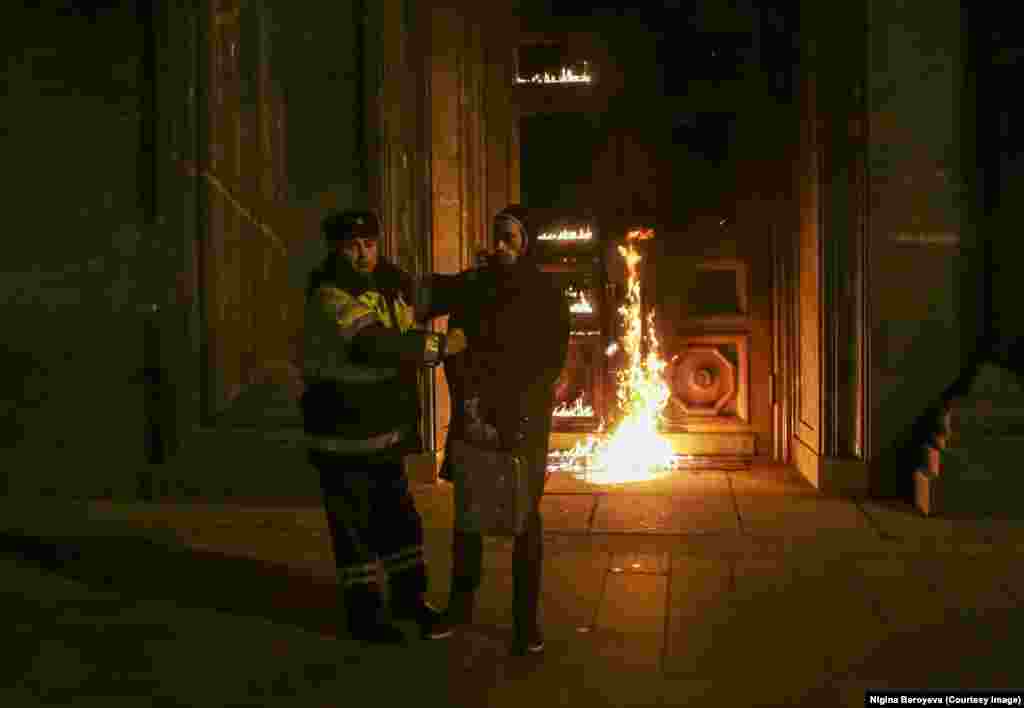
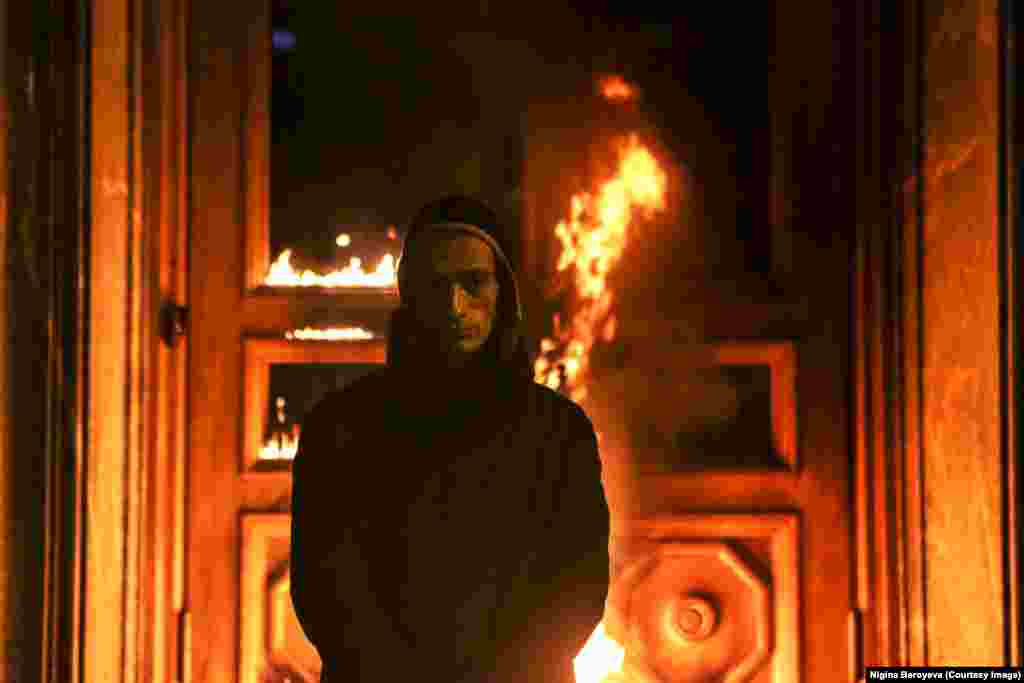
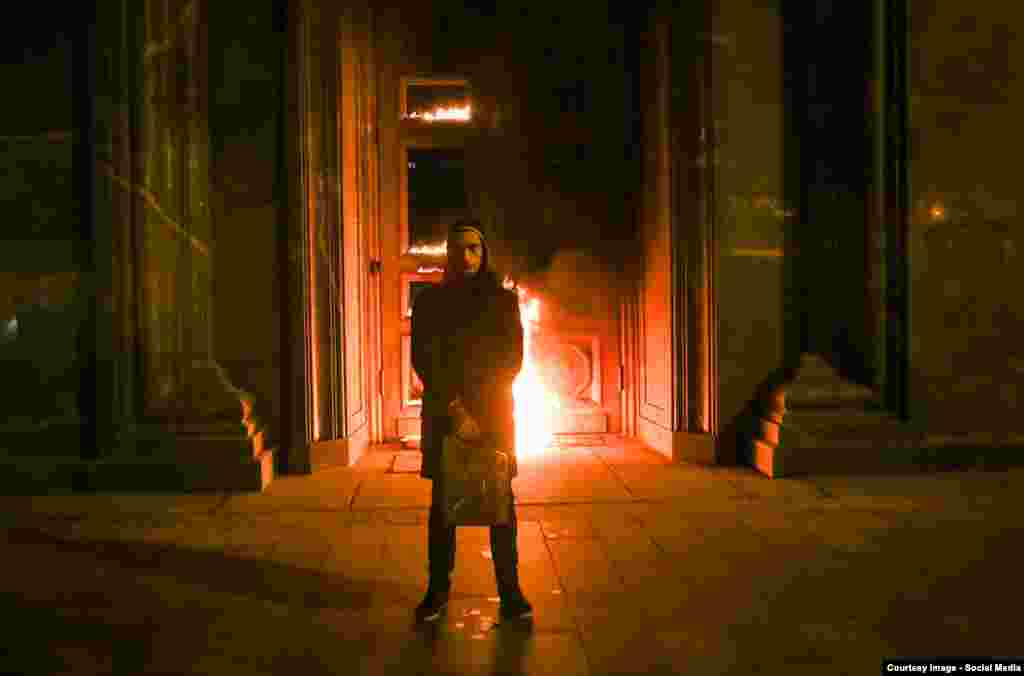
Pavlensky was tried on charges of damaging a cultural site for dousing the doors of the FSB building, dubbed Lubyanka after the square it sits on, with fuel and setting it on fire in a November performance that he called Threat and an accompanying video titled Lubyanka Door Burning.
The downtown Moscow building was used by the FSB's Soviet-era political-police predecessors and was the site of detentions and executions of prominent figures during the Stalinist purges.
Pavlensky described the stunt as an attempt to highlight the security services' campaign of "terror" against Russian society.
"We witnessed that it is possible to methodically destroy culture, to be engaged in the methodical destruction of culture, and then on this basis to declare oneself a cultural monument," Pavlensky told journalists on June 8. "We have seen an active graveyard that also is the center of government, the center of power over 146 million people."
President Vladimir Putin used to have an office in the building when he was head of the FSB in the mid-1990s, before becoming prime minister.
"We must be very vigilant and very active. Otherwise, in the near future, a prison of our daily life will become a prison in literal sense for each of us," he said outside the court.
WATCH: Artist Fights The Kremlin With Nudity And Self-Harm
Pavlensky had faced a sentence of up to three years in prison, but prosecutors unexpectedly asked the court to fine, not jail, him.
Pavlensky must also pay 481,000 rubles ($7,400) in damages for the cost of the damaged door.
"I can't pay the fine," Pavlensky said, telling journalists that it was a matter of principle not to pay money to the authorities.
His trial was closely watched amid concern that it could become a repeat of the Pussy Riot trial, in which some members of the protest punk group were sentenced to two years in prison in 2012 for "hooliganism motivated by religious hatred" after performing a song criticizing Putin and the Russian Orthodox Church leadership in one of Moscow's major cathedrals.
Their incarceration caused an outcry in the West.
PHOTO GALLERY: Pavlensky's Threat -- The Story Behind The Photo
Pavlensky's Threat: The Story Behind The Photo
1/10Photojournalist Nigina Beroyeva. It was nearly 1 a.m. on a November morning when the 33-year-old found herself following the silent figure of Pyotr Pavlensky through Moscow's streets. Moments before taking the most important photo of her career, Beroyeva "had no idea what was about to happen."
The photo of performance artist Pyotr Pavlensky in front of the burning door of Federal Security Service (FSB) headquarters in Moscow is one of the defining images of Russia’s current era. But, as the two young journalists who were there recall, it’s a small miracle any photographs survived the night.
Show moreShow less
2/10Romensky, a journalist with an independent television channel in Russia. Like Beroyeva, he hadn't met Pavlensky. But one week before the artist's planned "action," Pavlensky contacted Romensky and gave him the address of a 24-hour "Chocoladnitza" cafe in central Moscow. Knowing nothing more, Romensky says, he agreed to meet the artist with his video camera. "I still have no idea why he chose me."
The photo of performance artist Pyotr Pavlensky in front of the burning door of Federal Security Service (FSB) headquarters in Moscow is one of the defining images of Russia’s current era. But, as the two young journalists who were there recall, it’s a small miracle any photographs survived the night.
Show moreShow less
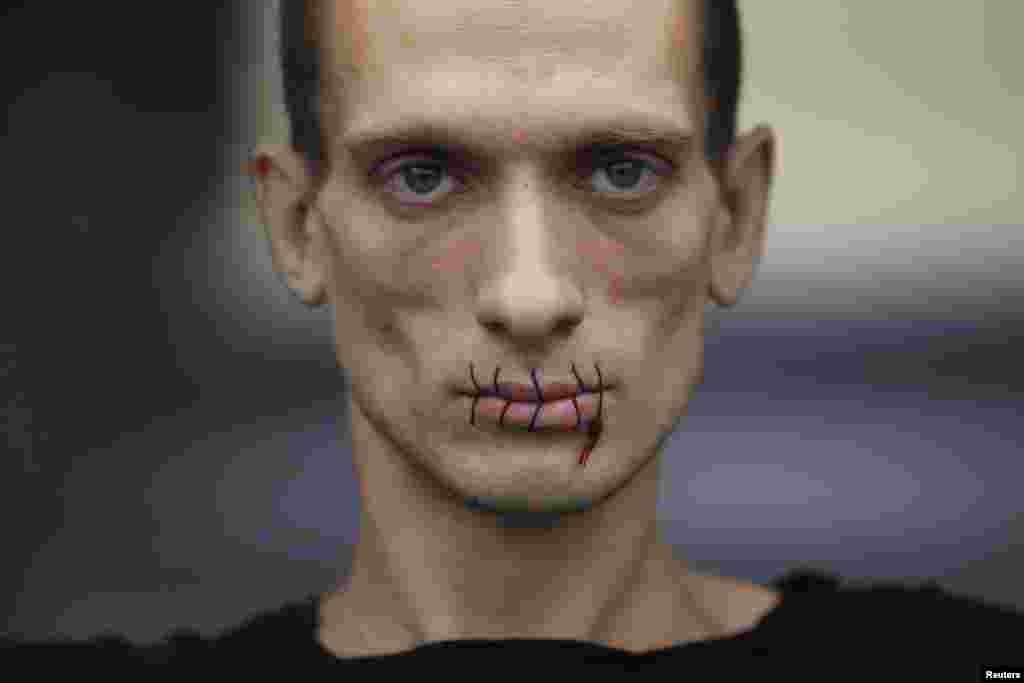
3/10Pavlensky, protesting against the arrest of members of Pussy Riot in 2012. Both journalists speak highly of the artist. Beroyeva: "Even with his mouth sewn shut, he can say something the whole world hears."
The photo of performance artist Pyotr Pavlensky in front of the burning door of Federal Security Service (FSB) headquarters in Moscow is one of the defining images of Russia’s current era. But, as the two young journalists who were there recall, it’s a small miracle any photographs survived the night.
Show moreShow less
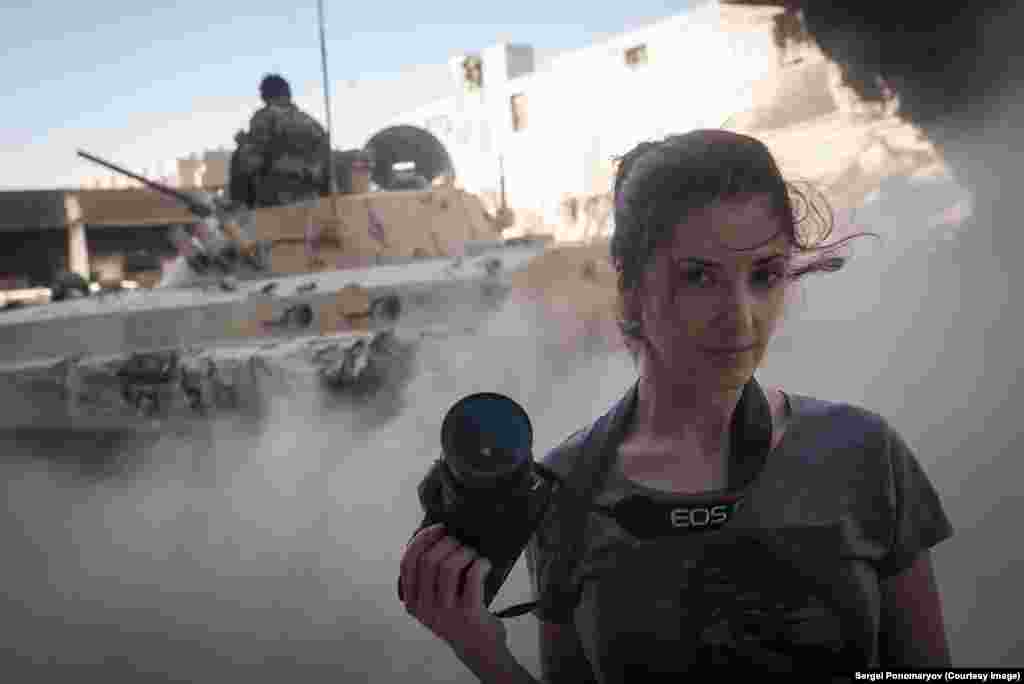
4/10Beroyeva on assignment in Syria. As the two friends chatted in a bar in central Moscow, Romensky made the snap decision to invite his friend along to the mysterious cafe meeting. Beroyeva recalls the moments in the cafe that Pavlensky "arrived after about 20 minutes and sat across the room. He didn't talk to us or order any food, just waited for about 10 minutes, then stood up and walked out, and we followed him."
The photo of performance artist Pyotr Pavlensky in front of the burning door of Federal Security Service (FSB) headquarters in Moscow is one of the defining images of Russia’s current era. But, as the two young journalists who were there recall, it’s a small miracle any photographs survived the night.
Show moreShow less
5/10The pair trailed the hooded figure through an underpass. Beroyeva remembers: "We came up and could see he was doing something against this door and then the fire started very suddenly. We only grabbed our cameras out of our bags then."
The photo of performance artist Pyotr Pavlensky in front of the burning door of Federal Security Service (FSB) headquarters in Moscow is one of the defining images of Russia’s current era. But, as the two young journalists who were there recall, it’s a small miracle any photographs survived the night.
Show moreShow less
6/10"He just stood there, he made no declarations or anything. He was very calm." Between the first and last pictures she took that night, the metadata from Beroyeva's camera shows 17 seconds passing before her camera was wrestled out of her grip by uniformed men who ran to the scene. "We were saying, 'We're journalists' over and over, but I was pressed against the wall of the building and Vladimir was wrestled to the ground."
The photo of performance artist Pyotr Pavlensky in front of the burning door of Federal Security Service (FSB) headquarters in Moscow is one of the defining images of Russia’s current era. But, as the two young journalists who were there recall, it’s a small miracle any photographs survived the night.
Show moreShow less
7/10After forcing him to the pavement, Romensky recalls the men "sitting on top of me." In an attempt to safeguard the historic footage he'd just made, Romensky tried to pull the memory card out of his camera as he struggled under the men. "While I was trying to get the SD card out of the camera, [the memory card] broke in half. I got nothing from that night, just the experience!"
The photo of performance artist Pyotr Pavlensky in front of the burning door of Federal Security Service (FSB) headquarters in Moscow is one of the defining images of Russia’s current era. But, as the two young journalists who were there recall, it’s a small miracle any photographs survived the night.
Show moreShow less
8/10Once detained, the two friends were driven away in a black Mercedes to a police station. Beroyeva remembers investigators questioning them through the night "using different interrogation techniques, sometimes they would threaten to charge us with being accomplices.... It was scary, I felt very vulnerable. I'm not used to that kind of situation." At 7 a.m., after being questioned through the night, the pair was released.
The photo of performance artist Pyotr Pavlensky in front of the burning door of Federal Security Service (FSB) headquarters in Moscow is one of the defining images of Russia’s current era. But, as the two young journalists who were there recall, it’s a small miracle any photographs survived the night.
Show moreShow less
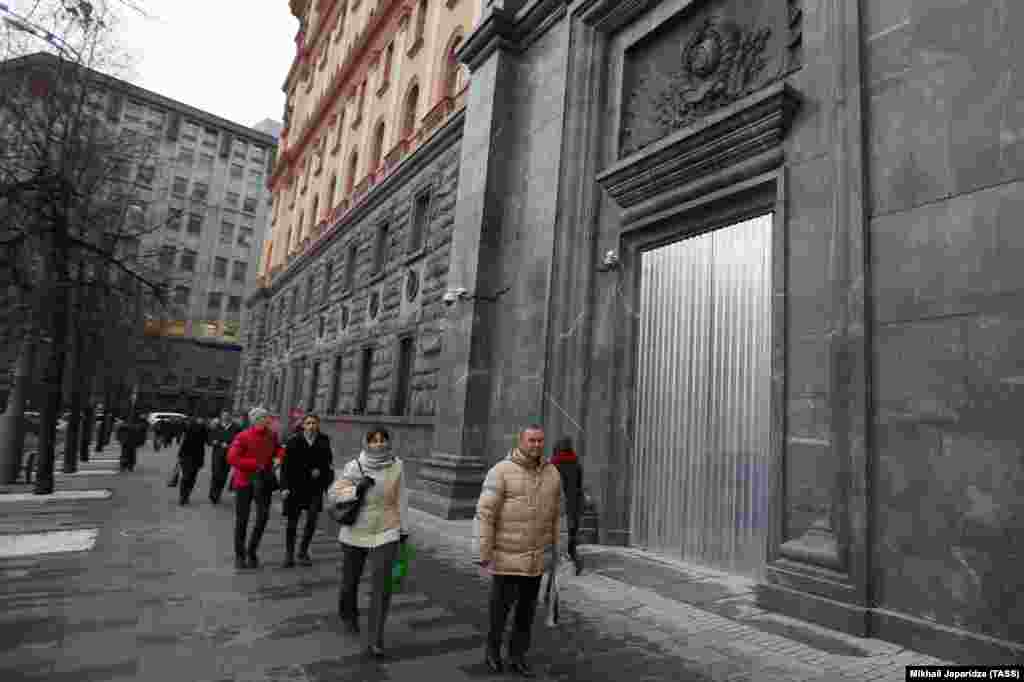
9/10The door to the FSB, covered by a sheet of metal two days after being scorched by Pavlensky. Free, and reunited with her camera, Beroyeva was amazed to find all the images still on her memory card. Soon after her pictures were released through agencies "my phone exploded, I was getting calls from around the world. I'm not used to that either!"
The photo of performance artist Pyotr Pavlensky in front of the burning door of Federal Security Service (FSB) headquarters in Moscow is one of the defining images of Russia’s current era. But, as the two young journalists who were there recall, it’s a small miracle any photographs survived the night.
Show moreShow less
10/10Today, seven months on from that November night, Beroyeva was squashed into a Moscow courthouse where she captured this photo of Pavlensky's handcuffs being unclicked. Soon after, he walked out a free man. Beroyeva speculates this is not the end for an artist who has confounded Russian authorities. "I won't be surprised if this performance just keeps going."
The photo of performance artist Pyotr Pavlensky in front of the burning door of Federal Security Service (FSB) headquarters in Moscow is one of the defining images of Russia’s current era. But, as the two young journalists who were there recall, it’s a small miracle any photographs survived the night.
Show moreShow less
Previous slide
Next slide
Pavlensky, 32, is known for intensely physical performances to highlight perceived restrictions on political freedoms. He has previously nailed his scrotum to Red Square, sewn his lips together, wrapped himself in barbed wire, and sliced off part of his ear.
Pavlensky has reportedly stated that his goal is to be tried for terrorism.
He consistently likened his case to that of Ukrainian filmmaker Oleh Sentsov, who was convicted by a Russian-run court of terrorism for setting fire to the offices of a pro-Kremlin party in Russian-annexed Crimea in 2014.
Pavlensky was also convicted last month for vandalism in a separate case for a 2014 performance in his home city of St. Petersburg, called Freedom and inspired by Ukraine's EuroMaidan unrest that unseated a pro-Russian president.
In that case, Pavlensky was given a noncustodial sentence of 16 months that was then immediately lifted as the statute of limitations had expired during the trial.
Pavlensky told journalists and supporters on June 8 that "it does not matter" how his trial ended.
"What is important is the fact that we were able to unmask, uncover the truth: the government is founded on the methods of terror."
With reporting by RFE/RL's Russian Service, AP, AFP, and Reuters
RFE/RL journalists report the news in 24 languages in 18 countries where a free press is banned by the government or not fully established. We provide what many people cannot get locally: uncensored news, responsible discussion, and open debate.








![After forcing him to the pavement, Romensky recalls the men "sitting on top of me." In an attempt to safeguard the historic footage he'd just made, Romensky tried to pull the memory card out of his camera as he struggled under the men. "While I was trying to get the SD card out of the camera, [the memory card] broke in half. I got nothing from that night, just the experience!"](https://gdb.rferl.org/247fd126-c7eb-4493-88a3-3ba1afd5dd83_w1024_q10_s.jpg)