




An economy fueled by fighting. From TV screens to classrooms, an all-pervading narrative of civilizational confrontation with the West. Thousands of war-scarred soldiers, some of them violent convicts sprung from prison to fight in the bloodiest battles in Ukraine, returning to cities and towns across Russia.
At President Vladimir Putin's showcase economic forum in St. Petersburg earlier this month, billowing black smoke from Ukrainian drone strikes on oil facilities near his hometown was a stark symbol of the setbacks hitting Russia in the fifth year of a full-scale invasion he hoped would bring Kyiv to its knees in weeks.
Those and other Ukrainian attacks deep inside Russia have come as dramatic reminders that to have a chance of achieving any of Putin's main war goals, even the capture of Ukraine's Donbas region in its entirety, Moscow's forces will have to fight on.
Less visible at the forum was the welter of domestic factors that, for Putin, amounts to a major disincentive to ending the war he started.
It's a web he himself has spun -- and one that would be difficult to undo, analysts say, without creating substantial risks for Russia and for his own political standing after more than a quarter-century in power as president or prime minister.
Putin, in effect, has created a monster. Or, as political scientists Seva Gunitsky and Jeremy Morris put it in a recent article in the journal Foreign Affairs , he has "stumbled into a war trap that…no one can easily dismantle."
"We're talking about the shadow economy, labor markets, regional budgets, even the social hierarchy inside the country -- all reordered around the conflict," Gunitsky, the George Ignatieff Chair of Peace and Conflict Studies at the University of Toronto, told RFE/RL in an interview. "In that sense, it has become a nationwide institutional and economic order whose inertia constrains even Putin."
"Stopping it would mean economic dislocation, social upheaval, and possibly even a political crisis that the regime is simply not prepared to face," he said.
Since the start of the full-scale invasion, entire regions, industries, and sectors of the population have become dependent on money streams related to the war, from men joining the military for the high pay to weapons manufacturers.
These cash flows "don't benefit the broader population. But for the sectors that do depend on them -- like the arms industry, which employs millions -- the continuation of conflict is essential," Gunitsky said. "Any disruption would be deeply destabilizing."
'The Slow Bleed'
An end to the fighting would bring many soldiers back home to an uncertain future, including convicted criminals who joined up in exchange for their freedom. Veterans of prison and the war have already carried out a rash of violent crimes across Russia,
"Russia faces costs either way -- but they're very different kinds of costs," Gunitsky said. "The costs of continuing the war are slow and diffuse: inflation, labor shortages, civilian stagnation. The costs of stopping the war are immediate and concentrated: mass unemployment, a veteran crisis, and potential collapse in defense industries."

"Historically, regimes almost always choose the slow bleed over acute crisis," he said.
So far, Putin has made that same choice -- or, at any rate, has put off any change of course.
Despite the Kremlin's portrayal of Putin as a resolute man of action, Russia expert Mark Galeotti describes him as a "fence-sitter" who perennially puts off making big decisions or changes.
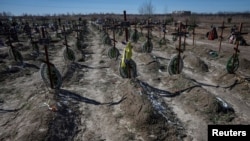
Plus, Putin may fear that halting the fighting now would leave him with too little to show for it, after nearly five years of all-out war in which Russian forces have made limited gains while suffering massive casualties -- almost 500,000 killed, according to a British intelligence estimate in May.
Sword Of Damocles
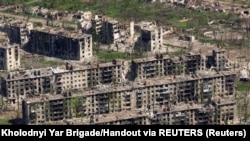
Many of the deaths have come in long, grinding, deadly battles in the Donbas -- the Donetsk and Luhansk regions of eastern Ukraine -- that have left cities in ruins. Putin has baselessly claimed those two regions, as well as Crimea, Zaporizhzhya, and Kherson, are now in Russia, creating pressure on his own state to control them in full.
"If there's a peace deal that can't be sold as victory, that creates enormous tension," Gunitsky told RFE/RL.
"Any settlement -- even a cease-fire -- would have to allow Putin to portray it as a credible victory, or at least a credible first step toward one," he said.
That may be a big reason why Putin seems determined to take the remainder of the Donbas, at a minimum, though force or diplomacy: Several times, the Kremlin has said a Ukrainian withdrawal from the strategically important portion that Kyiv still holds is a precondition for talks.
Opinion polls show that most Russians favor peace talks over more war, and some analysts say Putin could sell almost any outcome as a victory, or at least a tentative one.
"We've always got to remember that Russia has the option of declaring peace at any time," Galeotti said on his podcast on June 14: It could say it's stopping with front-line positions frozen in place, but hold the prospect of a renewed offensive like a "sword of Damocles hanging over the head of Ukraine and by extension the West."
"In Russia…there is clearly a campaign within certain elements of the elite, particularly the business and technocratic elites, to try and persuade Putin that he can afford to just simply declare a triumph and end the war," he said, adding that Putin, who has maintained power by playing rival camps in the government and security structures off against one another, "clearly has allowed this to happen."
"So, Putin is willing to see a debate, but there's no evidence so far that this debate is changing his mind: At present he is either still supportive of the hawks' contention" that Russian forces will take the rest of the Donbas this year if they press on, "or, at the very least, he has not been convinced by the alternative argument," Galeotti said. "And in the absence of any kind of decision from Putin, the status quo prevails, so the war continues."
'A New Kind Of Problem For Putin'
Sam Greene, a professor at the Russia Institute at King's College London, also raised the prospect that Putin could potentially seek to placate both hawks and doves -- or in Greene's roughly similar terms, Bears and Foxes -- by seeking a cease-fire "in which Russia retains claims on Ukrainian territory, and in which Europe remains mobilized to contain and confront Moscow."
"That could plausibly satisfy the Foxes, by lowering the running costs of the war, while still satisfying the Bears, who would get continued military investment and political prominence in a Russia that remains geared up for conflict," Greene wrote.
It would also be less of a jolt to the Kremlin's portrayal of the war as part of an existential struggle against an immoral West that is out to destroy Russia -- a narrative that has been imposed on society at every level.
However, the "risk-averse" Putin's most likely course is probably "to keep muddling through with the war," Greene wrote. "But we shouldn't pretend that this option is cost-free for the Kremlin."
While "there are lots of reasons why keeping the war going for Putin is easier than ending it," he wrote, both groups in the Russian elite -- advocates of more war and those who would prefer peace -- are souring on the status quo.
"What we're increasingly seeing…is that neither camp believes that the current prosecution of the war serves their interests," Greene wrote. While they are deeply at odds over the future, "they increasingly agree that the present is both unsustainable and undesirable. And that creates a new kind of problem for Putin."


