



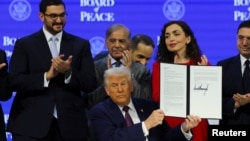
US President Donald Trump has signed into existence a Board of Peace, an initiative he says will seek to resolve global conflicts and promote stability, peace, and governance "in areas affected or threatened by conflict."
The board, which some fear could undermine the United Nations, was originally proposed to oversee the rebuilding of the Gaza Strip as part of a deal to rebuild the devastated territory following the war between Israel and Hamas, which the United States and European Union have designated as a terrorist organization.
The board's charter, however, does not limit its role to Gaza.
The following are the main points of the initiative, presented by Trump in Davos, Switzerland, on January 22.
Who Will Lead The Board of Peace?
The Board of Peace's inaugural chairman is Trump, who will hold the post until he designates a successor. He can only be removed from the post by voluntarily stepping down "or as a result of incapacity, as determined by a unanimous vote of the Executive Board."
A founding Executive Board composed of public officials and private individuals has been created. The appointed members are: US Secretary of State Marco Rubio, US special envoy Steve Witkoff, Trump's son-in-law Jared Kushner, Former British Prime Minister Sir Tony Blair, billionaire businessman and chief executive officer of Apollo Global Management Marc Rowan, American business executive Ajay Banga, and US national-security adviser Robert Gabriel.
In addition, Nickolay Mladenov, a Bulgarian politician and former UN Middle East envoy, will be the Board of Peace's representative on the ground in Gaza.
Who Are The Members?
The Trump administration sent out more than 50 invitations to countries around the world. Members are invited to join for free for three years. At the end of the three-year period, the chairman of the peace board may then decide to renew a country's membership. However, if a country wishes to become a permanent member, they can do so by paying a $1 billion fee within the first year of joining the group.
The White House has not published a list of those countries who were extended invitations, but the following countries were signatories to the document presented on January 22: Saudi Arabia, the United Arab Emirates, Bahrain, Jordan, Qatar, Turkey, Hungary, Bulgaria, Argentina, Mongolia, Morocco, Pakistan, Indonesia, Kosovo, Uzbekistan, Kazakhstan, Paraguay, Armenia, and Azerbaijan.
In addition, Israel, Egypt, Belarus, Albania, and Vietnam have also agreed to join the board. Trump has said Russia has accepted as well, though the Kremlin has not officially confirmed his comments.
Meanwhile, several nations have said they are still looking at the possibility. Those include China, Canada, Britain, Germany, and Japan.
Many European nations have already rejected the offer they received, including Sweden, Norway, and France.
Ukraine has said it has to wait to see Russia's decision as it is hard to envision being on a peace board with a country it is at war against.
The Vatican has said Pope Leo, the first American pontiff and a critic of some of Trump's policies, has been invited to join the board, though no decision has been announced.
What Is The Board's Mandate?
The board initially had a mandate from the UN Security Council as part of the Gaza peace deal; it was to focus solely on the peaceful rebuilding of Gaza, with a lifespan lasting until 2027.
Trump's vision for the board -- which will be funded through voluntary funding from member states, other states, organizations, and other sources -- is to undertake peace-building functions in areas affected or threatened by conflict.
Member states will vote on the pursuit of new peace-building initiatives in accordance with international law.

