





WASHINGTON -- US President Donald Trump called on members of Iran’s military, police, and the Islamic Revolutionary Guards Corps (IRGC) to lay down their arms, promising “total immunity” if they abandon the country’s ruling clerical establishment.
As he made his remarks, fears continued to rise that the US and Israeli war on Iran was spreading throughout the Middle East, not only affecting Washington's Arab allies, but also non-Gulf nations, such as Azerbaijan, Turkey, Cyprus, and even Sri Lanka, some 3,900 kilometers away.
Trump, speaking at the White House on March 5, urged security forces to side with the Iranian public and help bring down the government that has ruled the country since the 1989 Iranian Revolution.
“I’m once again calling on all members of the Iranian Revolutionary Guard, the military, and the police to lay down their arms,” Trump said. “Now is the time to stand up for the Iranian people and help take back your country.”

He emphasized those who surrender would receive protection. "We'll give you immunity," Trump said, adding that those who defect would be on "the right side of history."
"You'll be perfectly safe with total immunity, or you'll face absolutely guaranteed death. And I don't want to see that," he said.
Trump also appealed to Iranian diplomats stationed abroad to seek asylum and assist in shaping Iran's future.
"We urge Iranian diplomats around the world to request asylum and help us shape a new and better Iran with great potential," he said.
Later, in an interview with NBC News, Trump said he wasn't currently considering the use of US troops on the ground in Iran.
"It's a waste of time. They've lost everything. They've lost their navy. They've lost everything they can lose," he told NBC News in a phone call, adding that Iranian Foreign Minister Abbas Araqchi's earlier remark that Iran was ready for a US or Israeli ground invasion was a "wasted comment."
Claim of Heavy Military Losses
The US president claimed that Iranian military capabilities had been severely degraded during recent fighting.
“In three days, their anti-aircraft weapons are gone. They have no air force. They have no air defense,” Trump said. “All of their airplanes are gone. Their communications are gone.”
He also said roughly 60 percent of Iran’s missiles and 64 percent of its launchers had been destroyed and that the country’s navy had lost 24 ships.
“Their navy is gone,” he said.
He accused Tehran of previously aiming missiles at several Gulf countries, including Qatar, Saudi Arabia, and the United Arab Emirates.
“They were going after the entire Middle East,” Trump said. “Then we came along. We blew up their party.”
A Say In The Next Ruler
Hours earlier, Trump had said Washington will help choose the next leader of Iran after the country’s supreme leader, Ali Khamenei, had been killed in the initial stages of the joint US-Israeli air strikes on February 28.
Trump, speaking to Reuters, ruled out Mojtaba Khamenei, the son of the late supreme leader -- a hardliner who has been considered a favorite to succeed his father -- calling him a “lightweight.”
"We want to be involved in the process of choosing the person who is going to lead Iran into the future," he was quoted by the agency as saying.
"We don't have to go back every five years and do this again and again...Somebody that's going to be great for the people, great for the country."
"Khamenei's son is unacceptable to me. We want someone that will bring harmony and peace to Iran," Trump said in an interview with Axios.
Hegseth: Fight Just Begun
Meanwhile, US defense chief Pete Hegseth warned Tehran it was making a mistake if it thought the United States could not sustain the ongoing war, adding that US forces had just begun to fight.
"Iran is hoping that we cannot sustain this, which is a really bad miscalculation," Hegseth told reporters at the US Central Command headquarters in Tampa, Florida.
The Pentagon on March 5 said the US military has sunk more than 30 Iranian ships so far and that ballistic missile attacks by Iran have decreased by 90 percent since the first day of the war, with some 60 percent of launchers destroyed.
Israel Launches Next Phase, Iran Retaliates
Israeli Chief of General Staff Eyal Zamir on March 5 said the country's forces were launching the next phase of its attacks in Iran in which "we will further dismantle the regime and its military capabilities."
He said that since February 28, the Israeli Air Force has carried out some 2,500 attacks in Iran in the initial "surprise attack phase," gaining air superiority and destroying more than 60 percent of ballistic missile launchers.
Iranian state TV reported explosions in several parts of the capital in the early morning hours of March 6.
Israeli forces also intensified attacks on Iran-allied Hezbollah forces in neighboring Lebanon.
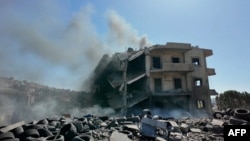
In retaliation, Iranian forces fired two new waves of rockets at Israel and have used warheads with cluster munitions, Iranian state TV reported.
Cluster munitions have largely been banned internationally because they spread explosives over large areas and are particularly dangerous for civilians. Israel has previously accused Iran of firing such munitions.
Elsewhere, an Iranian missile strike ignited a blaze at Bahrain's state-owned oil refinery, while in Saudi Arabia, some Western embassy staff in Riyadh were told to shelter in place after an attack on the US Embassy compound earlier this week.
The United Arab Emirates said its air-defense systems had intercepted six ballistic missiles, one of which landed on its soil. Emirati officials said the Gulf state is considering freezing Iranian assets to punish Tehran for the attacks on its territory.
Sites in non-Gulf nations Azerbaijan, Turkey, and Iraq have also been targeted by Iranian drones during the first six days of fighting. A US submarine sank an Iranian warship off the waters of Sri Lanka on March 4, killing at least 87 sailors.

Fears were growing in Azerbaijan, Iran's northwestern neighbor, that the South Caucasus country could become embroiled in the war.
Baku accused Iran of firing drones that struck an airport and school in Azerbaijan's Nakhchivan autonomous region on March 5, calling it an "act of terror" and vowing to respond. Tehran denied it fired the drones that injured two people.
The US State Department on March 5 warned American citizens in Azerbaijan to avoid travel to the Nakhchivan region following the drone strikes.

