


Trump's Syria Withdrawal Announcement Criticized By Allies, Praised By Putin
President Donald Trump says the United States will pull its troops out of Syria after "historic victories" over Islamic State. (file photo)
U.S. President Donald Trump has defended his unexpected decision to withdraw U.S. troops from Syria, a move met with concern by members of the anti-Islamic State (IS) coalition, but lauded by Russia.
Trump said in several tweets early on December 20 that his decision was in line with his promise from his 2016 presidential campaign to withdraw from Syria.
Trump made the surprise announcement in a video message posted on Twitter saying that "after historic victories" against IS militants, U.S. troops are "all coming back and they’re all coming back now" from Syria.
"Now it’s time for our troops to come back home," he added.
The video posting came after confusion and some concerns were raised by U.S. lawmakers and allies in response to an earlier tweet by the president that said, "We have defeated [IS] in Syria, my only reason for being there during the Trump Presidency."
U.S. officials told media outlets the president had decided to rapidly withdraw all troops from Syria, and White House spokeswoman Sarah Sanders said some of the 2,000-strong U.S. force had begun to leave after the militants' "territorial caliphate" had been defeated.
France, Britain, and Germany, key members of the anti-IS coalition, reacted to the announcement with skepticism, saying that much remains to be done in Syria.
France said it would maintain its participation in the anti-IS coalition. "For now of course we remain in Syria," France's European Affairs Minister Nathalie Loiseau said on December 20, adding that "the fight against terrorism is not over."
A British government statement warned that "much remains to be done" in fighting the IS group in Syria.
"The global coalition against [IS] has made huge progress," the statement issued late on December 19 said.
"But much remains to be done and we must not lose sight of the threat they pose. Even without territory, [IS] will remain a threat," the statement said.
PHOTO GALLERY: U.S. Forces In Syria (click to view)
Boots On The Ground: U.S. Forces In Syria
1/14U.S. armored vehicles driving through Hajin, in eastern Syria, in December 2018.
This is what the American military presence in Syria -- which U.S. President Donald Trump says he will begin withdrawing -- looked like during its nearly three years in the country.
2/14U.S. Marines firing a howitzer during fighting in northern Syria in March 2017. American troops have been operating inside Syria since early 2016.
This is what the American military presence in Syria -- which U.S. President Donald Trump says he will begin withdrawing -- looked like during its nearly three years in the country.
3/14Kurdish fighters from the People's Protection Units (YPG) chat with members of U.S. forces in the Syrian town of Al-Darbasiyah in April 2017. The stated U.S. mission in Syria includes training and advising rebel forces fighting Islamic State (IS) militants.
This is what the American military presence in Syria -- which U.S. President Donald Trump says he will begin withdrawing -- looked like during its nearly three years in the country.
4/14U.S. Marines pop a mortar towards an IS target in eastern Syria in October 2018. U.S. forces have also launched "kill or capture" missions targeting prominent IS leaders.
This is what the American military presence in Syria -- which U.S. President Donald Trump says he will begin withdrawing -- looked like during its nearly three years in the country.
5/14U.S. soldiers in a house they converted into an outpost in northern Syria. The U.S. deployment currently stands at around 2,000 troops, up from just a few hundred in 2017.
This is what the American military presence in Syria -- which U.S. President Donald Trump says he will begin withdrawing -- looked like during its nearly three years in the country.
6/14U.S. soldiers inside a YPG base in northeastern Syria in April 2017. Four American service members have been killed since the Syrian operation began, most recently in March 2018 when an American and a British soldier were killedby an explosive.
This is what the American military presence in Syria -- which U.S. President Donald Trump says he will begin withdrawing -- looked like during its nearly three years in the country.
7/14U.S. and Turkish forces conduct joint patrols on the outskirts of Manbij in November 2018. Syria is today an "ever congested" battle space, with U.S.-, Turkish-, Syrian-, Russian-, and Iranian-affiliated fighters all variously cooperating and clashing in the country.
This is what the American military presence in Syria -- which U.S. President Donald Trump says he will begin withdrawing -- looked like during its nearly three years in the country.
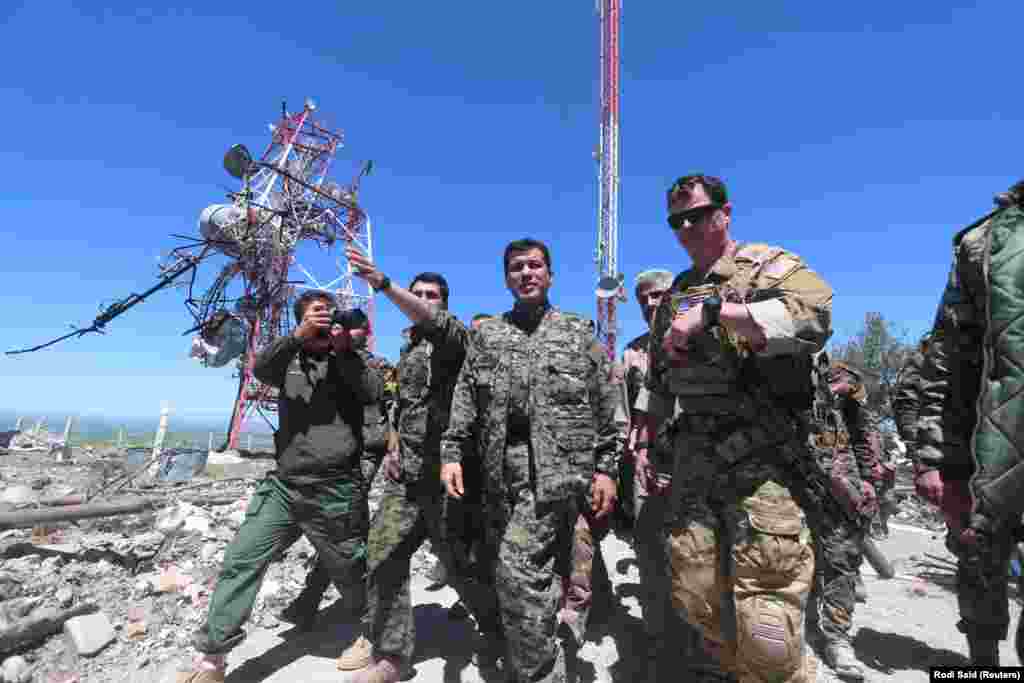
8/14A U.S. military commander (right) with YPG fighters as they inspect the damage done to a YPG base after it was hit by Turkish air strikes.
This is what the American military presence in Syria -- which U.S. President Donald Trump says he will begin withdrawing -- looked like during its nearly three years in the country.
9/14U.S. Marine howitzers pummel an IS position during the four-month battle for Raqqa, the de facto "capital" of the Islamic State group until the city was liberated in October 2017.
This is what the American military presence in Syria -- which U.S. President Donald Trump says he will begin withdrawing -- looked like during its nearly three years in the country.
10/14A U.S military demining vehicle leads a convoy near Raqqa in July 2017.
This is what the American military presence in Syria -- which U.S. President Donald Trump says he will begin withdrawing -- looked like during its nearly three years in the country.
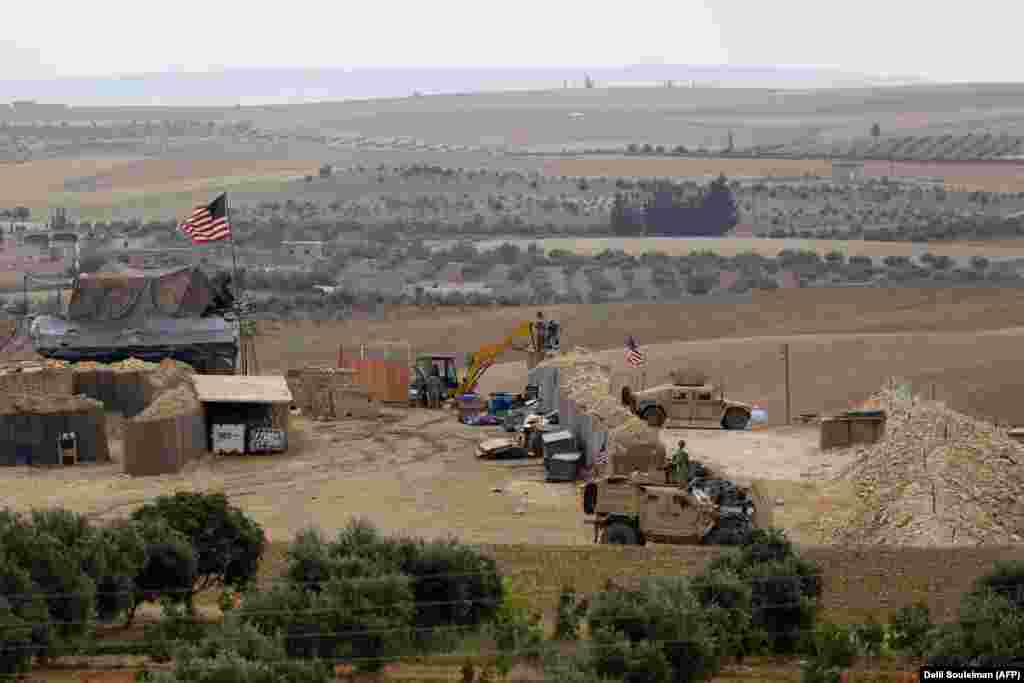
11/14A U.S. base near Manbij in May 2018. The most infamous clash of the U.S. deployment came when hundreds of fighters aligned with the Syrian regime -- many of them Russian -- launched an attack on a Kurdish base with U.S. special forces inside...
This is what the American military presence in Syria -- which U.S. President Donald Trump says he will begin withdrawing -- looked like during its nearly three years in the country.
12/14An Air Force B-52 Stratofortress refueling during a bombing mission over Syria in February 2017. After the regime-aligned forces attacked the Kurdish base, American aircraft and artillery were used to pummel the attackers. At least dozens were killed in the "inferno,"including many Russian mercenaries.
This is what the American military presence in Syria -- which U.S. President Donald Trump says he will begin withdrawing -- looked like during its nearly three years in the country.
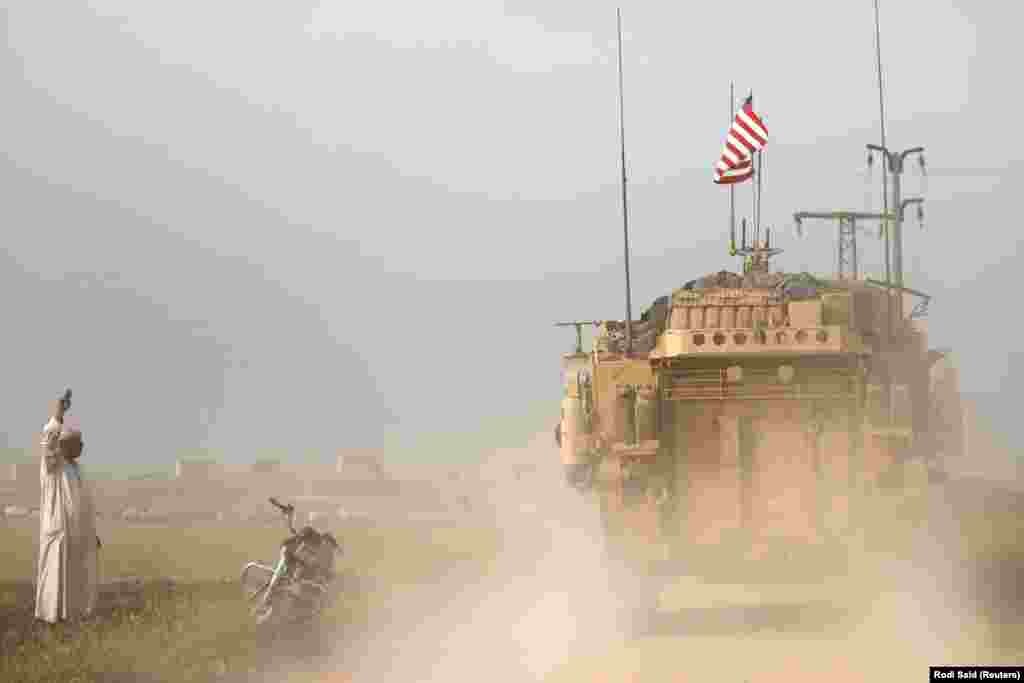
13/14A local flashes a "V for victory" sign at U.S. military vehicles near Al-Darbasiyah. According to the U.S. Defense Department, the coalition has recaptured around 90 percent of the territory once held by IS in Syria.
This is what the American military presence in Syria -- which U.S. President Donald Trump says he will begin withdrawing -- looked like during its nearly three years in the country.
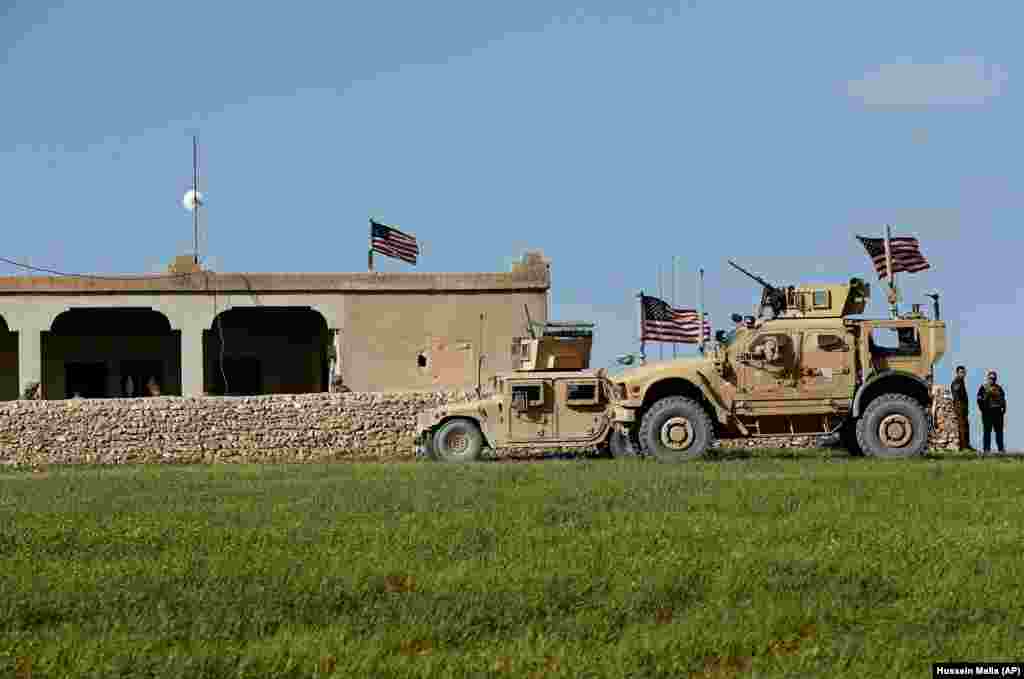
14/14A U.S. vehicle near Manbij in April 2018. On December 19, U.S. President Donald Trump declared it was time for American troops "to come back home." The statement led to a flurry of criticism that the move would embolden IS, with one Republican senator saying a withdrawal would be a mistake, claiming the Islamic State group has been "degraded" but not yet defeated.
This is what the American military presence in Syria -- which U.S. President Donald Trump says he will begin withdrawing -- looked like during its nearly three years in the country.
Previous slide
Next slide
Junior Defense Minister Tobias Ellwood was more blunt, retweeting a message from Trump that the jihadists had been defeated in Syria with the words: "I strongly disagree."
Germany also voiced concern, with Foreign Minister Heiko Maas saying in a statement that "the abrupt change of course by the American side comes as a surprise not only for us." Maas said that while IS has been pushed back, "the threat is not yet over."
But Russia, who together with Iran has given Syrian President Bashar al-Assad's government crucial support throughout the Syrian conflict, welcomed Trump's announced withdrawal.
President Vladimir Putin, speaking at his annual news conference in Moscow on December 20, said he agreed with Trump that the defeat of the Islamic State group removes the need for the U.S. military presence in the country.
Putin reiterated Moscow's long-held argument that the U.S. presence in Syria was illegitimate since it did not have the stamp of approval from the UN Security Council or from Assad's government.
"If the U.S. decided to withdraw its contingent, it has done the right thing," Putin said.
But the Russian leader added a note of skepticism, saying that it remains to be seen whether America will indeed withdraw and noting Washington's repeated promises to end its 17-year presence in Afghanistan.
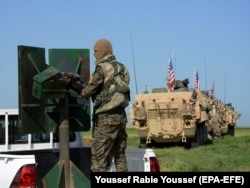
There are currently around 2,000 American troops in Syria. (file photo)
In the United States, many Republican and Democratic lawmakers condemned Trump's move. Some said it handed a victory to Russia and Iran.
Others said it was a betrayal to U.S.-backed Kurdish fighters in the war-torn country.
One U.S.-allied Kurdish militia, the Syrian Democratic Forces (SDF) said Trump's decision to withdraw from Syria would have a "negative impact" on the campaign to rout IS.
"The withdrawal decision will be a direct blow to efforts to completely defeat the terrorist organization and will have dangerous consequences on global stability and peace," the SDF said in a December 20 statement.
Addressing the UN Security Council later in the day, U.S. diplomat Rodney Hunter said the United States "remains committed to the permanent destruction of [IS] and other terrorist groups in Syria."
Washington will also "use all instruments of our national power to press for a withdrawal of Iranian-backed forces" in the war-torn country, Hunter added.
The Syrian conflict, which began with a government crackdown on protesters in March 2011, has left more than 400,000 people dead, displaced millions, and devastated many historic sites across the country.
In 2014, IS fighters seized large swaths of Syrian and Iraqi territory in a lightning offensive and proclaimed a so-called Islamic "caliphate."
IS militants have lost virtually all the territory they once controlled in Iraq, but still carry out sporadic attacks.
RFE/RL journalists report the news in 24 languages in 18 countries where a free press is banned by the government or not fully established. We provide what many people cannot get locally: uncensored news, responsible discussion, and open debate.