



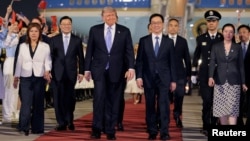
US President Donald Trump arrived in Beijing on May 13 for a closely watched summit with Chinese leader Xi Jinping, as the war in Iran and its fallout on global energy markets loom over efforts to stabilize ties between the world's two largest economies.
Trump, making his first trip to China since 2017, will begin two days of formal talks with Xi on May 14. While trade tensions, Taiwan, artificial intelligence, and rare earth exports are expected to dominate the agenda, the ongoing conflict in Iran and the near paralysis of shipping through the Strait of Hormuz have added urgency -- and complexity -- to the meeting.
Speaking before departing Washington, Trump downplayed suggestions that Beijing could play a decisive role in ending the war.
"I don't think we need any help with Iran," Trump told reporters at the White House on May 12. "We'll win it one way or the other, peacefully or otherwise."
The summit is expected to test whether Washington and Beijing can preserve a fragile equilibrium at a time of mounting global instability. Both governments, analysts say, appear focused on maintaining stability in one of the world's most consequential bilateral relationships as economic uncertainty and geopolitical crises mount globally.
"Both China and the United States have a vested interest in creating a steady state relationship between the two of them," Rana Mitter, ST Lee chair in US-Asia relations at the Harvard Kennedy School, told RFE/RL. "The United States clearly has active interests elsewhere, particularly in the Middle East at the moment, and China also is keen to restart its faltering economy."
Trade Truce Under Pressure
Despite the geopolitical backdrop, both sides have signaled that trade and economic issues will remain the centerpiece of the summit.
"We're going to be talking with President Xi about a lot of different things," Trump said before boarding Air Force One. "More than anything else will be trade."
The visit also comes at a politically delicate moment for both leaders.
Trump has faced domestic criticism over the economic fallout from the Iran war, particularly rising fuel prices and inflation concerns tied to disruptions in Middle Eastern energy supplies.
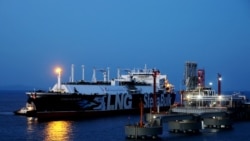


For Beijing, slowing export growth and concerns about global demand raise worrying signals for the country's economy and have increased pressure to prevent further deterioration in relations with Washington.
Trump administration officials say the White House hopes to preserve a fragile trade truce reached last year that eased some tariffs and export controls in exchange for renewed Chinese shipments of rare earth minerals, whose supply chain China dominates and that are critical to US manufacturing and defense industries.
The two sides are also expected to discuss purchases of US agricultural products and Boeing aircraft, as well as possible mechanisms for future economic coordination.
Taiwan, Iran, and Strategic Friction
Chinese officials are also expected to press Trump on Taiwan, which Beijing claims as its territory and has vowed to eventually bring under its control.
Beyond Taiwan, Iran is expected to remain central to the discussions.
China has maintained close ties with Tehran throughout the conflict, continuing to purchase Iranian oil while publicly criticizing US actions in the region. Beijing has also sought to present itself as a stabilizing diplomatic force, contrasting its approach with what Chinese officials portray as American unilateralism.
The Trump administration has increasingly scrutinized that relationship. In recent weeks, Washington sanctioned several Chinese companies accused of processing Iranian crude and four Chinese entities allegedly linked to satellite support for Iranian military operations.
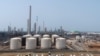
US officials say Trump is expected to pressure Xi over Beijing's economic support for Tehran during the summit.
Still, analysts caution that neither side appears eager for a major confrontation.
"On Iran and broader geopolitical issues, discussions may focus on avoiding further oil price spikes and managing escalation risks, but deep alignment is unlikely given the underlying strategic differences," Alicia Garcia-Herrero, chief economist for Asia-Pacific at Natixis, a French financial firm, told RFE/RL.