



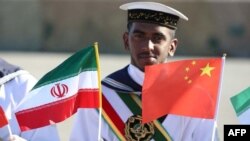
WASHINGTON -- The war with Tehran is casting a shadow over US President Donald Trump's high-stakes summit with Chinese leader Xi Jinping in Beijing later this week, where Iran is expected to emerge as one of the most sensitive issues on the agenda.
Trump is scheduled to arrive in Beijing on May 13 and meet Xi on May 14-15 after postponing the trip earlier this year because of the conflict involving Tehran. Senior US officials say Trump plans to press Xi directly on China's economic and technological ties with Iran, including oil purchases and alleged transfers of dual-use goods.
In an interview with RFE/RL, Ken Moriyasu, a senior fellow at the Hudson Institute, said Beijing may tactically help ease tensions but will resist any effort that could threaten the survival of Iran's regime, which he described as central to China's long-term Eurasian strategy.
RFE/RL: With Trump expected to press Xi on Iran and Washington unveiling new sanctions targeting China-linked Iranian oil networks, how important is this moment in US-China diplomacy over Tehran?
Ken Moriyasu: I'm sure Trump will ask Xi Jinping for help on Iran, and I'm sure China is very keen on seeing the end of this war just as much as Trump wants it to end. But I'm also very sure Xi does not want regime change in Tehran. So while he may agree to encourage Tehran to reach some kind of compromise, I'm very sure Xi will resist any pressure from Trump to punish Iran in a way that could lead to regime change.
RFE/RL: When you look at China's relationship with Iran today, how much influence does Beijing realistically have with Tehran?
Moriyasu: The relationship is ongoing, but we have to understand it through China's long-term strategy and how important Iran is within it.
If there is regime change in Tehran and the country becomes pro-US, pro-Western, and moves away from China, that cuts directly against China's long-term continental strategy.
For the past 15 years, China has been trying very hard to reduce its dependence on maritime trade routes, especially for energy, because oil tankers have to pass through choke points like the Strait of Hormuz and the Strait of Malacca. So China has been moving toward inland pipelines, and within this continental strategy Iran occupies the southern flank, or southern anchor.
If Iran becomes pro-Western, it would disrupt China's overland connectivity with the Middle East and Europe. It would complicate the energy logistics and military corridors tied to the Belt and Road Initiative, and it would undermine the idea of a contiguous Eurasian interior insulated from US military power -- something China has tried to establish over the past 15 years.
RFE/RL: Given those deep economic ties with Iran, especially in energy exports and oil purchases, does that translate into meaningful political leverage for Beijing?
Moriyasu: It gives leverage to Iran more than it gives leverage to China.
If Iran understands China's long-term strategy, then Tehran has leverage. And the United States has to understand China's policy and recognize that China will never support policies that could lead to regime change.
This is also connected to Taiwan. As long as the United States maintains a chokehold on China's energy imports through the Strait of Malacca or the Strait of Hormuz, China cannot realistically take Taiwan by force.
Even if China could militarily invade Taiwan, the US could strangle the Chinese economy by blocking those routes.
So what China is trying to do first is establish a continental corridor that protects it from US retaliation. Once that Eurasian sanctuary or fortress is complete, then Beijing would have more options regarding Taiwan.
I'm not saying China will invade Taiwan if that corridor is completed, but it would certainly give Beijing more strategic flexibility.
RFE/RL: If Trump presses Xi to use that leverage over Iran, what kind of response do you expect from Beijing?
Moriyasu: China is pursuing two long-term goals simultaneously: It wants to move away from maritime trade routes, and it also wants to move away from oil dependence itself.
That's why China is aggressively encouraging a transition from gasoline-powered cars to electric vehicles, with electricity generated through nuclear power or coal. Much of that coal comes from domestic or Mongolian sources, which are insulated from US military interference.
China is not there yet, however, so it still needs oil. That means this war and rising oil prices are hurting China right now.
In the long run, though, China wants to reduce dependence both on maritime shipping and on oil itself.
Beijing needs stability in the foreseeable future, but it has no interest in helping Trump achieve control over the Strait of Hormuz or support regime change in Tehran. That is not in China's long-term strategic interest.
RFE/RL: Against that backdrop, do you see China playing more of a quiet diplomatic role behind the scenes, or remaining cautious publicly?
Moriyasu: Any role China plays will be tactical, not strategic. I'm very sure of that.
RFE/RL: As Washington manages Iran, Ukraine, and strategic competition with China simultaneously, how do policymakers balance all these challenges at once?
Moriyasu: This is one more reason Xi may help tactically but not strategically.
The reality is that tension between Washington and Tehran is not bad for Beijing. If Washington is distracted by war involving Iran, it takes attention away from Taiwan. That gives China more time to prepare.
So a certain level of tension between Washington and Tehran actually serves China's strategic interests.
But in the long run, China's plan is first to establish continental corridors through which it can secure energy and trade without US interference. That is the first phase, perhaps over the next decade.
Then China would be able to project power more confidently toward the maritime rimlands and potentially think about Taiwan operations afterward. The United States needs to understand what China is trying to do.
RFE/RL: At what point could the crisis become serious enough for Beijing to act more decisively, either diplomatically or strategically?
Moriyasu: China reportedly has strategic oil reserves that can last around four months.
As that timeline approaches, Beijing would come under greater pressure to secure alternative routes or work with Washington and Tehran to keep the Strait of Hormuz open. But there is still some time before China reaches that point.
RFE/RL: Trump already delayed this trip once because of Iran. Could Iran emerge as one of the defining issues of the summit, even beyond trade and the broader US-China relationship?
Moriyasu: In the bigger picture, the US-China great power competition is really a competition over control of Eurasia.
From China's perspective, it wants uninterrupted access to Central Asian energy markets and trade routes to Europe without US interference.
The United States does not necessarily need to dominate Central Asia itself. But it does need to disrupt China's efforts enough so Beijing never feels absolute confidence that Central Asia, the Caucasus, and Turkey are fully within its sphere -- because once China has that confidence, it will have greater ability to project power outward, especially toward Taiwan.
The US strategy should be to deny China that absolute confidence.
In that sense, Iran is part of this larger competition. Iran is part of the sanctuary or fortress that China and Russia are trying to build in the Eurasian heartland.
But Iran itself is not the defining issue in US-China competition. The whole of Eurasia is.
RFE/RL: Could this summit mark a turning point in how Washington and Beijing engage on major international security crises going forward?
Moriyasu: No, absolutely not. China and the United States have fundamentally different visions for Eurasia, and that competition will continue regardless of this summit.
Any tactical agreements they reach -- soybean deals, Boeing deals, whatever -- do not change the broader structure.
The real structure is great power competition over the Eurasian heartland.
RFE/RL: Some Republican lawmakers argue Trump should publicly call out China over its support for Iran behind the scenes. How widespread is that thinking in Washington right now?
Moriyasu: Any support China gives Iran behind the scenes is tactical. It is not the fundamental issue.
The fundamental issue is that China needs the regime in Tehran for its continental strategy. Whether senators are angry about behind-the-scenes assistance is secondary to that much larger strategic reality.

