



Accessibility links

Breaking News

News

Turkey Approves Sending Troops To Joint Russian Monitoring Center In Azerbaijan

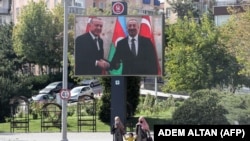
A large billboard featuring images of Turkish President Recep Tayyip Erdogan (left) and Azerbaijani President Ilham Aliyev in Ankara (file photo)

The Turkish parliament has passed a resolution to send troops to monitor a Russia-brokered peace accord between Azerbaijan and Armenia.

Parliament passed the motion on November 17 with the support of all but one party after President Recep Tayyip Erdogan put forward the request to send troops to a planned monitoring center in Azerbaijan.

Turkey, which backed Azerbaijan in a six-week conflict with ethnic Armenian forces over the breakaway region of Nagorno-Karabakh, signed a memorandum last week with Russia to create a joint monitoring center in Azerbaijan.

The resolution grants a one-year mandate to deploy Turkish soldiers and civilian support to a joint monitoring center “at a place Azerbaijan will determine” and in line with strategic agreements between the two countries.
The state-run Anadolu news agency said the resolution highlights that Azerbaijan requested a joint Turkish-Russian presence at the monitoring center.

It also gives Erdogan broad authority to determine the timing and size of any deployment.

The Russian-brokered peace deal reached on November 10 came after Azerbaijani forces made major battlefield gains to regain territory lost to Armenian separatists nearly three decades ago.

The accord allows Azerbaijan to keep a sizable chunk of the mountainous region, as well as all of the area ringing the enclave. Around 2,000 Russia peacekeepers will be deployed to maintain security in the territory for a period of five years.

Russian officials have said that Ankara’s involvement will be limited to the work of the monitoring center on Azerbaijani soil, and Turkish peacekeepers would not enter Nagorno-Karabakh.
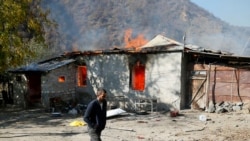
Nagorno-Karabakh: Azerbaijanis Plan Return As Armenians Destroy Homes
please wait

No media source currently available

0:00 0:02:02 0:00

Russian President Vladimir Putin said on November 17 that the joint Russian-Turkish monitoring center would largely involve the use of drones to evaluate the situation on the ground in Nagorno-Karabakh.

"We agreed to set up a joint center that would use drones. We will jointly control the situation along the contact line with the use of these aerial vehicles. We will receive information, analyze it together, and make conclusions about what is going on on the ground in the online mode," Putin said in an interview with Russian media.

France, which along with the United States and Russia, co-chairs the Minsk Group that has spearheaded talks in the past between Armenia and Azerbaijan, urged Russia on November 17 to clear up "ambiguities" over the accord it brokered.

"The cease-fire was essential to save thousands of lives. But there are ambiguities," French Foreign Minister Jean-Yves Le Drian told parliament.

He specifically mentioned the issue of refugees, the delimitation of the cease-fire, the presence of Turkey, the return of foreign fighters, and negotiations of over the final status of Nagorno-Karabakh.

Le Drian added that these issues would be discussed at a meeting of French, U.S., and Russian diplomats in Moscow from the Minsk Group on November 18.

The U.S. State Department backed France's view, saying there were still questions that the Russians needed to clarify about the deal, "and that included the role of the Turks.”
Mass Exodus As Armenians Flee Nagorno-Karabakh
please wait

No media source currently available

0:00 0:03:27 0:00

The United States and France have suspected Turkey deployed Syrian rebel mercenaries to support Azerbaijan amid multiple media reports of their presence on the battlefield during the six-week conflict with ethnic Armenian forces.

Nagorno-Karabakh is recognized as part of Azerbaijan, but the ethnic Armenians who make up most of the population reject Azerbaijani rule.

They have been governing their own affairs, with support from Armenia, since Azerbaijan's troops and ethnic Azeri civilians were pushed out of the region in a war that ended in a cease-fire in 1994.

Fighting broke out in and around Nagorno-Karabakh on September 27, killing more than 2,000 soldiers and civilians on both sides over the ensuing weeks. Azerbaijan has not provided a figure for its military casualties.

With reporting by AP, AFP, Reuters, Sabah, Cumhuriyet, and Anadolu

All Of The Latest News

U.S. Approves Sale Of Fighter Jets To Bulgaria Amid Speculation About Supply Of MiGs To Ukraine

A U.S. Boeing B-52 bomber (top) flies with a Ukrainian MiG-29 over Ukraine in August 2020.

The U.S. State Department has approved the potential sale of up to eight F-16 fighter jets to Bulgaria, the Defense Department has said.

"The proposed sale will improve Bulgaria's capability to meet current and future threats by enabling the Bulgarian Air Force to deploy modern fighter aircraft routinely in the Black Sea region," the Defense Security Cooperation Agency said.

U.S. officials said the $1.673 billion agreement was not directly related to Russia's invasion of Ukraine, which comes amid continuing speculation that a NATO ally could provide Ukraine with Russian-made MiG-29 aircraft to fight Russian forces and that such a move would involve the United States "backfilling" that ally's fleet of jets with U.S. aircraft in exchange.

Bulgaria is one of the three NATO members that have MIG-29s, which Ukrainian pilots are capable of flying. The others are Poland and Slovakia.

Pentagon spokesman John Kirby, asked about the F-16 sale, downplayed the suggestion it could be tied to Bulgaria providing MIG-29s to Ukraine. Kirby said he would not characterize the sale as "backfilling" but did not provide further details.

Bulgarian Prime Minister Kiril Petkov said last month there was no deal to provide MIG-29s to Ukraine.

Even though Bulgaria is close to the conflict, Petkov said, "Currently we will not be able to send military assistance to Ukraine." He added that any such assistance would have to be approved by the Bulgarian parliament.

The United States announced during U.S. Defense Secretary Lloyd Austins visit to Sofia on March 19 that Washington would deploy a Stryker armored-vehicle infantry company for a NATO battle group being established in Bulgaria.

Based on reporting by AFP and Reuters

U.S. Says Russia 'Repositioning' Forces To Mount Offensive In East, South Ukraine

U.S. national-security adviser Jake Sullivan (file photo)

U.S. national-security adviser Jake Sullivan says Russian forces are repositioning to regions of Ukraine in the east and south after meeting stronger Ukrainian resistance than they expected near Kyiv.

"At this juncture we believe Russia is revising its war aims" to focus on "eastern and parts of southern Ukraine rather than target most of the territory," Sullivan said at a briefing on April 4.

The goal is likely to "surround and overwhelm" Ukrainian forces in the region, he said.

"Russia could then use any tactical success it achieves to propagate a narrative of progress and mask...prior military failure."

Sullivan warned that Russia was redoubling its efforts after pulling many troops from around the capital and will fight to take significantly more territory than the Moscow-backed separatists held in the region, commonly known as the Donbas, prior to the launch of Russia's invasion on February 24.

The United States also expects Russian military forces to do what they can to hold the city of Kherson in the south and Kharkiv in the east, Sullivan told reporters at the White House on April 4.

But Sullivan described the pullback of Russian forces from areas around Kyiv as a retreat, saying they did not achieve their objectives and stressed that that United States will continue to support Ukraine with military and humanitarian aid.

"The Russians have now realized that the West will not break" in its support of the Ukrainian government, Sullivan said.

Sullivan said Washington will have announcements of additional military assistance for Ukraine in the coming days, adding that the next phase of the war in Ukraine could last "months or longer."

In response to the killings of civilians in the town of Bucha, he said the United States was coordinating with its allies in Europe and plans to announce new sanctions against Russia this week.

Asked whether the White House agreed with assessments by Ukrainian President Volodymyr Zelenskiy that genocide was committed in Bucha, Sullivan said: "We have seen atrocities, we have seen war crimes, we have not yet seen a level of systematic deprivation of life of the Ukrainian people to rise to the level of genocide."

He said the International Criminal Court could be the venue for a war crimes trial, and the United States will consult its allies about holding Russia accountable for the killings of civilians in Bucha.

With reporting by AFP and AP

Germany Puts Gazprom Germania Temporarily Under State Control

German Economy and Climate Protection Minister Robert Habeck attends a session of the lower house of parliament in Berlin on January 13.

Germany will temporarily take control of the German subsidiary of Russian energy giant Gazprom, the government has announced in a move it said was necessary to secure energy supply and critical infrastructure amid growing distrust between Germany and Russia in the wake of the war in Ukraine.

Energy Minister Robert Habeck said Germany's Bundesnetzagentur energy regulator would become the trustee of Gazprom Germania until September 30.

The move comes after Russia's state-owned Gazprom said it was withdrawing from Gazprom Germania on April 1.

Habeck justified the move by citing the current "unclear" legal structure behind Gazprom Germania and a breach of its obligation to inform German authorities of ownership-changes reporting regulations.

"The government is doing what is necessary to ensure security of supplies in Germany, and that includes not exposing energy infrastructures in Germany to arbitrary decisions by the Kremlin," Habeck said.

Under the interim arrangement, voting rights in Gazprom Germania will be transferred to the Bundesnetzagentur.

The energy regulator will be allowed to dismiss management members and appoint new ones, as well as "take all necessary measures to guarantee supplies," Habeck said.

Germany has backed sweeping Western sanctions against Moscow over its invasion of Ukraine, but because of its heavy reliance on Russian energy imports, Berlin thus far has resisted pressure to boycott Russian oil and gas.

Calls for a German boycott of Russian oil and gas have grown louder at home and abroad following recent allegations of atrocities committed against civilians in the Ukrainian town of Bucha.

Based on reporting by AFP and dpa

U.S. Says Spain Acted On Its Behalf Of In Seizing Russian Oligarch's Yacht

Russian businessman Viktor Vekselberg (file photo)

Spanish police who seized a $90 million yacht belonging to Russian oligarch Viktor Vekselberg were acting at the request of the United States, the Department of Justice has said.

The vessel violated U.S. bank-fraud, money-laundering, and sanctions statutes, the department said on April 4 in a news release.

The U.S. investigation alleges that Vekselberg bought the yacht, named Tango, in 2011 and had owned it since then.

It also alleges that Vekselberg used shell companies to hide his interest in the Tango to avoid bank oversight into U.S. dollar transactions related to it.

Vekselberg, a billionaire with ties to Russia's mining industry, and those working on his behalf made payments through U.S. banks for the support and maintenance of the Tango, the warrant for the seizure of the yacht said.

This included a payment for a December 2020 stay at a luxury resort in the Maldives and mooring fees for the yacht.

Vekselberg was first sanctioned by the U.S. Treasury Department in April 2018. More sanctions were added on March 12 of this year.

The yacht was impounded on April 4 at the Mediterranean port of Palma de Mallorca by Spanish police in coordination with U.S. federal agents, Spanish police said in a statement.

It is the fourth yacht linked to a Russian billionaire to be impounded in Spain.

Authorities in Italy and France have also impounded yachts with links to Russian oligarchs as part of Europe's efforts to pressure Russian President Vladimir Putin to pull back from Ukraine.

Based on reporting by AFP and Reuters

Kyrgyzstan Takes Over Kumtor Gold Mine After Out-Of-Court Settlement With Centerra

The government insisted that Centerra's operations endangered human lives and the environment, which the company denied.

BISHKEK -- Kyrgyzstan has taken over the Kumtor gold mine after the government reached an out-of-court settlement with the Canadian Centerra Gold company.

President Sadyr Japarov announced in a televised statement on April 4 that Kyrgyzstan had taken 100 percent control of the mine.

Centerra made public the agreement, according to which it received all of its common shares held by the state-owned company Kyrgyzaltyn, while Kyrgyzaltyn got a 100 percent stake in the company's two Kyrgyz subsidiaries, Kumtor Gold Company CJSC and Kumtor Operating Company.

Kumtor has been a target of financial and environmental disagreements for years and became the subject of a battle for control between the Central Asian state and Centerra Gold after the government temporarily took control of the mine last year.

Japarov's government insisted that Centerra's operations endangered human lives and the environment, which the company denied.

In May 2021, the Canadian firm said it had "initiated binding arbitration to enforce its rights under long-standing investment agreements with the government."

Many Kyrgyz lawmakers have expressed concern about an alleged lack of transparency at Kumtor since the government took control of the gold mine.

European Countries Expel Diplomats Over Russia's Alleged War Crimes

'They Killed People Systematically': Bucha Residents Describe War Crimes By Expelled Russian Forces
please wait

No media source currently available

0:00 0:05:37 0:00

Germany, France, Latvia, and Lithuania have announced the expulsion of dozens of Russian diplomats as part of a joint European reaction to the killing of civilians in the Ukrainian town of Bucha, allegedly by Russian forces before they retreated.

The German government declared 40 Russian diplomats "undesirable,” and France said it would expel 35 Russian diplomats, saying their activities were "against our security interests."

German Foreign Minister Annalena Baerbock called the move a response to the "unbelievable brutality" the Kremlin had unleashed in Ukraine.

The diplomats expelled from Germany have worked "against our freedom, against the cohesion of our society," Baerbock said. "We will not tolerate this any longer."

Berlin's decision was communicated to Russian Ambassador Sergei Nethayev after he was summoned to the Foreign Ministry, Baerbock said. The affected envoys have five days to leave Germany.

The French Foreign Ministry said in a statement that the expulsions from France were part of a European approach to the killings in Bucha, where dozens of bodies were found in mass graves or littering the streets over the weekend.

The Kremlin has rejected Western accusations that Russian forces were responsible.

Lithuania said earlier it had expelled Russia's ambassador to Vilnius and was recalling its top diplomat in Moscow in response to reports that Russian forces killed dozens of civilians in Bucha.

"Lithuania stands in full solidarity with Ukraine and the Ukrainian people, who are victims of Russia's unprecedented aggression. We are therefore lowering the level of Russia's diplomatic representation," Lithuanian Foreign Minister Gabrielius Landsbergis said in a statement on April 4.

"Unfortunately, what the world saw in Bucha can be only the beginning. We will be able to discover even more evidences of cruel war crimes in other towns upon their liberation. The war crimes and crimes against humanity committed by the Russian armed forces in Ukraine will not be forgotten," he added.

Photographs showing the bodies of some of the dead civilians in Bucha, which lies on the northwest edge of Kyiv, with their hands bound have shocked many and prompted calls for stepped-up sanctions against Russia and the criminal prosecution of the perpetrators.

After Lithuania announced its move, Baltic neighbor Latvia said it was "reducing its diplomatic relations with the Russian Federation" in connection with Russia's unprovoked invasion of Ukraine and the German government declared 40 Russian diplomats "undesirable persons."

The details of Latvia's move will be announced "once internal procedures are complete," Foreign Minister Edgars Rinkevics said.

With reporting by AFP, Reuters, and dpa

OSCE Says Hungarian, Serbian Elections Marred By 'Absence' Of Level Playing Fields

Hungarians vote in a polling station in Miskolc on April 3.

The Organization for Security and Cooperation in Europe (OSCE) says weekend elections in both Serbia and Hungary were marred by their "absence" of level playing fields.

The OSCE said in a statement on April 4 that in Hungary, voting was well run and offered "distinct" alternatives, but its mission of 312 observers from 45 countries found the balloting was damaged "by the pervasive overlapping of government and ruling coalition's messaging that blurred the line between state and party, as well as by media bias and opaque campaign funding."

In the April 3 general election, Prime MInister Viktor Orban's Fidesz party scored a landslide victory, taking just over 53 percent of the vote, compared with 35 percent by the united opposition coalition led by Peter Marki-Zay.

In an unprecedented move for an EU member state, the OSCE deployed a full monitoring mission for the vote amid concerns over potential election fraud and the use of state resources to give the ruling party an unfair advantage.

The OSCE also criticized a tandem referendum held on a new law banning the portrayal of LGBT people to those under 18 years of age.

"The legal framework for the referendum held on the same day as the elections was largely inadequate for a democratic process and did not provide equal opportunities for referendum campaigns," the OSCE said of the plebiscite, which failed due to a lack of ballots cast.

Many have criticized the referendum since the controversial law was already approved last year.

The OSCE was similarly critical of presidential and parliamentary elections held in neighboring Serbia the same day.

The OSCE said they too were held on "an uneven playing field" with a number of shortcomings tipping the process in favor of the incumbents.

"This was a competitive campaign and, importantly, included opposition candidates this time, but the pervasive influence of the ruling parties gave them undue advantage," said Kyriakos Hadjiyianni, special coordinator and leader of the OSCE short-term observers.

Early official results showed President Aleksandar Vucic easily winning a second five-year term in office, while his ruling Serbian Progressive Party (SNS) also took the most votes.

Throughout the campaign, his critics complained that the president had tightened his grip on power through his control of the media and government to a point where a survey last month by the pollster Demostat showed 43 percent of the country didn't believe the elections would be free or fair.

Lithuanian Filmmaker Kvedaravicius Killed In Besieged Ukrainian City

Mantas Kvedaravicius

Noted Lithuanian filmmaker Mantas Kvedaravicius has been killed in the southern Ukrainian city of Mariupol, where there has been weeks of heavy fighting since Russian invaded the country last month.

Russian film director Vitaly Mansky said on Facebook on April 3 that Kvedaravicius died after a missile hit his car in Mariupol over the weekend.

The Ukrainian Defense Ministry confirmed Kvedaravicius had died while trying to leave the city.

The 45-year-old filmmaker had for years documented the city on film and was recording a new report about the ongoing siege of Mariupol by Russian troops.

Kvedaravicius, who was also an anthropologist and archaeologist, was an author of the 2011 documentary Barzakh (Limbo) about the two devastating post-Soviet wars in Russia's North Caucasus region of Chechnya.

Another documentary he made, Mariupolis, showed everyday life in Mariupol in 2014, when Russian troops unsuccessfully tried to take over the city following Moscow's occupation of Ukraine's Crimean Peninsula.

Kazakh Arrested, Accused Of Plotting To Kill President

A photo on the KNB's website purports to show the arrest of the "foreign intelligence agent."

The Kazakh Committee for National Security (KNB) says it has detained a man who allegedly planned to kill President Qasym-Zhomart Toqaev.

The KNB said on April 3 that the person, whose identity was not disclosed, worked for the intelligence agency of an unspecified country and, among other things, also planned "to create Russophobic views" and anti-Russian propaganda in the country.

According to the KNB, the detained man is a Kazakh citizen who also planned to attack other officials and carry out terrorist attacks against law enforcement officers. The KNB also said that a sniper rifle, illegal drugs, and a large amount of U.S. dollars in cash were confiscated from the suspect.

The statement also says the suspect confessed that he worked for a foreign intelligence agency. The statement gave no further details.

Kazakh officials have been on edge since early January, when protests in the remote town of Zhanaozen over a sudden fuel-price hike quickly spread across the country and led to violent clashes in Almaty and elsewhere.

Toqaev called on the Russian-led Collective Security Treaty Organization to send troops to Kazakhstan in the wake of the deadly anti-government protests, which were also directed at former President Nursultan Nazarbaev, who resigned in 2019 but retained large political influence in the tightly controlled Central Asian state with almost limitless powers.

Several close associates of Nazarbaev, including his nephew Qairat Satybaldy, were arrested in mid-March.

Kazakhstan's Anti-Corruption Agency said on April 4 that several of Satybaldy's partners were arrested on corruption charges.

U.S., Britain Call For Russia's Suspension From UN Rights Council

U.S. Ambassador Linda Thomas-Greenfield addresses an awards ceremony at the State Department in Washington on March 14.

The United States and Britain say they are seeking the removal of Russia from the UN Human Rights Council, following reports that Russian forces killed dozens of civilians in the Ukrainian town of Bucha.

"Russia's participation on the Human Rights Council is a farce," U.S. Ambassador to the United Nations Linda Thomas-Greenfield said on April 4 while in the Romanian capital, Bucharest, to see how the country, which shares a border with Ukraine, is handling a massive influx of refugees.

"And it is wrong, which is why we believe it is time the UN General Assembly vote to remove them," she added.

Removing Russia from the council, which is based in Geneva, would need the support of at least two-thirds of the UN General Assembly's 193 members. A motion for removal can be based made if a country is found to be persistently committing gross and systematic violations of human rights during its membership.

Russia, which is currently in the second year of its three-year term on the council, invaded Ukraine on February 24.

Since then, the General Assembly has adopted two resolutions denouncing Russia with at least 140 votes in favor.

"My message to those 140 countries who have courageously stood together is: the images out of Bucha and devastation across Ukraine require us to now match our words with action," Thomas-Greenfield told reporters in Romania.

In New York, Russian Ambassador to the UN Vasily Nebenzya called the attempt to exclude Russia from the Human Rights Council "unbelievable," adding that it will not be helpful to peace talks.

"This is again unprecedented and this will not facilitate or encourage or be helpful to what is happening between Russia and the Ukrainian peace talks," Nebenzya said at a news conference.

He repeated Russian denials of the accusations of atrocities in Bucha, saying the footage presented was "staged." Russia will present more evidence on the issue at a UN Security Council meeting on April 5, he said.

Russian troops recently pulled out of Bucha, which lies on the northwest outskirts of Kyiv, and in their wake dozens of bodies were found.

Photographs showing the bodies of some of the dead civilians with their hands bound have shocked many and prompted calls for stepped-up sanctions against Russia and the criminal prosecution of the perpetrators.

"The images out of Bucha and devastation across Ukraine require us to now match our words with action," Thomas-Greenfield said.

Hours after Thomas-Greenfield made her comments, Britain joined the call for Moscow's ouster from the council.

"Given strong evidence of war crimes, including reports of mass graves and heinous butchery in Bucha, Russia cannot remain a member of the UN Human Rights Council," U.K. Foreign Secretary Liz Truss said in a tweet.

"Russia must be suspended."

Bucha Mayor Anatoliy Fedoruk said on April 2 that about 300 locals had been killed during the Russian occupation of the town and that some 280 bodies had been discovered in a mass grave.

Russia has denied allegations that its forces were involved in the killings, calling the reports a "provocation."

With reporting by Reuters and AP

Three Russian Activists Charged Over Distribution Of Home-Printed Newspaper

"We were detained in the city center while distributing the newspaper that covered the official information about the 'special operation' in Ukraine, including information taken directly from the Defense Ministry's website," one activist said.

PERM, Russia -- Three Russian activists in the Urals city of Perm have been charged with "discrediting the Russian Federation's armed forces" for allegedly publishing at home copies of an online magazine that has been covering the war Moscow launched against Ukraine last month.

One of the activists, Olga Turpanova, told RFE/RL on April 3 that she and the two other activists were briefly detained the day before while distributing home-printed copies of the news digest Vestnik zvezdy (The Star Herald), published by the online magazine Zvezda (Star).

"We were detained in the city center while distributing the newspaper that covered the official information about the 'special operation' in Ukraine, including information taken directly from the Defense Ministry's website," Turpanova said, adding that she and the other two activists were charged and then released.

Turpanova said all three have rejected the charge.

Russia's media regulator, Roskomnadzor, has strictly limited access to information about the invasion of Ukraine unleashed by Russia on February 24 and directed media to describe events in Ukraine a "special military operation" and not a "war" or an "invasion."

On March 5, President Vladimir Putin signed a new law that calls for sentences of up to 15 years in prison for people who "deliberately distribute false news" about the Russian military.

Several Russian media outlets have chosen to suspend operations rather than face heavy restrictions on what they can report. The Kremlin has also blocked many foreign news outlets.

Zvezda magazine said last week that it had started issuing its digest each Friday on A4 format paper so that people could print it out themselves and to distribute among relatives and friends.

Zvezda's website was blocked in early March at Roskomnadzor's request, after which the online magazine started publishing its materials on social media.

Bucha Residents Describe 'Systematic' Killings By Russian Troops

The bodies of men, some with their hands tied behind their backs, lie on the ground in Bucha on April 3.

BUCHA, Ukraine -- Residents of this suburb of Kyiv told RFE/RL they managed to survive the "systematic" killing of the town's population by Russian troops that until recently occupied the area.

Images showing the bodies of dead civilians in Bucha, which Russian forces occupied in early March and left around April 1, have emerged in the last couple of days and have prompted international condemnation of Russia, including accusations of genocide and war crimes.

Several local residents told RFE/RL that what they saw after they emerged from their houses after Ukrainian forces recaptured the town was "horrific," with the bodies of dozens of civilians who had been shot dead lying in the streets.

One man said a Russian sniper deliberately killed several people in the area, including one of his relatives.

Russia Accused Of Atrocities In Kyiv Suburb Of Bucha
please wait

No media source currently available

0:00 0:02:20 0:00

"A sniper started shooting in the area on March 5,” the man said. “When we left our house before the curfew time that day, a sniper killed my son-in-law. After that, it all started. They were shooting at everyone who was out,” the man said.

Another resident said he witnessed Russian soldiers killing three civilians by shooting them for no clear reason.

Live Briefing: Russia Invades Ukraine

RFE/RL's Live Briefing gives you all of the major developments on Russia's invasion, how Kyiv is fighting back, the plight of civilians, and Western reaction. For all of RFE/RL's coverage of the war, click here.

"After shooting one of them, they also threw a grenade on his body. We buried his parts later…. It was horrible," the man said, adding that his own brother was shot dead when he was walking to a bomb shelter on March 5.

"It was a system,” the man said. “They were killing people systematically. I personally heard how one sniper was boasting that he ‘offed’ two people he saw in apartment windows.... There was no need. There was no military justification to kill. It was just torturing civilians. On other blocks, people were really tortured. They were found with their hands tied behind their backs and shot in the back of the head.”

Bucha Mayor Anatoliy Fedoruk said on April 2 that about 300 locals had been killed during the Russian occupation of the town and that some 280 bodies had been discovered in a mass grave.

The Ukrainian Prosecutor-General’s Office said on April 3 that prosecutors investigating possible war crimes by Russia have found 410 bodies in towns outside of Kyiv and that 140 of them had been examined.

Russia has denied allegations that its forces were involved in the killings, calling the reports a “provocation.”

High-Treason Trial Of Former Russian Journalist Ivan Safronov Starts

Ivan Safronov

MOSCOW -- The trial of Ivan Safronov, a prominent former Russian journalist accused of high treason in a case widely considered as politically motivated, has started.

The Moscow City Court started the high-profile trial behind closed doors on April 4 with Safronov facing a possible penalty of 25 years in prison if convicted on a charge that he passed secret information about Russian arms sales in the Middle East to NATO member the Czech Republic in 2017.

The Meduza newspaper published the text of Safronov's testimony at the trial that it obtained from his former lawyer, Ivan Pavlov, according to which, Safronov, who was arrested on July 7, 2020, reiterated his innocence and called the charge against him illegal.

The 31-year-old journalist, who covered the defense industry for the newspapers Kommersant and Vedomosti, is also a former adviser to the head of Russia's space agency Roskosmos, Dmitry Rogozin.

Safronov has repeatedly denied the accusations and his supporters have held pickets in Moscow and other cities demanding his release.

Human rights organizations have issued statements demanding Safronov’s release and expressing concerns over an intensifying crackdown on dissent in Russia.

Former U.S. Marine Jailed In Russia Ends Hunger Strike, Reportedly Receives Medical Care

Joey Reed, the father of former U.S. Marine Trevor Reed, stands next to a placard of his son outside the U.S. Capitol in Washington in July.

A former U.S. Marine who is serving a nine-year prison term in Russia has ended a hunger strike that he began in late March and has been transferred to a prison medical facility, his lawyers and prison officials say.

The regional branch of the Federal Penitentiary Service (FSIN) in Mordovia, where Trevor Reed is imprisoned, told the Russian news agency Interfax on April 4 that Reed had ended his hunger strike on April 1 after prison officials granted his request to be transferred to a prison hospital.

Defense lawyers Sergei Nikitenkov and Viktoria Buklova confirmed that Reed had ended his hunger strike after being seen by doctors.

Reed began his protest on March 30, saying he had been denied necessary medical care.

The same day, Reed's parents met in Washington with U.S. President Joe Biden to raise awareness of the case. Reed's father, Joe Reed, told CNN that his son "has all the symptoms of active tuberculosis" and that Russian prison authorities had denied him needed medical treatment.

"He's still coughing blood," Joey Reed said. "And yet he's receiving no treatment for it, except aspirin."

Reed's parents urged Russian officials to test their son for the disease.

Reed, a 30-year-old from Texas, was sentenced in 2020 after being convicted of assaulting two Russian police officers in 2019. The U.S. government and Reed denied the allegations and questioned the fairness of the proceedings.

In November 2021, Reed went on a hunger strike for an unspecified period of time to protest violations of his rights, including his "illegal" placement in solitary confinement.

Reed is one of several U.S. citizens to face trial in Russia in recent years on charges that their families, supporters, and in some cases the U.S. government have said appear trumped up.

Another former U.S. Marine, Paul Whelan, was sentenced to 16 years in prison in May 2020 on espionage charges condemned by the United States as a "mockery of justice."

Whelan, who like Reed maintains his innocence, is also currently serving his sentence in a prison in Mordovia.

The United States has been pushing Russia to release both Whelan and Reed.

With reporting by Interfax

Early Results Give Vucic New Five-Year Term As Serbian President

Serbian President Aleksandar Vucic declared victory on April 3: "We will maintain the policy that is important for the Europeans, Russians, and Americans, and that is...military neutrality."

BELGRADE -- Incumbent Aleksandar Vucic, according to an early official count, has won Serbia’s presidential vote, while his ruling Serbian Progressive Party (SNS) also appears to have taken the most votes in parliamentary elections.

The National Electoral Commission said on April 4 that with 87.7 percent of the ballots counted, Vucic had 59.5 percent, enough to avoid a runoff with his closest competitor, opposition candidate Zdravko Ponos, who is trailing in second place at 17.5 percent. Lawyer and politician Milos Jovanovic was third among the eight candidates running with 5.8 percent of the vote.

The deadline for announcing the final results is April 7.

In the concurrent parliamentary elections, the SNS led with 43.4 percent, while its longtime coalition partner, the Socialist Party of Serbia, was third with 11.7 percent. Ponos's United for Victory alliance obtained 13.1 percent of all ballots cast in the April 3 vote.

Vucic has already declared victory, saying in a televised acceptance speech that he would stay the course of balancing the country's European Union membership aspirations with Belgrade's close and developing ties with Moscow and Beijing.

"We will maintain the policy that is important for the Europeans, Russians, and Americans, and that is...military neutrality," he said.

"Serbia will try to preserve friendly and partnership relations in many areas with the Russian Federation," Vucic added, while admitting Moscow's war in Ukraine had impacted the campaign as voters sought stability.

Serbia gets almost all of its gas supplies from Russia, while its army has close ties with Russia's military.

Further adding to the tight relationship between Moscow and Belgrade, the Kremlin also supports Serbia's opposition to the independence of Kosovo by blocking its membership to the United Nations.

Ponos, a retired military general, remained defiant in defeat, saying that Vucic will be exposed for his mismanagement of the country.

“These elections are [the] beginning of the end of Aleksandar Vucic…. We will not waste this,” he said.

While the nongovernmental Center for Research, Transparency, and Accountability (CRTA) said its observers submitted five criminal complaints to authorities over “irregularities,” election officials said the process had been carried out overall “without major problems” and in a “democratic manner.”

The issues mentioned by the CRTA included the buying of votes at polling stations, keeping parallel voter lists, violating the secrecy of the ballot, recording events at polling stations, as well as the presence of unauthorized persons at polling stations.

The elections were monitored by more than 4,000 observers, as well as delegations from the European Parliament, the OSCE Office for Democratic Institutions and Human Rights, and the European Network of Election Observation Organizations.

Five years after winning his first term as president, Vucic remains the dominant force in Serbia, preaching peace and stability at a time when Europe is being rocked by its biggest conflict since the end of World War II with Russia's war against Ukraine.

But his critics complain he has tightened his grip on power through his control of the media and government to a point where a survey last month by the pollster Demostat showed 43 percent of the country didn't believe the elections would be free or fair.

"In recent years, the ruling Serbian Progressive Party (SNS) has steadily eroded political rights and civil liberties, putting pressure on independent media, the political opposition, and civil society organizations," Freedom House said in its latest assessment of Serbia, which it ranked 62nd out of 100 nations in its freedom index for 2021.

Iran Blames Washington For Delay In Talks But Says Deal 'Within Reach'

Foreign Ministry spokesman Saeed Khatibzadeh

Iran says the United States is to blame for a delay in continuing talks to finalize a nuclear deal with world powers that is "very much within reach."

Foreign Ministry spokesman Saeed Khatibzadeh said on April 4 that Tehran "won't wait forever" after several last-minute snags threatened to derail months of efforts to revive the 2015 agreement, which curbed Iran’s sensitive nuclear activities in exchange for the lifting of international sanctions.

U.S. State Department spokesman Ned Price said in a briefing on March 22 that the onus is on Tehran "to make decisions that it might consider difficult."

"America is responsible for the halt of these talks ... a deal is very much within reach," Khatibzadeh told a weekly news conference.

The biggest and most complicated stumbling block is reported to be Iran’s demand that the United States drop the powerful Islamic Revolutionary Guards Corps (IRGC) -- a branch of the Iranian armed forces that plays a significant role in the economy -- from its list of Foreign Terrorist Organizations (FTOs).

Tehran has said that the IRGC’s removal from the blacklist is a “red line.” Washington has not directly commented on the issue, although it said separate U.S. sanctions against the IRGC would remain in place under any agreement.

In the United States, the issue is controversial given that American officials have accused the IRGC of creating instability and supporting militant groups in the region. The IRGC is also in charge of Iran’s controversial missile program.

Iran signed the landmark deal with the United States, Britain, France, Germany, Russia, and China in 2015. It allowed for the easing of sanctions in return for curbs on Iran’s nuclear programs.

But then-President Donald Trump in May 2018 pulled the United States out of the deal, saying the terms were not strict enough to prevent Iran from developing nuclear weapons and also to punish Tehran for alleged support of extremist activity in the region.

Iran has denied it is seeking nuclear weapons, saying the program is for civilian purposes, and it has rejected accusations of support for extremists.

However, after Washington pulled out, Iran has breached limits set in the deal and has insisted the United States lift its sanctions before it returns to the accord.

With reporting by IRNA

'Russia Must Answer To The World': Global Condemnation Of Ukraine Killings Mounts

The bodies of men, some with their hands tied behind their backs, lie on the ground in Bucha on April 3.

KYIV -- Evidence that Russian troops killed dozens of civilians in Ukraine has sparked cries of "war crimes" from the international community and calls for further measures against Moscow, which dismissed the reports as a "provocation."

U.S. President Joe Biden called on April 4 for a war crimes trial against Russian President Vladimir Putin, calling him a war criminal and saying he plans to seek more sanctions against Russia.

"This guy is brutal...what is happening in Bucha is outrageous," Biden said, referring to the Ukrainian town where Russian forces reportedly killed dozens of civilians. Putin "is a war criminal."

Speaking outside the White House on April 4, Biden said more evidence should be gathered to use in a war crimes trial.

Biden's comments came after Ukrainian President Volodymyr Zelenskiy visited Bucha, a town outside Kyiv where Ukrainian officials say the bodies of civilians have been found. Zelenskiy called the Russian actions "genocide" and called for the West to apply tougher sanctions against Russia.

Live Briefing: Russia Invades Ukraine

RFE/RL's Live Briefing gives you all of the major developments on Russia's invasion, how Kyiv is fighting back, the plight of civilians, and Western reaction. For all of RFE/RL's coverage of the war, click here.

As he toured the area on the northwestern edge of Kyiv, Zelenskiy, wearing a bulletproof vest and accompanied by military personnel, spoke to the nation on television, saying such scenes made it more difficult to sit at a table with Russia and negotiate an end to the unprovoked war Moscow launched last month.

"Every day, when our fighters enter and retake territory, you see what's been happening," the Ukrainian leader said.

"These are war crimes and will be recognized by the world as genocide," Zelenskiy said, adding he expected evidence of similar crimes will be found in other occupied regions after Russian forces are ousted from them.

Zelenskiy was due to speak on April 5 to UN Security Council diplomats outraged by growing evidence that Russian forces have deliberated killed civilians, many of them shot in yards, streets and homes, and their bodies left in the open.

Ukrainian Foreign Minister Dmytro Kuleba also predicted that evidence of civilian killings would be found in other towns that Russian forces occupied.

"The horrors that we've seen in Bucha are just the tip of the iceberg of all the crimes (that) have been committed by the Russian Army," Kuleba said at a news conference in Warsaw alongside British Foreign Minister Liz Truss.

"Half-measures are not enough anymore. I demand most severe sanctions this week, this is the plea of the victims of the rapes and killings. If you have doubts about sanctions, go to Bucha first."

Moscow has denied the allegations, with various top Kremlin officials describing them as a "provocation" intended to discredit Russia. Kremlin spokesman Dmitry Peskov said, "We categorically reject all allegations."

He added that Russia was requesting a meeting of the UN Security Council to address what Moscow has decried as "Ukrainian provocations." Britain, which currently holds the presidency of the Security Council, has said the body will discuss Ukraine at its already scheduled session on April 5.

Earlier, the Russian Defense Ministry also claimed, without evidence, that the Bucha images were "another staged performance by the Kyiv regime" and that all Russian forces had left the town by March 30.

The Russian Investigative Committee on April 4 announced an "investigation" into the accusation that Ukraine had spread "deliberately false information" about the actions of Russian forces in Bucha.

WATCH: RFE/RL correspondent Levko Stek traveled to Bucha on April 3 shortly after its liberation by Ukrainian forces, witnessed the carnage in the streets, and spoke to residents about what happened there.

'They Killed People Systematically': Bucha Residents Describe War Crimes By Expelled Russian Forces
please wait

No media source currently available

0:00 0:05:37 0:00

Earlier on April 4, the European Union began discussions of new sanctions against Russia in the wake of the reports alleging atrocities, according to EU foreign policy chief Josep Borrell, with some of the bloc's members calling for restrictions of imports of Russian energy supplies.

"We stand in full solidarity with Ukraine and the Ukrainian people in these somber hours for the whole world," Borrell said, calling the drafting of new sanctions "a matter of urgency."

The United States and its allies are coordinating on new sanctions against Russia and plan to announce them this week, U.S. national-security adviser Jake Sullivan said.

Sullivan also said Russian forces were repositioning to regions of Ukraine in the east and south after experiencing stronger Ukrainian resistance than they expected near Kyiv.

German Defense Minister Christine Lambrecht told her country's ARD public broadcaster that European officials "would have to talk about halting gas supplies from Russia," even though German Chancellor Olaf Scholz has previously resisted sanctions targeting Russian energy exports.

As Russian forces have withdrawn from areas around the Ukrainian capital, Kyiv, reports emerged that hundreds of civilians had been shot and dumped in mass graves or left on the streets in the Kyiv suburb of Bucha.

Photographs showing the bodies of dead civilians with their hands bound shocked many and prompted calls for stepped-up sanctions against Russia and the criminal prosecution of the perpetrators.

UN High Commissioner for Human Rights Michelle Bachelet said the photographs from Bucha and other areas "raise serious and disturbing questions about possible war crimes, grave breaches of international humanitarian law, and serious violations of international human rights law."

Meanwhile, Polish Prime Minister Mateusz Morawiecki called for an "international commission to investigate this crime of genocide." He also joined calls for "clear and determined sanctions" against Russia.

A body with its hands bound by white cloth lies on a street in Bucha on April 3.

U.S Ambassador to the United Nations Linda Thomas-Greenfield called for the General Assembly to "remove" Russia from the UN Human Rights Council, calling Russia's presence there "a farce."

Other countries around the world have also condemned the alleged atrocities and called for action against Russia.

"The reports of Ukrainian civilians who have been killed, raped, and severely wounded by Russian troops are beyond reprehensible," New Zealand Prime Minister Jacinda Ardern told reporters in Wellington on April 4.

"Russia must answer to the world for what they've done," she added, saying that her government would discuss additional measures to support Ukraine in its struggle against the Russian invasion.

Japanese Prime Minister Fumio Kishida described the reported incidents as "violations of international law."

A dog lies next to the body of a man on a street in the town of Bucha on April 3.

French President Emmanuel Macron said in a radio interview on April 4 that there are indications Russian forces committed "war crimes" in Bucha.

"What happened in Bucha demands a new round of sanctions and very clear measures," Macron said, adding that additional sanctions should target Russian exports of coal and oil.

Spanish Prime Minister Pedro Sanchez said the same day that Russian forces may have gone as far as committing "genocide" in Bucha.

"We will do everything to ensure that those who have perpetrated these war crimes do not go unpunished," Sanchez said in Madrid.

Ukrainian President Zelenskiy lashed out on April 3, accusing Russian forces of committing "genocide" in the town and told Kremlin leaders they should come to Bucha to see what their military had done.

WATCH: Russian forces have been accused of committing atrocities in the town of Bucha, northwest of the Ukrainian capital. Bodies of civilians were seen lying in the streets as Ukrainian troops took up positions in the Kyiv suburb following a Russian withdrawal.

Russia Accused Of Atrocities In Kyiv Suburb Of Bucha
please wait

No media source currently available

0:00 0:02:20 0:00

A correspondent for RFE/RL's Ukrainian Service on April 2 saw the bodies of what appeared to be civilians spread out on the streets of the small city. In one location alone, the correspondent saw up to 10 bodies on the street.

AP journalists saw the bodies of at least 21 people in various spots around Bucha. The bodies of one group of nine people -- all in civilian clothes -- were scattered on the ground near a site that local residents said Russian forces had used as a base. The victims appeared to have been killed at close range.

In all, Ukrainian authorities have said the bodies of at least 410 civilians have been found in the area around Kyiv that was controlled by Russia forces until last week.

When Russia invaded Ukraine on February 24, Putin justified the assault by saying Moscow intended to "de-Nazify" and "demilitarize" Ukraine.

With reporting by AP, Reuters, and TASS

Ukrainian President Uses Grammy Awards To Appeal For Support

"Fill the silence with your music. Fill it today, to tell our story. Support us in any way that you can,” Ukrainian President Volodymyr Zelenskiy told the Grammy audience.

Ukrainian President Volodymyr Zelenskiy made an appeal for international support during an appearance via video at the Grammy Awards in Las Vegas on April 3.

“What is more opposite to music?” Zelenskiy said in English, addressing the ceremony to honor the best recorded music of the previous year. “The silence of ruined cities and killed people. Fill the silence with your music. Fill it today, to tell our story. Support us in any way that you can.”

His appeal was followed by a performance of John Legend’s Free featuring Ukrainian musicians and a reading by Ukrainian poet Lyubov Yakymchuk.

Zelenskiy, 44, has made numerous personal appeals for support since Russia invaded Ukraine on February 24. He has addressed the U.S. Congress, the Japanese parliament, the British and Australian parliaments, and Israel’s Knesset, among others, calling for military and economic aid for Ukraine and punishing sanctions against Russia.

“Our musicians wear body armor instead of tuxedos,” he told the audience at the Grammy ceremony. “They sing to the wounded in hospitals, even to those who can’t hear them – but the music will break through.”

Based on reporting by Reuters and AP

Opposition Concedes As Hungary's Orban Claims Landslide Victory

In a late-night speech to supporters, Viktor Orban hailed his win, which he described as a “victory so big that it could be seen even from the moon.”

BUDAPEST -- The leader of Hungary’s united opposition, Peter Marki-Zay, has conceded defeat in his country’s April 3 parliamentary elections, a vote in which longtime nationalist Prime Minister Viktor Orban has claimed a landslide victory.

Marki-Zay, 49, charged that the win by Orban’s Fidesz party was due to its dominance of the country’s media space and its manipulation of state resources.

“I don’t want to hide my disappointment, my sadness…. We knew this would be an uneven playing field,” Marki-Zay told supporters after preliminary voting results were announced. “We admit that Fidesz got a huge majority of the votes. But we still dispute whether this election was democratic and free.”

Hungary’s central election committee said late on April 3 that with 98 percent of the votes counted, Orban’s Fidesz had 53.1 percent, followed by Marki-Zay’s six-party opposition alliance with 35 percent. Fidesz was also projected to win 88 of the 106 single-mandate constituencies.

In a late-night speech to supporters, Orban, 58, hailed his win, which he described as a “victory so big that it could be seen even from the moon.”

“We won the best when everyone came together against us,” Orban said. "Huge international power centers and organizations have moved against us, and they, too, have to say something: Every penny they gave to the Hungarian left was a waste of money."

Based on the preliminary results, Fidesz should have 135 seats, a two-thirds majority, in the next parliament, while the opposition alliance will have 56 seats. The far-right Our Homeland party also picked up seven seats.

The expected tight race had given rise to concerns that Orban would not play fair in the balloting.

In an unprecedented move for an EU member state, the Organization for Security and Cooperation in Europe (OSCE) deployed a full monitoring mission for the vote amid concerns over potential election fraud and the use of state resources to give the ruling party an unfair advantage.

Meanwhile, domestic issues were pushed to the side for the most part in the campaign, which was instead dominated by the war in Ukraine, which borders Hungary.

Though Orban has supported Ukraine in general, he has also refused to allow NATO weapons to flow into its neighbor, saying Hungary should stay out of the war.

Orban has used the war to stir up the mix of conservatism and nationalism that has allowed him to govern for the past 12 years with a so-called supermajority of at least two-thirds of parliament, allowing Fidesz to enact deep changes while bypassing the opposition.

The election victory was the fourth consecutive landslide for Orban, who is the longest-serving head of government in the European Union.

Critics accuse him of cementing single-party rule by modifying the constitution, taking over many media outlets, and rewriting election rules to Fidesz’s advantage.

He has frequently been at odds with other members of the European Union, which have criticized his brand of “illiberal democracy,” his anti-immigration policies, and measures his government has adopted that target the LGBT community.

With reporting by AP, Reuters, and dpa

U.K. PM Accuses Putin, Russia Of 'War Crimes,' Vows To Increase Sanctions, Support For Ukraine

British Prime Minister Boris Johnson (file photo)

British Prime Minister Boris Johnson said his country would increase sanctions on Moscow and bolster military aid to Ukraine following "despicable attacks against civilians" by Russia in Bucha and Irpin near Kyiv.

"I will do everything in my power to starve [Russian President Vladimir] Putin's war machine," Johnson said in a statement on April 3.

"We are stepping up our sanctions and military support, as well as bolstering our humanitarian support package to help those in need on the ground," he said.

Johnson, who has taken a tough line against Moscow following its unprovoked attack on Ukraine, said the deadly attacks near Kyiv were evidence that Russia was committing war crimes in Ukraine.

Russia Accused Of Atrocities In Kyiv Suburb Of Bucha
please wait

No media source currently available

0:00 0:02:20 0:00

"Russia's despicable attacks against innocent civilians in Irpin and Bucha are yet more evidence that Putin and his army are committing war crimes in Ukraine," he said.

Ukrainian Prosecutor-General Iryna Venedyktova said on April 3 that prosecutors investigating possible war crimes by Russia have found 410 bodies in towns near Kyiv and that 140 of them had been examined.

Russia denied allegations that its forces were involved in the killing of civilians in the town of Bucha near Ukrainian capital amid an international outcry accusing Moscow’s forces of atrocities in the Kyiv area and elsewhere in Ukraine.

Based on reporting by Reuters and AFP

Russia Accused Of Atrocities In Kyiv Suburb Of Bucha

Russia Accused Of Atrocities In Kyiv Suburb Of Bucha
please wait

No media source currently available

0:00 0:02:20 0:00

NATO Chief Says Russian Forces Near Kyiv 'Repositioning,' Not Withdrawing

NATO Secretary-General Jens Stoltenberg (file photo)

Russia is repositioning its forces around Kyiv and not conducting a real “withdrawal,” NATO Secretary-General Jens Stoltenberg said, as he warned that new attacks could take place.

“What we see is not a withdrawal, but we see that Russia is repositioning its troops," the NATO chief told CNN in an interview on April 3.

"We should not in a way be too optimistic because the attacks will continue and we are also concerned about potential increased attacks," he said.

U.S. and Western officials have downplayed suggestions in recent days that Russian forces were withdrawing, saying instead that they were likely repositioning and resupplying — and possibly gearing up for a new offensive in the eastern Donbas region.

Meanwhile, Stoltenberg labeled the reported killings of civilians in the Ukrainian city of Bucha as "horrific."

"It is a brutality against civilians we haven't seen in Europe for decades, and it's horrific, and it's absolutely unacceptable," Stoltenberg said.

In a separate interview with CNN, U.S. Secretary of State Antony Blinken also expressed revulsion at the sight of civilian bodies strewn along Bucha’s streets.

"You can't help but see these images as a punch to the gut," Blinken said.

"This is the reality of what's going on every single day as long as Russia's brutality against Ukraine continues," he added.

Russia has faced mounting international condemnation amid reports of possible war crimes committed by its forces in Bucha, a Kyiv suburb, and in other parts of Ukraine.

Based on reporting by CNN and AFP

Pope Francis Calls For Prayers For 'Martyred Ukraine'

Pope Francis

Pope Francis has called for prayers for Ukraine during an April 3 Mass during the second day of his visit to Malta.

“Let us pray for peace and remember the humanitarian tragedy of martyred Ukraine,” the pontiff said, calling Russia’s invasion of Ukraine a “sacrilegious war.”

The pope also visited the John XXIII Peace Lab, a nongovernmental center named after Pope John XXIII that is preparing to receive Ukrainian refugees.

A day earlier, Francis, 85, said he was considering an invitation to visit the Ukrainian capital, Kyiv.

Ukrainian President Volodymyr Zelenskiy and Kyiv Mayor Vitali Klitschko earlier extended the invitation to the pope.

Based on reports by AFP, AP, and dpa

Many Ballots, Few Surprises Expected In Serbian Elections

Many Ballots, Few Surprises Expected In Serbian Elections
please wait

No media source currently available

0:00 0:01:04 0:00

Horror, Outrage Grow As Scenes Of Carnage Emerge In Ukraine's Bucha

The bodies of two people in civilian clothes lie on a street in Bucha on April 3. They were shot by Russian soldiers, according to local residents. The hands of one of the bodies are tied behind its back.

KYIV -- Ukrainian and world leaders expressed horror and outrage after scenes of civilian deaths and mass executions emerged from the once-quiet town of Bucha following its occupation by Russian forces, raising accusations of atrocities and war crimes committed by Kremlin troops.

An angry Ukrainian President Volodymyr Zelenskiy lashed out on April 3, accusing Russian forces of committing “genocide” in the town and told Kremlin leaders they should come to Bucha to see what their military had done.

"I want all the leaders of the Russian Federation to see how their orders are being fulfilled," Zelenskiy said in a video address, switching from Ukrainian to Russian.

"These kinds of orders. This kind of fulfillment. And there is a common responsibility. For these killings, for this torture, for arms blown off by blasts...for the shots in the back of the head," he said.

He said that Russian President Vladimir Putin and the Russian military must be held responsible for the actions of the country's troops in Ukraine.

"When we find people with their hands tied behind their backs and beheaded, I don't understand," he said of the scenes of victims strewn on the streets of Bucha.

More videos and photographs emerged of the deadly aftermath of the Russian occupation of the town, about 35 kilometers northwest of the capital, Kyiv.

A correspondent for RFE/RL’s Ukrainian Service saw the bodies of what appeared to be civilians spread out on the streets of the small city. In one location alone, the correspondent saw up to 10 bodies on the street.

Russia Accused Of Atrocities In Kyiv Suburb Of Bucha
please wait

No media source currently available

0:00 0:02:20 0:00

AP journalists saw the bodies of at least 21 people in various spots around Bucha. The bodies of one group of nine people -- all in civilian clothes -- were scattered on the ground near a site that local residents said Russian forces had used as a base. The victims appeared to have been killed at close range.

At least two of them had their hands tied behind their backs and one was shot in the head, AP said.

AFP and Reuters were among Western news agencies that reported seeing people dead and bound on the streets of Bucha and nearby.

Ukraine's prosecutor-general, Iryna Venedyktova, said on April 3 that the bodies of 410 civilians had been removed from towns in the Kyiv area after Ukrainian troops retook them from Russian forces.

'People Are Being Torn To Pieces': Inside The Liberated Kyiv Suburb Of Irpin
please wait

No media source currently available

0:00 0:05:01 0:00

Venedyktova said the cases would be used as part of an investigation into alleged war crimes after prosecutors were able to enter the area for the first time on April 3 following the Russian retreat.

The mayor of Bucha said 300 residents had been killed in the town by Russian forces while Chechen fighters controlled the area.

Zelenskiy said he had created a “special mechanism” to investigate alleged Russian crimes in Ukraine.

The Russian Defense Ministry issued a statement on April 3 denying that its forces were involved in civilian killings in Bucha and claimed without evidence that the scenes had been “staged” by Kyiv for the media.

Western leaders expressed horror as they condemned the images coming out of Bucha, near Irpin, and elsewhere in Ukraine since the unprovoked invasion by Russian forces that started on February 24.

The Last One To Leave: Ukrainian Troops Evacuate Elderly Man From Abandoned Neighborhood
please wait

No media source currently available

0:00 0:04:06 0:00

On Twitter, the U.S. Embassy in Ukraine wrote: "The images coming out of Bucha and other areas abandoned by Putin’s forces are horrific. The U.S. government is committed to pursuing accountability using every tool available. We cannot stand quiet, the world needs to know what happened, and we all must act."

British Prime Minister Boris Johnson said that "Russia's despicable attacks against innocent civilians in Irpin and Bucha are yet more evidence that Putin and his army are committing war crimes in Ukraine."

"I will do everything in my power to starve Putin’s war machine,” Johnson said, adding that Britain will step up its sanctions against Moscow and its military support for Kyiv.

Condemnations also came from leaders in the Czech Republic, France, Germany, Greece, Italy, and Poland.

Live Briefing: Russia Invades Ukraine

RFE/RL's Live Briefing gives you all of the major developments on Russia's invasion, how Kyiv is fighting back, the plight of civilians, and Western reaction. For all of RFE/RL's coverage of the war, click here.

Polish Prime Minister Mateusz Morawiecki wrote on Facebook that the European Union must impose stronger sanctions on Moscow and supply Kyiv with more arms. He called on an international panel to investigate the killings in Bucha.

"The crimes Russia has committed on close to 300 inhabitants of Bucha and other towns outside Kyiv must be called acts of genocide and be dealt with as such," Morawiecki said.

United Nations chief Antonio Guterres said he was "deeply shocked by the images of civilians killed in Bucha."

"It is essential that an independent investigation leads to effective accountability," he added in a statement.

German Chancellor Olaf Scholz said his country will draw up new sanctions with allies against Moscow over the "war crimes" committed by Russian troops in Bucha.

"The murder of civilians is a war crime, and we must relentlessly investigate these crimes committed by the Russian armed forces," he said. "In the coming days, we will decide with our circle of allies on further measures. President Putin and his supporters will feel the consequences."

Russia forces, having faced tougher-than-expected Ukrainian resistance near Kyiv, have retreated to areas to the north and east of the capital.

Some experts doubt that the troops have withdrawn but suspect they are repositioning to focus their attacks on the east of Ukraine, where separatists have held territory since 2014.

Elsewhere on April 3, while Kyiv was relatively quiet, Ukrainian authorities reported a Russian attack on a hospital in the eastern town of Rubizhne, killing one person and injuring three.

In the south, one person was killed and 14 were injured after a Russian strike on the city of Mykolayiv, Governor Vitaliy Kim said on Telegram.

The reports could not immediately be independently confirmed.

With reporting by AFP, Reuters, AP, and dpa

Load more

XS
SM
MD
LG