



Gordana Knezevic, who is responsible for our Balkans Without Borders blog, has been writing about rising tensions between Kyiv and Belgrade. Here's a taster:
Belgrade's Balancing Act Between East And West Tested By Ukraine
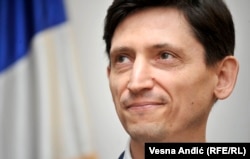
Ukraine has long expressed unhappiness about the presence of Serbian volunteer fighters among the Russia-backed separatist forces it is battling in its eastern regions.
But Ukraine's ambassador to Serbia, Oleksandr Aleksandrovych, seriously ratcheted up tensions when he not only accused Russia of using its propaganda and security services to lure Serbians to fight against Kyiv, but hit close to Belgrade's heart by suggesting in an interview that Moscow was using Serbia to sow discord in the Balkans.
He rattled off a long list of alleged Russian destabilization efforts in his November 1 interview with the Balkan Investigative Reporting Network (BIRN): "Russia trains Serbian mercenaries to kill Ukrainians. Russia used Serbian extremists to make a coup d'etat in Montenegro. Russia encourages Serbian separatism in [the Serb-dominated Bosnian entity of] Republika Srpska to destabilize Bosnia and Herzegovina.... Russia uses the Serbian factor to destabilize Macedonia. Russia plays an active role in putting Serbian Kosovars against Albanian Kosovars. Russia sells its airplanes to Serbia to create tensions with Croatia."
The ambassador used those examples to highlight Kyiv's reasons to question Serbian intentions when it comes to their relationship.
"When you have Serbian politicians traveling to Crimea and praising Putin for his 'wise and strong policies', when you have Serbian mercenaries [fighting in separatist-held territories], when you have Serbia voting in the UN against Ukraine -- all of that naturally creates a negative image of Serbia in Ukraine," Aleksandrovych said.
Aside from Serbia's 2016 vote against a UN resolution calling for international monitoring of the human rights situation in Ukraine, Aleksandrovych's verbal volley referred to actions not officially endorsed by Belgrade: a trip to Crimea taken in early November by members of the opposition Radical Party, and, of course, the contentious Serbian volunteer fighters.
Read more here.
Another story from our news desk which was posted overnight. Not strictly related to the crisis but bound to be of interest to Ukraine watchers:
Ukraine Detains Russian Allegedly Involved In Klebnikov Killing
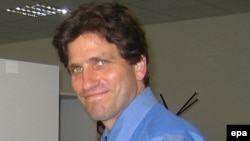
Ukraine's main security agency says it has detained two Russian citizens wanted by Interpol, including one who allegedly was involved in the assassination of American journalist Paul Klebnikov.
The Ukrainian Security Service (SBU) said in a statement on November 18 that it had detained a Chechen native who is a Russian citizen who "participated in a number of assassinations, in particular, the editor in chief of the Russian edition of Forbes and the deputy chairman of the apparatus of the government of the Chechen Republic in 2001-2003."
Shortly after being appointed the first editor of the Russian edition of Forbes magazine, Klebnikov was attacked by armed gunmen outside his office building in Moscow in July 2004.
Authorities said the killing was a response to Klebnikov's investigative work, which included books on Russian tycoon Boris Berezovsky and Chechen rebel leader Khozh-Akhmed Nukhayev.
Prosecutors later accused Nukhayev of masterminding the crime and arrested three Chechen men for carrying out the hit.
All three men were eventually acquitted and authorities said they no longer believed Nukhayev had ordered the killing.
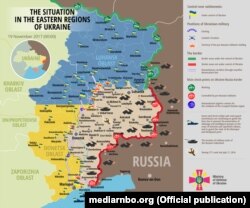
Here is today's map of the latest situation in the Donbas conflict zone, according to the Ukrainian Defense Ministry. (CLICK IMAGE TO ENLARGE)
Here's another item that was filed overnight by our Washington bureau:
Prisoner Swap Between Ukraine, Pro-Russia Separatists Appears to Be Moving Closer
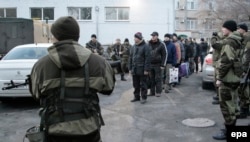
Ukraine and pro-Russia separatists appear to be moving closer to a new round of prisoner exchanges after a flurry of comments from Kyiv, Moscow, and separatist groups.
Yuriy Tandit, an adviser to the Security Service of Ukraine (SBU), on November 18 told Ukraine's Channel 5 that the "most important thing is that it happens fast, because many of the men have been there for a good three years."
Optimism has grown over the past few days after the Kremlin said Russian President Vladimir Putin on November 15 told separatist leaders Aleksandr Zakharchenko of the Donetsk region and Igor Plotnitsky of Luhansk by phone that he favored a prisoner swap with Kyiv.
Kremlin spokesman Dmitry Peskov said Zakharchenko and Plotnitsky supported a swap in principle but "pointed out that the issue will have to be worked out further on with representatives of Ukraine."
The SBU on November 16 said it welcomed "any steps" by Russia that would facilitate exchanges of people held by Kyiv and the Russia-backed separatists in eastern Ukraine.
Tandit said the SBU was prepared to hand over the hundreds of separatist fighters being held by Ukrainian authorities in return for Ukrainian troops held by separatists.
Reports say Ukraine has 306 separatist fighters in custody, while the separatists are holding 74 government soldiers.
The separatists have controlled the capitals and some other districts of the Luhansk and Donetsk provinces since the spring of 2014, when Moscow fomented separatism amid unrest that led to the downfall of Moscow-friendly Ukrainian President Viktor Yanukovych that February.
Russia does not recognize the separatist-held areas as independent and says it supports Ukraine's territorial integrity. Moscow also denies providing the separatists with troops, weapons, and other support in a war that has killed 10,000 people in the two regions since April 2014, despite what Kyiv and NATO say is incontrovertible evidence of such support.
The Russian statements confirming that Putin spoke to the Russia-backed separatist leaders represented a rare public acknowledgment of such direct contacts.