


OSCE Monitor Killed In Car Accident In Eastern Ukraine
By RFE/RL
A member of the Special Monitoring Mission of the Organization for Security and Cooperation in Europe was killed in a road accident in Kramatorsk in the Donetsk region on January 18, the OSCE said.
Vitalie Zara was a citizen of Moldova who had been working for the Luhansk Monitoring Team since July 2015, serving in Sievierodonetsk, Luhansk, and Kadiivka, the organization said in a posting on Facebook on January 19.
Zara was traveling in a taxi in Kramatorsk when the car accident took place. He died at the scene, Russian news agency Interfax reported.
"He is remembered as a trusted, hard-working friend and colleague, always with a smile, and will be missed and mourned," the OSCE said. "Our thoughts and prayers are with his family."
Kurt Volker, the special U.S. envoy for Ukraine, also offered "condolences to the family, friends, and colleagues of Vitalie Zara" on Twitter.
It was the second death of an OSCE monitor in eastern Ukraine in the last year. An American observer was killed last April when the car he was traveling in drove over a land mine.
With reporting by Interfax
That concludes our live-blogging of the Ukraine crisis for Friday, January 19, 2018. Check back here tomorrow for more of our continuing coverage. Thanks for reading and take care.
'Tragic' Measles Outbreak Kills Eight In Ukraine
By RFE/RL's Ukrainian Service
Ukraine's top health official says eight people have died of complications from measles amid a recent outbreak in the country, which the World Health Organization (WHO) has ranked last in terms of measles-vaccination coverage in Europe.
Acting Health Minister Ulyana Suprun told lawmakers on January 19 that a child who had not been vaccinated against measles died the previous day.
"This is the eighth fatal case since the onset of the outbreak, and this is a tragedy for our society, in which people die from diseases that are preventable by vaccinations," Suprun said.
The Ukrainian Health Ministry on January 16 said it had registered 1,285 cases of measles in the country in the first two weeks of this year -- including 856 children. There were a total of 4,782 measles cases registered in Ukraine in all of 2017.
A total of five people, including three children, died of measles in Ukraine last year.
Marthe Everard, the WHO's representative in Ukraine, said in a statement this week that at least twice as many children were vaccinated against measles in 2017 compared to the previous year.
But she said "the continuing spread of measles in Ukraine demonstrates that more must be done to vaccinate all those who have fallen behind."
With reporting by AFP and Interfax
EU Calls For Release Of 'Illegally Detained' Ukrainians In Crimea, Russia
By RFE/RL
The European Union has called for the release of Ukrainian citizens being held "illegally" in Crimea, the Ukrainian peninsula whose 2014 seizure by Moscow triggered international condemnation and Western sanctions targeting Russia.
In a January 19 statement, Maja Kocijancic, the spokeswoman for EU foreign policy chief Federica Mogherini, cited the case of pro-Kyiv activist Volodymyr Balukh, who was sentenced by a court in Russia-controlled Crimea on January 16 to three years and seven months in prison in a high-profile retrial on charges of weapons and explosives possession.
Kocijancic noted that Balukh was "known to have opposed the illegal annexation of the Crimean Peninsula by the Russian Federation" and that the EU does not recognize the court's jurisdiction.
"International human rights observers must be granted full, free, and unhindered access to the peninsula, and the European Union expects all illegally detained Ukrainian citizens in the illegally annexed Crimean Peninsula and in Russia to be released as swiftly as possible," Kocijancic said.
Russia's seizure of Crimea badly damaged Moscow's relations with Kyiv and the West and triggered sanctions by the EU, the United States, and several other countries.
Rights groups say Crimea residents who opposed Russia's takeover have faced discrimination and abuse at the hands of the Moscow-imposed authorities.
The European Parliament in March 2017 called on Russia to free more than 30 Ukrainian citizens who were in prison or otherwise detained in Russia, Crimea, and parts of eastern Ukraine controlled by Russia-backed separatists.
In her January 19 statement, Kocijancic also cited the case of Crimean Tatar activist Bekir Degermendzhi, who was detained in November in the Crimean city of Simferopol on what the spokeswoman called "dubious charges" related to alleged extortion.
Degermendzhi, who remains in custody, suffers from asthma, a condition his lawyers say has worsened since his detention.
"In view of the critical medical condition he suffers, it is essential that he is immediately granted access to appropriate medical care," Kocijancic said.
She added that the EU "remains committed to fully implementing its policy of nonrecognition of the illegal annexation of Crimea and Sevastopol."
With reporting by the Crimean Desk of RFE/RL's Ukrainian Service
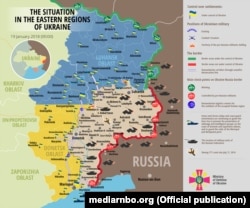
Here is today's map of the security situation in eastern Ukraine, according to the National Security and Defense Council (CLICK TO ENLARGE):
Kyiv Rebrands Its War In The East
By Christopher Miller
KYIV -- Ukraine's "antiterrorist operation" is officially over. But since the fight against Russia-backed separatists that most Ukrainians know as the "ATO" grinds on, what is still up for debate is: under what name?
With the passage of a contentious reintegration bill by Ukrainian lawmakers on January 17, Kyiv is rebranding the nearly 4-year-old conflict in eastern Ukraine.
Besides defining the vast swath of territory seized by the separatists in Ukraine's eastern regions as "temporarily occupied" by Russia -- a move backers say will help the government restore control over the area and better defend Ukraine's interests in international courts -- the bill puts the Ukrainian army's top command formally in charge of all military and law enforcement activities there, thus formally ending the so-called antiterrorist operation.
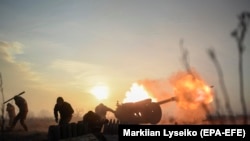
Often referred to by its snappy acronym "ATO" -- "Ah-toh" in Ukrainian -- that's how the conflict that has killed more than 10,300 people, including at least eight this month, has been officially called since it was launched by the Ukrainian Security Service (SBU) in April 2014. At the time, Moscow's forced annexation of Crimea was complete and its alleged clients were wresting territory in a mainland Ukraine hobbled by divisive protests and the fresh ouster of a Kremlin-friendly president.
Once the reintegration bill is signed into law by President Petro Poroshenko, the Ukrainian operation will be known -- officially, at least -- by the clunkier "Measures To Ensure National Security And Defense, And Repulsing And Deterring The Armed Aggression Of The Russian Federation In Donetsk And Luhansk Oblasts," for which there does not appear to be a catchy acronym.
Notably, the bill does not state outright that Ukraine is at war with Russia.

When asked on January 19 whether there had been a discussion about what to replace "ATO" with, a Ukrainian official who asked that his name not be used because the issue was not resolved half-jokingly used the Ukrainian abbreviation from the new terminology, "ZZNBO," to describe it.
Confirming the end of the "ATO" to RFE/RL, a presidential spokesman downplayed the name. "More important [is] that the military will now be fully and officially in charge," he added.
Ukraine's Defense Ministry and General Staff of the Armed Forces did not immediately respond to requests for clarity. But a commander who asked that his name not be used because he wasn't authorized to speak for the entire military suggested "Russian aggression" -- a blanket term used frequently by Ukraine's leaders to describe everything from military operations to cyberattacks attributed to Moscow -- "will suit just fine."
Such language has never sat well with Russian officials, who lashed out at Ukraine's passage of a bill that labels Russia "an aggressor state."
"You cannot call this anything but preparation for a new war," the Russian Foreign Ministry said in a statement on January 18, adding that the bill "risked a dangerous escalation in Ukraine with unpredictable consequences for world peace and security."
Rushed Response
Shedding the "ATO" name has been a long time coming.
Kyiv launched the "ATO" under SBU leadership in its rush to respond to the seizure of buildings and territory by armed individuals across Ukraine's Donetsk and Luhansk regions in spring 2014. The separatists involved in that violence were part of what Kyiv and NATO regard as a thoroughly 21st-century approach by Russia dubbed "hybrid warfare."
Underfunded and underprepared due to decades of post-Soviet neglect, Ukraine's military was caught flat-footed at the start of the conflict. In the nearly four years since, however, the Ukrainian armed forces have built themselves into the second-biggest standing army in Europe, with roughly 250,000 active-duty troops and tens of thousands of reservists.
Military instructors have come from the United States, the United Kingdom, Canada, and other Western countries to train Ukrainian troops. Some, including the United States, have given Ukraine's growing army valuable equipment with which to operate.
On December 22, the administration of U.S. President Donald Trump broke with previous policy to announce it would supply Kyiv with U.S.-made Javelin antitank missiles "to deter further aggression," as State Department spokesperson Heather Nauert put it.
Through it all, the "ATO" name held, and "terrorist" became a part of the Ukrainian lexicon, in an effort to show Moscow and the separatists as the aggressors. Everyone from the president, to soldiers on the front lines, to the national media, to the babushka watching the evening news has uttered the word.
While there have been murmurs about Kyiv wanting to drop it, the first and only real attempt to do so came with the bill passed this week.
But old habits die hard.
The press center for Ukraine's military operation in the east was still using "ATO" in reports and "#ATO" as its profile image on its Facebook page on January 19.
Meanwhile, Balazs Jarabik, a nonresident scholar focusing on Eastern Europe, said he doesn't think the change will be much of an issue among Ukrainians.
"They got 'Russia' instead of 'terrorists,'" Jarabik said.