

Here's another news item, this time from the Crimean Desk of RFE/RL's Ukrainian Service:
Crimean Activist Gets Prison For Pro-Ukraine Social Media Posts
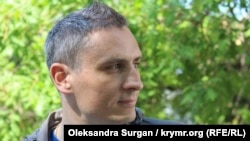
A Crimean activist has been sentenced to two years in prison over pro-Ukrainian comments made on social media, a ruling that activists say is unprecedented.
Ihor Movenko was found guilty of extremism by the Russia-controlled court in Sevastopol on May 4.
The charges stem from comments Movenko posted in the "Crimea is Ukraine" group on the social network VKontakte in 2016.
“If I’m not mistaken, this is the first time someone has been imprisoned for comments made on social media,” said Darya Sviridova of the Ukrainian Helsinki Human Rights Union.
"Obviously, a Ukrainian citizen is being persecuted for taking a pro-Ukrainian position on occupied territory," Sviridova added.
A lawyer for Movenko, Oksana Zheleznyak, said the ruling would be appealed.
Movenko was beaten in Sevastopol in September 2016 while riding a bicycle that displayed a sticker with the symbol of the far-right Azoz battalion.
Movenko suffered serious injuries in the attack, but police never investigated the incident.
Following the assault, Movenko was detained in December 2016 by Russia-installed security authorities in Crimea and charged with extremism on social media.
Since Russia’s annexation of Crimea in March 2014, the human rights situation has reportedly deteriorated on the Ukrainian Peninsula.
Human Rights Watch has called Crimea a "black hole" for human rights.
Here's what seems to be a photo of the town council brawl in Nikopol, which we reported on yesterday:
Good morning. We'll get the live blog rolling with this item that was filed overnight by our news desk:
Ill Treatment Of Police Suspects Still Common In Ukraine, EU Report Says
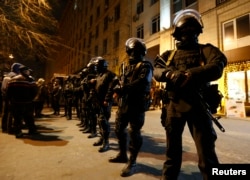
A new report from the Council of Europe finds that, despite significant efforts in Ukraine to adopt European human right standards, law enforcement bodies in the country continue to treat suspects badly.
"The problem of ill treatment still exists and has a systematic nature," said the report, which was released on May 4 as part of the European Union's and council's Partnership for Good Governance Project aimed at strengthening human rights in the former Soviet country.
The report said the principle reason for what it called "ill treatment by police" in Ukraine was an "established investigative practice which requires a suspect's confession as the starting point" for a criminal investigation.
It said the practice of first obtaining confessions from suspects -- "often extracted in an illegal manner" -- is "widely spread and supported" by police so they can "present better investigative statistics."
Once the confessions are extracted, the report said, the "inadmissible evidence" is "quite often accepted in court proceedings," perpetuating the rights violations in the legal system.
The report also found shortcomings in Ukrainian law that contribute to the ill treatment of suspects, including a "lack of a functional independent institution responsible for investigating" rights violations by police.
We are now closing the live blog for today, but we'll be back again in the morning to follow all the latest developments. Until then, you can keep up with all our other Ukraine coverage here.