




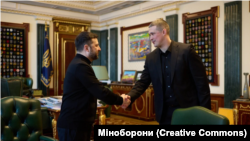
KYIV -- President Volodymyr Zelenskyy sacked Mykhaylo Fedorov as defense minister, a dramatic shakeup of his Cabinet that sent shockwaves through Ukrainian political and military circles and stoked new questions about oversight of Ukraine's stubborn defense against Russia's all-out invasion.
Fedorov, a youngish, whiz-kid bureaucrat who has spearheaded digital transformation efforts across the government and embraced drone innovation as an important weapon in the war, confirmed he had been relieved of his post on July 15.
The move sparked protests in the capital, Kyiv, and other Ukrainian cities, where people gathered to voice their opposition to the decision.
A protester speaking to RFE/RL in Kyiv on July 16 said the demonstrators had gathered in support of Fedorov, criticizing the government's decision to dismiss him at a time when reforms at the Defense Ministry had begun, and their results were already becoming visible.
"We know that he is the most effective defense minister in the history of Ukrainian independence," she said, adding that "we do not understand this decision and are protesting against it."
"I don't remember anyone ever being removed so unjustifiably. I mean, people are usually dismissed for poor results, but this will be a joy for Russia," said another protester who told RFE/RL that he was taking part in such a spontaneous protest for the first time.
He added that he was convinced that removing Fedorov and his team from their positions would have a very negative impact on the Defense Ministry's work.
Standing beside a sign reading "Fedorov's dismissal is a crime," a protester named Stefan told Current Time that he rarely attends demonstrations but felt compelled to join this one.
"I generally don't go to rallies, but I see this as such a stupid decision, such an incompetent one -- we're simply shooting ourselves in the foot -- that even I couldn't stay away and had to come," he said.
Dmytro Koziatynskiy, a Ukrainian veteran who called for the July 16 protest in Kyiv, also criticized the planned cabinet reshuffle.
"They want to replace an effective defense minister with a completely ineffective one who, in my opinion, has no competence at all," he told Current Time.
According to RFE/RL correspondents in Kyiv, several hundred people took part in a rally in support of Fedorov, where chants such as "Bring Fedorov back" were heard.
Similar protests were also held in Lviv, Kharkiv, Dnipro, and Odesa.
Fedorov's short tenure as defense minister has coincided with Ukrainian forces battling Russian troops to a near stalemate.
Short-range tactical drones have helped Ukraine plug holes in their defenses, and keep Russian troops from making substantial forward movement. But Ukrainian commanders also continue to struggle with a lack of manpower and experienced units to counter Russian attempts at breaking through.
Fedorov noted several achievements during his time at the ministry, including the blocking of Russian troops' access to Starlink satellites, which "dramatically reduced their ability to wage an effective drone war."
But ultimately, he admitted, a conflict with other Cabinet members -- namely army chief Oleksandr Syrskiy -- became insurmountable.
"We ran into a situation where all the initiatives we proposed began to be blocked," Fedorov told reporters on July 16.
"Instead of figuring out how to defeat Russia asymmetrically -- which is the Commander-in-Chief's task -- he [Syrskiy] figured out how to divide the country we are all living in today. And that's a major problem," Fedorov added.
Dan Rice, president of American University Kyiv and a former special adviser to the commander-in-chief of Ukraine's armed forces, told RFE/RL that Fedorov could be moved to another senior role, including potentially as prime minister or Ukraine's ambassador to the United States, although he stressed that "you just don't know" what Zelenskyy intends.
"I think he's done an amazing job in a very short period of time," Rice said of Fedorov.
"I think he has a chance to help Ukraine-US relations tremendously. But time will tell what President Zelenskyy wants."
Fedorov said Zelenskyy offered him an adviser role "or to find some other way to remain part of the team," but he declined the offer.
Zelenskyy announced the start of the government reshuffle on July 12, saying the changes are needed to implement an updated political strategy.
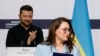
He said the reshuffle also is intended to renew the Cabinet of Ministers and said responsibility for key areas of foreign policy would be assigned to officials with relevant experience.
Earlier on July 15, Zelenskyy endorsed Serhiy Koretskiy, the chief executive of Naftogaz, the country’s largest state-owned oil and gas company, as the next prime minister.
He was confirmed to the post by parliament in a session on July 16 as the protests continued on the streets.
Naftogaz is a major source of government revenue and a politically powerful corporation.
One of the youngest ministers in Zelenskyy's government, Fedorov, 34, was named Ukraine's first minister of digital transformation in 2019, a position aimed at modernizing the government’s clunky government services, many dating back to the Soviet era.
Equally important was providing transparency for long-opaque bureaucratic processes, helping to root out deep-seated corrupt practices.
The reforms -- described as “a state in a smartphone" -- were embraced by Ukrainians, and Fedorov’s popularity and success led to a cabinet promotion, to deputy prime minister, with an expanded portfolio.
Fedorov was named to take over the Defense Ministry in January.
While his lack of a military background prompted some grumbling among Ukraine's uniformed armed forces, his promotion ushered in a surge in drone warfare and production -- an area of wartime innovation that Ukraine has excelled at.
In recent weeks Ukraine has used drones to strike multiple targets deep inside Russia territory.
The strikes against Kremlin energy assets, including oil terminals and tankers at sea, are part of a campaign Kyiv has labeled as "long-range sanctions" against Russia.
The drone attacks on Russian energy sites have led to massive shortages throughout the country, with even Moscow -- which is often immune to crises in the country -- feeling the pressure, with long lines at gas stations leading to angry outbursts by drivers.

