

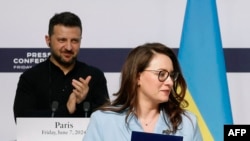
On the war front, Ukrainian forces have battled Russian troops to near stalemate, and Ukrainian drones are inflicting pain at the pump for Russian drivers, successes that President Volodymyr Zelenskyy is happy to bask in.
On the home front, however, there’s another yet another less-glowing battle looming: Zelenskyy's political fights as he tried to keep his war-time government in the good graces of an exhausted Ukrainian electorate.
Zelenskyy on July 12 ordered another major shake-up of his Cabinet, pushing out his prime minister. It’s the second shuffle of his government this year and at least the third since the start of Russia’s all-out war in February 2022.
“Personnel changes will begin in Ukraine to ensure the implementation of the updated political strategy,” he said in a statement posted to social media on July 12. He gave no further explanation.
Mostly popular as the country’s first and only wartime president, Zelenskyy’s popularity is falling. Pressure is building for him to relent and order new elections, something his political allies argue has been impossible due to the imposition of martial law because of the war.
There’s a handful of public political figures who are keeping their powder dry, waiting for the chance to take a shot at unseating Zelenskyy. Ukraine’s former top commander-in-chief, who is now ambassador to London, is chief among them.
“Ukraine remains at war and cannot have elections, so these kinds of rotations are the only way to bring in 'fresh' effective cadre,” said Orysia Lutsevych, an analyst and head of the Ukraine Forum at Chatham House, a London think tank.
In the shake-up, Yulia Svyrydenko, a well-regarded technocrat who was brought in almost exactly a year ago, was pushed out as prime minister. Zelenskyy did not immediately announce his choice for a replacement.
Svyrydenko’s ouster, Lutsevych said, was likely due in part to her political affiliation with Andriy Yermak, Zelenskyy’s former chief of staff.

Yermak was forced out last November after he was caught up in a major corruption scandal involving energy sector kickbacks and air defense systems.
Zelenskyy ended up replacing him with another prominent Ukrainian who was seen as a potential political rival: Kyrylo Budanov, the enigmatic head of the military intelligence agency responsible for several spectacular operations against Russian forces.
“Svyrydenko also associated with Yermak's legacy, as she was widely seen as his protege,” Lutsevych said. “Replacing her will also show Ukrainians that Zelenksyy is cleaning up the executive of Yermak's influence.”
Yevhen Mahda, a political scientist and director of the Institute of World Politics, a Kyiv think tank, suggested it was an abrupt decision.
“The prime minister, who had no public complaints from practically anyone except the opposition, comes to a meeting with the president, and there she is told that she must resign,” he said.
The perception that she was “Yermak’s man” hung over Svyrydenko, but Mahda said that she spoke out regularly against Yermak.
The prime minister’s office holds less power than the presidency, so the job mainly consists of minding legislative matters in parliament, as well as cabinet meetings.
Under Ukrainian law, the prime minister's resignation needs the approval of parliament, and entails the resignation of the entire government.

A Top Contender
Among the leading contenders to replace Svyrydenko is Serhiy Koretskiy, the chief executive of Naftogaz, the country’s largest state-owned oil and gas company, a major source of government revenue and a politically powerful corporation.
Around the same time as the announcement of the shake-up, Zelenskyy posted a photography of himself with Koretskiy, saying he “ensured that Ukraine’s national interests were upheld” while looking after an “extremely complex sector.”
“I agree that Koretskiy is the top contender,” said Volodymyr Fesenko, a Kyiv-based political analyst. “He’s a figure with a positive reputation, both in the West and within Ukraine, who doesn’t have any negative baggage.
“He has a reputation as a good manager, and at the same time, let’s say, no particular political ambitions or close political ties to various political factions or oligarchic groups,” he told RFE/RL’s Ukrainian Service.
Critics of Zelenskyy slammed this most recent shake-up as him stomping on Ukraine’s constitutional norms
"Who will be the next prime minister of Ukraine? It means absolutely nothing. None,” said Serhiy Rudenko, a political columnist and author of a biography of Zelenskyy. “Zelenskyy, despite the constitution, dismisses and appoints the heads of government.… There’s no competition. No government program. No assessment after a dismissal."
“The person who has taken over all the powers in this state is Volodymyr Zelenskyy,” Rudenko said. “Everyone else is just part of the president’s entourage.”

Two other less likely candidates to become prime minister include Mykhaylo Fedorov, a youngish, whiz-kid bureaucrat who has spearheaded digital transformation efforts across the government and embraced drone innovation as an important weapon in the war. Also Denys Shmyhal, who has served in various posts under Zelenskyy, including a stint as prime minister.
Ukrainian media have also raised the possibility of Fedorov losing his post as defense minister even if he is not tapped to be prime minister. The newspaper Ukrainska Pravda reported that Fedorov was in “systemic conflict” with other Cabinet members involved in defense spending, due to Fedorov’s purported unwillingness to engage in shady backroom dealing, and other practices.
Looming On The Horizon
Zelenskyy was first voted into office in 2019 in a landslide election, buoyed by Ukrainians attracted to his pledge to find an end to tension with Moscow.
Three years later, Russia launched its invasion, and Zelenskyy’s popularity soared as Ukrainians flocked to the poise and defiance of a wartime leader.
But more than four years in, Ukrainians are exhausted by the fighting, which shows no sign of abating. This past winter was one of the worst for Ukrainians, after Russia repeatedly pummeled electricity and municipal heating facilities.
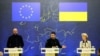
Zelenskyy’s popularity has also taken a dent from a series of scandals, over procurement of food for the armed forces in 2023, for example.
The graft investigation surrounding Yermak -- whom Zelenskyy has known since his earlier career as an actor and comedian -- was the worst to hit his presidency, and it led to the ouster of the justice and energy ministers, further dented his popularity.
Public opinion polls show the most credible challenger to Zelenskyy if elections were held this year would be Valery Zaluzhniy, a retired general who commanded Ukraine’s armed forces for the first two years of the war.

He was pushed out in February 2024, sidelined from internal politics, and sent to London with an important diplomatic post: ambassador to Britain.
Inside Ukraine, it’s an open secret that Zaluzhniy plans to challenge Zelenskyy if the opportunity presents itself. According to Ukrainska Pravda, Zelenskyy summoned Zaluzhniy back to Kyiv in mid-June around the time of Kier Starmer’s decision to step down as Britain’s prime minister.
During the meeting, Zelenskyy reportedly asked Zaluzhniy if he intended to run for the presidency if elections were held later this year. Zaluzhniy said “yes, I will,” according to the paper.