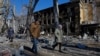
The gunshots rang out amid stopped midday traffic, panicking bystanders on a busy road in the Ukrainian Black Sea city of Odesa. Masked men wearing bulletproof vests pulled other men from a white minivan, throwing them to the pavement and pounding on them to make them stay still.
The masked men were from Ukraine’s main security agency, the SBU. The men being detained were from the regional military recruiting office, in charge of seeking out draft dodgers and conscripts eligible to fight on the front lines.
Some bystanders were ebullient.
The April 21 arrests were part of a sting, authorities said, targeting corrupt recruiters who solicit bribes and extort people who do not want to enlist -- or are ineligible to.
It’s far from an isolated case.
More than four years into Russia’s all-out war, Ukraine’s defense, where manpower is concerned, continues to be somewhat less than all-out. Kyiv has spent years trying to come up with a better system to entice, attract, and recruit people to serve, on the front lines or otherwise.
It’s still a major challenge. Corruption among recruiters isn’t helping.
"On the one hand, everyone says we must fight until victory, and on the other hand, everyone is running away from mobilization,” Kyrylo Budanov, the former head of Ukraine’s military intelligence agency, lamented this month. “This is a huge, enormous problem.”
"Wars are not won without people. Without people, wars are lost, that does happen. But winning without people -- that simply doesn't exist," Budanov said in an interview with the Ukrinform state news agency.
“The Ukrainian government has sought to fix the image of the recruitment system, but more work needs to be done,” according to an analysis published last month by the Carnegie Endowment for International Peace.
“The main recipe for bribery and corruption is the unwillingness of a significant part of citizens to fulfill their constitutional duty to protect the state if they have the financial means to buy such an opportunity,” said Viktor Kevlyuk, a military analyst at the Kyiv-based Center for Defense Strategies and co-author of the analysis.

‘Our Guys Are On The Front Line, And They Need To Be Replaced By Someone’
In the weeks after the February 2022 full-scale invasion, Ukraine thwarted what many had predicted would be a cakewalk for the Russian Army, using a mix of pluck, prowess, and bravery -- as well as incompetence on the part of some Russian commanders.
Ukrainian forces managed to pull off two successful counteroffensives late in 2022, knocking Russian troops back on their heels.
As the war ground on, Russia took advantage of its larger size, and deeper defense base, to throw more men into the fight.
A partial mobilization order in September 2022 brought in tens of thousands of men. Authorities devised a patchwork recruitment system that included extraordinary wages and benefits, paid from federal and regional budgets.
The result was a reliable flow of men sent to the front -- with eyewatering casualty rates.
Russia’s figures are nearing 1.5 million dead and wounded, according to Western intelligence and expert estimates, a mind-boggling number that amounts to more casualties than what Moscow has cumulatively suffered from all wars it has fought since 1945.

Ukraine’s killed and wounded, meanwhile, are believed to be in excess of 500,000 -- proportionally an even bigger problem given its smaller population.
"Our guys are on the front line, and they need to be replaced by someone,” Budanov, who is now President Volodymyr Zelenskyy’s chief of staff, said in his interview. “And those avoiding service definitely don't understand that.”
Officials struggled to streamline Ukraine’s system for attracting and maintaining soldiers. In April 2024, Zelenskyy signed legislation that lowered the minimum age for men to be mobilized and required all men to update their draft data with the authorities.
The legislation also increased payments to volunteers and authorized some convicts to serve.
Last spring, officials announced a program of incentives that include cash bonuses, subsidized mortgages, free university education, and the right to travel abroad after completing service.
As of January 2025, around 800,000 troops were serving in Ukraine’s armed forces and other branches such as the Territorial Brigades and National Guard.
Under martial law, most men aged 18-60 are not allowed to leave the country.
One parliamentary estimate from 2024 said there were 4.35 million Ukrainian men between 25 and 60 -- who were not exempt from military service on family or professional grounds, not yet serving, not disabled, and not living under Russian occupation or abroad -- eligible to serve. Other estimates put the number slightly higher, at around 5 million.
The current system for ensuring there is a steady flow of people in the pipeline relies on what is known as Territorial Centers for Recruitment and Social Support. Those centers are charged not only with recruiting men, but also hunting down draft dodgers.
The effort has been controversial, if not outright loathed. In one notorious case, recruiters showed up at a Kyiv concert by the country's most popular rock group, handing out summonses -- and dragging a man across the pavement as he shouted in protest and onlookers showered the recruiters with chants of "Shame!"
Another video filmed on April 23 shows a recruiter in western Ukraine fighting with a man on a rooftop before both of them plunge to the ground.
Military recruiters frequently drive around towns and cities in minibuses, looking for men. Frequently, recruiters will forcefully detain resisters, then trundle them away in the vehicles, a process known as “busification.”
Meanwhile, a robust parallel system has sprung up to help people escape being enlisted.
Ukrainian border guards have said it costs draft dodgers around $15,000 to pay smuggling gangs who often hire local children to guide them across the border into Romania or elsewhere.
"There is no split in Ukrainian society” on this issue, Ukrainian political scientist Volodymyr Fesenko told Current Time. However, “there is tension regarding military recruitment centers, regarding mobilization, and unfortunately this tension is growing…. Unfortunately, there is clear corruption and excessive use of violence."
‘Mobilization Is Necessary. Somebody Has To Fight’
Odesa -- a famed Black Sea port city legendary for its criminal underworld – has been the focus of scores of complaints by men who say recruiters routinely extort bribes. The parliament’s human rights office said it had received nearly 200 complaints last year of rights violations by military recruiters.
In the April 21 incident, which was filmed by multiple bystanders and posted to Telegram and other social media, SBU officers stopped a minibus after a chase, firing gun shots and arresting eight men at gunpoint, forcing them to lie face down on the asphalt amid passing traffic.

One local news report said the recruiters, along with a police officer, demanded a $30,000 bribe from a former soldier who had received an official exemption, one local news outlet reported. The man was forcibly dragged into a minibus and threatened with a weapon. The SBU officers reportedly confiscated bats, brass knuckles, knives, and unlicensed guns from the minibus.
Though Ukrainians continue to overwhelmingly support the war effort, much of Ukrainian society is also exhausted and eager for some sort of resolution to end the fighting. Efforts to ensure eligible men are enlisted to fight are mostly supported, but corruption, bribery, extortion, and violent tactics frequently employed by recruiters are widely loathed.
“You can’t avoid it. Mobilization is necessary. Somebody has to fight,” one Odesa woman, who did not give her name, told RFE/RL’s Ukrainian Service. “And those who avoid service, they should be forcibly made to serve. But there needs to be civilized methods, without [torture]. And these incidents, they make you think.”