





President Volodymyr Zelenskyy says he held a "substantive discussion" with members of Ukraine's parliament on the possibility of holding elections amid pressure from the United States to hold a vote despite wartime legal restrictions.
Addressing Ukrainians in a nightly video on December 10, Zelenskyy said strong security guarantees from Kyiv's allies -- especially Washington -- are needed to hold a vote.
"If partners, including our key partner in Washington, speak so much and so specifically about elections in Ukraine, about elections under martial law, then we must provide legal Ukrainian answers to every question and every doubt," he said, responding to a suggestion by US President Donald Trump that Kyiv was using the war as an excuse to avoid elections.

"It is not easy, but pressure on this issue is definitely not what we need.... Security challenges depend on partners, primarily America. Political and legal challenges must be answered by Ukraine. And they will be," he added.
Elections During Martial Law
The White House has been pushing for Ukraine to hold elections -- Trump told Politico in an interview published on December 9 that "it's time"-- even though Ukraine's constitution doesn't allow for elections during wartime.
In a shift from previous statements, Zelenskyy told reporters on December 9 that he would push parliament to draft legislation allowing for elections during martial law.
A vote could follow in 60 to 90 days once there are security guarantees in place to make sure voting would be safe for Ukrainians.
Zelenskyy's comments come amid intense negotiations aimed at ending Russia's all-out war on Ukraine, launched in February 2022. Ukrainian officials have been pushing back on a US-drafted peace plan that was seen as heavily favoring Russia.

The possibility of holding elections has been regularly dismissed, with officials saying it would be impossible given daily Russian air strikes across the country, thousands of soldiers battling on the front lines, and millions of Ukrainians displaced.
Opinion polls show most Ukrainians are against holding wartime elections, though with the last elections held in 2019, some want changes in the government to bring in fresh ideas. Widely popular, Zelenskyy's support has slipped in recent weeks amid a major corruption scandal that led to the resignation of an influential adviser, Andriy Yermak.
On the battlefield and in negotiations, Russian officials believe they have the upper hand, and the 28-point plan proposed by the United States echoes most of the hard-line positions that Moscow has held since before the invasion.
Coalition Of The Willing
Ukraine's European allies, meanwhile, have been unenthusiastic about Washington's proposal.

Before a planned meeting between the so-called Coalition of the Willing -- which includes Germany, France, Britain -- with Zelenskyy on December 11, leaders from the three countries held a phone call with Trump.
Trump said he exchanged "pretty strong words" with the leaders of France, Britain, and Germany over Ukraine, another sign of a widening rift on how to end the war as it nears its fourth anniversary.
"We discussed Ukraine in pretty strong words," Trump told reporters when asked about the call with British Prime Minister Keir Starmer, French President Emmanuel Macron, and German Chancellor Friedrich Merz.
Zelenskyy, meanwhile, said Ukraine had agreed on key points of a possible reconstruction plan in discussions with US Treasury Secretary Scott Bessent and other senior officials, including Trump's son-in-law Jared Kushner and BlackRock CEO Larry Fink.
"The principles of the economic document are completely clear, and we are fully aligned with the American side," Zelenskyy said.
"An important common principle is that for reconstruction to be of high quality and economic growth after this war to be tangible, real security must be at the core. When there is security, everything else is there, too."
Sticking Points On Peace Plan
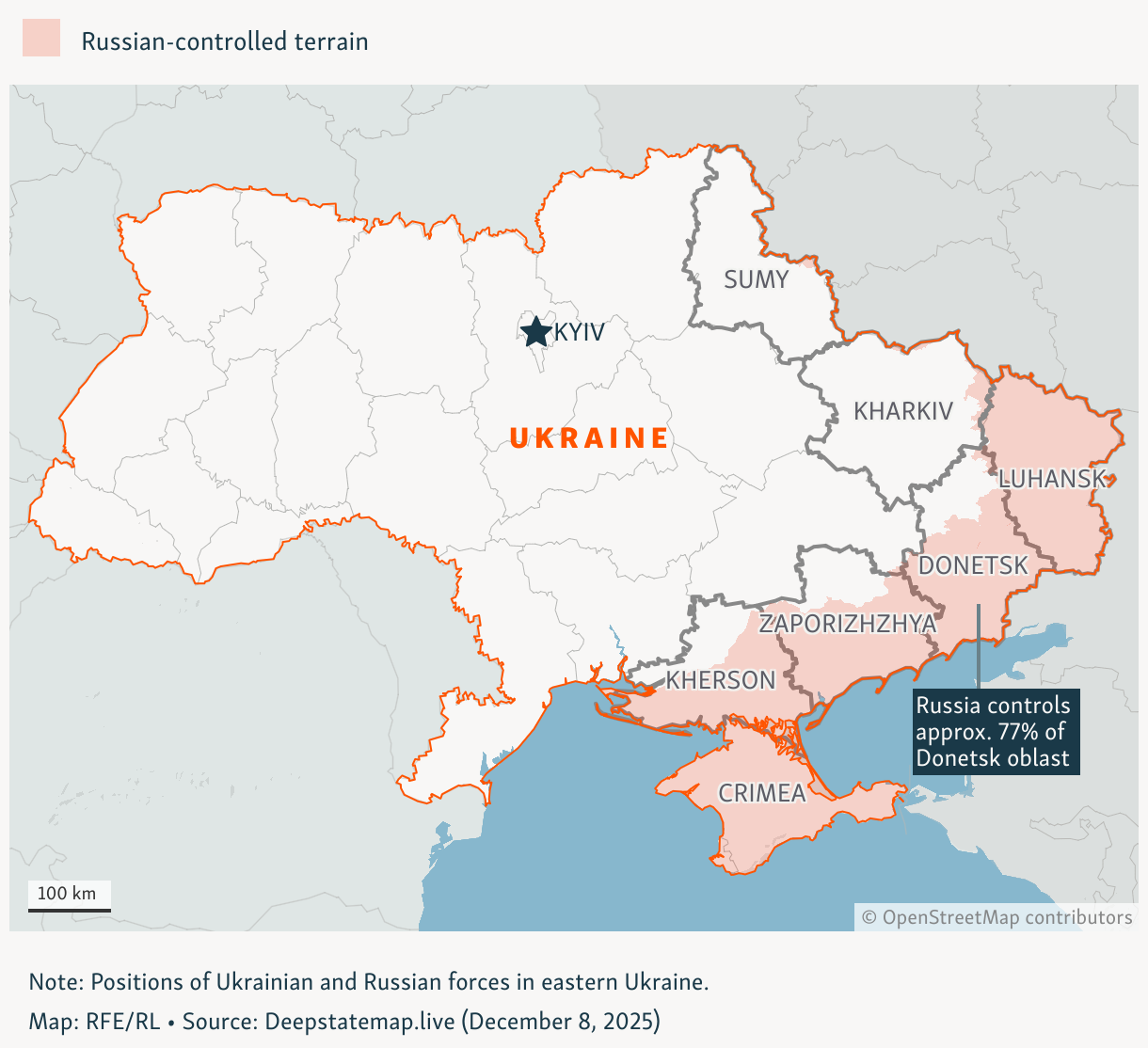
There have been several major sticking points in the back-and-forth negotiations including the size of Ukraine's armed forces, Western security guarantees, and Russia's insistence that Ukraine be permanently barred from seeking NATO membership.
The White House peace proposal, and the belief that it heavily favors Russian interests, has drawn criticism from some Republican lawmakers in Congress.
President Vladimir Putin "is mocking President Trump and buying time to keep killing Ukrainian families," Representative Joe Wilson said.
Bloomberg and Axios, citing US and Ukrainian sources, reported that Ukraine sent a revised peace plan to Washington on December 10.
According to an Axios report, Kyiv sent the US a response with comments, proposed amendments, and new ideas to resolve sticking points such as the territory and the Zaporizhzhya nuclear plant to make the plan workable.
Meanwhile, the US House of Representatives passed a massive defense policy bill on December 10 authorizing a record $901 billion in annual military spending, including support for Ukraine.
The bill, the National Defense Authorization Act (NDAA), allocates $800 million for Ukraine -- $400 million for each of the next two years -- through the Ukraine Security Assistance Initiative.
This initiative pays US companies to supply Ukraine's military with weapons.
The US Senate is expected to pass the bill next week, and Trump says he will sign it once it reaches the White House.