WATCH: Biden In Kyiv Says 'Russian Aggression Unacceptable'
Speaking in Kyiv, U.S. Vice President Joe Biden said that "it is unacceptable in the 21st century for countries to attempt to redraw borders by force in Europe or intervene militarily because they don't like a decision their neighbors have made."
Speaking alongside Ukrainian President Petro Poroshenko on November 21, he also said if Russia would fulfill commitments it made in Minsk to end the crisis in Ukraine and would respect the country's territorial integrity, "we could begin a rational discussion about sanctions."
But instead, he said, "we have seen blatant disregard of the [Minsk] agreement by Moscow."
"Do what you agreed to do, Mr. Putin," Biden said.
Biden is in Ukraine as the country marks a year since the start of protests that led to the ouster of the country’s former pro-Kremlin regime.
The U.S. vice president also said Washington does not and will not recognize Russia's annexation of Crimea and will insist others also do not recognize it.
He called Russia's annexation of the peninsula and its backing for separatist rebels in eastern Ukraine a "flagrant violation of the bedrock principles of the international system."
Biden, who arrived in Kyiv late on November 20, also urged Ukrainians to form a new government in "days not weeks" following recent elections, which he said were free and fair.
He called on the new government to work toward greater integration with Europe and work for Ukraine's democratic and economic future.
He said so long as Kyiv does that, the United States will be "at your side."
Biden did not mention any new U.S. nonlethal military aid to Kyiv during the press conference.
Poroshenko said Kyiv should complete the formation of a coalition government "within six days."
Earlier on November 21, Ukraine's newly formed five-party ruling coalition reportedly set the country's joining NATO as a major goal.
The five pro-Western parties -- the Petro Poroshenko Bloc, the Popular Front, Samopomich, the Radical Party, and Batkivshchyna -- initialed the agreement in parliament in Kyiv.
A draft coalition agreement posted on the Samopomich party's website on November 21 said the coalition plans to amend Ukraine's laws and foreign policy to cancel the country's nonaligned status and seek NATO membership.
PHOTO GALLERY: The Evolution Of The Maidan
The Evolution Of Euromaidan
1/21Protesters hold Ukrainian and European Union flags during a rally to support European integration in central Kyiv on November 21, 2013.
Euromaidan -- the name given to the pro-European protests in Ukraine's capital, Kyiv -- started late on November 21, 2013, when up to 2,000 protesters gathered on the city's central Maidan Nezalezhnosti (Independence Square). The movement, sparked by President Viktor Yanukovych's abrupt decision to abandon talks on a pact on closer relations with the European Union, started peacefully, but did not end that way. The violence started with the government's crackdown on protesters overnight on November 30. Months later, Yanukovych would flee the country and around 100 protesters would be dead.
Show moreShow less
2/21A protester on Kyiv's Independence Square on November 24, 2013, the biggest protest rally in Ukraine's capital since the 2004 Orange Revolution. The opposition called the rally after President Viktor Yanukovych's government reversed a plan to sign a historic deal deepening ties with the EU, in a U-turn critics said was forced by the Kremlin.
Euromaidan -- the name given to the pro-European protests in Ukraine's capital, Kyiv -- started late on November 21, 2013, when up to 2,000 protesters gathered on the city's central Maidan Nezalezhnosti (Independence Square). The movement, sparked by President Viktor Yanukovych's abrupt decision to abandon talks on a pact on closer relations with the European Union, started peacefully, but did not end that way. The violence started with the government's crackdown on protesters overnight on November 30. Months later, Yanukovych would flee the country and around 100 protesters would be dead.
Show moreShow less
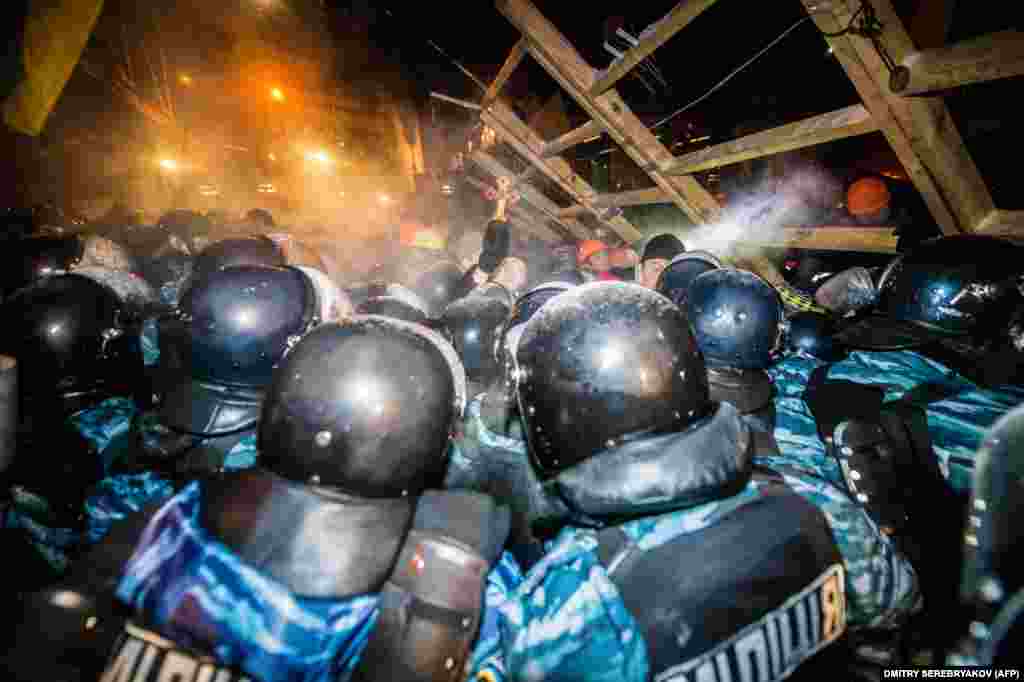
3/21At about 4.30 a.m. on November 30, soldiers of the Berkut riot-police unit violently dispersed Euromaidan activists who had stayed on Independence Square for the night.
Euromaidan -- the name given to the pro-European protests in Ukraine's capital, Kyiv -- started late on November 21, 2013, when up to 2,000 protesters gathered on the city's central Maidan Nezalezhnosti (Independence Square). The movement, sparked by President Viktor Yanukovych's abrupt decision to abandon talks on a pact on closer relations with the European Union, started peacefully, but did not end that way. The violence started with the government's crackdown on protesters overnight on November 30. Months later, Yanukovych would flee the country and around 100 protesters would be dead.
Show moreShow less
4/21The violent dispersal of protests by the Berkut sparked riots the following day in Kyiv. On December 1, protesters reoccupied the square and further clashes with the authorities and political ultimatums by the opposition ensued for the rest of the month.
Euromaidan -- the name given to the pro-European protests in Ukraine's capital, Kyiv -- started late on November 21, 2013, when up to 2,000 protesters gathered on the city's central Maidan Nezalezhnosti (Independence Square). The movement, sparked by President Viktor Yanukovych's abrupt decision to abandon talks on a pact on closer relations with the European Union, started peacefully, but did not end that way. The violence started with the government's crackdown on protesters overnight on November 30. Months later, Yanukovych would flee the country and around 100 protesters would be dead.
Show moreShow less
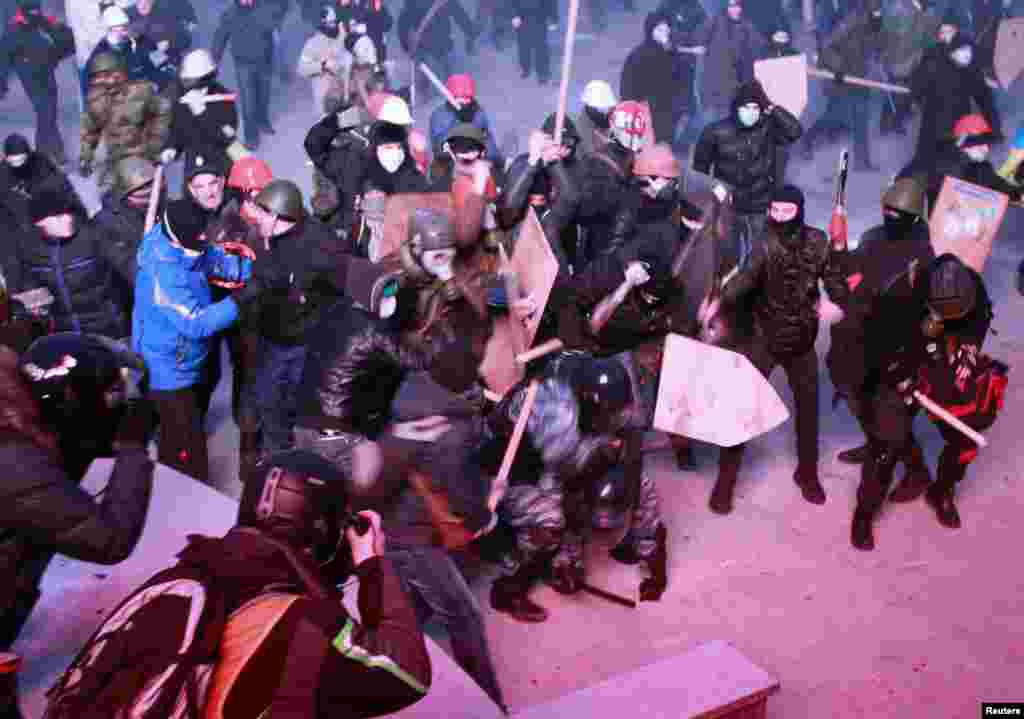
5/21Protesters clash with police during the storming of the presidential office in Kyiv during a mass opposition rally on December 1, 2013.
Euromaidan -- the name given to the pro-European protests in Ukraine's capital, Kyiv -- started late on November 21, 2013, when up to 2,000 protesters gathered on the city's central Maidan Nezalezhnosti (Independence Square). The movement, sparked by President Viktor Yanukovych's abrupt decision to abandon talks on a pact on closer relations with the European Union, started peacefully, but did not end that way. The violence started with the government's crackdown on protesters overnight on November 30. Months later, Yanukovych would flee the country and around 100 protesters would be dead.
Show moreShow less
6/21Euromaidan protesters gather in central Kyiv on December 8.
Euromaidan -- the name given to the pro-European protests in Ukraine's capital, Kyiv -- started late on November 21, 2013, when up to 2,000 protesters gathered on the city's central Maidan Nezalezhnosti (Independence Square). The movement, sparked by President Viktor Yanukovych's abrupt decision to abandon talks on a pact on closer relations with the European Union, started peacefully, but did not end that way. The violence started with the government's crackdown on protesters overnight on November 30. Months later, Yanukovych would flee the country and around 100 protesters would be dead.
Show moreShow less
7/21Pro-European protesters sleep inside Kyiv City Hall on December 7, 2013. Thousands of protesters gathered in Kyiv to demand the government's resignation and early elections. They blocked the cabinet of ministers' building and occupied a labor-union building and the city administration, where they had hoisted the EU flag a day earlier.
Euromaidan -- the name given to the pro-European protests in Ukraine's capital, Kyiv -- started late on November 21, 2013, when up to 2,000 protesters gathered on the city's central Maidan Nezalezhnosti (Independence Square). The movement, sparked by President Viktor Yanukovych's abrupt decision to abandon talks on a pact on closer relations with the European Union, started peacefully, but did not end that way. The violence started with the government's crackdown on protesters overnight on November 30. Months later, Yanukovych would flee the country and around 100 protesters would be dead.
Show moreShow less
8/21People surround a statue of Soviet state founder Vladimir Lenin, which was toppled by protesters during a rally organized by supporters of EU integration in Kyiv on December 8, 2013.
Euromaidan -- the name given to the pro-European protests in Ukraine's capital, Kyiv -- started late on November 21, 2013, when up to 2,000 protesters gathered on the city's central Maidan Nezalezhnosti (Independence Square). The movement, sparked by President Viktor Yanukovych's abrupt decision to abandon talks on a pact on closer relations with the European Union, started peacefully, but did not end that way. The violence started with the government's crackdown on protesters overnight on November 30. Months later, Yanukovych would flee the country and around 100 protesters would be dead.
Show moreShow less
9/21Pro-European protesters stand on a barricade built to block the way to Independence Square in Kyiv on December 9.
Euromaidan -- the name given to the pro-European protests in Ukraine's capital, Kyiv -- started late on November 21, 2013, when up to 2,000 protesters gathered on the city's central Maidan Nezalezhnosti (Independence Square). The movement, sparked by President Viktor Yanukovych's abrupt decision to abandon talks on a pact on closer relations with the European Union, started peacefully, but did not end that way. The violence started with the government's crackdown on protesters overnight on November 30. Months later, Yanukovych would flee the country and around 100 protesters would be dead.
Show moreShow less
10/21Riot police storm a barricade held by protesters on Independence Square in Kyiv late on December 11, 2013. The demonstrators defiantly refused to leave and resisted the police in a tense standoff. Berkut riot police and Interior Ministry special forces moved against the protesters at around 2 a.m. in a move that prompted U.S. Secretary of State John Kerry to express "disgust" over the crackdown.
Euromaidan -- the name given to the pro-European protests in Ukraine's capital, Kyiv -- started late on November 21, 2013, when up to 2,000 protesters gathered on the city's central Maidan Nezalezhnosti (Independence Square). The movement, sparked by President Viktor Yanukovych's abrupt decision to abandon talks on a pact on closer relations with the European Union, started peacefully, but did not end that way. The violence started with the government's crackdown on protesters overnight on November 30. Months later, Yanukovych would flee the country and around 100 protesters would be dead.
Show moreShow less
11/21Ukrainian opposition leaders Arseniy Yatsenyuk and Vitali Klitschko speak to protesters in Independence Square on December 29, 2013.
Euromaidan -- the name given to the pro-European protests in Ukraine's capital, Kyiv -- started late on November 21, 2013, when up to 2,000 protesters gathered on the city's central Maidan Nezalezhnosti (Independence Square). The movement, sparked by President Viktor Yanukovych's abrupt decision to abandon talks on a pact on closer relations with the European Union, started peacefully, but did not end that way. The violence started with the government's crackdown on protesters overnight on November 30. Months later, Yanukovych would flee the country and around 100 protesters would be dead.
Show moreShow less
12/21Pro-European protesters take part in New Year celebrations on Independence Square in central Kyiv on January 1, 2014.
Euromaidan -- the name given to the pro-European protests in Ukraine's capital, Kyiv -- started late on November 21, 2013, when up to 2,000 protesters gathered on the city's central Maidan Nezalezhnosti (Independence Square). The movement, sparked by President Viktor Yanukovych's abrupt decision to abandon talks on a pact on closer relations with the European Union, started peacefully, but did not end that way. The violence started with the government's crackdown on protesters overnight on November 30. Months later, Yanukovych would flee the country and around 100 protesters would be dead.
Show moreShow less
13/21The Ukrainian parliament votes for antiprotest laws, which themselves sparked a fresh wave of protests on January 16, 2014.
Euromaidan -- the name given to the pro-European protests in Ukraine's capital, Kyiv -- started late on November 21, 2013, when up to 2,000 protesters gathered on the city's central Maidan Nezalezhnosti (Independence Square). The movement, sparked by President Viktor Yanukovych's abrupt decision to abandon talks on a pact on closer relations with the European Union, started peacefully, but did not end that way. The violence started with the government's crackdown on protesters overnight on November 30. Months later, Yanukovych would flee the country and around 100 protesters would be dead.
Show moreShow less
14/21Pro-EU protesters clash with Ukrainian riot police during a rally near government administration buildings in Kyiv on January 19, 2014. Protesters attacked riot police with sticks and tried to overturn a bus blocking their path to parliament, as up to 100,000 Ukrainians massed in defiance of sweeping new laws aimed at stamping out antigovernment demonstrations.
Euromaidan -- the name given to the pro-European protests in Ukraine's capital, Kyiv -- started late on November 21, 2013, when up to 2,000 protesters gathered on the city's central Maidan Nezalezhnosti (Independence Square). The movement, sparked by President Viktor Yanukovych's abrupt decision to abandon talks on a pact on closer relations with the European Union, started peacefully, but did not end that way. The violence started with the government's crackdown on protesters overnight on November 30. Months later, Yanukovych would flee the country and around 100 protesters would be dead.
Show moreShow less
15/21Protesters clash with riot police in downtown Kyiv on January 22, 2014.
Euromaidan -- the name given to the pro-European protests in Ukraine's capital, Kyiv -- started late on November 21, 2013, when up to 2,000 protesters gathered on the city's central Maidan Nezalezhnosti (Independence Square). The movement, sparked by President Viktor Yanukovych's abrupt decision to abandon talks on a pact on closer relations with the European Union, started peacefully, but did not end that way. The violence started with the government's crackdown on protesters overnight on November 30. Months later, Yanukovych would flee the country and around 100 protesters would be dead.
Show moreShow less
16/21People gather at the the site of clashes between pro-European protesters and riot police in Kyiv on January 23.
Euromaidan -- the name given to the pro-European protests in Ukraine's capital, Kyiv -- started late on November 21, 2013, when up to 2,000 protesters gathered on the city's central Maidan Nezalezhnosti (Independence Square). The movement, sparked by President Viktor Yanukovych's abrupt decision to abandon talks on a pact on closer relations with the European Union, started peacefully, but did not end that way. The violence started with the government's crackdown on protesters overnight on November 30. Months later, Yanukovych would flee the country and around 100 protesters would be dead.
Show moreShow less
17/21Tents of antigovernment protesters are seen in Independence Square in temperatures of around minus 19 degrees Celsius in central Kyiv on January 30.
Euromaidan -- the name given to the pro-European protests in Ukraine's capital, Kyiv -- started late on November 21, 2013, when up to 2,000 protesters gathered on the city's central Maidan Nezalezhnosti (Independence Square). The movement, sparked by President Viktor Yanukovych's abrupt decision to abandon talks on a pact on closer relations with the European Union, started peacefully, but did not end that way. The violence started with the government's crackdown on protesters overnight on November 30. Months later, Yanukovych would flee the country and around 100 protesters would be dead.
Show moreShow less
18/21A still photo from a video by RFE/RL's Ukrainian Service shows Ukrainian security personnel with a Kalashnikov assault rifle and sniper rifle in a confrontation with protesters in Kyiv on February 20, 2014. Dozens of protesters are believed to have been killed by gunfire on this day.
Euromaidan -- the name given to the pro-European protests in Ukraine's capital, Kyiv -- started late on November 21, 2013, when up to 2,000 protesters gathered on the city's central Maidan Nezalezhnosti (Independence Square). The movement, sparked by President Viktor Yanukovych's abrupt decision to abandon talks on a pact on closer relations with the European Union, started peacefully, but did not end that way. The violence started with the government's crackdown on protesters overnight on November 30. Months later, Yanukovych would flee the country and around 100 protesters would be dead.
Show moreShow less
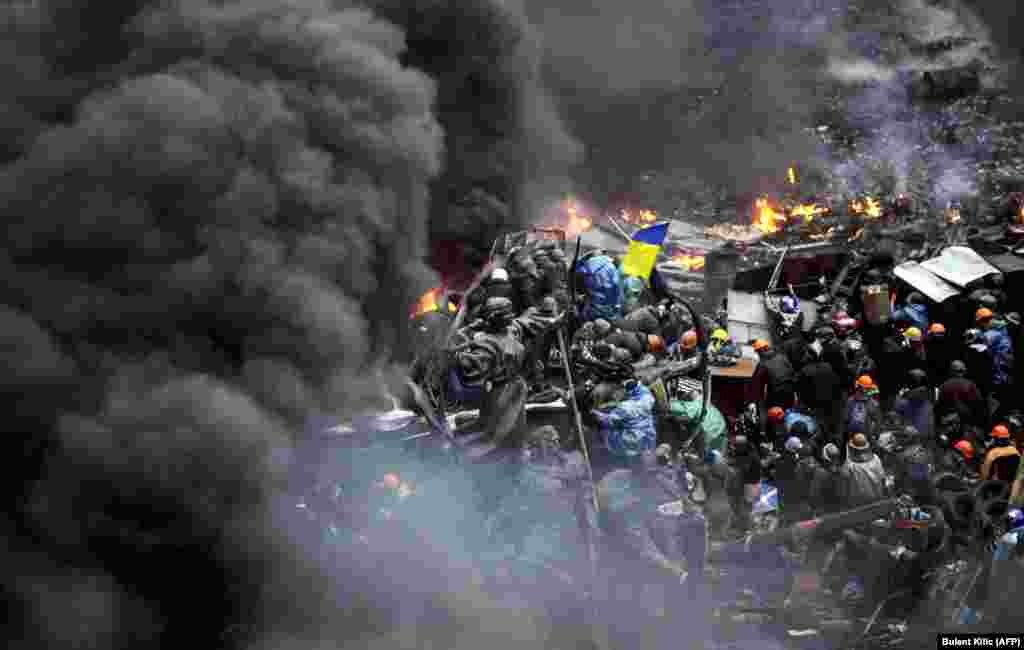
19/21Protesters stand behind burning barricades during a face-off against police in Kyiv on February 20.
Euromaidan -- the name given to the pro-European protests in Ukraine's capital, Kyiv -- started late on November 21, 2013, when up to 2,000 protesters gathered on the city's central Maidan Nezalezhnosti (Independence Square). The movement, sparked by President Viktor Yanukovych's abrupt decision to abandon talks on a pact on closer relations with the European Union, started peacefully, but did not end that way. The violence started with the government's crackdown on protesters overnight on November 30. Months later, Yanukovych would flee the country and around 100 protesters would be dead.
Show moreShow less
20/21Protesters catch fire as they stand behind burning barricades during clashes with police in Kyiv on February 20. Numbers vary, but Euromaidan activists say around 100 protesters were killed in total during the antigovernment protests.
Euromaidan -- the name given to the pro-European protests in Ukraine's capital, Kyiv -- started late on November 21, 2013, when up to 2,000 protesters gathered on the city's central Maidan Nezalezhnosti (Independence Square). The movement, sparked by President Viktor Yanukovych's abrupt decision to abandon talks on a pact on closer relations with the European Union, started peacefully, but did not end that way. The violence started with the government's crackdown on protesters overnight on November 30. Months later, Yanukovych would flee the country and around 100 protesters would be dead.
Show moreShow less
21/21Pictures of people who were killed during the winter protests are attached to a bridge as municipal workers clean up a barricade on Independence Square in Kyiv on August 11, 2014. The downtown area of the Ukrainian capital was reopened after citizens had cleaned up the central streets two days previously.
Euromaidan -- the name given to the pro-European protests in Ukraine's capital, Kyiv -- started late on November 21, 2013, when up to 2,000 protesters gathered on the city's central Maidan Nezalezhnosti (Independence Square). The movement, sparked by President Viktor Yanukovych's abrupt decision to abandon talks on a pact on closer relations with the European Union, started peacefully, but did not end that way. The violence started with the government's crackdown on protesters overnight on November 30. Months later, Yanukovych would flee the country and around 100 protesters would be dead.
Show moreShow less
Previous slide
Next slide
The official signing of the coalition agreement is expected to take place at the first session of the new parliament scheduled for November 27.
Prime Minister Arseniy Yatsenyuk said at the ceremony of the document's initialing that the coalition would be made up of 300 legislators out of a total of 450 seats.
He also said that the new cabinet will be established in 10 days, adding that preparation of the agenda of the new government is under way.
Ukrainian media reports cited lawmakers who took part in the discussions of the coalition agreement as saying that besides joining NATO the coalition also agreed that the return of Russian-occupied Crimea to Ukrainian control will be a chief goal.
The coalition agreement immediately drew fire from Moscow.
Leonid Slutsky, the chairman of Russia's State Duma committee for the CIS, said the coalition agreement was doing the West's bidding.
"This is exactly what the puppeteers from across the Atlantic were eyeing when they ignited the flames of the Maidan a year ago," he said.
The coalition agreement also mentioned as a priority the protection of the legal interests of Crimean Tatars, as well as all Ukrainian citizens living in "occupied territories."
The parties also reportedly agreed on working together toward Ukraine’s integration into the European Union.
Additionally, the coalition called for permanent military bases in the country's east, where the Ukrainian Army is fighting pro-Russian separatists, and for the allocation of at least 3 percent of the nation's gross domestic product for defense.
The parties agreed to cancel immunity for lawmakers, reform the election system, ban Soviet and Nazi symbols, and decentralize the power structure.
And the parties agreed to thoroughly investigate the killings of protesters on Kyiv’s Independence Square in February 2014.
Biden’s visit came as Ukrainians marked a new national holiday commemorating the start of the Euromaidan protests a year ago.
Dozens of people gathered on November 21 in Independence Square, laying flowers at shrines to the more than 100 people who died in protests that started on the same day in 2013.
When Poroshenko laid a candle at the shrines, some mourners frustrated by the authorities' failure to bring officials of the previous government to justice over the deaths shouted “Shame!” "Who is a hero for you, Poroshenko?" and "Where are their killers?"
They also heckled him for failing to keep a promise to confer the title of national hero on the victims, which would bring financial benefits to their families.
The Euromaidan demonstrations began with a few hundred people who met spontaneously on the square on November 21, 2013, angered by then-President Viktor Yanukovych’s rejection of a landmark deal with the European Union in favor of closer ties with Russia.
After that first night, as the protests quickly swelled to tens of thousands of demonstrators, brutal police efforts to disperse the crowds with batons and tear gas backfired.
As the crowds got bigger, the protesters began to call for the ouster of Yanukovych, who fled the country in late February after more than 100 people were killed in clashes with police that failed to end the demonstrations.
In March, Russia annexed Ukraine’s Crimean peninsula and an armed conflict between government foprces and pro-Russian rebels started in eastern Ukraine the following month.
The United Nations said on November 20 that at least 4,317 people have been killed and 9,921 wounded in the fighting, which has left the rebels in control of much of the Donetsk and Luhansk provinces and brought ties between Russia and the West to post-Cold War lows.
Representatives of Ukraine, the separatists, and Russia reached agreement on a cease-fire and steps toward peace at talks in Minsk on September 5.
RFE/RL journalists report the news in 24 languages in 18 countries where a free press is banned by the government or not fully established. We provide what many people cannot get locally: uncensored news, responsible discussion, and open debate.