





Ukrainian President Volodymyr Zelenskyy said the next round of US-brokered peace talks with Russia is "likely" to take place in the United States as officials from both countries wrapped up a second day of renewed negotiations.
Ahead of the Abu Dhabi meetings on February 4-5, both Russian and Ukrainian officials hinted at glimmers of optimism to end the full-scale invasion, which Russia launched on February 24, 2022, and which has now killed or wounded nearly 2 million men on both sides.
With no other apparent breakthroughs in the sputtering efforts to end Moscow's all-out war on Ukraine, the two sides agreed to another prisoner-of-war swap, something that has occurred periodically throughout the war.
Steve Witkoff, the White House envoy who has led the US-led talks, announced the exchange, in which 314 prisoners were released on February 5.
"While significant work remains, steps like this demonstrate that sustained diplomatic engagement is delivering tangible results and advancing efforts to end the war in Ukraine," Witkoff said in a post to X.
Neither Russian nor Ukrainian officials made any announcements about the outcome of the talks. Kyrylo Budanov, the former head of Ukraine's military intelligence who is now a top presidential adviser, was quoted by RBK-Ukraine as saying they were "indeed constructive."
Later in the day, Zelenskyy said the prisoner exchange was "most important," adding that it had been a long time since Kyiv had been able to "unblock" the diplomatic process of returning its citizens.



Despite the hints of progress, Russia continued to barrage Ukraine with drones and missile. On the eve of the talks, Russia launched one of its largest aerial attacks of the war, targeting Ukraine’s energy infrastructure and deepening misery for civilians suffering through a bitterly cold winter.
Kremlin spokesman Dmitry Peskov told reporters that Russia's position remains unchanged and that it is "absolutely clear and well understood by both Kyiv and the American negotiators."
Markus Ziener, a former Moscow-based correspondent who is now a fellow with the German Marshall Fund, said the prisoner swap signaled some progress.
"But I'm rather skeptical if we get to the nitty-gritty, actually, of the whole negotiations," he told RFE/RL. "So far, there is not really much that gives us hope that a settlement of the war is within reach."
After initially holding face-to-face talks in months immediately following February 2022, Moscow and Kyiv did not hold direct negotiations until May of last year. US President Donald Trump has been frustrated that the war continues to rage, despite the fact that he made making resolving it a top foreign policy priority.

In addition to Witkoff, who has met seven times with Russian President Vladimir Putin over the past year, Trump's son-in-law, Jared Kushner, was also attending the talks. The meetings include current and former intelligence agency officials from both countries, and have focused on narrow topics.
The gap between two sides’ positions has narrowed somewhat, with the main sticking point being the question of territory in Ukraine’s Donbas region that Kyiv controls but Moscow claims.
Zelenskyy has proposed setting up a demilitarized zone, possibly with European peacekeepers. Russia has decidedly rejected that option.
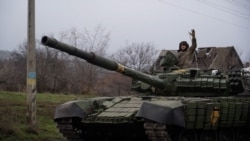
Kyiv is also seeking binding security guarantees from the United States and other Western allies, that would obligate outside countries to come to Ukraine’s aid if Russia were to attack again in the future.
Ukrainian political analyst Ihor Reiterovych urged the West to offer stronger guarantees for Ukraine -- and to avoid a repeat of the 1994 Budapest Memorandum. That agreement, signed by the United States, Russia, and Britain, guaranteed Ukrainian territorial integrity in exchange for Kyiv eliminating its nuclear arsenal.
"I would put myself in the shoes of the Russian president: if I want to negotiate a peace settlement, I would not hammer Ukraine and pound them the way they do," Ziener said. "I would actually try to create a situation where you can reach a settlement."
"Given all the sacrifices Ukraine has [made] so far. I think it's very difficult for Ukraine to say, OK, well, we'll cede to the Russian demands and [then] so many lives have been lost in vain," he said. "So I believe that it's difficult really to find a settlement that would ask Ukrainians to make major concessions at this point."

