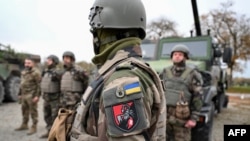
Ukrainian soldiers of the 155th Separate Mechanized Brigade stand next to military vehicles during a training exercise in France. (file photo)
It was supposed to be at the vanguard of a modernized Ukrainian Army, trained in Western tactics by French instructors, armed with Western weaponry, equipped to take on a bigger Russian Army on the battlefield.
That hasn't happened.
Instead, the Ukrainian military’s 155th Separate Mechanized Brigade has been roiled by desertions, incriminations, and now, scathing public criticism accusing commanders of incompetence.
The brigade’s commander was abruptly replaced last month just after the unit returned from training in France, and Ukraine’s lead law enforcement agency is investigating reports that dozens, possibly hundreds, of its soldiers have gone AWOL, or absent without leave.
The 155th’s problems have burst into the open at a wrenching time for Ukraine, with its population exhausted from nearly three years of full-scale war and its military exhausted from relentless Russian offensives.
The problems, and the public venting, also illustrate the wider issues that have plagued Ukraine's military for months, if not years -- and, experts say, have hampered its ability to wage an effective full-scale defense, or offense, against a larger, better-equipped Russian force.
“The training that I imagined should happen in the third year of war, what it should have been like, is not there,” one lieutenant, currently on unauthorized leave from the brigade, told RFE/RL’s Ukrainian Service.” “I, for one, do not know what I am supposed to do. I'm not ready to give up and execute any orders with untrained people. Plus, I’m untrained myself. I command 30-something people. I'm not ready to risk their lives.”
“In France, I was taught absolutely nothing,” said the officer, who spoke on condition of anonymity since public criticism of the military can result in criminal prosecution.
At least 59 soldiers from the brigade left the training grounds in France without authorization, the officer said, a figure that was echoed by Yuriy Butusov, a popular Ukrainian war correspondent who described the brigade as “complete organizational chaos.”
In an interview, Butusov said the decision behind the brigade’s training and formation were more political than anything.
“There is simply no point in creating such brigades that are not fully staffed, that have no time at all to train, as we see,” he told RFE/RL’s Ukrainian Service. “If we say we need a new brigade, then this is a matter that should take at least a year to complete. In addition to individual training, we need to ensure management at many levels.”
Inevitable Chaos?
Western allies have poured billions of dollars into weaponry and equipment for Ukraine’s armed forces, equipping them with modern technology to fight a bigger Russian Army with more weaponry as its disposal.
They also sought to retrain Ukraine’s armed forces, moving them away from the doctrine and tactics that its senior Soviet-trained officer corps grew up on, and introducing NATO-style thinking, such as combined arms warfare and emphasizing smaller brigades, rather than larger divisions.
Ukrainian command created several new brigades. Some units were sent to Germany for training. Another unit was set up in France last year to great fanfare: the 155th Separate Mechanized Brigade was dubbed the “Anne of Kyiv” Brigade, named for an 11th century Kyiv princess who later became Queen of France. French President Emmanuel Macron announced the unit’s creation during anniversary celebrations for the World War II Normandy invasion in June.
Two months later, about 2,000 Ukrainian soldiers -- about the half the size of a standard NATO brigade -- were sent to France for training that included instruction on advanced French weapons systems; Macron later paid a highly publicized visit to the unit in October.
When the 155th began rotating back to Ukraine in late November, Ukrainian forces had already been struggling for months trying to stave off accelerating Russian offensives in multiple places across the roughly 1,100-kilometer front line.
On December 12, the brigade’s commander, Colonel Dmytro Ryumshin, was replaced, just days before it was supposed to head into combat. The reason for Ryumshin’s dismissal was unclear, but he posted a statement on the brigade’s Facebook page thanking the unit’s soldiers and officers for their “loyalty and professionalism.”
Days earlier, lawmaker Maryana Bezuhla criticized how the brigade was conceived, saying it was patched together haphazardly from other units, which in turn deprived other units of troop strength.
“What happened to the 155th: even though the French attempted to make the brigade specialized, it wasn’t spared from stupid military decisions, which tore the unit apart,” she wrote on Facebook. "Within the brigade chaos reigns."
“Why create a new brigade when the existing brigades were critically understaffed, if it was then divided up to assign people to the old brigades? What's the point?” Sternenko said in a post to X. “In addition to the blow to our image in French eyes, where part of the brigade was trained and equipped with equipment, we again suffered high losses and exhaustion.”
“This madness must be stopped before it completely undermines the army's ability to organize resistance,” he wrote.
'I'd Rather Go AWOL'
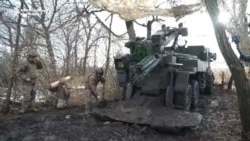
Despite the reported organizational problems, the brigade has deployed in part to help in the defense of Pokrovsk, a Donbas city that is under major threat of encirclement by Russian forces. Reports say the unit fielded German-made Leopard tanks and French artillery.
But the brigade lieutenant who spoke to RFE/RL on condition of anonymity said some equipment they were provided was broken; excavators, for example, used to dig trenches and defenses. He also described some of the problems with command orders.
“When we returned from France, some part of the brigade was already near Pokrovsk,” he said. “Then we received an order to transfer to the infantry, and a lot of people went AWOL. Days later, we were sent to the Dnipropetrovsk region. And the next day, we received an order to go to a settlement 20 kilometers from the front line.
“My commander wrote to me: ‘Gather nine people. Tomorrow you’re going to a specific place.’ I asked him what we were supposed to do there. He said: ‘I don't know’,” the lieutenant said. “That is, the commanders are unprofessional, they haven’t trained people.”
He said some soldiers think “I'd rather go AWOL. If I get caught, then at least, sooner or later, the prison door will open. The lid of a coffin will never open.”
Unconfirmed reports suggest that the brigade has suffered disproportionate casualties in the defense of Pokrovsk, something Butusov said was significant.
“Most of the 155th soldiers on the front line are trying to fulfill their duties honestly,” Butusov wrote in his December 31 Facebook post. “But due to a certain criminal attitude toward soldiers’ lives, the 155th Brigade has suffered significant losses from the very first days” of deployment.
Fear And Hope As Battle For Ukraine’s Pokrovsk Looms
1/17A woman walks through a suburb of Pokrovsk in early December.
In the early days of the full-scale Russian invasion my colleagues and I had based ourselves in Pokrovsk, where cafes, restaurants, and shopping centers offered a respite from the front lines. Now we are watching it die. Since 2022, I’ve seen many cities overtaken by war. Some fall quickly and disappear from the headlines, others hold on to the bitter end: Syevyerodonetsk, Lysychansk, Soledar, and others familiar only to the military and journalists. Now Pokrovsk is on that list.
Russian forces have neared the outskirts of Pokrovsk, a strategically important transportation and logistics hub in Ukraine’s eastern Donetsk region. Once home to more than 60,000 people before Russia's full-scale invasion of Ukraine in February 2022, only a fraction of this population now remains in the embattled city. Photojournalist Serhiy Nuzhnenko recently visited Pokrovsk with a colleague from RFE/RL's Donbas.Realities and talked to some residents who are still living there.
Show moreShow less
2/17A woman rides past a cinema with a banner declaring “Pokrovsk -- the strength of the Cossack clan.”
A curfew is in place in Pokrovsk from three in the afternoon until 11 a.m. the next day. As soon as the curfew is lifted we park our car and walk through the city streets. Only a handful of people are out and about. In the background, artillery can be heard working to the south and east, where Russian forces are advancing from both directions.
Russian forces have neared the outskirts of Pokrovsk, a strategically important transportation and logistics hub in Ukraine’s eastern Donetsk region. Once home to more than 60,000 people before Russia's full-scale invasion of Ukraine in February 2022, only a fraction of this population now remains in the embattled city. Photojournalist Serhiy Nuzhnenko recently visited Pokrovsk with a colleague from RFE/RL's Donbas.Realities and talked to some residents who are still living there.
Show moreShow less
3/17Many shops here are closed and apparently abandoned. Svitlana Yaroslavovna (pictured) operates one that is still open, selling sweets, milk and sausage. “When it’s quiet, I get nervous. It feels like maybe the military are surrendering us. I hope they don’t,” she confides after making us coffee. “Because [the nearby settlements of] Novohrodivka and Selydove were both surrendered very quickly even though there were fortifications there. I’m not a soldier, but I wish they hadn’t allowed them to fall."
Russian forces have neared the outskirts of Pokrovsk, a strategically important transportation and logistics hub in Ukraine’s eastern Donetsk region. Once home to more than 60,000 people before Russia's full-scale invasion of Ukraine in February 2022, only a fraction of this population now remains in the embattled city. Photojournalist Serhiy Nuzhnenko recently visited Pokrovsk with a colleague from RFE/RL's Donbas.Realities and talked to some residents who are still living there.
Show moreShow less
4/17"Dragon's teeth" anti-tank obstacles in Pokrovsk.
Suppliers for Yaroslavovna's grocery shop still come every weekday, she tells us, but some drivers are afraid to come into the city center. “We meet them behind the bridge and transfer the products, then drive them in ourselves.”
If Russian troops keep pushing closer, Yaroslavovna says, “I’ll close the shop and flee with the dogs and cats that I’m looking after here. I definitely won’t live here under the Russians, if the front gets any closer. But for now, I’ll be here for as long as I can."
Russian forces have neared the outskirts of Pokrovsk, a strategically important transportation and logistics hub in Ukraine’s eastern Donetsk region. Once home to more than 60,000 people before Russia's full-scale invasion of Ukraine in February 2022, only a fraction of this population now remains in the embattled city. Photojournalist Serhiy Nuzhnenko recently visited Pokrovsk with a colleague from RFE/RL's Donbas.Realities and talked to some residents who are still living there.
Show moreShow less
5/17The city slowly comes to life as we continue walking, people are appearing, carrying water and food. A makeshift market is operating nearby. It feels almost like any normal winter morning in a provincial eastern town, only the booming of nearby explosions offers a constant reminder of the situation in Pokrovsk.
Russian forces have neared the outskirts of Pokrovsk, a strategically important transportation and logistics hub in Ukraine’s eastern Donetsk region. Once home to more than 60,000 people before Russia's full-scale invasion of Ukraine in February 2022, only a fraction of this population now remains in the embattled city. Photojournalist Serhiy Nuzhnenko recently visited Pokrovsk with a colleague from RFE/RL's Donbas.Realities and talked to some residents who are still living there.
Show moreShow less
6/17In some suburbs there is still electricity and gas, but central heating no longer operates in Pokrovsk. People warm their apartments with electric heaters or gas burners.
Russian forces have neared the outskirts of Pokrovsk, a strategically important transportation and logistics hub in Ukraine’s eastern Donetsk region. Once home to more than 60,000 people before Russia's full-scale invasion of Ukraine in February 2022, only a fraction of this population now remains in the embattled city. Photojournalist Serhiy Nuzhnenko recently visited Pokrovsk with a colleague from RFE/RL's Donbas.Realities and talked to some residents who are still living there.
Show moreShow less
7/17The still smoldering remains of a building in Pokrovsk that was wiped out by a Russian glide bomb.
Donetskoblhaz JSC, the company that supplies gas and electricity to Pokrovsk says it is becoming increasingly difficult for their repair crews to work amid frequent shelling. The company announced that, as of December 12, it would suspend gas supplies due to “the consequences of hostilities on the gas distribution system.”
Russian forces have neared the outskirts of Pokrovsk, a strategically important transportation and logistics hub in Ukraine’s eastern Donetsk region. Once home to more than 60,000 people before Russia's full-scale invasion of Ukraine in February 2022, only a fraction of this population now remains in the embattled city. Photojournalist Serhiy Nuzhnenko recently visited Pokrovsk with a colleague from RFE/RL's Donbas.Realities and talked to some residents who are still living there.
Show moreShow less
8/17A Pokrovsk resident collects water from one of a handful of supply points in the city.
One of the biggest challenges for Pokrovsk's residents is sourcing water. Locals say that Russian forces destroyed water pumping stations outside the city in August 2022, and since then most water has been sourced from tankers organized by local government and aid organizations.
Russian forces have neared the outskirts of Pokrovsk, a strategically important transportation and logistics hub in Ukraine’s eastern Donetsk region. Once home to more than 60,000 people before Russia's full-scale invasion of Ukraine in February 2022, only a fraction of this population now remains in the embattled city. Photojournalist Serhiy Nuzhnenko recently visited Pokrovsk with a colleague from RFE/RL's Donbas.Realities and talked to some residents who are still living there.
Show moreShow less
9/17Anton, who came to collect water on his day off.
The local man evacuated his family but has remained to work at a mine in Pokrovsk that was still in operation in early December. “I think everyone is considering leaving. Only those who are waiting [for a Russian takeover] are not," he says. "I hope [Ukraine's military] will drive them away, and we can continue to live here."
Russian forces have neared the outskirts of Pokrovsk, a strategically important transportation and logistics hub in Ukraine’s eastern Donetsk region. Once home to more than 60,000 people before Russia's full-scale invasion of Ukraine in February 2022, only a fraction of this population now remains in the embattled city. Photojournalist Serhiy Nuzhnenko recently visited Pokrovsk with a colleague from RFE/RL's Donbas.Realities and talked to some residents who are still living there.
Show moreShow less
10/17Vasyl, an elderly local crossing an empty street in Pokrovsk.
“My friends have gone to the Dnipropetrovsk region,” he tells us. “The poor are suffering everywhere. No one needs people. This is a fight for territory, not people. I am 81 years old. I think if [the Russians] restore order there will be heat, gas, and so on. I am being very frank, but, people will have one hell of a time surviving [until then].”
Russian forces have neared the outskirts of Pokrovsk, a strategically important transportation and logistics hub in Ukraine’s eastern Donetsk region. Once home to more than 60,000 people before Russia's full-scale invasion of Ukraine in February 2022, only a fraction of this population now remains in the embattled city. Photojournalist Serhiy Nuzhnenko recently visited Pokrovsk with a colleague from RFE/RL's Donbas.Realities and talked to some residents who are still living there.
Show moreShow less
11/17A printed sign announces “pharmacy working” in Pokrovsk.
Along with pharmacies, cafes, and a bookstore, the biggest surprise was an Apple Store that was still operating in early December. Though perhaps as I’m writing this it has already closed down.
Russian forces have neared the outskirts of Pokrovsk, a strategically important transportation and logistics hub in Ukraine’s eastern Donetsk region. Once home to more than 60,000 people before Russia's full-scale invasion of Ukraine in February 2022, only a fraction of this population now remains in the embattled city. Photojournalist Serhiy Nuzhnenko recently visited Pokrovsk with a colleague from RFE/RL's Donbas.Realities and talked to some residents who are still living there.
Show moreShow less
12/17Bells in the cathedral begin to ring, calling the faithful to prayer and momentarily drowning out the sounds of war. The bells frighten a flock of pigeons which flap into the air then settle on the Soviet-era apartment block whose windows are boarded up with chipboard.
Russian forces have neared the outskirts of Pokrovsk, a strategically important transportation and logistics hub in Ukraine’s eastern Donetsk region. Once home to more than 60,000 people before Russia's full-scale invasion of Ukraine in February 2022, only a fraction of this population now remains in the embattled city. Photojournalist Serhiy Nuzhnenko recently visited Pokrovsk with a colleague from RFE/RL's Donbas.Realities and talked to some residents who are still living there.
Show moreShow less
13/17A local woman walking her dog.
Even after covering the war for years, moments like this, showing hope for life amid destruction and death are always surprising. The animals seem to be accustomed to the backdrop of explosions and show no signs of fear.
Russian forces have neared the outskirts of Pokrovsk, a strategically important transportation and logistics hub in Ukraine’s eastern Donetsk region. Once home to more than 60,000 people before Russia's full-scale invasion of Ukraine in February 2022, only a fraction of this population now remains in the embattled city. Photojournalist Serhiy Nuzhnenko recently visited Pokrovsk with a colleague from RFE/RL's Donbas.Realities and talked to some residents who are still living there.
Show moreShow less
14/17"We live, we keep hoping,” Valentyna Vasylivna (pictured) tells us as she walks through her war-damaged city. “I have a pension of 2,700 hryvnias ($65) per month. Where would I go? My apartment walls keep me warm, this is my home.”
Russian forces have neared the outskirts of Pokrovsk, a strategically important transportation and logistics hub in Ukraine’s eastern Donetsk region. Once home to more than 60,000 people before Russia's full-scale invasion of Ukraine in February 2022, only a fraction of this population now remains in the embattled city. Photojournalist Serhiy Nuzhnenko recently visited Pokrovsk with a colleague from RFE/RL's Donbas.Realities and talked to some residents who are still living there.
Show moreShow less
15/17At Pokrovsk Railway Station the platforms are empty. This homeless man was trying to stay warm in a sleeping bag, and to get some sleep.
Russian forces have neared the outskirts of Pokrovsk, a strategically important transportation and logistics hub in Ukraine’s eastern Donetsk region. Once home to more than 60,000 people before Russia's full-scale invasion of Ukraine in February 2022, only a fraction of this population now remains in the embattled city. Photojournalist Serhiy Nuzhnenko recently visited Pokrovsk with a colleague from RFE/RL's Donbas.Realities and talked to some residents who are still living there.
Show moreShow less
16/17A man pushes a load of firewood. Behind him is the road towards Shevchenko, where Russian forces are currently advancing from the south.
Some civilians we spoke to told us of friends and neighbours who are returning to Pokrovsk despite the city's precarious situation. Some couldn't find work elsewhere and ran out of money; others couldn't get used to living away from their hometown. Many say the only state help that registered refugees receive is a payment of 11,000 hryvna, ($265) and those people who leave by their own means cannot even count on this.
Russian forces have neared the outskirts of Pokrovsk, a strategically important transportation and logistics hub in Ukraine’s eastern Donetsk region. Once home to more than 60,000 people before Russia's full-scale invasion of Ukraine in February 2022, only a fraction of this population now remains in the embattled city. Photojournalist Serhiy Nuzhnenko recently visited Pokrovsk with a colleague from RFE/RL's Donbas.Realities and talked to some residents who are still living there.
Show moreShow less
17/17A road sign for Pokrovsk on the outskirts of the city.
We leave Pokrovsk with heavy hearts. It seems likely we could return soon to the city to film street battles. We remember the words of shopkeeper Svitlana Yaroslavovna: "I hold on to my faith in God, and the armed forces of Ukraine, this is where I place my hope."
Russian forces have neared the outskirts of Pokrovsk, a strategically important transportation and logistics hub in Ukraine’s eastern Donetsk region. Once home to more than 60,000 people before Russia's full-scale invasion of Ukraine in February 2022, only a fraction of this population now remains in the embattled city. Photojournalist Serhiy Nuzhnenko recently visited Pokrovsk with a colleague from RFE/RL's Donbas.Realities and talked to some residents who are still living there.
Show moreShow less
Previous slide
Next slide
Another brigade soldier, who also spoke on condition of anonymity, said Butusov’s criticism was largely true but was incomplete.
“The situation with the formation was even worse than he described,” the soldier said.
The State Bureau of Investigation, Ukraine’s lead law investigative agency, confirmed to RFE/RL’s Ukrainian Service that it was investigating the reports of soldiers deserting. A brigade press officer declined to comment.
Asked about the brigade’s problems, France’s presidential office, Elysee Palace, referred the question to the French Defense Ministry.
"It was the Ukrainian Armed Forces that organized the selection of Ukrainian military personnel to form this brigade and manage the processes,” the ministry said. “Also…the Ukrainian Armed Forces determine the conditions for the [brigade’s] deployment in Ukraine.”
Yevhenia Rusetska has been a correspondent for RFE/RL's Ukrainian Service since 2023. She has spent seven years covering combat operations and their consequences.
Zoriana Stepanenko is a Brussels correspondent for RFE/RL's Ukrainian Service and Current Time TV, covering the EU and NATO with a focus on Ukraine and Russia.
She reports breaking news and provides in-depth analysis from EU and NATO summits, key national elections, and international court proceedings, and conducts high-profile interviews. Her interviews have been cited by Newsweek and the Financial Times.
Born in Ukraine's Poltava region, she holds a master's degree in social communications from Taras Shevchenko National University of Kyiv.
Before joining RFE/RL in 2021, she worked as a foreign correspondent for Ukraine's national television, reporting from Brussels, Washington D.C., and Moscow.
Mike Eckel is a senior international correspondent reporting on political and economic developments in Russia, Ukraine, and around the former Soviet Union, as well as news involving cybercrime and espionage. He's reported on the ground on Russia's invasion of Ukraine, the wars in Chechnya and Georgia, and the 2004 Beslan hostage crisis, as well as the annexation of Crimea in 2014.










![Many shops here are closed and apparently abandoned. Svitlana Yaroslavovna (pictured) operates one that is still open, selling sweets, milk and sausage. “When it’s quiet, I get nervous. It feels like maybe the military are surrendering us. I hope they don’t,” she confides after making us coffee. “Because [the nearby settlements of] Novohrodivka and Selydove were both surrendered very quickly even though there were fortifications there. I’m not a soldier, but I wish they hadn’t allowed them to fall." ](https://gdb.rferl.org/07682f19-0cca-4699-bb49-de631d02fd62_w1024_q10_s.jpg)


![Anton, who came to collect water on his day off.<br />
<br />
The local man evacuated his family but has remained to work at a mine in Pokrovsk that was still in operation in early December. “I think everyone is considering leaving. Only those who are waiting [for a Russian takeover] are not," he says. "I hope [Ukraine's military] will drive them away, and we can continue to live here."](https://gdb.rferl.org/55cfa829-1dc1-446b-ad5b-7f77dc02716d_w1024_q10_s.jpg)
![Vasyl, an elderly local crossing an empty street in Pokrovsk.<br />
<br />
“My friends have gone to the Dnipropetrovsk region,” he tells us. “The poor are suffering everywhere. No one needs people. This is a fight for territory, not people. I am 81 years old. I think if [the Russians] restore order there will be heat, gas, and so on. I am being very frank, but, people will have one hell of a time surviving [until then].” ](https://gdb.rferl.org/8610c9a8-c9a7-426e-9426-334a2bc9176d_w1024_q10_s.jpg)