



Accessibility links

Breaking News

UNESCO Chief Decries Worst Destruction Of Ancient Sites Since WWII

A year ago, all was quiet at Palmyra. This picture, from March 14, 2014, shows locals with bicycles at the ancient oasis city.
1/9 A year ago, all was quiet at Palmyra. This picture, from March 14, 2014, shows locals with bicycles at the ancient oasis city.
Syrian authorities say Islamic State militants have advanced to within 2 kilometers of Palmyra, an ancient city with outstanding architectural heritage dating from the first century. The militants have caused significant damage to similar sites they have overrun in Iraq, posting videos of themselves destroying antiquities. UNESCO includes Palmyra on its list of World Heritage sites, describing it as one of the most important cultural centers of the ancient world -- a crossroads for local, Persian, Greek and Roman influences.
The remains of the Roman theatre date back to the 2nd century. Until recently, it was host to the annual Palmyra Festival.
2/9 The remains of the Roman theatre date back to the 2nd century. Until recently, it was host to the annual Palmyra Festival.
Syrian authorities say Islamic State militants have advanced to within 2 kilometers of Palmyra, an ancient city with outstanding architectural heritage dating from the first century. The militants have caused significant damage to similar sites they have overrun in Iraq, posting videos of themselves destroying antiquities. UNESCO includes Palmyra on its list of World Heritage sites, describing it as one of the most important cultural centers of the ancient world -- a crossroads for local, Persian, Greek and Roman influences.
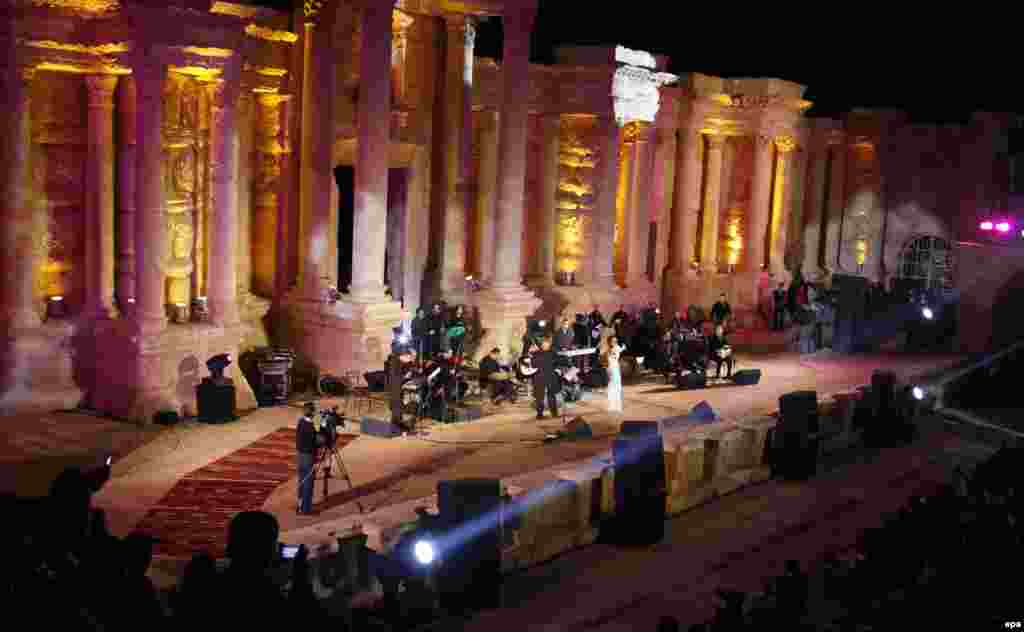
Lebanese singer Najwa Karam performs at the opening ceremony of the Palmyra Festival in 2010.
3/9 Lebanese singer Najwa Karam performs at the opening ceremony of the Palmyra Festival in 2010.
Syrian authorities say Islamic State militants have advanced to within 2 kilometers of Palmyra, an ancient city with outstanding architectural heritage dating from the first century. The militants have caused significant damage to similar sites they have overrun in Iraq, posting videos of themselves destroying antiquities. UNESCO includes Palmyra on its list of World Heritage sites, describing it as one of the most important cultural centers of the ancient world -- a crossroads for local, Persian, Greek and Roman influences.
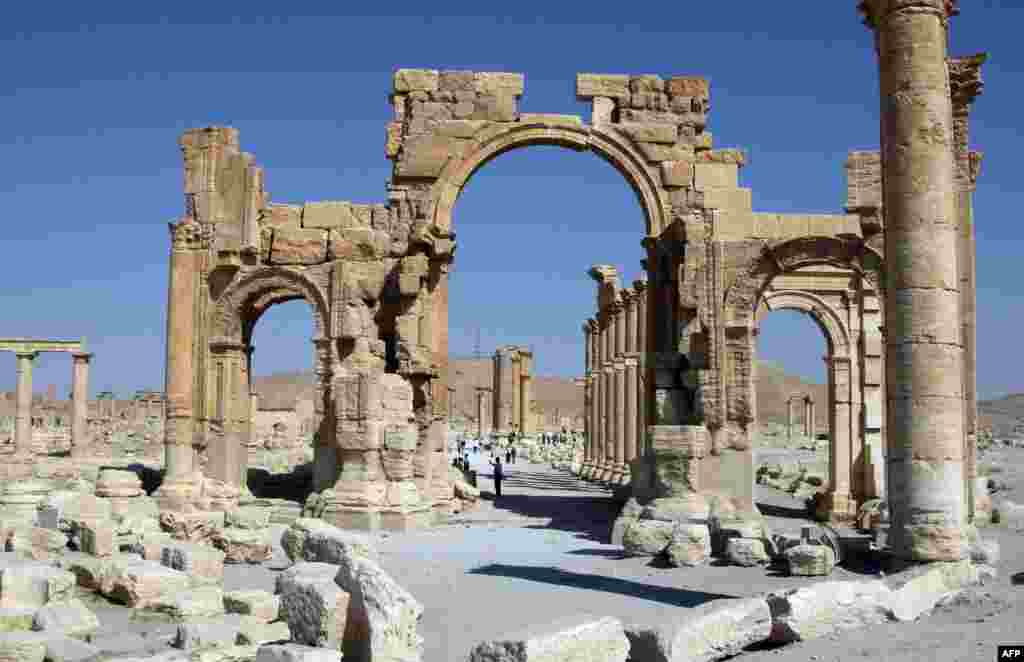
More Roman ruins. Palmyra became increasingly prosperous after the Romans took control at the beginning of the 1st century.
4/9 More Roman ruins. Palmyra became increasingly prosperous after the Romans took control at the beginning of the 1st century.
Syrian authorities say Islamic State militants have advanced to within 2 kilometers of Palmyra, an ancient city with outstanding architectural heritage dating from the first century. The militants have caused significant damage to similar sites they have overrun in Iraq, posting videos of themselves destroying antiquities. UNESCO includes Palmyra on its list of World Heritage sites, describing it as one of the most important cultural centers of the ancient world -- a crossroads for local, Persian, Greek and Roman influences.
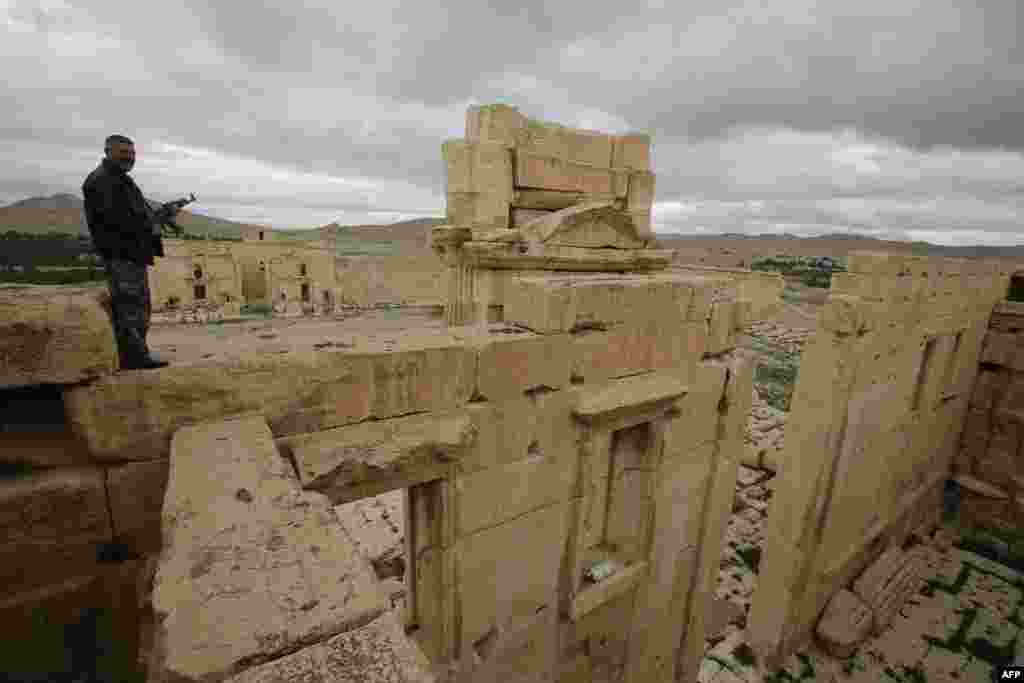
March 2014 - A Syrian policeman stands on the sanctury of Baal, one of three pagan gods worshipped in Palmyra in the 1st century.
5/9 March 2014 - A Syrian policeman stands on the sanctury of Baal, one of three pagan gods worshipped in Palmyra in the 1st century.
Syrian authorities say Islamic State militants have advanced to within 2 kilometers of Palmyra, an ancient city with outstanding architectural heritage dating from the first century. The militants have caused significant damage to similar sites they have overrun in Iraq, posting videos of themselves destroying antiquities. UNESCO includes Palmyra on its list of World Heritage sites, describing it as one of the most important cultural centers of the ancient world -- a crossroads for local, Persian, Greek and Roman influences.
Palmyra is believed to have been founded by King Solomon.
6/9 Palmyra is believed to have been founded by King Solomon.
Syrian authorities say Islamic State militants have advanced to within 2 kilometers of Palmyra, an ancient city with outstanding architectural heritage dating from the first century. The militants have caused significant damage to similar sites they have overrun in Iraq, posting videos of themselves destroying antiquities. UNESCO includes Palmyra on its list of World Heritage sites, describing it as one of the most important cultural centers of the ancient world -- a crossroads for local, Persian, Greek and Roman influences.
A 2nd century limestone relief excavated in 2008 from a cemetery in Palmyra. Shapes of 13 men and women, all from the same family, are engraved on it.
7/9 A 2nd century limestone relief excavated in 2008 from a cemetery in Palmyra. Shapes of 13 men and women, all from the same family, are engraved on it.
Syrian authorities say Islamic State militants have advanced to within 2 kilometers of Palmyra, an ancient city with outstanding architectural heritage dating from the first century. The militants have caused significant damage to similar sites they have overrun in Iraq, posting videos of themselves destroying antiquities. UNESCO includes Palmyra on its list of World Heritage sites, describing it as one of the most important cultural centers of the ancient world -- a crossroads for local, Persian, Greek and Roman influences.
From the same dig - the scene depicts two Palmyrian merchants and a child standing next to a camel.
8/9 From the same dig - the scene depicts two Palmyrian merchants and a child standing next to a camel.
Syrian authorities say Islamic State militants have advanced to within 2 kilometers of Palmyra, an ancient city with outstanding architectural heritage dating from the first century. The militants have caused significant damage to similar sites they have overrun in Iraq, posting videos of themselves destroying antiquities. UNESCO includes Palmyra on its list of World Heritage sites, describing it as one of the most important cultural centers of the ancient world -- a crossroads for local, Persian, Greek and Roman influences.
The sun sets behind ruined columns at Palmyra, November 2010.
9/9 The sun sets behind ruined columns at Palmyra, November 2010.
Syrian authorities say Islamic State militants have advanced to within 2 kilometers of Palmyra, an ancient city with outstanding architectural heritage dating from the first century. The militants have caused significant damage to similar sites they have overrun in Iraq, posting videos of themselves destroying antiquities. UNESCO includes Palmyra on its list of World Heritage sites, describing it as one of the most important cultural centers of the ancient world -- a crossroads for local, Persian, Greek and Roman influences.
Previous slide
Next slide

Islamic State extremists in Syria and Iraq are engaged in the "most brutal, systematic" destruction of ancient sites since World War II, according to the head of the UN cultural agency.

The stark warning by Irina Bokova, the director-general of the United Nations Educational, Scientific and Cultural Organization (UNESCO), came hours after militants demolished a 1,500-year-old monastery in central Syria.

The world's only recourse is to try to prevent the sale of looted artifacts, thus cutting off a lucrative stream of income for the militants, she told The Associated Press news agency.

A series of recent attacks has stoked fears that Islamic State (IS) is accelerating its campaign to demolish and loot heritage sites. On August 20, witnesses said the militants bulldozed St. Elian Monastery in central Syria, an important pilgrimage and tourist site.

Days earlier, IS beheaded antiquities scholar Khaled al-Asaad, who had dedicated his life to overseeing the ruins of Palmyra in Syria, one of the Middle East's most spectacular archaeological sites.

Asaad, who worked for over 50 years as head of antiquities in Palmyra, had recently turned 83, his son told the New York Times.

Since capturing about a third of Syria and Iraq last year, IS fighters have destroyed mosques, churches and archaeological sites, causing extensive damage to the ancient cities of Nimrud, Hatra, and Dura Europos in Iraq. In May, they seized Palmyra, the Roman-era city on the edge of a modern town of the same name.

"We haven't seen something similar since the Second World War," Bokova said of the scope of the IS campaign against ancient sites. "I think this is the biggest attempt, the most brutal systematic destruction of world heritage."

Bokova said recent images of archaeological sites under IS control in Iraq and Syria show signs of widespread illegal digging and looting. "If you look at the maps, the photos, the satellite pictures of it, you will not recognize one place," she said. "It is just hundreds of holes all around them."

There is very little the world can do to stop the extremists from inflicting more damage, she said, but stopping the trafficking in artifacts must be a priority.

Bokova spoke hours after IS posted photos on social media showing bulldozers destroying the St. Elian Monastery near the town of Qaryatain in central Syria. The group had captured the town in early August.

A Qaryatain resident who recently fled to Damascus said militants leveled the shrine and removed church bells. The man, who spoke on condition of anonymity for fear his relatives still in Qaryatain might be harmed, called on the UN to protect Christians and Christian sites.

Osama Edward, the director of the Christian Assyrian Human Rights Network, said shelling of the area by Syrian government troops over the past two weeks had already damaged the monastery. "Daesh continued the destruction of the monastery," said Edward.

A Catholic priest, the Reverend Jacques Mourad, who had lived at the monastery, was kidnapped in May and remains missing. According to Edward, Mourad sheltered both Muslim and Christian Syrians fleeing the fighting elsewhere in Homs province.

Activists said that shortly after capturing Qaryatain, IS abducted 230 residents, including dozens of Christians. Activists said some Christians were released, but the fate of the others is still unknown.

In another attack, IS militants beheaded Palmyra scholar Khaled al-Asaad on August 18, hanging his bloodied body from a pole in the town's main square. Asaad, a long-time site director, had refused to leave Palmyra after it was overrun by IS.

Bokova said she believes Asaad was "brutally murdered" because he refused to divulge where authorities had hidden treasures secreted out of Palmyra before the IS takeover. She would not say whether UNESCO was aware of where the artifacts were taken, saying only "we hope they are in safe places."

She recalled her first visit to Palmyra before the outbreak of the conflict, with Asaad escorting her. "He introduced me to this beautiful Venice of the desert, as it was called," she said. "We walked through the colonnades, more than a kilometer of beautiful colonnades."

Palmyra has remained largely intact, but Bokova said "we know that some of the destruction is starting."

"The drama...and the tragedy, I think is that we don't know what will happen tomorrow," she said. "The fact that Dr. al-Asaad was accused of protecting a place where idolatry is being practiced shows that unfortunately this [destruction] may not stop."

With reporting by AP
  • 16x9 Image

    RFE/RL

    RFE/RL journalists report the news in 24 languages in 18 countries where a free press is banned by the government or not fully established. We provide what many people cannot get locally: uncensored news, responsible discussion, and open debate.

This item is part of
XS
SM
MD
LG