




WASHINGTON -- US Congressman Abraham Hamadeh says the Armenia-Azerbaijan peace process is moving faster than many expected and predicts a final peace agreement could be reached well before the end of President Donald Trump's current term.
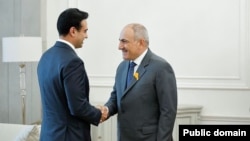
Hamadeh, a Republican from Arizona and a member of the House Armed Services and Veterans' Affairs committees, has emerged as an active congressional interlocutor on the South Caucasus. He visited Azerbaijan in June and Armenia in August and met with the countries' leaders.
In an interview with RFE/RL on September 9, Hamadeh described the proposed Trump Route for International Peace and Prosperity (TRIPP) as more than an economic project, arguing it could bind Armenia and Azerbaijan together politically and economically while opening the South Caucasus to greater Western trade and investment.
Unveiled as part of the US-mediated peace process following Armenia's war with Azerbaijan over its breakaway region of Nagorno-Karabakh, TRIPP envisages rail and road infrastructure, possible oil and gas pipelines, and fiberoptic and electricity ventures.
Armenia and Azerbaijan fought for more than three decades over Nagorno-Karabakh, an Azerbaijani region populated mainly by ethnic Armenians. Normalization gained momentum after Azerbaijan retook the territory in 2023 and a Washington peace summit in August 2025 helped break the deadlock.
RFE/RL: You recently visited Azerbaijan and Armenia and met with the leaders of both countries. What obstacles still stand in the way of turning a peace declaration into a final and lasting peace?
Abraham Hamadeh: We should look at where we were just one year ago. One year ago, in August, was when you had both [Armenian Prime Minister Nikol] Pashinian and [Azerbaijani President Ilham] Aliyev here at the White House with Trump, something that nobody ever saw coming, especially this quickly, where you had this agreement for peace, and now we are off to the races. I bet you know Trump and Secretary of State Marco Rubio have been so instrumental, and even Vice President JD Vance has been to the region. It looks like US government officials at all levels are committed to this.
My involvement with this was meeting with the Armenian ambassador and Azerbaijani ambassador separately, and getting them together. They both came to Arizona at my brother's house. They've both been to an event for me in Mar-a-Lago. We have a great relationship, so we're trying to make sure and ensure that this peace is solidified.
Any of the obstacles are, to be honest, just time. It takes time for emotions to settle down after being in a period of war and for decades of war. And so, from my experience being over there, both in Baku and Yerevan, it's going very smoothly, and both sides are absolutely committed to ensuring the South Caucasus is peaceful and prosperous.

RFE/RL: The next challenge is implementation. What should peace look like on the ground in terms of borders, transport, trade, prisoners, security?
Hamadeh: Yes, there's still some challenges, of course. There are some prisoners the Armenians would like back from Azerbaijan. Each side has their own opinions on all of these issues.
One of the things I believe is going to help is not just Azerbaijan and Armenia's relationship, but Turkey and Armenia's relationship, which I think has been a little bit understated lately. Both sides agreed to open up their borders to start off with diplomatic crossings back in 2022. That still has not been implemented yet. We hope to see their border open up just so that Armenia gets another avenue for trade other than going to Russia or Georgia or Iran. So we need to ensure the Turkish border with Armenia opens up.
We need to make sure the Azerbaijan and Armenia TRIPP goes well. But all this -- again, it's been only one year, and in terms of history, it's so new. So everything is going well, and both leaders are very popular within their countries, and they have to support the people, which is very important.
TRIPP: Much More Than Just Economics
RFE/RL: You describe TRIPP as central to the future of the region. Do you see the proposed corridor primarily as an economic project, or as something that could itself help guarantee and sustain regional peace? And if TRIPP were delayed or politically blocked, could that put the peace process at risk?
Hamadeh: I see no reason why it's going to be delayed. TRIPP is much more than just economics. Of course, it's going to benefit the economies of both countries, but it's going to solidify them and tie them so much diplomatically, politically, economically.
They are neighbors, and there's a long history between the two. It's going to take time for it to happen, but I am so confident with this TRIPP corridor -- named after Trump, of course -- that once the construction begins, once it's fully operational, the amount of opportunity for the South Caucasus is immense.
The reason people don't talk about the South Caucasus much is because a lot of people don't even know where that is on a map. But I recognize, having been there and having been a student of history there, the Russians are becoming less influential in the South Caucasus, which is a big benefit for the US. The Iranians are totally decimated; they're distracted right now. So the Caucasus of Georgia, Armenia, Azerbaijan, Turkey's help -- they have a lot of potential to be that bridge between Asia, especially Central Asia, which is also very understated, connecting them to the Caucasus, through the Caspian Sea, through this TRIPP corridor to beyond, to Turkey, into Europe.
Right now Azerbaijan provides so much gas to Europe. Sixteen to seventeen countries are exporting this gas. They provide 25 percent of Italy's natural gas. I mean, it's remarkable. So there's already so much development happening now. Just imagine when this TRIPP corridor is actually fully operational.
RFE/RL: Moscow has increasingly criticized the proposed "Trump route," most recently with Russian Security Council Deputy Secretary Aleksei Shevtsov suggesting its implementation could allow the US to deploy troops or intelligence capabilities in Armenia. What is your response to those claims?
Hamadeh: This has nothing to do with a US military presence. We've got plenty of presence in the Middle East and in Turkey, but this is a peace between two countries that's been long overdue.
This is classic Russian disinformation. They're trying to destabilize Armenia, which is a democracy; it's one of the most stable democracies in the region. So they are trying to just discredit Pashinian right now with some of the population.
The Russian influence with Armenia is stronger than, say, in the other Caucasus countries, and you can't trust the Russians. And right now they're very much distracted by the Ukrainian war...and they're realizing there's this big void that the United States is stepping into right now.
The Azerbaijanis, Armenians, they would much rather partner with the US than Russians; we are much more reliable. We are the ones making peace possible. The Russians have had their influence in those countries, and they've disappointed both of them.
Continued US Involvement Is Key
RFE/RL: Beyond signing agreements, what would make this peace irreversible? What are the concrete conditions that would convince you that the conflict is genuinely behind Armenia and Azerbaijan?
Hamadeh: Right now, the United States' continued involvement is going to ensure we have eyes and ears with both countries. And Trump has an amazing relationship with Aliyev, Pashinian. And once TRIPP is completed, I believe we won't even be talking about the war anymore.
Think about Armenia and Turkey right now. They already have flights going between Istanbul and Yerevan, and once the border is open between, once they normalize relations, that is huge. So we are moving past so much of this animosity that's been built in for generations, and a lot of it has been Russian influenced, into this new world where the South Caucasus, the potential is just beginning.
RFE/RL: Is Washington's engagement in the region tied to the Trump administration, or do you see it becoming a longer-term US strategic commitment?
Hamadeh: This is long-term. I say that we have a big Armenian community in the US. We all know that, but the Azerbaijanis have done a good job at messaging that they want peace as well.
So I don't see this as a partisan issue. This is going to transcend Democrats, Republicans. The ultimate goal for people should be to have peace, and people like me who are in Congress are big advocates for the South Caucasus.
I assure you, in my conversations with my colleagues, I encourage them to visit the region to see it for themselves, to see what United States leadership, America First leadership, looks like on the ground.
Iran, Russia, And A Changing South Caucasus
RFE/RL: Let me turn to Iran. You have described the changing regional balance as an opportunity for everyone involved. Could the Armenia-Azerbaijan peace process and TRIPP fundamentally change Iran's role or expectations in the South Caucasus?
Hamadeh: Yes, but the Iranians are so distracted right now, so it's hard to tell, right? But the Iranians' influence is not just in the Caucasus, but look at the broader Middle East. I mean, their influence in Lebanon is waning, and in Syria, it's completely gone. So the Iranians have their own internal struggles.
But this is why TRIPP is so important to continue the development of Azerbaijan or Armenia with the West, so they no longer have to rely on any goods coming in from the Iranians.
I mean, yes, right now I understand that they still trade with Iran. I understand that, but it's their neighbor, right? It's going to be more limited, I assure you, in the future. Just like Russia, which has blockaded a lot of the Armenian goods just recently. Right now you're starting to see both Russia and Iran are trying to deal with this new reality that the South Caucasus is changing, but they themselves have their own internal wars that have been going on.
The timing of all of this is almost providential, where you have Trump's commitment to peace and his great relationship with both leaders of Azerbaijan and Armenia. You have so many people who are committed to this that I think right now the South Caucasus has never had this much attention given by the US before, and it's only going to continue to grow.
RFE/RL: Given that level of US engagement, do you expect the Armenia-Azerbaijan peace agreement to be fully finalized before the end of President Trump's tenure?
Hamadeh: Oh, absolutely. I think you're going to see it come a lot sooner rather than later.

